

By the end of 2026, the aviation industry will face a critical shortfall of 24,000 professional pilots, yet the barrier to entry remains a gauntlet of regulatory complexity and volatile training costs. You recognize that the path to a major airline isn’t just about logging hours; it’s about navigating a high-stakes environment where any deviation from FAA standards can ground a career before it starts. Precision is non-negotiable. This reality demands a transition from casual flight instruction to a rigorous, institutionalized approach to airline pilot career training.
This guide provides the definitive roadmap to mastering the 1,500-hour requirement while maintaining the elite professional standards demanded by tier-one carriers. You’ll learn how to secure financial predictability through fixed-price models and navigate the intricacies of M1 visa logistics and residential immersion. We’ll analyze the precision of FAA Part 141 pathways and the specific strategies required to transition from a student pilot to an airline ready pilot program graduate in the current high-demand market.
The landscape of airline pilot career training has shifted from a series of elective certifications to a high-stakes professional development track. In 2026, the industry is no longer seeking enthusiasts; it’s demanding highly disciplined flight deck officers ready to command complex systems. This evolution is driven by an unprecedented global demand where the margin for error in training is non-existent. Our academy functions as a rigorous gatekeeper, ensuring that only those who embody the discipline of a professional career reach the commercial flight deck. The objective is no longer just a license; it’s the mastery of a professional vocation.
Major carriers face a projected shortfall of 24,000 pilots in the U.S. this year alone. Boeing’s current outlook projects a requirement for 122,000 new pilots in North America through 2045. This massive scale of fleet expansion has fundamentally transformed airline recruitment strategies. Carriers now prioritize candidates from accelerated, structured programs that mirror airline operational environments. The transition from a recreational mindset to a professional one is mandatory for those seeking to secure a seat. Airlines are no longer looking for pilots who can simply fly; they are looking for officers who can manage sophisticated automation and adhere to strict regulatory codes under pressure. This shift has created a surge in first officer opportunities for those who can demonstrate immediate readiness for Part 121 operations.
Professional aviation is distinct from hobbyist flying. While a hobbyist seeks the freedom of the skies, a professional pilot seeks mastery of FAA Regulatory Pathways. The path is a rigid hierarchy: Private Pilot License, Instrument Rating, Commercial Pilot License, and Multi-Engine ratings. Our airline pilot career training utilizes a disciplined “zero to hero” model, which we treat as a high-performance academy rather than a casual school. This track ensures students move through the curriculum with the urgency required to meet airline hiring windows. The ultimate benchmark is our airline ready pilot program, which serves as the gold standard for professional transition. It demands excellence, moving beyond basic flight skills to instill the high-level discipline required for a professional’s legal standing. Success in this environment requires a no-nonsense attitude toward technical proficiency and absolute regulatory adherence. Every administrative and technical task is treated as a critical component of your professional career.
The selection of a regulatory pathway is the first critical maneuver in a professional pilot’s career. While Part 61 training offers a flexible, decentralized approach often suited for recreational flying, elite airline pilot career training necessitates the rigid structure of FAA Part 141. This pathway requires schools to adhere to a strictly approved syllabus, ensuring every student meets the same high-level professional standards. This isn’t merely a preference; it’s a requirement for those who understand that airlines value standardized, predictable excellence. Adhering to official FAA pilot requirements through a Part 141 curriculum signals to major carriers that you’ve been trained within a system of high-stakes accountability and professional seriousness.
Part 141 programs provide a direct route to certification with significantly reduced flight hour requirements. For instance, students can achieve a Commercial Pilot License in as few as 190 hours, compared to the 250 hours mandated under Part 61. This efficiency is achieved through a series of mandatory stage checks and standardized testing protocols that act as rigorous quality control measures. These checkpoints ensure that students don’t just log hours but master specific competencies before advancing. Airlines prioritize graduates from these structured environments because they mirror the training protocols of commercial flight decks. The discipline required to navigate a Part 141 syllabus prepares you for the high-pressure training environment of a regional or major airline. For candidates who want to become a commercial pilot fast, the Part 141 pathway offers the most efficient and structured route to achieving that goal.
Securing a seat on a commercial flight deck requires reaching the 1,500-hour Airline Transport Pilot (ATP) milestone. For graduates of specific Part 141 programs, this requirement can be reduced to 1,000 or 1,250 hours for a Restricted ATP (R-ATP), providing a faster entry into the industry. The gap between initial commercial certification and the ATP requirement is typically bridged by serving as a flight instructor. Our CFI Fast Track program is designed to accelerate this hour-building phase, transforming you from a student into a professional mentor. This transition is a critical professional milestone in your airline pilot career training, demanding a no-nonsense attitude toward safety and regulatory adherence. To ensure your financial strategy matches your career ambitions, consider the stability of a Fixed-Price Career Program to eliminate cost volatility during this intensive phase.
Professional aviation is an investment in a high-yield career, but traditional “pay-as-you-go” models introduce unacceptable financial risk. In 2026, the volatility of operating costs makes hourly-based airline pilot career training a gamble rather than a strategy. Fuel prices and maintenance surcharges fluctuate without warning, often leaving students with unfinished ratings and depleted budgets. This isn’t just a financial hurdle; it’s a career-threatening risk. A professional must secure their path with the same precision they use to calculate a weight and balance profile.
Variable-rate lessons create a “ticking clock” psychological burden that actively degrades the learning environment. When every minute in the cockpit translates to a fluctuating bill, the student’s focus shifts from technical mastery to cost containment. This environment is antithetical to the high-level discipline required for professional success. While university pilot training programs offer one structured path, many candidates find that traditional academies with variable pricing lack the necessary cost controls. An elite academy acts as a financial gatekeeper, providing a stable environment where the only priority is safety and procedural accuracy.
We address this instability through our Fixed-Price Career Program. This model eliminates the hidden fees and “extra hour” charges that plague lower-tier schools. By providing an all-inclusive professional track, we prioritize student proficiency over billable hours. You aren’t paying for time; you’re paying for the achievement of a professional standard. This structure ensures that your airline pilot career training remains on schedule and within budget, regardless of market fluctuations in fuel or parts.
The ROI in 2026 is undeniable for those who reach the flight deck. With median annual wages for airline pilots reaching $239,200 and regional first officers starting near $98,560, the capital required for elite training is recovered rapidly. To fully understand how base salaries, per diems, and 401k contributions combine into a comprehensive wealth-building package, review the complete breakdown of airline pilot salary structures and total compensation in 2026. However, that return is only realized if you complete the program. A fixed-price model ensures you reach the commercial flight deck without the interruptions of budget exhaustion. It’s a superior financial hedge that aligns your training costs with the high-stakes reality of the modern aviation industry.
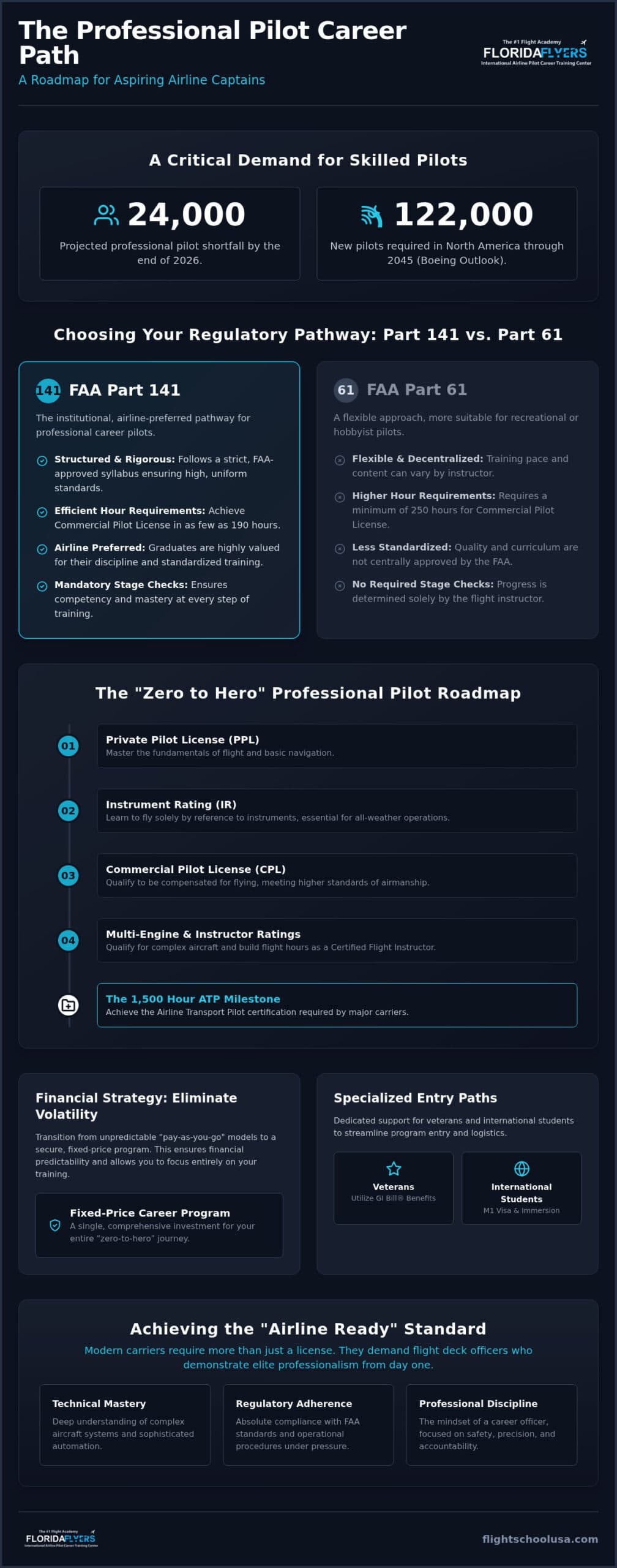
The path to the flight deck is not a one-size-fits-all endeavor. For those entering the industry from the military or from abroad, specialized airline pilot career training requires a high-level understanding of specific regulatory and financial frameworks. Precision in these early stages is mandatory. Veterans and international candidates face unique logistical hurdles that can ground a career if not managed with professional seriousness. Our academy functions as a powerhouse of industry knowledge, providing the specific roadmap required to navigate these complex entry points with efficiency and authority.
Military veterans possess the discipline and high-stakes experience that major carriers demand. Leveraging using GI Bill flight training benefits is a strategic move to offset the significant costs of professional certification. Eligibility for these benefits generally requires an honorable discharge and an existing Private Pilot License. Once established, the VA provides reimbursement for advanced ratings including Instrument, Commercial, and Multi-Engine certifications under an FAA Part 141 syllabus. This structured reimbursement model is designed for results. It ensures that veterans can transition from military service to a commercial cockpit without the financial volatility of variable-rate programs. The transition is rigorous. It demands a no-nonsense attitude toward civilian regulatory adherence while maintaining the elite standards of military service.
The United States remains the global gold standard for aviation education. Navigating an international student flight academy requires a methodical approach to federal compliance. The process is strictly sequential. First, the academy issues an I-20 form after verifying the applicant’s financial and academic readiness. This document is the legal foundation for the M1 Visa application at a U.S. Embassy. There are no shortcuts. Additionally, every foreign student must complete a mandatory TSA background check before the first hour of flight training is logged. These administrative tasks are treated as critical components of a professional’s legal standing.
Initiate your professional transition by leveraging our specialized international student flight academy admission services to navigate the M1 Visa process with precision.
The ‘Airline Ready’ standard serves as the ultimate benchmark for professional excellence. It marks the critical evolution from a pilot who operates an aircraft to a flight deck officer who manages a multi-million dollar operation. Precision is mandatory. While basic certification confirms technical skill, the commercial environment demands a higher echelon of readiness. Our academy acts as the elite gatekeeper of these industry standards, ensuring every graduate embodies the discipline required by tier-one carriers. This is the final stage of your airline pilot career training, where technical proficiency aligns with the uncompromising rigors of professional aviation.
Elite training requires elite equipment. We utilize advanced flight training devices and glass cockpit technology to mirror the systems found in modern regional jets. This immersion is anchored by intensive multi-engine training. You don’t just learn to recover from an engine failure; you learn to manage complex automation and high-altitude aerodynamics under high-stakes conditions. It’s about developing the command presence necessary for a career on the flight deck.
Professionalism is both a legal and operational necessity. Crew Resource Management (CRM) is non-negotiable in our curriculum, as it forms the foundation of safe multi-pilot operations. We demand absolute precision in administrative tasks. Logbook management and regulatory compliance are treated as critical components of your professional standing. Inaccurate record-keeping represents a risk to your career; we eliminate that risk through methodical quality control. Additionally, our students benefit from the direct mentorship of seasoned airline veterans who instill the no-nonsense attitude required to survive an airline check-ride. This level of professional grooming separates our graduates from those of standard flight schools.
The final phase of your journey is the Airline Ready Program. This track bridges the gap between commercial certification and the demands of a Part 121 flight deck. It focuses on high-altitude operations, jet transition profiles, and advanced systems management. To reach the mandatory 1,500-hour ATP milestone, our CFI Fast Track Program provides the most efficient path for rapid hour building. By serving as an instructor within our disciplined environment, you solidify your technical mastery while logging the time necessary for airline entry. It’s a proven system. This roadmap ensures you reach 1,500 hours with the professional maturity that airlines demand in 2026.
Secure your future in the cockpit and join the next generation of elite aviators. Apply for the Professional Pilot Career Program today.
The 2026 aviation landscape offers unprecedented opportunities for those who approach their development with professional seriousness. Success requires more than just logging hours; it demands a strategic alignment with FAA Part 141 standards and a commitment to the ‘Airline Ready’ benchmark. By selecting a structured pathway, you eliminate the risks associated with decentralized training and volatile hourly costs. Your airline pilot career training shouldn’t be a series of variables but a calculated progression toward a commercial command.
As an FAA Part 141 Certified Academy, we provide the elite environment required to master these complexities. Our Fixed-Price Financial Security model removes the burden of hidden fees; meanwhile, on-site Student Housing ensures total immersion in your professional craft. The transition from student to first officer is a high-stakes maneuver that requires a powerhouse of industry knowledge and unwavering discipline.
Secure Your Seat in the 2026 Professional Pilot Career Program
The flight deck of a major carrier is reserved for those who demand excellence from themselves today. We’re ready to help you earn your wings.
Accelerated airline pilot career training typically requires seven to nine months to reach commercial multi-engine certification. Achieving the 1,500-hour Airline Transport Pilot (ATP) milestone generally takes an additional 12 to 18 months of active flight instructing. This timeline assumes a full-time, immersive schedule within a structured academy environment. Precision in scheduling is mandatory to meet the hiring windows of major carriers in 2026.
GI Bill benefits are applicable to advanced ratings but generally don’t cover the initial Private Pilot License. Veterans can deploy these assets for Instrument, Commercial, and Multi-Engine certifications through an FAA Part 141 program. This reimbursement structure is designed for those transitioning from military service to a professional flight deck. Every administrative task is treated as a critical component of your professional’s legal standing.
A Fixed-Price Career Program eliminates the financial volatility of hourly rates by providing an all-inclusive cost for specific certification milestones. Hourly models expose students to fuel price fluctuations and maintenance surcharges, which can ground a career due to budget exhaustion. Our fixed-rate model prioritizes technical proficiency over billable hours. It provides the financial security required to focus entirely on mastering complex flight systems.
International students must secure an M1 Visa for vocational flight training in the United States. This process begins with the issuance of an I-20 form from an authorized academy, followed by a mandatory TSA background check. These regulatory steps are critical components of a foreign student’s legal standing during their residency. We provide specialized M1 Visa admission services to ensure every step is navigated with professional accuracy.
Commercial pilots must hold an FAA First-Class Medical Certificate to exercise the privileges of an Airline Transport Pilot license. This examination evaluates cardiovascular health, neurological function, hearing, and vision corrected to 20/20. Maintaining this medical standing is a continuous regulatory requirement for every professional on the flight deck. It’s the standard of health required to manage the high-stakes environment of a modern commercial aircraft.
Once you reach the 1,500-hour milestone, or the R-ATP reduced minimums of 1,000 or 1,250 hours, you become eligible for the Airline Transport Pilot (ATP) certificate. This is the final gateway to a First Officer position at a regional carrier. Our airline ready pilot program ensures you possess the technical maturity to pass the rigorous airline interview and simulator evaluation. Seniority in the industry makes early entry into this phase critical. Before you reach that milestone, it’s worth understanding the full scope of airline pilot salary progression and total compensation so you can plan your financial future from day one of training.
An FAA Part 141 school follows a strictly approved syllabus with higher levels of oversight and standardized testing. This structured environment allows for reduced flight hour requirements for certain certifications compared to the flexible Part 61 pathway. Professional career tracks favor Part 141 because it mirrors the training protocols of major commercial carriers. It represents the gold standard for those who demand excellence and efficiency in their development. Candidates who want to become a commercial pilot fast will find that the Part 141 framework delivers the accelerated, structured progression necessary to reach the flight deck ahead of the competition.


