

The traditional pay-as-you-go flight training model is a strategic liability that forces the student to assume 100% of the financial risk for every maintenance delay, weather cancellation, and fuel price fluctuation. Most aspiring professionals enter the cockpit with a justified fear of hidden surcharges and the administrative friction of hourly billing. You deserve a training environment where the focus remains on elite proficiency rather than the ticking of a Hobbs meter.
By enrolling in a fixed price flight training program, you effectively transfer the burden of operational volatility to the academy and secure the financial certainty required for complex loan applications. This guide demonstrates how fixed-cost structures accelerate your career trajectory by aligning institutional incentives with your rapid graduation. We will analyze the shift from FAA minimums to actual proficiency needs, the elimination of billing anxiety, and the precise timeline you can expect as you transition into a high-stakes professional airline career.
Professional aviation demands fiscal precision and a disciplined approach to career planning. A fixed price flight training program serves as a total-contract solution for professional certification, locking in your investment against the unpredictable nature of the aviation market. Traditional pay-as-you-go models are a strategic liability. They expose students to extreme operational volatility, where the final cost of a commercial license remains an unknown variable until the day of the checkride. This exposure creates significant anxiety for those relying on fixed-sum loans or strict personal budgets.
The primary drivers of cost overruns in 2026 are fuel surcharges and high instructor turnover. While an hourly rate might look attractive on a marketing brochure, it’s a poor metric for your total career investment. Fuel prices fluctuate based on global geopolitical shifts, and hourly schools pass these costs directly to the student through mid-program price hikes. Additionally, when a school suffers from high instructor turnover, students are often forced to repeat lessons with new personnel to establish a rapport and verify skills. You end up paying twice for the same maneuver. A fixed-price model eliminates this friction by ensuring the academy, not the student, bears the financial weight of these operational inefficiencies. For a deeper examination of how these two models compare across every cost variable, the pay as you go vs fixed price flight school strategic financial analysis for 2026 provides a comprehensive breakdown of the true numbers behind each approach.
Relying on FAA Part 61 minimum hours for budgeting is a common mistake that leads to immediate financial distress. These minimums represent a legal floor for certification, not a realistic expectation for professional proficiency. Most candidates encounter a proficiency gap, requiring 20% to 30% more flight time than the minimums to meet the high standards of an airline checkride. Hourly schools often profit from this slower student progression, as every extra hour flown adds to their bottom line. By contrast, a structured accredited syllabus within a fixed-price framework aligns the school’s incentives with your success. The goal shifts from billing hours to achieving mastery in the most efficient timeline possible.
Weather and maintenance delays are inevitable in aviation, but their financial impact varies wildly depending on your payment structure. In non-structured programs, a week of bad weather leads to skill decay. When you finally return to the cockpit, you must pay for “refresher” hours to regain your previous proficiency level. This creates a compounding cost effect that can add thousands of dollars to your total bill. Managing the administrative burden of dozens of individual invoices and flight logs further distracts you from the rigors of your studies. Sticker shock is the realization that your initial estimated budget was based on impossible FAA minimums rather than the actual hours required to achieve professional competency in a real-world environment.
A premier fixed price flight training program isn’t merely a financial product; it’s a rigorous operational framework designed for maximum career velocity. The “Zero to Hero” progression represents the industry standard for candidates seeking an elite transition from novice to professional. This immersive bundle encompasses the Private Pilot Certificate, Instrument Rating, Commercial Pilot Certificate, and Multi-Engine Rating. By consolidating these certifications, academies stabilize costs using high-fidelity flight simulation training devices and intensive ground school. These tools reduce reliance on high-cost airframe hours while ensuring students meet certification standards with surgical precision. Elite programs further distinguish themselves by including FAA written examination fees and designated pilot examiner checkride fees, ensuring the student’s focus remains strictly on performance rather than administrative logistics. Candidates who want a complete breakdown of this progression from first flight to commercial certification should review the zero to hero flight school commercial pilot path for 2026, which details the exact timeline and regulatory milestones required for airline-ready status.
Oversight is the bedrock of price integrity. Elite academies operate as FAA-approved pilot schools under Part 141 regulations. This status requires a structured, FAA-verified curriculum that mandates specific progress checks and quality control measures. Unlike the decentralized nature of Part 61 training, Part 141 programs offer a predictable path to graduation. This regulatory oversight ensures that the academy maintains a high standard of instructional quality, which directly prevents the training delays that inflate costs in less disciplined environments. For the career-minded student, the efficiency of a Part 141 environment is non-negotiable.
Professional transparency requires a clear understanding of contract boundaries. You must verify that the total cost covers the essential pillars of certification without hidden “convenience” fees. A standard professional bundle typically includes:
While the core training is covered, candidates must account for personal gear and regulatory compliance costs. Common exclusions often involve aviation headsets, current charts, electronic flight bag subscriptions, and FAA medical certificates. Students should scrutinize contracts for “add-on” fees related to fuel surcharges or remedial training. If you’re ready for a disciplined, all-inclusive path to the cockpit, evaluating the Fixed-Price Career Program is the logical next step in your professional development. Reading the fine print ensures you won’t encounter the sticker shock that plagues less structured flight schools.
The traditional “pay-as-you-go” model is fundamentally flawed. It places the entire burden of operational inefficiency on the student. If an aircraft grounded for maintenance or a week of inclement weather necessitates remedial flight hours, the student pays the price. A fixed price flight training program fundamentally restructures this relationship through a mechanism known as risk transfer. In this elite framework, the academy assumes the financial risk of additional training hours. This shifts the academy’s role from a service provider to a strategic partner. When the school absorbs the cost of extra hours, its institutional incentives align perfectly with your success. Efficiency is no longer just a goal; it’s a fiscal necessity for the institution.
There’s a profound psychological advantage to “checkbook-free” training days. Professional pilot candidates must navigate the FAA’s rules for getting a pilot’s license with absolute focus. Worrying about the ticking cost of a Hobbs meter during a complex instrument approach is a distraction you cannot afford. By removing the administrative friction of per-flight billing, you’re free to dedicate 100% of your cognitive load to mastery. This disciplined environment fosters a high-stakes professional mindset, preparing you for the rigors of an airline cockpit where performance is the only metric that matters.
Lenders demand certainty. Complexity breeds risk, and a fluctuating training budget is a significant red flag during the underwriting process for aviation loans. A defined price tag simplifies the entire financial lifecycle. It allows for precise debt-to-income projections, which are critical for securing the high-limit funding required for professional certification. When you present a lender with a fixed-price contract, you demonstrate a level of fiscal responsibility that pay-as-you-go students cannot match. This clarity often results in more favorable loan terms and a streamlined approval process. It ensures you have the capital to finish what you start without the threat of mid-program funding gaps.
In a fixed-rate environment, the school’s motivation shifts toward providing the highest quality instruction and aircraft availability. There’s no incentive for “hour padding” or unnecessary lesson repetitions. Instead, the focus is on standardized progress checks and surgical instructional precision. The academy is incentivized to maintain its fleet to the highest standards to avoid the cost of grounded aircraft. Every component of the Fixed-Price Career Program is engineered to move you through the syllabus at maximum velocity. High-performance training requires an academy that’s as invested in your graduation date as you are. This accountability ensures that you’re not just another student in the pattern, but a professional on a mission.
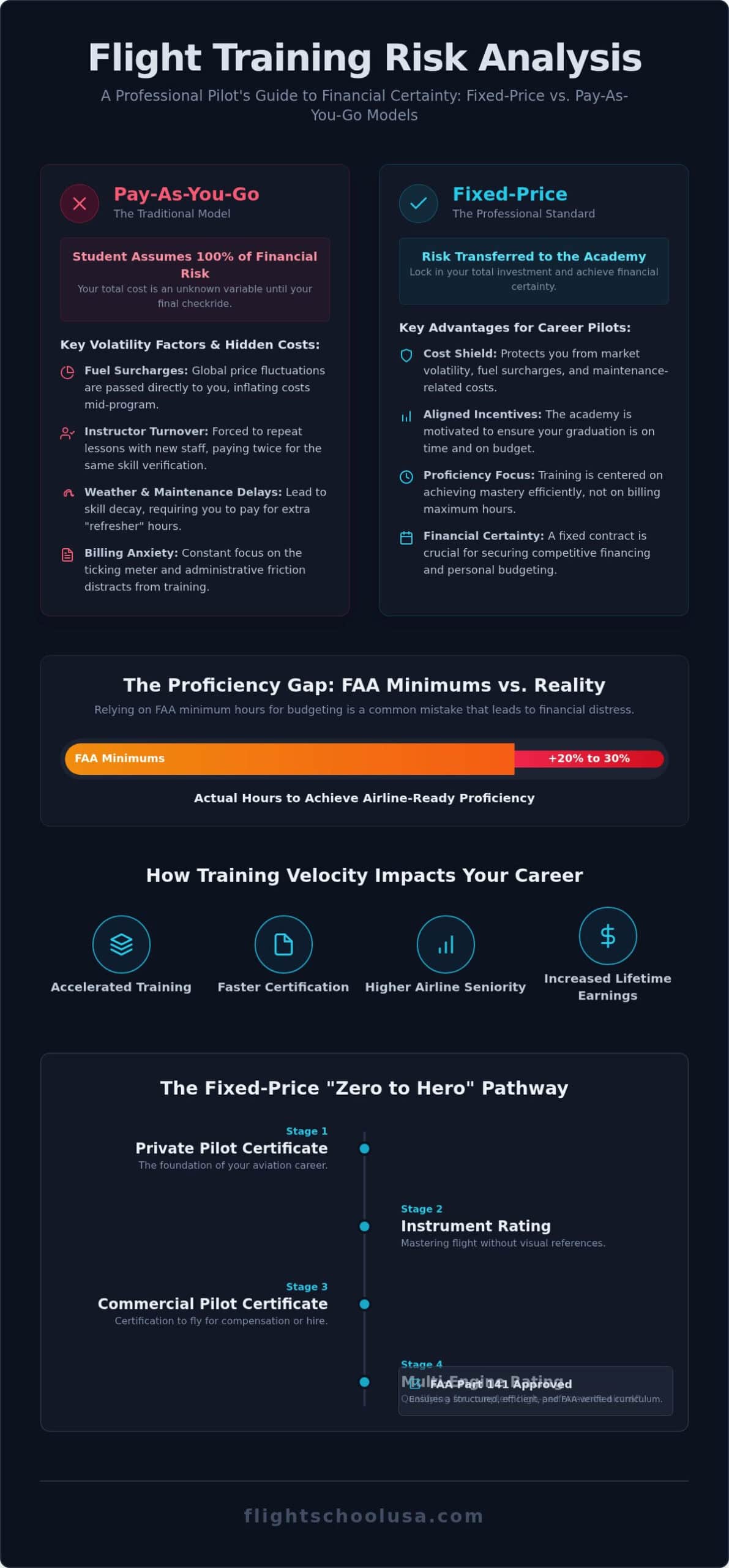
In the high-stakes world of professional aviation, time is a depleting asset. The primary advantage of a fixed price flight training program is not just cost certainty, but the institutional momentum it creates. Because the academy assumes the financial risk of additional flight hours, they are incentivized to move you through the syllabus at maximum velocity. This training velocity is the most critical factor in your long-term return on investment. Every month spent in a less structured, pay-as-you-go program is a month of lost seniority at the airline level. Seniority is the only currency that matters in this industry. It dictates your pay scale, your quality of life, and the airframes you are eligible to command.
Reaching a major carrier just one year earlier can result in career earnings that differ by millions of dollars over a 30-year span. Seniority determines your ability to bid for premium international routes, preferred schedules, and rapid upgrades to Captain. In 2026, the persistent pilot shortage has driven first-year total compensation at regional airlines to ranges between $95,000 and $130,000, including signing bonuses. By entering the workforce ahead of your peers, you secure a higher position on the seniority list that protects you during economic fluctuations and accelerates your progression to wide-body aircraft and elite pay brackets.
Professional development requires total immersion, which is why Student Housing should be viewed as a strategic training asset rather than an ancillary expense. Residential training eliminates commute fatigue and the logistical friction that often leads to training drop-outs in non-structured programs. When you live on-site, you are surrounded by a cohort of high-performance candidates and seasoned instructors, fostering an environment of constant knowledge retention and peer accountability. This immersive model significantly reduces the “cognitive restart” time required after breaks in training, ensuring that every hour spent in the cockpit is utilized for maximum skill acquisition. Reducing external stressors allows you to maintain the disciplined focus necessary to master complex regulatory and technical requirements.
Flight School USA stands as the premier institution for those who demand excellence. Our fixed price flight training program is the elite national choice, specifically engineered to provide financial certainty in an era of extreme operational volatility. We don’t just offer flight lessons; we provide a high-performance pathway to the major airlines. By integrating the Airline Ready Program, we ensure our graduates possess the technical mastery and cockpit resource management skills required for an immediate, seamless transition into a commercial jet. This is not a casual flight school. It’s a professional academy for serious candidates who value surgical precision in their training.
For those who’ve served, our GI Bill Flight Training options provide a disciplined environment to utilize earned benefits with maximum efficiency. We respect the rigors of military service and translate that discipline into civilian pilot certification. Similarly, our M1 Visa Admission Services provide a seamless pipeline for flight school for international students seeking FAA certification in the United States. We treat visa compliance and admissions as critical administrative components of your professional legal standing, ensuring that global students can focus entirely on their training without the friction of regulatory delays or administrative errors. This level of specialized support ensures that every student, regardless of their origin, meets the highest industry standards.
The path to a major airline requires 1,500 hours of flight time. Our CFI Fast Track Program is a strategic tool designed to bridge this gap with professional urgency. By securing your CFI, CFII, and MEI ratings through our fixed-price model, you prepare for immediate employment as an elite professional instructor. We maintain an aggressive internal hiring track for top-performing graduates. This allows you to build the turbine-ready experience necessary for your next career move while earning a professional salary within our own rigorous training environment. Veterans pursuing this pathway should review the comprehensive breakdown of using GI Bill for CFI training in 2026 to understand how to tactically deploy Chapter 33 benefits toward securing CFI and CFII ratings without unnecessary out-of-pocket costs. It’s a proven method for maintaining momentum while fulfilling the FAA’s flight time requirements.
Secure your position in our next Fixed-Price Career Program track
Transitioning from a candidate to a professional pilot requires more than just flight hours; it demands a strategic alignment of financial certainty and training velocity. By selecting a fixed price flight training program, you eliminate the operational volatility of hourly billing and ensure that institutional incentives are locked onto your graduation date. This risk-transfer model is the most effective mechanism for capturing early airline seniority, which directly dictates your lifetime earnings and career trajectory in the current market.
Flight School USA remains the elite national standard for candidates who prioritize results over excuses. As a veteran-owned and GI Bill approved academy, we provide the disciplined environment necessary for high-stakes professional development. Our FAA Part 141 certified curriculum, integrated student housing, and M1 Visa sponsorship services ensure a seamless, immersive experience for both domestic and international professionals. Every administrative and instructional component is designed to maintain the highest industry standards for our graduates.
Apply for the Fixed-Price Career Program at Flight School USA
Your future in the cockpit is a matter of professional choice, not financial chance. Take command of your career timeline today and join the ranks of the industry’s premier aviators. We’re ready to help you reach the flight deck.
A comprehensive fixed price flight training program includes all aircraft rental hours, certified flight instructor fees, ground school instruction, and pre-flight briefings required for professional certification. Elite programs consolidate the Private Pilot, Instrument, and Commercial ratings into a single, high-performance curriculum. This structure eliminates the administrative friction of individual invoices and ensures you have all necessary resources to reach professional standards without hidden surcharges.
The academy assumes the financial burden of any additional flight hours required to reach proficiency. This risk-transfer mechanism ensures that if you require extra time to master a specific maneuver, you don’t face unexpected billing. It aligns the institution’s incentives with your rapid graduation, as the school is motivated to provide the most efficient, high-quality instruction possible to meet the contract terms.
While the upfront commitment is significant, a fixed price flight training program is often more cost-effective because it shields you from fuel surcharges and 2026 market volatility. Traditional models frequently suffer from sticker shock when training delays necessitate refresher hours. By locking in your costs, you capture earlier airline seniority, which provides a significantly higher return on investment over a thirty-year career. Candidates who want a rigorous side-by-side cost breakdown should review the pay as you go vs fixed price flight school financial analysis to understand the full scope of long-term savings.
Yes, veterans can utilize their GI Bill benefits at Flight School USA to fund their professional development. We are a veteran-owned and GI Bill approved academy that understands the specific regulatory requirements for military transitions. Our staff provides specialized support to ensure your benefits are applied correctly toward your goal of becoming an elite professional airline pilot. Veterans seeking to maximize their Chapter 33 benefits beyond initial certification should also explore the tactical strategies for using GI Bill for CFI training to bridge the gap to 1,500 hours without exhausting benefits prematurely.
Elite contract-based programs typically include FAA written exam fees and designated pilot examiner checkride fees within the total cost. This all-inclusive approach ensures that you can focus entirely on your practical performance without the distraction of administrative billing. You should always verify these specific inclusions within your training contract to ensure there are no hidden regulatory costs during the final phase of certification.
A defined price tag provides lenders with the financial certainty required for a streamlined underwriting process. Lenders prefer fixed-price contracts because they eliminate the risk of mid-program funding gaps caused by budget overruns in pay-as-you-go models. This clarity allows for more accurate debt-to-income projections, often resulting in more favorable loan terms and faster approval for aspiring professional pilots.
Withdrawal procedures are strictly governed by the terms of your professional training contract. Most academies utilize a pro-rata refund policy based on the training already completed and the resources utilized. Because these programs are high-stakes professional commitments, it’s critical to review the specific legal clauses regarding termination to understand your financial standing in the event of a career shift or personal emergency.
Flight School USA provides dedicated student housing to facilitate a fully immersive training environment. While housing is a separate logistical component, it’s integrated into the total cost of attendance for candidates seeking maximum knowledge retention. Living on-site reduces commute fatigue and ensures you remain focused on the rigors of the Airline Ready Program alongside a cohort of high-performance peers.


