

If you intend to command a commercial flight deck, you must recognize that the United States is the premier global authority for professional pilot development. Selecting a flight school for international students is a high-stakes decision where precision in planning is as critical as precision in the cockpit. You likely understand that an FAA certification is the ultimate professional credential, yet many candidates suffer career delays because they underestimate the rigorous regulatory and financial demands of the M1 visa process.
This guide eliminates the ambiguity surrounding your professional transition. You’ll master the strategic requirements for M1 visa admission, navigate essential TSA security threat assessments, and secure a career track that protects your capital from the volatile costs of hourly training. We provide a methodical roadmap from initial admission to professional housing. This ensures you remain strictly compliant with 2026 SEVIS requirements while focusing exclusively on achieving elite pilot status and global certification.
Aviation is an industry of absolute standards. For those seeking a flight school for international students, the United States represents the undisputed pinnacle of professional pilot development. It’s not merely about logging hours; it’s about mastering a system of training that the global aviation community recognizes as the gold standard. When you train in the US, you’re investing in a legacy of technical excellence that commands respect from every major airline recruitment board worldwide.
The strategic advantage of US training lies in its geographic and regulatory complexity. Candidates navigate diverse weather patterns, high-density traffic, and sophisticated air traffic control systems. This isn’t just practice; it’s a mission-critical preparation for the realities of commercial flight. Transitioning from zero experience to a professional pilot career track in this environment builds a level of command that is difficult to replicate elsewhere. The ROI is clear: you’re paying for a credential that opens doors at major carriers across the globe. Candidates who approach this transition with a structured institutional framework — as outlined in the comprehensive guide to airline pilot career training for professional aviation in 2026 — gain a decisive edge in navigating the 1,500-hour requirement and the regulatory complexity that defines the path to a tier-one carrier.
The FAA Pilot Certification Process under Part 141 regulations is designed for maximum efficiency and professional rigor. Unlike less structured programs, Part 141 environments require FAA-approved syllabi and frequent stage checks to ensure every student meets elite performance metrics. This technical superiority makes the conversion of US hours to EASA or DGCA licenses a streamlined process. Global carriers don’t just prefer US-trained pilots; they actively seek them out because they know these individuals have been tested against the world’s most stringent safety and operational codes.
Securing entry to a flight school for international students requires more than just talent; it requires administrative precision. The M1 visa is the mandatory regulatory pathway for those pursuing vocational pilot training in the United States. This isn’t a general academic permit. It’s a high-stakes legal status that demands strict adherence to Federal Aviation Administration (FAA) and Department of Homeland Security (DHS) protocols. Any lapse in compliance can terminate your training mission before you ever reach the flight line.
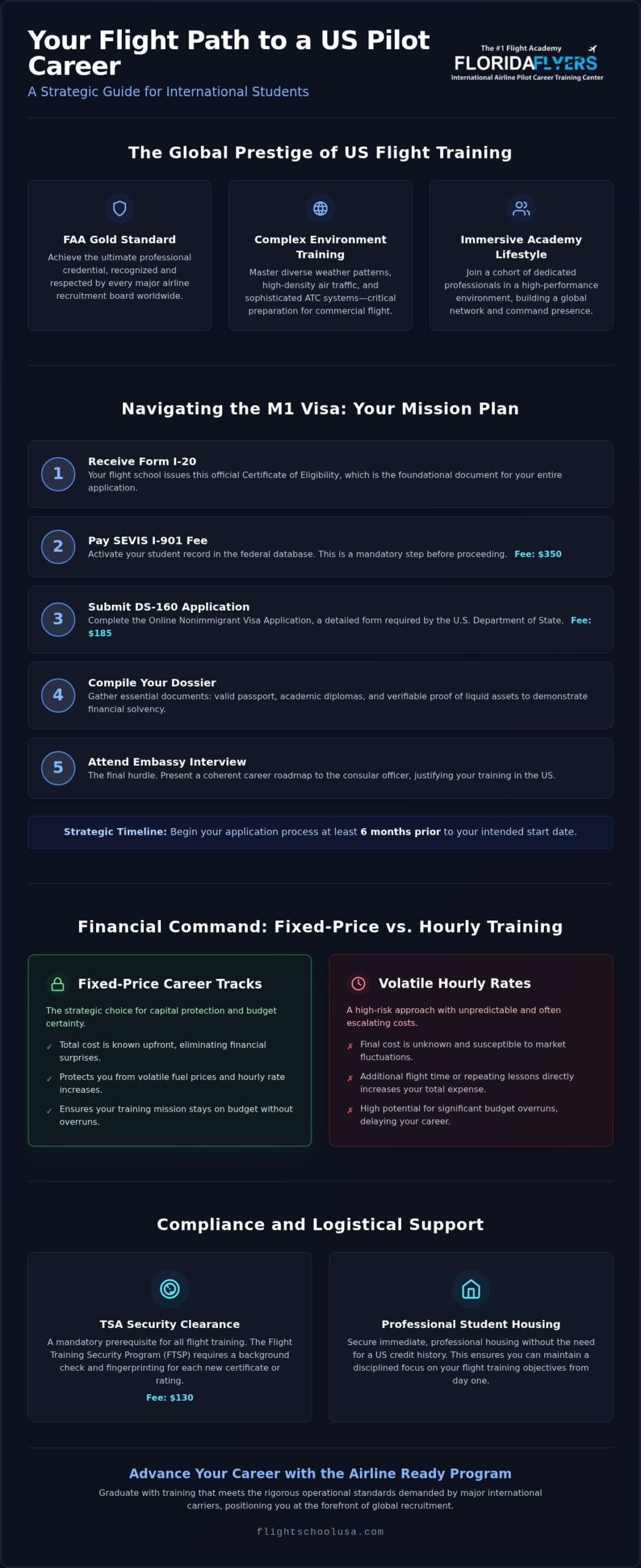
The admission sequence begins with the issuance of Form I-20. This document serves as your official certification of eligibility. Once our academy issues your I-20, you must pay the $350 SEVIS I-901 fee to activate your record in the Student and Exchange Visitor Information System. Following this, you’ll submit the DS-160 application, which carries a $185 fee. This process is methodical. It requires you to demonstrate financial solvency and a clear intent to return to your home country after certification. If you require expert oversight to manage these requirements, our M1 Visa Admission Services ensure your application meets every regulatory benchmark.
Strategic planning for 2026 enrollment must begin at least six months prior to your intended start date. You’ll need to compile a comprehensive dossier. This includes a valid passport, academic diplomas, and verifiable proof of liquid assets. The embassy interview is the final hurdle. Consular officers evaluate your professional intent with extreme scrutiny. You must present a coherent career roadmap that justifies your training in the US as a critical step for your domestic aviation market. Candidates who study the M1 visa flight school USA 2026 strategic admission roadmap gain a decisive advantage by understanding the precise documentation sequence and financial benchmarks that consular officers demand.
Security clearance is a prerequisite for every flight hour. The TSA Flight Training Security Program mandates a background check and a $130 processing fee for each new certificate or rating. This involves a rigorous fingerprinting process and a security threat assessment that must be completed before training commences. Maintaining your legal status during accelerated tracks is non-negotiable. Non-compliance doesn’t just result in a fine. It can lead to immediate deportation and a permanent ban from US airspace. We act as the gatekeeper of these standards, ensuring your focus remains on the cockpit while we manage the regulatory perimeter.
Financial planning is a mission-critical component of professional pilot development. For a flight school for international students, budget volatility isn’t just an inconvenience; it’s a threat to your regulatory standing. Many candidates arrive in the United States with a budget calculated on “best-case” hourly rates, only to see their capital depleted by variables they cannot control. Hourly models are inherently unstable for foreign candidates who operate with fixed currency reserves and strict M1 visa timelines.
You must treat your training budget as a strategic reserve. Traditional “pay-as-you-go” models expose you to market fluctuations that can stall your progress. If your funds run dry before you achieve Commercial Multi-Engine certification, your visa status is jeopardized. This financial anxiety is a primary cause of student attrition, which is why elite academies have shifted toward a more disciplined financial structure. Understanding the full scope of these financial dynamics is essential; the authoritative resource on airline pilot career training and fixed-price program strategy in 2026 provides a detailed breakdown of how to secure financial predictability on the path to a major carrier.
Transparency is the foundation of professional command. By enrolling in the Fixed-Price Flight Training Program, you lock in your investment before you leave your home country. This model eliminates the “fuel surcharge” and “instructor fee” spikes that plague hourly schools. In 2026, market volatility remains a significant risk for those paying by the hour. A fixed-price contract shifts the financial risk from the student to the academy. It incentivizes the school to provide efficient, high-performance instruction because delays cost the institution rather than the student.
Cheap hourly rates are often a deceptive marketing tactic used to lure the uninformed. Students frequently encounter “landing fee” traps or unexpected “checkride fee” surcharges that aren’t included in initial quotes. These administrative costs can add thousands to your total expenditure. Weather delays are the most significant budget inflator in hourly schools. If you’re paying by the hour, a week of grounded aircraft doesn’t just stall your progress; it drains your living expense reserves without advancing your flight hours. For any flight school for international students, these variables can lead to a financial shortfall that forces a premature return home.
Professional pilot certification requires a clear, upfront financial roadmap. You need to account for everything from your initial Private Pilot certificate to your final Commercial Multi-Engine rating. Securing a fixed-price agreement ensures you can focus exclusively on mastering the aircraft. This financial command allows you to maintain the high-level discipline required to graduate on schedule and enter the global airline market with your credentials fully intact.
Logistics are the silent engine of successful pilot development. When choosing a flight school for international students, the administrative burden of securing a residence in a foreign country can be a significant distraction. You can’t afford to divert your attention from complex flight maneuvers to manage utility bills or negotiate long-term leases. A professional academy must provide a turnkey logistical solution that allows you to maintain a singular focus on your certification.
Our infrastructure is designed to eliminate the common friction points that stall international candidates. Most US landlords require a domestic credit history and a commitment to 12-month contracts. These requirements are often impossible for foreign students to meet. We resolve this by offering professional Student Housing directly. You gain immediate access to a secure, high-connectivity environment tailored for rigorous study and rapid recovery between flight blocks.
Elite accommodation is more than a convenience; it’s a strategic asset. Our residential facilities feature dedicated study areas and high-speed infrastructure to support advanced flight simulation software and theoretical research. A stable living environment directly correlates with higher performance during FAA checkrides. By residing within the academy perimeter, you eliminate the fatigue of long commutes and maximize your training hours. This residential model is the catalyst for the accelerated training timeline. It enables you to move from initial induction to commercial certification with maximum efficiency.
Mastery of Aviation English is a non-negotiable requirement for international command. The “Total Immersion” strategy we employ goes beyond the classroom. Living in a professional residential setting ensures you’re constantly exposed to the lexicon of the industry. You’ll engage in daily tactical discussions with instructors and senior students. This reinforces your understanding of complex radio communications. This environmental exposure is critical. It transforms technical vocabulary into second-nature command. For any flight school for international students, this level of immersion is the fastest path to operational fluency in high-density US airspace.
Your transition to a US-based flight deck is a high-stakes objective that requires an elite partner. As a premier flight school for international students, we don’t just provide instruction; we execute a comprehensive career mission. Our M1 Visa Admission Services remove the administrative friction that often stalls international candidates. By providing expert guidance through the complex regulatory maze, we ensure your focus remains on achieving professional command. This disciplined approach is mirrored in our Airline Ready Program, which is specifically engineered to meet and exceed the operational standards of global carriers.
The Fixed-Price Career Program remains the cornerstone of our offering for the serious international investor. It provides the financial certainty required for long-term strategic planning. For those seeking to maximize their professional standing, our CFI Fast Track Program offers a rapid path to advanced instructor credentials. Veterans pursuing this pathway should understand that using GI Bill for CFI training requires precise execution of Chapter 33 benefits within the 2026 vocational cap to avoid out-of-pocket costs on the path to 1,500 hours. This allows you to build high-quality US flight hours that are highly valued in the global recruitment market. We demand excellence because the airlines you’ll eventually fly for demand the same. This academy functions as a high-performance environment where results are the only acceptable metric.
We utilize a summary-first approach to document verification to expedite the I-20 issuance process. You’ll have direct access to admissions mentors who specialize in navigating the specific hurdles faced by foreign applicants. These experts understand the urgency of your mission. Securing your position in the 2026 training cohort requires immediate action and precise documentation. Our team acts as the gatekeeper of your administrative compliance, ensuring every dossier meets the rigorous standards of US immigration and the FAA. We treat your admission with the same professional seriousness as a pre-flight check.
A professional pilot resume featuring US-based flight hours is a powerful asset in any aviation market. We prepare you for the technical realities of DGCA, EASA, or local CAA license conversions through our Airline Ready Program. This curriculum focuses on the sophisticated systems and multi-crew coordination required by major airlines. You’ll graduate with the tactical proficiency and professional presence required to command a commercial aircraft anywhere in the world. The prestige of a US-trained pilot is recognized globally; we ensure you carry that reputation with authority. Secure your future with our International Pilot Career Program.
Professional pilot development in the United States is a high-stakes mission that demands absolute regulatory precision and financial discipline. By securing a position within an FAA Part 141 Certified Academy, you aren’t just logging hours; you’re mastering an elite system of aviation recognized by every major carrier worldwide. Your success depends on a dual-strategy: navigating the complex M1 visa protocols with expert oversight and protecting your capital through a Fixed-Price Career Program Guarantee. This ensures your training remains focused and uninterrupted by market volatility.
Selecting a premier flight school for international students is the most significant strategic decision of your career. With on-site student housing available, the logistical friction of international relocation is eliminated. This allows you to maintain the high-level discipline required for professional certification. The global airline market rewards those who train under the world’s most rigorous standards. Take the definitive step toward your commercial pilot career and secure your status as an elite aviator.
Apply for International Admission at Flight School USA
Your journey to professional command begins with a single, disciplined choice. We’re ready to guide your transition to the flight deck.
International students on an M1 visa are strictly prohibited from working in the United States during their vocational training mission. This regulatory restriction ensures that your focus remains entirely on your professional pilot development and technical mastery. Engaging in unauthorized employment is a severe violation of US immigration law. Such actions result in the immediate termination of your SEVIS record and permanent deportation from US airspace.
The M1 visa is the primary regulatory pathway for vocational flight training at a dedicated, high-performance academy. In contrast, the F1 visa is reserved for students enrolled in degree-granting academic programs at four-year universities. For those seeking an accelerated, professional career track without the time-intensive degree requirement, the M1 visa is the most efficient choice for attending a flight school for international students.
You must demonstrate the financial capacity to cover the total cost of your training program plus estimated living expenses for the entire duration of your stay. Consular officers require verifiable proof of liquid assets, such as bank statements or official loan approval letters. This financial command is a prerequisite for the issuance of your Form I-20 and is a critical component of your visa interview success.
Our academy typically issues the Form I-20 within seven to ten business days following the successful verification of your admission documents. This timeline depends on your speed in providing a valid passport copy, academic transcripts, and proof of funds. Once issued, your I-20 allows you to pay the mandatory SEVIS fee and schedule your required interview at the nearest US embassy or consulate.
You must achieve operational proficiency in English to meet FAA certification standards. Aviation is governed by English as the international language of flight; therefore, you must read, speak, and understand the language to hold a US pilot certificate. While perfect fluency isn’t required at the induction stage, you must demonstrate the command necessary to manage complex radio communications in high-density US airspace.
Failure of an FAA checkride requires mandatory retraining and a subsequent re-examination by a Designated Pilot Examiner. This is a professional setback rather than a legal one; your M1 visa status remains intact as long as you maintain full-time enrollment and satisfactory progress. Our instructors provide the rigorous remediation necessary to ensure you meet the elite performance metrics required for a successful retest and graduation.
FAA pilot licenses are globally recognized as the gold standard of aviation certification. Most civil aviation authorities, including EASA and DGCA, have established protocols for converting US credentials into local licenses. Attending a flight school for international students in the US provides you with a prestigious foundation. This significantly enhances your recruitment potential and career trajectory at major carriers within your home country.
You are permitted to bring your legal spouse and unmarried children under the age of 21 to the United States on M2 dependent visas. Your dependents are not authorized to work but may reside with you for the duration of your training. You must provide additional proof of financial assets to cover the increased living expenses for each family member included in your application dossier.


