
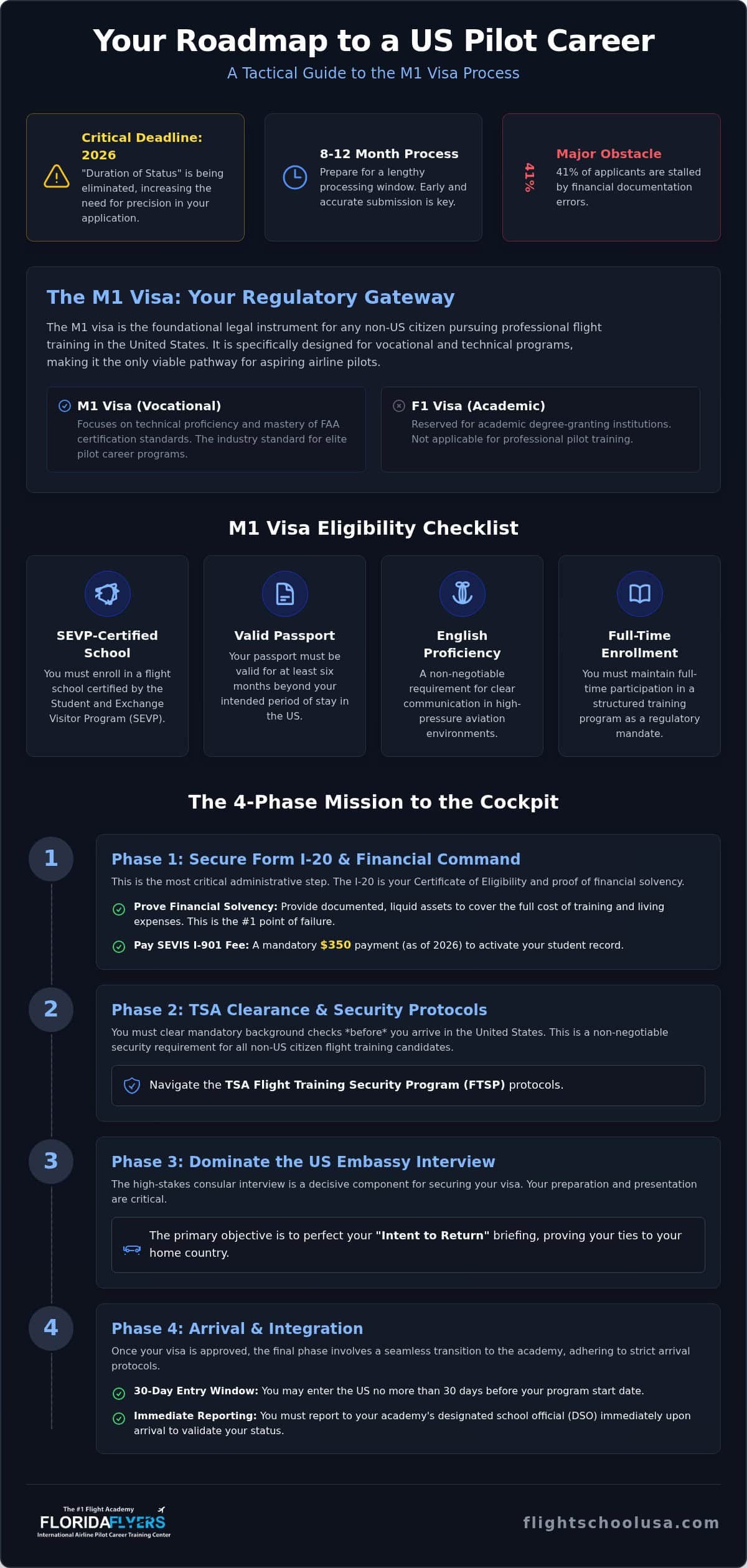
With the elimination of “duration of status” as of September 15, 2026, the margin for error in your US pilot training mission has effectively vanished. It’s no longer enough to simply apply. You must execute a high-precision regulatory maneuver to secure your seat in an elite academy. You likely recognize that an 8 to 12-month processing window and the constant threat of a visa denial are the primary obstacles between you and the cockpit. This tactical guide provides the roadmap required to secure your m1 visa flight school usa admission, ensuring you bypass the 41% of applicants who are currently stalled by financial documentation errors.
We understand that the complexity of SEVIS I-901 fees and the rigorous TSA Security Threat Assessment can be daunting for even the most disciplined candidates. You need a seamless transition that transforms administrative hurdles into a professional standard of compliance. This article previews the mandatory 2026 financial thresholds, the specific steps for I-20 issuance, and the strategic timeline necessary to transition from an applicant to a professional pilot in our Fixed-Price Career Program.
The M1 visa is the foundational legal instrument for any non-US citizen pursuing professional flight training within the United States. Unlike the F1 visa, which is reserved for academic degree-granting institutions, the M1 is specifically architected for vocational and technical excellence. For those targeting a career in the flight deck, this is the only viable pathway. Securing an m1 visa flight school usa placement is a high-stakes administrative mission. It requires total alignment with federal regulations and a commitment to a rigorous, full-time curriculum. This visa category prioritizes technical proficiency over general academia, making it the industry standard for elite initiatives like our Airline Ready Program. For a comprehensive technical breakdown of these regulations, you can reference this M-1 Visa Overview to understand the specific limitations regarding work authorization and stay duration.
Choosing the M1 pathway signals your intent to enter a high-performance career track. The focus here is not on elective subjects but on the mastery of FAA certification standards. This regulatory focus ensures that every hour spent in the cockpit or the classroom contributes directly to your professional standing. Failure to understand the technical distinctions between visa types often leads to costly delays or outright embassy rejections. Success requires a strategic partnership with an academy that treats your admission as a mission-critical operation. Candidates who want a complete view of the milestones ahead should review the full pilot career path for international students, which details every technical and financial requirement from M1 compliance through the 1,500-hour ATP standard.
Enrollment is not a casual agreement; it’s a regulatory mandate for full-time participation in a structured pilot training program. You must maintain a valid passport with at least six months of validity beyond your projected training completion date. Failure to meet this basic requirement results in immediate application rejection at the consular level. Additionally, English language proficiency is a non-negotiable barrier to entry. The FAA and the US Department of State demand that all candidates demonstrate a level of fluency that ensures safety in high-pressure aviation environments. If you cannot communicate with precision, you cannot command an aircraft in US airspace.
Your choice of institution dictates your legal standing. Training at an elite, SEVP-certified academy is the only way to guarantee the issuance of your Form I-20. The Student and Exchange Visitor Information System (SEVIS) is the federal database used to track international students and maintain the integrity of the US border. As an authorized gatekeeper, the flight school assumes responsibility for your status within SEVIS. Any deviation from training protocols or failure to maintain full-time status puts your legal standing at risk. Choosing an m1 visa flight school usa with a dedicated international admissions team ensures that your regulatory profile remains flawless from arrival through the completion of your professional ratings.
The Form I-20 is the single most critical document in your administrative arsenal. It acts as the official Certificate of Eligibility for Nonimmigrant Student Status. Without it, your application for an m1 visa flight school usa is dead on arrival. This document confirms that you’ve been accepted into a full-time program and that the institution has verified your financial capacity. For an elite academy, issuing an I-20 is a statement of confidence in your professional potential. It’s governed by strict SEVP Certification for Flight Schools standards; this ensures that only high-performance training centers can sponsor your entry into the United States.
Once the I-20 is issued, you must immediately address the SEVIS I-901 fee. As of 2026, this fee is $350. This payment is a mandatory requirement to activate your record in the federal database. You cannot schedule an embassy interview without a valid receipt. Treat this as a mission milestone that must be cleared with precision to avoid delays in your training timeline. Any administrative oversight at this stage can result in months of lost momentum.
Consular officers demand absolute proof of your ability to fund your training and life in the US without seeking employment. This is where most applications fail. You must provide documented evidence of liquid assets covering the full cost of your program plus living expenses. Acceptable evidence includes bank statements less than 30 days old or certified loan approvals. If you’re using a sponsor, a formal letter of support and their financial records are required. Consulates prioritize liquid funds over long-term investments like real estate. They need to see immediate access to capital. Our M1 Visa Admission Services team provides the specific oversight needed to ensure your financial dossier meets these rigorous federal standards.
The path to receiving your I-20 follows a disciplined sequence. You must first complete the academy’s international enrollment assessment to verify your background and intent. Next, you submit your certified financial documentation for a comprehensive internal audit. We don’t just pass these documents along; we verify they meet the threshold for success. Finally, once approved, your original Form I-20 is dispatched via secure international courier. You must have the physical document in hand for your interview. Digital copies are insufficient for the high-stakes environment of a US embassy. This process typically takes two to four weeks, so start early.
Securing the Form I-20 establishes your identity within the Student and Exchange Visitor Program (SEVP), but it does not grant you access to the cockpit. To legally begin flight training, you must clear the Transportation Security Administration (TSA) Flight Training Security Program (FTSP). This is a high-stakes security layer designed to vet every non-US citizen before they touch the controls of an aircraft. You cannot bypass this step. Any attempt to start training without an explicit “Permission to Initiate Training” (PTIT) is a federal violation that will terminate your status at an m1 visa flight school usa immediately. While your visa permits entry, the TSA clearance permits the actual training. These are two distinct regulatory hurdles that must be cleared with total precision.
The background check process is rigorous. It involves a deep dive into your personal history, travel records, and international standing. Upon arrival in the United States, you’ll be required to complete a fingerprinting appointment at an authorized collection site. This biometric data is the final component of your security dossier. Training remains grounded until the TSA issues a final “Determination of Eligibility.” In the current 2026 regulatory environment, this eligibility is typically valid for five years, allowing for a more streamlined progression through your ratings.
Initiating your security clearance requires a disciplined approach to documentation. You must first create a candidate account on the official TSA portal and select your specific training academy. A processing fee of $130 is required for the initial Category 3 rating assessment. You’ll need to upload high-resolution copies of your passport and your M1 visa once it has been issued. Precision is paramount here. Any discrepancy between your TSA application and your SEVIS record will trigger a Request for Evidence (RFE), stalling your progress for weeks. Do not wait until you arrive in the US to start this process; elite candidates begin their registration well before their departure date.
Your professional pilot career path involves multiple training stages, including Private, Instrument, and Multi-Engine ratings. Under the updated 2026 protocols, a single determination of eligibility now covers multiple providers and courses, but you must still maintain continuous compliance with all reporting requirements. Flight School USA acts as your strategic partner in this process, providing the oversight necessary to ensure your security filings are synchronized with your training milestones. We treat security compliance as a core component of your professional discipline. By maintaining a flawless security record, you protect your legal standing and ensure an uninterrupted transition into our Airline Ready Program.
The embassy interview is the definitive gatekeeper of your professional ambitions. You must approach this encounter not as a casual conversation, but as a high-stakes professional briefing where precision is paramount. Consular officers are trained to identify any lack of clarity or preparation. Your objective is to demonstrate that your m1 visa flight school usa admission is a strategic component of a well-defined career trajectory. Every answer must be concise, factual, and delivered with the confidence of a future pilot in command. At this level of professional scrutiny, vague responses regarding your training goals will lead to an immediate denial.
The “Intent to Return” to your home country is the most critical point of evaluation. Under US immigration law, consular officers operate with the legal presumption that every applicant intends to remain in the United States permanently. Your mission is to rebut this presumption with overwhelming evidence. You must prove that your ties to your home country; whether through family, property, or specific employment offers; are strong enough to ensure your departure after training. If you cannot convincingly link your US-based training to a commercial pilot position in your home market, the officer will view your application as a migration risk rather than a vocational pursuit.
Articulating why you selected a specific flight school for international students is central to your narrative. You must explain the technical advantages of FAA certification and why local training alternatives are insufficient for your career goals. Be prepared to discuss the specific fleet, the structured curriculum of our Airline Ready Program, and the efficiency of the US training environment. You aren’t just going to learn to fly; you’re going to the US to acquire a superior set of professional ratings that will make you a competitive asset to airlines in your home country. For candidates requiring a final tactical review of their case, our M1 Visa Admission Services team offers the expert oversight necessary to ensure your briefing is flawless.
Organization is a reflection of your professional discipline. Your portfolio must be flawlessly indexed, containing your original Form I-20, your SEVIS I-901 receipt, and your DS-160 confirmation page. Include our formal academy acceptance letter and the detailed training syllabus to prove the legitimacy of your program. It’s mandatory that you carry original financial documents, such as bank statements and loan approvals, rather than photocopies or digital scans. Consular officers often view the presentation of original, certified records as a primary indicator of an applicant’s credibility and financial command. Dress in professional attire to signal your respect for the rigors of the aviation industry and the gravity of the visa process.
Failure to report to the DSO is a critical compliance breach. It can lead to the immediate termination of your record and subsequent deportation. We treat this administrative arrival as the first check-ride of your career. It demonstrates your ability to follow complex regulatory instructions under pressure. Once your status is confirmed, you shift from the administrative phase into the execution of your fixed price flight training program. This transition is where your investment in a high-performance academy begins to yield professional results.
We don’t view Student Housing as a mere convenience; it’s a strategic asset designed to maximize your training efficiency. Living on-site eliminates the logistical friction of a daily commute, allowing you to dedicate every available hour to the flight line and ground school. Our housing facilities create a high-stakes environment where you’re surrounded by professional peers who share your discipline. This immersion is essential for those enrolled in accelerated career tracks like our CFI Fast Track and Airline Ready Program. In these high-intensity environments, the ability to engage in peer-to-peer briefing and collaborative study sessions can significantly reduce your time to certification. While competitors offer local housing as an afterthought, we provide it as a core component of your professional pilot career.
The final stage of integration involves a terminal check of your TSA fingerprinting status and an academy-specific orientation. You’ll be briefed on the standard operating procedures (SOPs) that govern our elite fleet and training environment. This isn’t a casual introduction; it’s a professional induction into a high-performance flight culture. As you transition onto the flight line, your focus shifts entirely to the mastery of the cockpit. You’ve cleared the regulatory hurdles, secured your financial command, and established your legal standing. Now, the mission is to execute your training with the precision required to earn your Commercial Pilot License and secure your future in the global aviation industry. Secure your position in our 2026 international class today.
We’re ready to act as your strategic partner throughout this entire mission. As an FAA Part 141 Certified Academy, we offer the prestige and structure necessary for international success. Our Fixed-Price Career Program Assurance provides the financial certainty you need for sponsorship, while dedicated on-site student housing keeps you immersed in a culture of excellence. Don’t let regulatory complexity ground your ambitions. Apply Now for M1 Visa Sponsorship at Flight School USA and take the first step toward your commercial pilot career. We’ll see you on the flight line.
M-1 students are strictly prohibited from engaging in any form of U.S. employment during their training period. This regulatory mandate ensures that your focus remains entirely on technical pilot certification. You must demonstrate total financial command before arrival, as unauthorized work is a federal violation that results in immediate visa termination and deportation. There are no exceptions for off-campus employment under this vocational classification.
Effective September 15, 2026, you’re admitted for a fixed period that matches your program length, not to exceed four years. The U.S. Department of Homeland Security has eliminated the “duration of status” policy to increase regulatory oversight. If your training extends beyond the date on your I-94 record, you must file a formal Extension of Stay with USCIS to maintain your legal standing.
You’ll receive a notification stating the specific reason for refusal, usually citing Section 214(b) for a lack of nonimmigrant intent. You can reapply, but you must present new, compelling evidence that addresses the initial grounds for denial. Our admissions team analyzes these high-stakes scenarios to help you rebuild a compliant dossier that proves your intent to return home after you complete your training mission.
Transfers between institutions are only permitted within the first six months of your initial entry into the United States. This maneuver requires formal approval from USCIS and a new Form I-20 from the receiving academy. Once this six-month window closes, you’re legally committed to your original m1 visa flight school usa for the remainder of your vocational training program. Exceptional circumstances are rarely granted.
Your spouse and unmarried children under the age of 21 are eligible for M-2 dependent status. While they’re permitted to reside with you in the U.S. for the duration of your training, they’re strictly prohibited from any form of employment. You must provide additional financial documentation proving your ability to support all dependents without U.S. based income during your fixed period of admission.
The M1 visa is the specific legal instrument for vocational pilot training, while the F1 is reserved for academic degree-granting institutions. Choosing an m1 visa flight school usa allows for a faster, technical path to FAA certification without the requirement of university-level academic courses. However, M1 status offers less flexibility regarding work authorization and program transfers compared to the academic F1 category.
You must provide documented proof of liquid assets covering the total cost of your training program plus all living expenses. For the 2026 calendar year, applicants should be prepared to show bank statements or loan documents totaling between $85,000 and $95,000. Consular officers place heavy emphasis on the credibility of these documents; statements must be less than 30 days old to be considered valid.
The U.S. government doesn’t mandate a specific English test, but the academy is required to verify your proficiency to meet FAA and SEVP standards. You must demonstrate a high level of fluency to ensure safety in the cockpit and adherence to complex air traffic control instructions. Elite programs often require standardized test scores or a formal interview to confirm you can operate effectively in English-only environments.


