

The true cost of a professional pilot license isn’t found on a price sheet; it’s hidden in the hours you haven’t flown yet. For most aspiring aviators, the debate between a pay as you go vs fixed price flight school represents the critical difference between a guaranteed career and a grounded dream. While the national average to obtain a Private Pilot License has climbed to 60 or 70 hours, far exceeding FAA minimums, many students find themselves paralyzed by creeping costs like fuel surcharges and rising instructor fees that often account for 80 percent of total training expenses.
You likely recognize that professional flight training is a high-stakes investment where financial ambiguity leads to failure. This strategic analysis empowers you to master these financial complexities by exposing the critical differences between hourly billing and fixed-price career tracks. We’ll examine the 2026 regulatory landscape, compare Part 61 and Part 141 efficiencies, and provide a clear roadmap for securing your total investment. By the end of this guide, you’ll understand how to mitigate risk and choose the fastest route to a professional cockpit.
The choice between a pay as you go vs fixed price flight school is the first executive decision of your aviation career. It’s a fundamental question of who owns the financial risk of your proficiency. In the pay-as-you-go model, you pay for aircraft rental and instructor time per session. This appears accessible because it requires less capital upfront, but it offers no protection against the volatility of training timelines. Conversely, a fixed-price model involves a comprehensive contract that covers all necessary certifications for a predetermined fee. This structure creates a financial firewall, ensuring your progression isn’t halted by a depleted bank account.
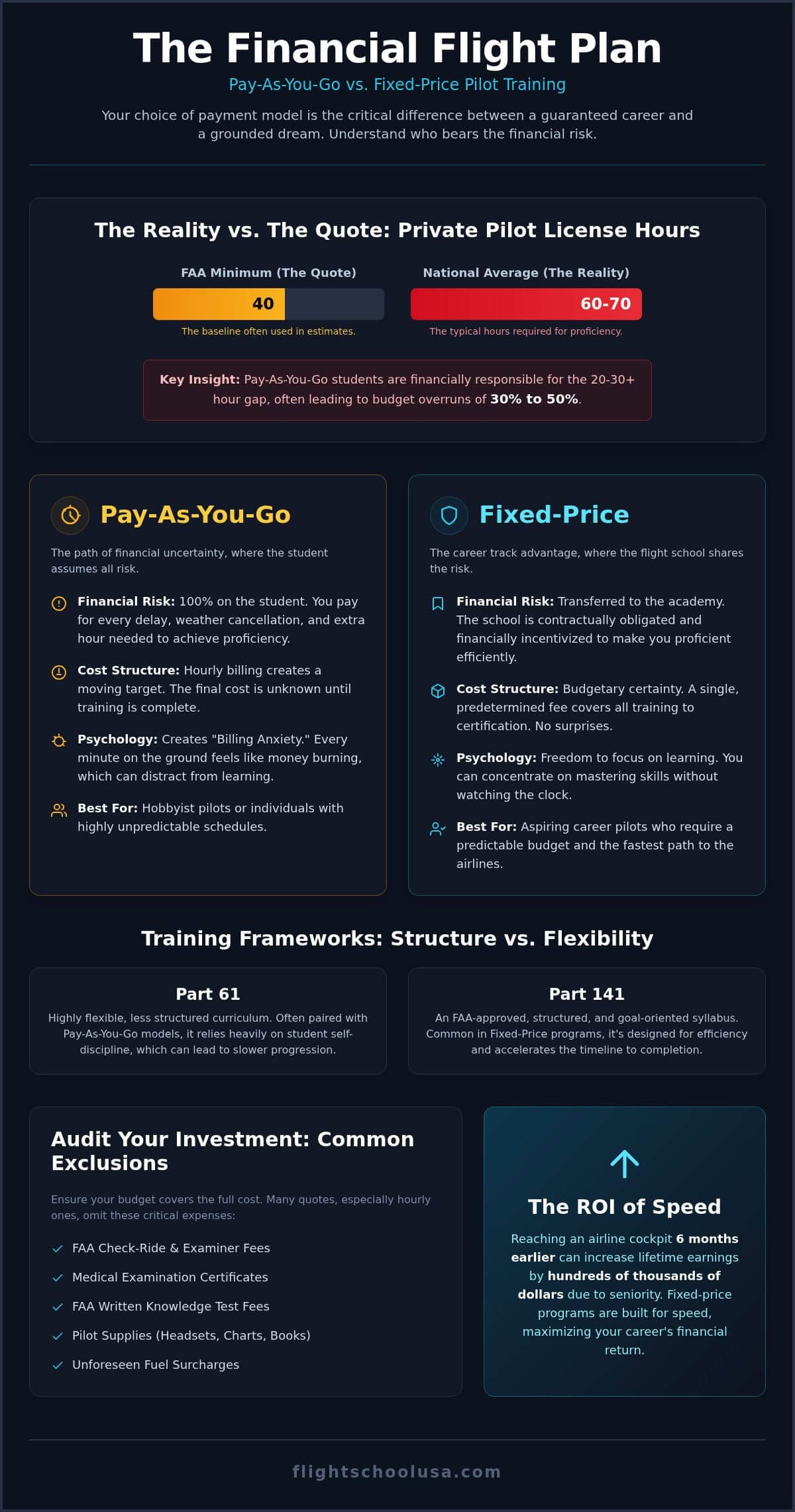
Most students encounter a harsh “sticker shock” when their training concludes. Estimated hourly quotes frequently balloon by 30% to 50% because they are often based on minimum FAA pilot certification standards rather than the reality of student performance. While the FAA minimum for a Private Pilot License is 40 hours under Part 61, the national average is actually 60 to 70 hours. In a pay-as-you-go system, you’re responsible for every additional hour. In a fixed-price program, the academy assumes that risk, incentivizing them to get you to check-ride readiness with maximum efficiency.
Hourly billing is the standard in a Part 61 environment. It offers scheduling flexibility that often appeals to hobbyists or those with irregular availability. However, for a career professional, this flexibility is a liability. It creates “billing anxiety,” where every minute on the taxiway feels like money burning. This psychological pressure often distracts from the rigors of flight, leading to slower progression and even more billing cycles. Without a fixed end-point, the total investment remains a moving target.
Fixed-price programs are built for the elite career track. These “bundled” programs align the school’s operational goals with your individual success. Because the academy is contractually obligated to reach a specific outcome for a set price, they provide a highly structured, immersive environment. High-performance academies utilize advanced simulators to maintain fixed-price profitability while ensuring you master complex maneuvers before ever burning expensive aviation fuel. It’s a disciplined approach that treats your training as a professional mission rather than a casual pursuit.
Professional aviation training is an exercise in risk management. When evaluating a pay as you go vs fixed price flight school, the central variable is the transfer of financial liability. In an hourly model, the student carries 100 percent of the risk associated with weather delays, maintenance issues, or learning plateaus. If you require ten additional hours to master crosswind landings, you pay for them. In contrast, a fixed-price contract transfers this burden to the academy. This creates a financial safety net that ensures proficiency standards are met without the threat of “checkbook fatigue,” which is a leading cause of mid-program dropouts.
Industry data regarding commercial pilot training costs suggests that initial estimates are rarely the final total. By locking in a price, you eliminate the uncertainty that plagues unstructured training environments. This protection isn’t just about saving money; it’s about protecting your career trajectory. When the school owns the cost of extra hours, they’re financially incentivized to provide superior instruction and well-maintained aircraft to keep you on schedule.
Reaching a commercial flight deck six months earlier can translate into hundreds of thousands of dollars in lifetime earnings due to airline seniority systems. When you compare the total investment of an elite program to a first-year officer’s salary, the value of speed becomes clear. ROI in aviation is the delta between training speed and career longevity. Choosing an Airline Ready Program ensures you aren’t just flying; you’re advancing toward a paycheck as quickly as the regulations allow.
For those utilizing GI Bill Flight Training or seeking M1 Visa Admission Services, financial transparency is a regulatory necessity. International students must provide proof of sufficient funds for the entire duration of their stay to secure their visa. A fixed-price model provides the exact documentation required by consulates. Similarly, veterans need a structured path where benefits are applied efficiently. Integrating these programs with dedicated student housing creates an immersive, high-velocity environment that prevents the stop-and-start rhythm of hourly training. This level of discipline is why the Fixed-Price Career Program remains the gold standard for those who treat flight training as a mission rather than a hobby.
The regulatory framework of your academy determines the financial efficiency of your training. When analyzing pay as you go vs fixed price flight school options, you must evaluate the FAA certification under which the school operates. Part 141 schools utilize an FAA-approved syllabus that allows for significantly lower minimum flight hour requirements. A Commercial Pilot License requires 190 hours under Part 141, whereas Part 61 requires 250 hours. This 60-hour delta represents a potential savings of $9,000 to $15,000, depending on aircraft rental and instructor rates. Fixed-price programs thrive in Part 141 environments because the structure is predictable and the outcome is legally defined.
Many students fall into the “self-discipline trap” of pay-as-you-go training. While paying per session seems convenient, it lacks the urgency of an elite career track. Without a rigid schedule, training often drags out, leading to “re-learning” costs where you spend paid hours regaining proficiency lost during long breaks. High-performance academies solve this by prioritizing fleet access for their career students. In a competitive market, students in a Fixed-Price Career Program receive priority for aircraft and dedicated instructors, while hourly renters often struggle with availability and maintenance delays. Financing your flight training requires a clear understanding of these operational differences to avoid wasting capital on inefficient training cycles.
Graduation rates in structured programs consistently outperform the fragmented progress of hourly training. The FAA Part 141 advantage isn’t just about lower hour minimums; it’s about the oversight and standardization that prevents training plateaus. By following a strict syllabus, you avoid the redundant costs associated with switching instructors or repeating lessons. This methodical approach ensures that every dollar spent is directed toward a specific certification milestone. It’s a powerhouse approach designed for those who demand excellence and efficiency.
Flexibility is often a euphemism for a lack of progress. While pay-as-you-go allows you to skip weeks of flying, this inconsistency is the enemy of proficiency. Major airlines prioritize candidates from high-stakes, structured environments because these graduates have proven they can handle the rigors of a professional training department. Full-time immersion is more than a convenience. It’s a statement of professional intent. For those serious about reaching a commercial deck, the disciplined environment of an Airline Ready Program is the only logical choice for maintaining momentum and securing a future in the cockpit. Aspiring professionals who want to understand the complete journey from first flight to airline placement should explore the zero to hero flight school commercial pilot path to see how a structured, high-velocity program maps every certification milestone.
Lenders prioritize stability over potential. Financial institutions are far more likely to approve significant loan amounts for a Fixed-Price Career Program because the total capital requirement is capped and the pathway to employment is clearly defined. Hourly training represents an open-ended liability that lenders view as high-risk; this often results in higher interest rates or outright denials. To find the “real” cost of a pay-as-you-go estimate, professional analysts recommend adding a minimum 20% contingency buffer to any hourly quote. This adjustment accounts for the inevitable proficiency gaps and operational delays that characterize unstructured training environments.
Hourly rates are deceptive and highly volatile. As of April 2026, a Cessna 172 “wet” rate fluctuates between $180 and $220 per hour, but these figures often ignore administrative fees or the mandatory ground school hours required for certification. Weather delays in a pay-as-you-go system don’t just stall your progress; they drain your budget as you pay for additional “review” flights to maintain currency before a checkride. Knowledge Test Readiness is a key variable in training cost, as poor preparation leads to remedial ground sessions billed at standard instructor rates of $60 to $90 per hour.
Full-time immersion requires a holistic financial strategy that extends beyond the cockpit. Your planning should incorporate Student Housing into the initial loan amount to ensure you remain focused on the flight deck rather than external logistics. For those seeking long-term ROI, budgeting for a CFI Fast Track Program is a strategic move. This transforms you from a tuition-paying student into a revenue-generating professional in the shortest possible timeframe. Secure your financial future by choosing a program that eliminates the “estimated” trap and provides a definitive route to the airlines.
The decision to enter the cockpit is a high-stakes commitment that demands a superior financial strategy. When you weigh the options of a pay as you go vs fixed price flight school, the objective is clear: you need a system that removes the variables and focuses on the mission. The Airline Ready Program at Flight School USA is designed specifically for this purpose. It functions as a strategic bridge, taking you from zero experience to a professional flight deck through a disciplined, FAA Part 141-approved curriculum. Unlike fragmented hourly training, this program provides the structural integrity required to meet the rigorous demands of airline recruiters.
Our Fixed-Price Career Program is the elite choice for commercial aspirants because it eliminates the financial friction that stalls most careers. We integrate the CFI Fast Track Program directly into our career tracks, providing a seamless transition into the hour-building phase. This is where you move from a student to a professional mentor, accumulating the 1,500 hours required for airline placement while earning an income. This isn’t just a training plan; it’s a career launchpad. By utilizing our dedicated Student Housing, you immerse yourself in a high-performance culture where learning never stops. This on-site residency facilitates rapid knowledge transfer and ensures you remain focused on your progression without the distractions of external logistics.
We maintain an unwavering commitment to financial transparency and strict regulatory compliance. As a powerhouse of industry knowledge, Flight School USA sets the national standard for FAA Part 141 training. Our instructors aren’t just hourly freelancers; they are career mentors dedicated to your command. We specialize in navigating the complexities of GI Bill Flight Training and M1 Visa Admission Services, ensuring that veterans and international students have a clear, compliant path to certification. Every administrative task is treated as a critical component of your professional standing, providing a sense of security that only a premier institution can offer.
A professional career in aviation requires methodical planning. Before you enroll, it’s critical to schedule a personal training consultation to audit your goals and align them with our accelerated tracks. Our admissions office is prepared to guide you through the specific requirements for utilizing GI Bill benefits or securing M1 Visa documentation. Don’t leave your future to the uncertainty of hourly estimates. Take command of your trajectory and Secure Your Fixed-Price Career Path at Flight School USA today.
The choice between a pay as you go vs fixed price flight school is ultimately a choice between financial uncertainty and professional precision. As analyzed throughout this guide, the pay-as-you-go model leaves you vulnerable to fuel volatility and training delays, while fixed-price tracks transfer that risk to the institution. By leveraging the structural rigor of a Part 141 environment, you secure the fastest route to a commercial cockpit and protect your long-term ROI through rapid career progression.
Flight School USA stands as a premier leader in this field. As an FAA Part 141 Certified Academy, we provide the elite discipline required for modern airline careers. Our programs offer dedicated student housing for total immersion and specialized GI Bill and M1 Visa support to ensure every administrative requirement is met with technical accuracy. You’ve audited the risks and understood the financial architecture of professional training. Now is the time to commit to the highest industry standards.
Take Command of Your Career: Explore Our Fixed-Price Programs. Your future on the commercial flight deck begins with a disciplined financial foundation and an unwavering focus on excellence.
Fixed-price training is typically more economical for career-bound students because it caps the total expenditure and prevents cost ballooning. While hourly rates may seem lower initially, they don’t account for the national average of 60 to 70 hours required for a Private Pilot License. In a pay as you go vs fixed price flight school comparison, the fixed-price model eliminates the 20 to 30 percent cost overruns common in unstructured programs.
If you require additional hours to reach proficiency, a true fixed-price contract ensures the academy absorbs those operational costs. This risk transfer is a hallmark of elite institutions that prioritize student outcomes over hourly billing. It provides a financial safety net that prevents training from stalling due to unexpected learning plateaus or weather delays.
FAA examiner fees, also known as Designated Pilot Examiner (DPE) fees, are external costs and are rarely included in a tuition quote. As of May 2026, these fees typically range between $600 and $1,300 per checkride. You must budget for these as independent expenses alongside other regulatory requirements like FAA medical certificates and knowledge test fees.
You can utilize GI Bill Flight Training for structured programs at FAA Part 141 certified academies. This funding is designed to support veterans transitioning into professional aviation careers through disciplined, high-velocity training tracks. Our admissions office provides specialized support to ensure your benefits are applied correctly to meet all regulatory standards.
Pay-as-you-go training frequently takes significantly longer because it lacks the structural rigor of a full-time career track. Students in these environments often face “re-learning” costs due to inconsistent scheduling and lower priority for aircraft and instructors. A pay as you go vs fixed price flight school analysis shows that structured immersion is the most efficient path to a commercial flight deck.
Housing costs are typically listed as a separate line item, though they are integral to a high-performance training environment. At Flight School USA, we offer dedicated Student Housing to facilitate full-time immersion and peer-to-peer learning. Including housing in your strategic financial plan allows you to focus exclusively on reaching professional proficiency milestones.
Airlines prioritize graduates from structured academies because these pilots have proven their ability to succeed in high-stakes, regulated training environments. The discipline required to complete a Part 141 syllabus mirrors the professional standards of major airline training departments. Completing a fixed-price program signals to recruiters that you are a disciplined professional capable of meeting strict operational timelines.
The initial deposit for a Fixed-Price Career Program varies based on the specific training track and financing structure. This payment secures your position in the academy and guarantees priority access to our fleet and senior instructors. Consult with our admissions department to receive a detailed financial roadmap tailored to your professional goals and certification needs. For a comprehensive breakdown of what to expect at each certification stage, review our guide on commercial pilot training costs to ensure your budget accounts for every regulatory and operational expense.


