
Treating professional aviation training as a variable “pay-as-you-go” expense is a strategic failure that often leads to depleted funds before a candidate secures their first rating. In a volatile economy, the uncertainty of fuel surcharges and hidden administrative fees can turn a promising career path into a financial liability. You recognize that becoming an elite aviator requires precision, yet the lack of transparency in standard commercial pilot training costs remains a primary barrier to entry for many qualified individuals.
This 2026 strategic guide eliminates that ambiguity by providing a definitive breakdown of the total investment required for professional certification. You’ll gain a comprehensive roadmap for utilizing Post-9/11 GI Bill benefits, which currently offer up to $17,661.89 per academic year for vocational training, and learn why a fixed-price career program is the superior method for mitigating budget volatility. We’ll analyze the high-stakes ROI of the Airline Ready Program against current industry salary benchmarks, ensuring your capital is deployed with maximum efficiency. From FAA Part 141 hour reductions to specialized financing assets, this is the blueprint for mastering the financial rigors of the flight deck.
Precision is the hallmark of a professional aviator. In 2026, that same precision must be applied to your capital. Treating commercial pilot training costs as a flexible estimate is a high-risk gamble that often results in career termination before the first checkride. The era of predictable, static hourly rates has ended, replaced by a volatile market where “pay-as-you-go” models frequently lead to financial exhaustion. To secure a seat on the flight deck, you must transition from a consumer mindset to a strategic investor mindset.
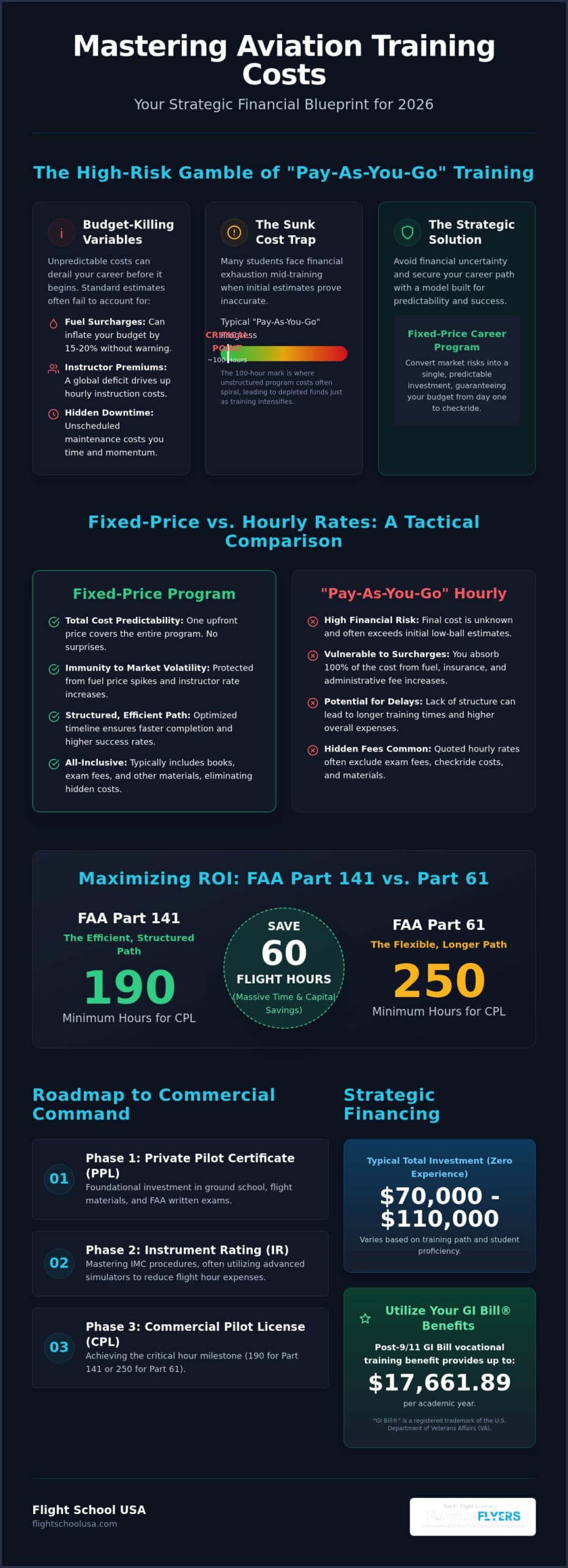
The current aviation market is defined by aggressive fuel surcharges and a global instructor deficit. These aren’t minor inconveniences; they’re budget-killers. Fuel surcharges alone can inflate a training budget by 15-20% without warning. If you’re utilizing a pay-as-you-go model, you’re vulnerable to these spikes and the hidden costs of aircraft downtime. Every hour an aircraft is grounded for unscheduled maintenance is an hour of lost momentum that isn’t reflected in a basic hourly quote. 2026 regulatory standards demand a more rigorous approach to budgeting than previous years, as the cost of non-compliance and retraining has reached an all-time high.
Choosing between training pathways is a critical financial decision that dictates your total commercial pilot training costs. While Part 61 offers flexibility, it often masks administrative fees, insurance premiums, and landing fees that aren’t disclosed in baseline quotes. In contrast, a structured part 141 flight school is designed for maximum ROI. According to FAA pilot certification standards, Part 141 programs allow students to qualify for a Commercial Pilot License in as few as 190 hours, compared to the 250 hours required under Part 61. This 60-hour reduction represents a massive saving in both time and capital, provided the program is managed with professional oversight.
The industry’s “Sunk Cost Trap” typically occurs at the 100-hour mark. This is the point where students in unstructured programs realize their initial estimates failed to account for the actual rigors of the syllabus. They run out of capital just as the training becomes most demanding. Avoiding this trap requires a move toward a Fixed-Price Career Program. This model converts variable market risks into a single, predictable investment, ensuring that your path to the cockpit isn’t derailed by fluctuating market drivers or unforeseen administrative expenses.
The progression from student pilot to commercial commander is a multi-stage financial operation. Each phase demands specific capital allocation and rigorous adherence to training milestones. Industry data for 2026 indicates that total commercial pilot training costs for zero-experience candidates typically range between $70,000 and $110,000, depending on the training path and student proficiency. Understanding this breakdown is critical for maintaining financial liquidity throughout the program. Precision is non-negotiable when it’s your career on the line.
Phase 1 begins with the Private Pilot Certificate (PPL). This requires a foundational investment in ground school, flight materials, and FAA written exams. While many schools provide baseline quotes, they don’t always include the financial impact of checkride anxiety. Re-testing fees and additional remedial flight hours can quickly derail a fragile budget. Following the PPL, Phase 2 focuses on the Instrument Rating (IR). Strategic candidates utilize advanced simulators to reduce total flight hour expenses while mastering IMC procedures. Adopting a zero to hero flight school model is the most efficient method for consolidating these phases into a single, streamlined timeline. Veterans should also verify their eligibility for GI Bill flight training benefits, which provide up to $17,661.89 per academic year for vocational training.
Phase 3 centers on the Commercial Pilot License (CPL) and the critical 250-hour milestone required under Part 61, or the reduced 190-hour requirement for Part 141 students. This stage involves complex aircraft endorsements and high-performance maneuvers. Phase 4, the Multi-Engine Rating, is where costs escalate. This is due to the higher hourly rates of twin-engine aircraft and specialized avionics like glass cockpits and EFIS. These advanced systems are mandatory for those seeking Airline Ready status. Instructor rates for these complex aircraft are significantly higher, reflecting the expertise required for multi-engine operations. Securing a seat in a Fixed-Price Career Program ensures these advanced costs are managed within a predictable framework, maximizing your professional ROI.
Selecting a payment structure isn’t a matter of convenience; it’s a decision that dictates your total commercial pilot training costs. The industry offers two primary paths: the Fixed-Price Career Program and the traditional Pay-As-You-Go model. While the latter is often marketed as “flexible,” this flexibility frequently translates into financial exposure. A Fixed-Price Career Program functions as a comprehensive financial contract, transferring the risk of market volatility from the student to the institution. It’s a strategic shield for your capital.
In the 2026 economic environment, fixed rates serve as a critical hedge against inflation and sudden fuel price hikes. When you lock in a price, you’re insulated from the surcharges that plague hourly students. Beyond the financial security, there’s a profound psychological benefit. You focus on mastery and regulatory compliance rather than watching the Hobbs meter. This eliminates the temptation to rush through complex maneuvers to save money, a practice that usually results in checkride failure and increased remedial costs. For a deeper breakdown of these models, consult our Pay-As-You-Go vs. Fixed-Price Flight School analysis.
Hourly training is a variable expense that rarely stays within the lines of an initial quote. Most students in these programs exceed “minimum hour” estimates by at least 25% due to weather delays, maintenance issues, and the natural learning curve. These delays aren’t just frustrating; they’re expensive. Every cancelled flight requires a “warm-up” hour to regain proficiency, effectively doubling the cost of that lesson. Additionally, hourly quotes often omit “Hidden Add-ons” like instructor briefing fees, fuel surcharges, and local taxes that quietly erode your training fund.
The “Proficiency vs. Hours” debate is where many candidates lose their footing. While some believe they’ll be the exception who finishes at the FAA minimum, the reality is that the 2026 certification standards are more demanding than ever. Stretching training due to cash flow issues leads to skill degradation, forcing you to pay for the same lesson twice. While some pursue Federal Student Aid for aviation programs at degree-granting institutions, vocational students must rely on precise budgeting. A fixed-price model ensures that commercial pilot training costs remain static, regardless of how many hours it takes you to reach professional-grade proficiency. It’s the only way to guarantee you don’t run out of capital before reaching the finish line.
Securing the necessary capital for professional aviation requires a sophisticated understanding of available financial instruments. In 2026, relying solely on personal savings is often an inefficient use of resources. Aspiring aviators must leverage veteran benefits, specialized lending, and industry-backed reimbursement programs to manage commercial pilot training costs without compromising their speed to market. Precision in financing is just as critical as precision in the cockpit.
Veteran candidates possess a significant tactical advantage through the Post-9/11 GI Bill. For the 2026-2027 academic year, the U.S. Department of Veterans Affairs has capped vocational flight training benefits at $17,661.89 per year. This asset is most effectively deployed within CFI Fast Track programs. These programs provide the structured environment necessary to reach the 1,500-hour airline hiring threshold while the government offsets the majority of certification expenses. Utilizing the GI Bill for CFI training allows for a seamless transition from military service to a high-earning commercial career. Unlike degree-granting programs that may take years, vocational tracks focus strictly on regulatory compliance and rapid hour accumulation.
International students must navigate a different set of financial rigors. To secure an M1 Visa, candidates must demonstrate “sufficient funds” to cover both their training and living expenses for the duration of their stay. Reducing total living expenses is often achieved by utilizing dedicated student housing, which provides a predictable cost structure for full-time cadets. For those utilizing private capital, aviation-specific loans currently offer fixed rates between 2.39% and 17.49% APR as of July 2026. While interest is a factor, the ROI is undeniable. The median annual salary for airline pilots reached $232,140 in 2025, while commercial pilots averaged $123,220. This earning potential allows for aggressive loan repayment. Additionally, many airlines now offer tuition reimbursement as a recruitment incentive, effectively subsidizing your commercial pilot training costs once you join their ranks.
Mastering these financial systems is the final step before takeoff. If you’re ready to deploy your veteran benefits effectively, explore our CFI Fast Track Program to accelerate your professional timeline.
The Fixed-Price Career Program represents the elite industry standard for aviators who prioritize financial predictability and professional excellence. While competitors offer “estimates” that fluctuate with market volatility, this program functions as a rigorous financial contract. It eliminates the risk of hidden fees and administrative surcharges that often cause commercial pilot training costs to balloon unexpectedly. You must recognize that the lowest initial quote is rarely the lowest actual cost. Choosing a bargain-tier school often leads to aircraft maintenance delays and instructor turnover, both of which drain your capital while providing zero progress toward your ratings.
Accelerated training tracks do more than just save time; they maximize your lifetime earnings potential. By compressing the timeline to reach regional airlines, you start your seniority clock significantly earlier than those in traditional programs. In the high-stakes world of aviation, seniority dictates everything from your aircraft type to your monthly schedule. The ROI of this investment is clear when viewed against 2025 compensation benchmarks. With median airline pilot salaries reaching $232,140, every month you spend in an inefficient training program represents a massive opportunity cost in lost wages. Our Airline Ready track is engineered to move you from the classroom to the cockpit with maximum velocity.
Our FAA Part 141 flight school environment is a powerhouse of industry knowledge designed to produce superior professional outcomes. We treat every administrative task and flight hour as a critical component of your legal standing. To support our full-time cadets, we integrate dedicated student housing and international M1 Visa services into our ecosystem. This all-inclusive approach removes the logistical barriers that often derail international and domestic students alike. You’re entering a high-performance academy that demands excellence and rewards it with a direct path to the airlines. We don’t just train pilots; we develop the next generation of airline commanders through a disciplined, results-oriented framework.
Don’t leave your career to chance or variable market rates. Secure your professional future and lock in your investment with our Fixed-Price Career Program. Precision in the cockpit begins with precision in your financial strategy. Join an elite cadre of professionals who understand that quality training is the most valuable asset on your balance sheet.
Mastering commercial pilot training costs is the first checkride of your professional career. You’ve seen how market volatility and hidden fees can derail a candidate’s progress, making the transition to a fixed-price model a strategic necessity rather than a luxury. By leveraging a structured FAA Part 141 environment and utilizing every available financing asset, you ensure that your capital is deployed with the same precision you’ll soon apply to high-performance maneuvers. The path to the cockpit is a high-stakes investment; those who prioritize financial predictability are the ones who reach the airline seniority list in record time.
Flight School USA stands as a prestigious gatekeeper of industry standards, offering 15+ years of elite training excellence and comprehensive support for both domestic and international cadets. With our FAA Part 141 certification and dedicated M1 Visa and housing support, we eliminate the logistical friction that slows your progression. It’s time to secure your professional ROI and join an elite cadre of aviators who demand nothing less than excellence.
Apply for our Fixed-Price Career Program and secure your 2026 training slot. Your future on the flight deck starts with a disciplined financial strategy. We look forward to seeing you at altitude.
The total investment for zero-experience candidates typically ranges from $70,000 to $110,000 as of 2026. This variable figure depends on the training pathway, student proficiency, and regional market drivers. Candidates must account for the full spectrum of ratings, including Private, Instrument, and Commercial certification. Choosing a structured program is essential for maintaining this budget and avoiding the financial depletion common in unmonitored training environments.
No, the Post-9/11 GI Bill does not typically cover the entire cost of professional pilot training. For the 2026-2027 academic year, the benefit is capped at $17,661.89 for vocational flight schools. Veterans must strategically apply these funds to advanced ratings like the CFI Fast Track Program rather than the initial Private Pilot Certificate, which is often not covered unless part of a degree-granting program.
In traditional hourly models, checkride fees and FAA written exam costs are rarely included in the initial tuition quote. These are third-party expenses paid directly to Designated Pilot Examiners and testing centers. However, elite career tracks like the Fixed-Price Career Program are designed to provide a more comprehensive financial structure. You must review your contract to ensure these administrative and regulatory fees are accounted for to prevent budget shortfalls.
A fixed-price program is often more cost-effective because it transfers the risk of training overruns and market volatility to the school. While hourly rates may appear lower on paper, most students exceed minimum hour requirements by at least 25% due to weather delays or skill plateaus. Fixed-price models insulate your commercial pilot training costs from these variables, providing a guaranteed path to certification without the threat of sudden fuel surcharges.
You must scrutinize contracts for hidden add-ons such as instructor briefing fees, fuel surcharges, landing fees, and insurance premiums. Many schools omit these from their marketing materials to present a lower baseline price. In 2026, fuel volatility is a primary driver of budget inflation. A professional-grade contract should explicitly state whether these variables are included or if they will be billed as additional expenses throughout your training.
International students generally cannot access U.S. federal student aid but may qualify for private aviation loans if they have a creditworthy U.S. citizen co-signer. To obtain an M1 Visa, you must demonstrate the financial capacity to cover both commercial pilot training costs and living expenses. Utilizing specialized M1 Visa admission services and on-site student housing can help streamline this process and provide the financial documentation required by U.S. immigration authorities.
Budgeting for housing depends on the duration of your full-time career track, but utilizing school-provided accommodation is the most efficient method for controlling living expenses. Dedicated student housing eliminates the need for long-term leases or utility deposits, which are often difficult for temporary residents or international cadets to secure. This immersive environment also fosters professional networking with fellow elite candidates, which is a critical component of career development in high-performance academies.
FAA Part 141 training saves money by significantly reducing the total flight hour requirements for certification. Under a Part 141 syllabus, a Commercial Pilot License can be achieved in as few as 190 hours, whereas Part 61 requires a minimum of 250 hours. This 60-hour reduction represents a massive saving in aircraft rental and instructor fees. The structured nature of Part 141 also ensures higher training efficiency and strict adherence to professional regulatory standards.


