
The path to a commercial cockpit isn’t measured by how many hours you spend in the air, but by the rigor of the oversight governing every minute of that flight time. While many aspiring pilots believe more hours equate to better skills, the industry’s elite recognize that a part 141 flight school provides a structured, FAA-audited curriculum that produces superior results in less time. You’ve likely felt the frustration of deciphering dense FAA regulations or feared that a non-standardized training schedule will drain your budget without securing a job. It’s a valid concern. Inefficiency is the greatest threat to a professional aviation career.
Choosing a high-performance academy ensures you aren’t just flying; you’re following a proven blueprint for airline placement. This guide details how Part 141 certification allows you to secure a commercial certificate in as few as 190 hours, compared to the 250 hours required under less regulated paths. We’ll explore the strategic advantages of the Fixed-Price Career Program, the specific $17,661.89 GI Bill cap for vocational training in 2026, and how international students leverage M1 Visa services to reach the flight deck faster. You’ll gain the clarity needed to stop guessing and start training with the precision that the industry demands.
FAA Part 141 certification represents a rigorous regulatory commitment. Unlike the flexible, decentralized nature of Part 61, a part 141 flight school operates as a high-performance academy under the direct scrutiny of the Federal Aviation Administration. This isn’t merely about learning to fly; it’s about adhering to a strictly governed institutional framework designed to produce professional aviators with surgical precision. For candidates pursuing airline pilot career training, the 141 standard is the non-negotiable benchmark for excellence. It transforms flight training from a casual pursuit into a disciplined professional endeavor where every minute is accounted for and every objective is verified.
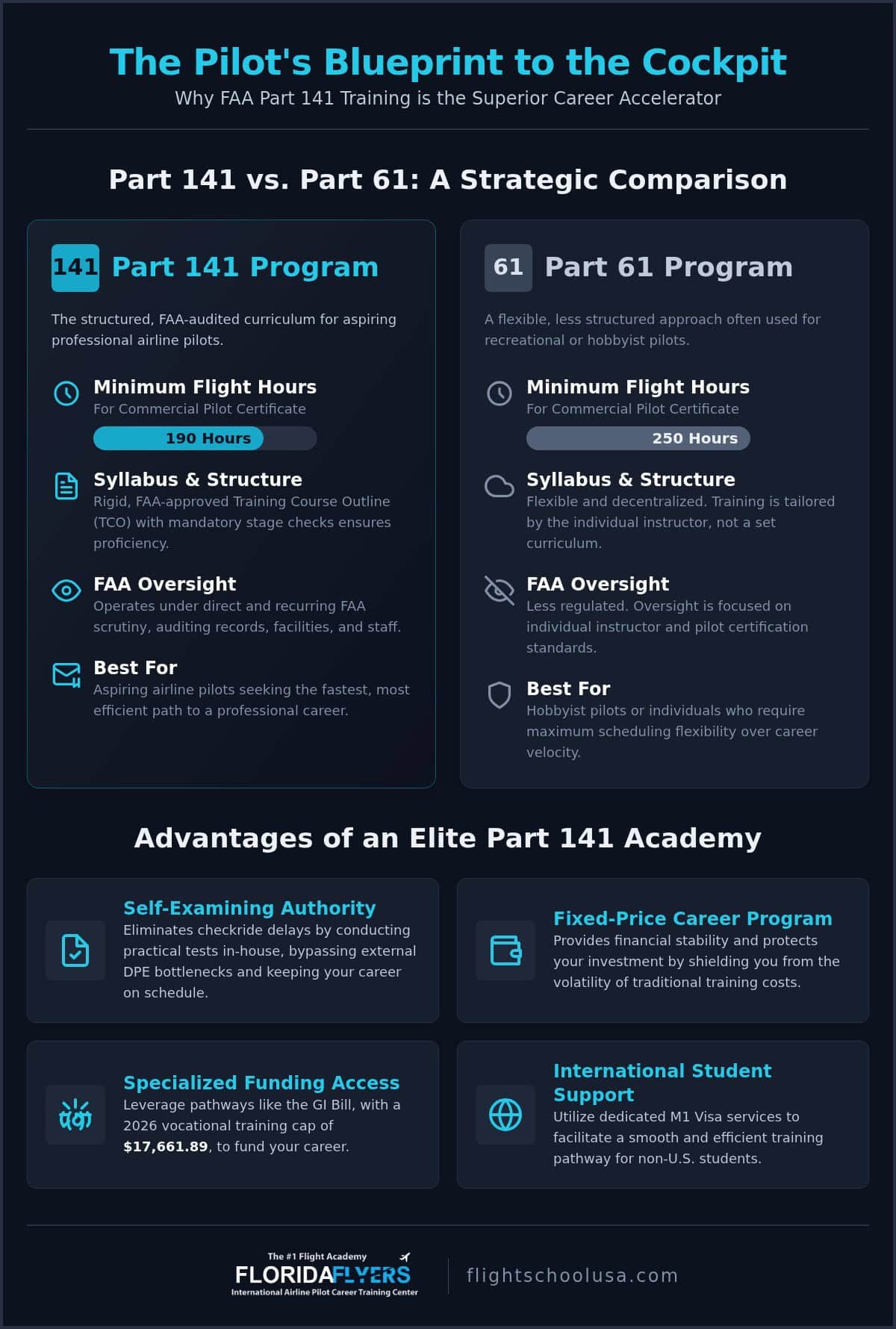
The foundation of every elite training program is the FAA-approved Training Course Outline (TCO). This document serves as a legal blueprint, detailing every lesson, objective, and completion standard. By mandating a sequential progression, the Part 141 structure effectively eliminates the “training plateau” where students often stagnate in less organized environments. Skill decay is mitigated through high-frequency, high-accountability sessions. Stage checks, conducted by senior instructors at critical milestones, act as internal quality gates. These checks ensure that no student advances without demonstrating total proficiency, which drastically reduces the risk of failure during a final checkride. A detailed Part 141 and Part 61 comparison reveals that while Part 61 offers flexibility for hobbyists, the 141 syllabus provides the tactical structure required for professional progression. At the helm, the Chief Flight Instructor acts as the ultimate gatekeeper, ensuring every instructor and student maintains the academy’s uncompromising standards.
Maintaining 141 status requires a school to pass recurring, exhaustive FAA inspections. These audits aren’t superficial; they scrutinize training records, aircraft maintenance logs, and personnel qualifications. This level of oversight protects the student’s financial and temporal investment by ensuring the school never deviates from federal safety and instructional codes. These audits verify that the institution possesses the requisite facilities, equipment, and administrative staff to support a high-volume professional track. Graduates from such institutions carry a level of prestige that is recognized by major carriers. They aren’t just pilots; they are products of a system that prioritizes compliance and procedural discipline. This rigorous quality control ensures that every hour logged contributes directly toward a career-ready profile, shielding students from the risks of substandard instruction or administrative neglect.
Efficiency in aviation is born from strict adherence to a superior system. A part 141 flight school doesn’t just offer training; it provides a high-velocity pathway that is legally recognized by the FAA as more effective than decentralized alternatives. This recognition translates into tangible advantages for the professional student, specifically regarding total flight hour requirements and the speed of certification. For those committed to a zero to hero flight school track, these structural benefits are the difference between entering the workforce in months versus years. The audited nature of this curriculum allows for the Fixed-Price Career Program to remain a stable financial reality, shielding students from the volatility of traditional training costs. Every hour counts.
Self-examining authority is a privilege reserved for elite institutions that demonstrate unwavering compliance and exceptional pass rates. It allows internal examiners to conduct practical tests and issue pilot certificates without the intervention of an external Designated Pilot Examiner (DPE). In 2026, DPE availability is a critical bottleneck that can delay a pilot’s career by several months. By removing this dependency, a Part 141 academy maintains total control over its training timeline. This level of institutional trust is mirrored in prestigious academic settings, such as a university Part 141 program, where the integration of testing and instruction ensures that certification happens the moment proficiency is met.
The FAA grants Part 141 schools the authority to certify pilots with fewer total flight hours because the training is more concentrated. Under these regulations, a student can earn a private pilot certificate in as few as 35 hours and a commercial pilot certificate in just 190 hours. This is a sharp reduction from the 250 hours required under Part 61. The FAA trusts this compressed timeline because every hour is part of an audited, high-stakes syllabus. This 60-hour reduction for commercial ratings represents a massive reduction in operational costs. It allows students to transition into revenue-generating roles significantly earlier. If you’re focused on maximum efficiency, exploring our professional training options is the next logical step in your development.
Aspiring aviators often mistake flexibility for an advantage. In reality, the lack of structure inherent in Part 61 training creates a high risk of mission creep, where inconsistent scheduling and variable instruction lead to expensive delays. A part 141 flight school eliminates this uncertainty by mandating a rigid, FAA-approved timeline. While Part 61 allows for a more casual pace, it requires 40 hours for a Private Pilot certificate and 250 hours for a Commercial Pilot certificate. Conversely, Part 141 standards permit certification at 35 and 190 hours, respectively. This 60-hour reduction in the commercial track is a massive tactical advantage for those utilizing a fixed price flight training program to lock in their career investment early.
Calculating the true return on investment requires looking beyond simple hourly rates. Part 61 students often face hidden delays such as instructor turnover and aircraft unavailability, which can extend training by months. In a Part 141 environment, institutional oversight ensures resources are prioritized for career-track students. Airlines show a documented preference for 141 graduates because their standardized background mirrors the training environment of a major carrier. To understand the full fiscal landscape, consult our strategic guide to pilot costs. Investing in a part 141 flight school isn’t just about the training fee; it’s about minimizing the time you spend as a student and maximizing your time as a high-earning professional.
Velocity is the primary metric of success for elite students. A full-time Part 141 student can realistically achieve Commercial Pilot status significantly faster than their Part 61 counterparts. Our Airline Ready Program is designed to integrate seamlessly with these 141 standards, ensuring that every flight hour serves a specific career objective. For those seeking the most direct route to employment, the cfi fast track program provides the final acceleration needed to start building professional time. By choosing the structured path, you aren’t just learning to fly; you’re executing a high-stakes career strategy that prioritizes results over the myth of flexibility.
Enrollment in a part 141 flight school is the first true test of a pilot’s professional discipline. It’s a formal vetting process that requires navigating a complex intersection of federal regulations, medical standards, and security protocols. This rigorous entry sequence ensures that only the most qualified candidates enter the high-stakes environment of an FAA-certified academy. Before you ever touch the controls of an aircraft, you must clear specific legal and physical hurdles that serve as the baseline for your entire career. Failing to document these correctly can result in immediate grounding or the forfeiture of training hours. Precision starts on the ground.
Securing an FAA First-Class Medical Certificate is the most critical initial step for any serious student. While the FAA permits lower-tier certificates for initial training, the elite choice for career-bound aviators is the First-Class designation. This proactive measure ensures you meet the physical standards required for airline operations before you invest significant capital. Legal eligibility also requires proof of U.S. citizenship or completion of the TSA Flight Training Security Program (FTSP). For non-U.S. citizens, the FTSP involves a $140 application fee and a comprehensive background check. Once approved, this Determination of Eligibility remains valid for five years, covering your entire progression through multiple ratings. You must be at least 17 years old to obtain a Private Pilot certificate and 18 for a Commercial certificate in 2026.
The administrative rigor of a 141 environment is a mandatory prerequisite for most specialized funding. For example, GI Bill flight training is almost exclusively restricted to Part 141 programs because the VA requires the audited structure and syllabus these schools provide. For the 2026-2027 academic year, the annual cap for vocational flight training stands at $17,661.89. International students face additional logistics, requiring M1 Visa admission services and verified proof of financial solvency. To support the intensive flight schedule required by these programs, choosing an academy with international student housing is essential for maintaining operational focus. If you’re ready to begin this professional transition, apply to our career-track program to verify your eligibility today.
Selecting a part 141 flight school is the most consequential tactical decision an aspiring pilot will make. At Flight School USA, we distinguish ourselves by offering a dual-certified environment that utilizes both Part 141 and Part 61 standards. This provides our students with a unique tactical advantage; you receive the rigid, audited structure of a 141 curriculum while maintaining the operational flexibility to handle specialized training needs. Every hour logged in our academy is treated with high-stakes, professional seriousness. We don’t view flight training as a hobby. We view it as the rigorous foundation of a high-performance career. Our Fixed-Price Career Program success rates are a direct result of this uncompromising oversight, ensuring that students reach their objectives without the financial volatility common in lesser institutions.
The intensity of an elite 141 syllabus requires more than just high-quality aircraft; it requires a total immersion environment. Our residential campus is designed to support this level of discipline. By providing dedicated Student Housing, we eliminate the external logistical stressors that often derail a student’s momentum. This allows you to live and train in a powerhouse of industry knowledge, surrounded by peers and mentors who demand excellence. Results matter. In 2026, the gap between a standard pilot and an elite aviator is defined by the quality of the gatekeeper who oversaw their training.
Established in 2008, Flight School USA has spent nearly two decades navigating the complex shifts of FAA regulations. We’ve evolved alongside the industry, ensuring our “Airline Ready” philosophy remains the gold standard for professional development. We don’t just train you for a license; we prepare you for the professional standards of a major carrier’s cockpit. Training in our nationally-recognized environment provides a level of prestige that serves as a powerful signal to recruiters. When you graduate from our academy, you carry the institutional credibility of a program that prioritizes procedural accuracy and regulatory compliance above all else.
Our commitment to your progression doesn’t end with a commercial certificate. We provide a seamless “Zero to Hero” pathway that incorporates our CFI Fast Track Program, allowing you to transition from student to instructor with maximum efficiency. This strategic progression is vital for building the professional flight time required for airline placement. We leverage our extensive national network to connect graduates with industry leaders, ensuring your career velocity remains high long after you leave our campus. You’ve seen the advantages of the Part 141 structure. Now, it’s time to execute. Your professional aviation career begins with a single, decisive step toward elite training. Contact our admissions team to start your enrollment and secure your position in our next 2026 cohort.
The path to the commercial cockpit demands more than ambition; it requires a tactical commitment to the most efficient training standards available. By choosing a part 141 flight school, you’ve opted for a high-velocity career track defined by FAA-audited precision and standardized excellence. The strategic advantages of reduced hour requirements and self-examining authority effectively eliminate the traditional bottlenecks that stall professional progression. This isn’t a casual journey. It’s a disciplined transition into the aviation industry’s elite ranks. Flight School USA remains the rigorous gatekeeper of these standards, providing the institutional credibility required to reach the flight deck with maximum efficiency.
Our academy stands ready with an FAA Part 141 Certified curriculum, a Fixed-Price Guarantee, and specialized M1 Visa and GI Bill approval. These resources ensure your focus remains on flight proficiency rather than administrative or financial hurdles. Now is the time to finalize your strategy and command your future. Secure Your Position in Our 2026 Fixed-Price Career Program and begin your ascent today. The industry is waiting for pilots of your caliber.
The primary difference lies in the level of FAA oversight and curriculum structure. A part 141 flight school operates under a strictly audited, FAA-approved syllabus that mandates specific lesson sequences and stage checks. Conversely, Part 61 allows for a decentralized, flexible approach that accommodates individualized schedules. While Part 61 is suitable for recreational flyers, the 141 track is the professional standard for those seeking maximum efficiency and standardized training quality.
No, not every Part 141 institution is eligible. To utilize GI Bill benefits, the academy must be specifically approved by the Department of Veterans Affairs. For the 2026-2027 academic year, the annual cap for vocational flight training is $17,661.89. It’s critical to verify that your chosen institution offers GI Bill Flight Training services to ensure your funding is applied correctly toward your professional ratings and certificates.
Yes, graduating from an elite 141 program signals to airline recruiters that you’ve been trained in a high-stakes, standardized environment. This mirrors the procedural discipline required by major carriers. Additionally, certain Part 141 programs allow for a Restricted Airline Transport Pilot (R-ATP) certificate. This credential permits you to enter the airline cockpit with fewer total flight hours than the standard 1,500-hour requirement, accelerating your career velocity significantly.
Under FAA Part 141 regulations, the minimum requirement for a Commercial Pilot License is 190 flight hours. This represents a substantial 60-hour reduction from the 250 hours mandated under Part 61. This efficiency is permitted because the FAA recognizes the intensity and rigor of the audited 141 curriculum. For career-bound students, this reduction translates into a faster transition from student status to a revenue-generating professional pilot role.
It is possible to transition from Part 61 to Part 141, but you must expect limitations on credit transfers. The FAA allows a part 141 flight school to credit only a portion of your previous Part 61 experience, typically capped at 25 percent or 50 percent depending on the specific course. This requires a thorough evaluation of your training records by the Chief Flight Instructor to ensure compliance with the academy’s approved syllabus.
Self-Examining Authority is a prestigious privilege granted by the FAA to schools with exceptional pass rates and compliance records. It allows the institution’s own examiners to issue certificates and ratings directly, bypassing the need for an external Designated Pilot Examiner (DPE). This matters because it eliminates the weeks of scheduling delays common with DPEs, ensuring your training progression remains on a fast-paced, predictable timeline that respects your professional goals.
While some programs offer part-time options, the 141 track is designed for the rigors of a full-time, intensive schedule. Success in our Fixed-Price Career Program depends on maintaining consistent momentum to prevent skill decay. Our academy provides Student Housing to support this immersive environment, allowing you to focus entirely on your professional development. This level of discipline is necessary to meet the high standards of an elite career track.
The exams are not inherently harder, as they all adhere to FAA Airman Certification Standards (ACS). However, Part 141 students face more frequent stage checks that function as high-stakes quality gates throughout the curriculum. These internal assessments are designed to ensure total proficiency at every milestone. This rigorous testing environment actually makes the final checkride more predictable, as you’ve already been vetted by senior instructors multiple times before the final evaluation.


