
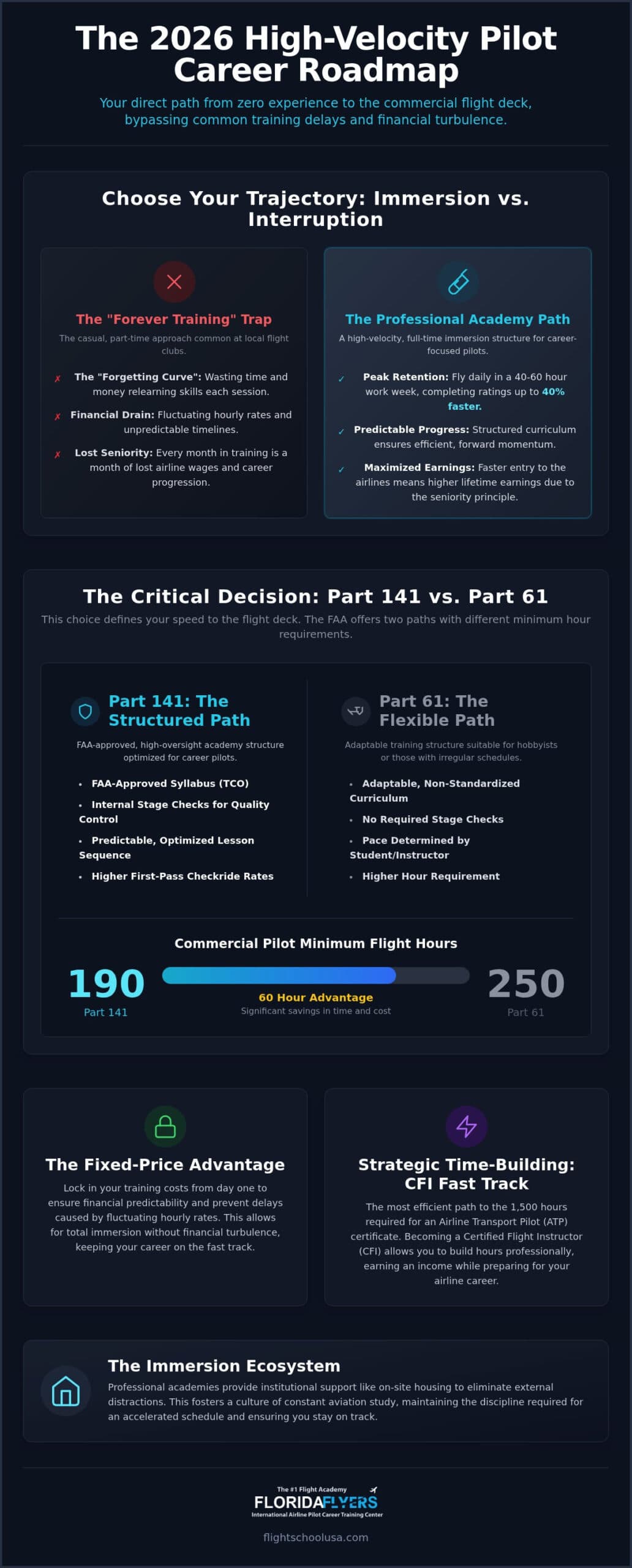
The difference between a hobbyist and a professional aviator is defined by the precision of their career trajectory. Most candidates find themselves grounded by the “forever training” trap, where aircraft shortages and fluctuating hourly rates turn a focused objective into a significant financial drain. You recognize that every month spent in training is a month of lost seniority and elite airline wages. To become a commercial pilot fast, you must abandon the casual approach of local flight clubs in favor of a high-velocity, professional academy structure.
This strategic 2026 guide reveals the elite pathways and regulatory frameworks required to transition from zero experience to a commercial flight deck with absolute efficiency. We’ll examine why the choice between Part 61 and Part 141 is the most critical decision of your career and how a Fixed-Price Career Program provides the financial predictability necessary for total immersion. You’ll gain a clear, disciplined roadmap that prioritizes airline placement over mere hour-building. This ensures your progression remains on schedule and compliant with the highest industry standards.
Accelerated flight training is a high-performance methodology designed to move candidates from zero experience to the flight deck with maximum efficiency. Unlike traditional “pay-as-you-go” models that allow for casual, intermittent progress, accelerated tracks demand total immersion. In 2026, the industry has shifted toward high-velocity academies that treat training as a 40 to 60 hour work week. This rigorous approach ensures that students maintain peak cognitive retention and procedural discipline. While the pace is intense, the FAA maintains strict regulatory guardrails to ensure that safety remains the primary objective during the acquisition of pilot licensing and certification.
The most significant obstacle to professional progress is the “forgetting curve.” Weekend flyers often spend the first half of every lesson relearning skills from the previous week, leading to instructional dragging and wasted resources. By flying daily, full-time students eliminate this knowledge decay. Data from professional academies indicates that immersive students often complete their ratings in 40% less time than their part-time counterparts. Professional environments are further bolstered by dedicated Student Housing, which removes external distractions and fosters a culture of constant aviation study. This immersion is the only reliable way to become a commercial pilot fast while meeting the high standards of modern carriers.
Airline hiring trends in 2026 continue to favor graduates who demonstrate the discipline required by accelerated programs. Carriers are prioritizing “Airline Ready” candidates who can transition seamlessly into complex turbine operations. This urgency is driven by a persistent shortage that places a premium on early entry into the workforce. The Seniority Principle dictates that a pilot’s career progression, scheduling, and compensation are determined by their date of hire, meaning earlier entry into the cockpit directly correlates to higher lifetime earnings. Utilizing a Fixed-Price Career Program allows students to secure this seniority without the risk of financial turbulence or training delays. In this competitive market, speed is not just a preference; it’s a financial imperative. Every month spent in training is a month of lost seniority at the major airlines.
Selecting the correct regulatory framework is the first strategic imperative for those who intend to become a commercial pilot fast. The Federal Aviation Administration (FAA) provides two distinct pathways for pilot certification: Part 61 and Part 141. While both lead to the same legal credentials, their internal structures and required flight hours differ significantly. For a career-oriented candidate, the choice is usually a matter of institutional discipline versus individual flexibility. In the high-stakes environment of 2026, the structured path is almost always the most efficient route to the airlines.
Under Part 141, the curriculum is standardized through a Training Course Outline (TCO). This FAA-approved syllabus allows schools to graduate commercial pilots with a minimum of 190 flight hours. In contrast, Part 61 training is more adaptable but requires a minimum of 250 total flight hours. This 60-hour discrepancy is the most immediate factor in your speed to market. When you examine the FAA commercial pilot requirements, the reduced hour minimums for Part 141 reflect the higher level of oversight and equipment standards provided by these elite academies. This structure doesn’t just save time; it saves the substantial costs associated with those additional 60 hours of flight time.
The advantage of a Part 141 academy lies in its predictability. Every lesson is part of a larger, optimized sequence that prevents instructional dragging. Stage checks act as internal quality control, ensuring that a student is proficient before moving to the next phase of training. This proactive approach identifies deficiencies early, preventing the costly delays that often plague less structured environments. Elite institutions leverage these stage checks to maintain a high-velocity training rhythm, which often results in higher first-pass rates during final checkrides. This institutional alignment ensures you remain “Checkride Ready” throughout the entire program. Before committing to any academy, applying a rigorous pilot training program checklist to evaluate elite flight academies will help you confirm that the institution meets these strict Part 141 benchmarks.
Part 61 remains a viable option for specific milestones or for professionals transitioning with existing experience. It allows for a tailored approach where a student can prioritize specific add-on ratings without following a rigid timeline. However, the speed of Part 61 is entirely dependent on instructor and aircraft availability. Without the institutional backing of a full-scale academy, Part 61 students often face scheduling bottlenecks that negate any perceived flexibility. For those committed to an accelerated airline career, the structured Fixed-Price Career Program under Part 141 remains the superior strategic choice for professional development.
Traditional flight training models often contain a structural flaw known as the “Speed Tax.” In an hourly billing environment, the financial incentive for a flight school is to prolong training, as every additional hour of instruction generates more revenue. This creates a fundamental conflict of interest between the student’s need to become a commercial pilot fast and the school’s profit model. When a school operates on hourly rates, instructional dragging becomes a common, yet often invisible, barrier to professional progress. To reach the airlines efficiently, you must choose a model that rewards speed rather than delay.
A Fixed-Price Career Program fundamentally realigns these objectives. By establishing a single, transparent cost for the entire certification track, the institution’s profitability becomes tied to your efficiency. This structure forces the academy to optimize every aspect of the training syllabus, ensuring that you move through milestones without administrative friction. It also eliminates the “checkbook stall,” a frequent occurrence where students must pause training to wait for billing cycles or additional funds. Continuous training is vital for maintaining the high-level discipline required to capitalize on the positive pilot career outlook projected for the next decade.
When the price of training is fixed, the burden of operational efficiency shifts from the student to the school. This model encourages the academy to provide its most experienced instructors and best-maintained aircraft to ensure students pass their checkrides on the first attempt. There are no hidden fees for ground briefings, fuel surcharges, or administrative overhead that typically inflate hourly programs. For career-track students, the return on investment is clear: you pay for the outcome of being a professional pilot, not for the time spent sitting on a taxiway. This institutional alignment is the only way to ensure your training remains high-velocity and focused strictly on certification standards.
A professional pilot career requires significant upfront financial transparency. Fixed pricing protects your investment against market fluctuations in fuel costs and maintenance inflation, which can otherwise cause mid-program price hikes. Beyond financial security, there is a profound psychological benefit to “pre-paid” immersion. When you don’t have to worry about the cost of every minute the engine is running, your focus remains entirely on cockpit performance and procedural mastery. Fixed pricing acts as a performance guarantee that compels the school to deliver results within your designated timeline.
Achieving a Commercial Pilot License (CPL) is a definitive milestone, yet it serves only as the first checkpoint in a professional career. To transition into the cockpit of a major carrier, you must clear the 1,500-hour requirement for the Airline Transport Pilot (ATP) certificate. This gap between 250 hours and 1,500 hours is where many aspiring aviators lose momentum. To become a commercial pilot fast, you must utilize a strategic time-building engine that replaces tuition costs with professional compensation. The most effective mechanism for this is the CFI Fast Track Program, which converts your technical knowledge into an instructional credential with high-velocity precision.
The Certified Flight Instructor (CFI) rating is the most critical tool in your professional arsenal. It allows you to build flight hours rapidly while earning a salary, effectively turning the time-building phase into a profitable career stage. Our accelerated CFI tracks are designed to move you from student to professional in a matter of weeks. This phase is built on the “Learn by Teaching” philosophy. By instructing others, you master the nuances of flight theory and emergency procedures to a degree that is impossible through solo flight alone. This depth of knowledge is exactly what airline recruiters look for during technical interviews, as it demonstrates a level of mastery beyond basic certification requirements.
Bridging the gap between a light piston aircraft and a commercial jet requires more than just hours; it requires a shift in operational mindset. The Airline Ready Program is the final stage of professional polish. This curriculum focuses on advanced systems training, multi-engine mastery, and the complexities of high-altitude operations. You’ll develop proficiency in Crew Resource Management (CRM), learning to operate within the standardized environments found at major airlines. This training ensures that when you reach the 1,500-hour mark, you aren’t just eligible for hire; you’re fully prepared for the rigors of turbine transition training.
The path to the flight deck demands institutional support and a clear progression plan. Secure your place in our elite Airline Ready Program to ensure your transition to the airlines is seamless and professional.
Flight School USA doesn’t just offer lessons; it executes a career mission. Our “Mission First” approach is designed to prioritize your professional timeline above all else, ensuring that every hour spent on the ramp or in the cockpit moves you closer to an airline flight deck. The 2026 hiring cycle rewards those who move with urgency and precision. There has never been a more tactical time to begin your airline pilot career training. To become a commercial pilot fast, you need more than just an instructor; you need an institution that functions as a rigorous gatekeeper of industry standards.
We provide logistical dominance for candidates who demand an elite training environment. For global high-achievers, our M1 Visa Admission Services streamline the complex regulatory path to U.S. flight training, removing administrative bottlenecks that often delay international careers. Transitioning military personnel can leverage a professional roadmap through our GI Bill Flight Training programs. These pathways aren’t merely administrative options; they’re strategic entry points into a high-stakes industry. Furthermore, our dedicated Student Housing supports this full-time immersion. By living on-site, you eliminate daily commutes and embed yourself in a professional aviation culture. This residential model significantly increases completion speed and facilitates high-level networking with peers who share your professional intensity.
The transition from a candidate to a professional pilot begins with a high-velocity assessment. We require all prospective students to schedule a discovery interview to evaluate their aptitude for our accelerated curriculum. This isn’t a casual consultation; it’s a professional screening to ensure you can handle the rigors of a 60 hour work week. To maximize your efficiency, we recommend preparing your FAA medical and student pilot certificates before your first day of training. Securing these administrative requirements early prevents grounded time and ensures you’re ready for flight operations immediately upon arrival. Your commitment to excellence starts with selecting an academy that demands as much from you as the airlines will. Success in this industry is reserved for those who treat their training with the gravity of a professional career. Contact our admissions team today to begin your command of the skies.
The transition from an aspiring aviator to a professional first officer requires more than just flight hours; it demands a strategic alignment with institutional excellence. By selecting a Part 141 program, you leverage a structured syllabus that reduces certification minimums and eliminates the instructional dragging found in casual flight schools. Financial predictability through a Fixed-Price Career Program ensures your momentum is never stalled by administrative billing delays or market fluctuations. To become a commercial pilot fast, you must align your ambitions with an academy that mirrors the operational tempo of the global airlines.
Flight School USA provides the logistical dominance necessary for total immersion. Our FAA Part 141 certified excellence is bolstered by dedicated student housing and a proven CFI Fast Track designed for rapid time building. This comprehensive infrastructure ensures that your focus remains entirely on cockpit performance and procedural mastery. The 1,500-hour hurdle is not an obstacle when you have a high-velocity roadmap and the support of a powerhouse institution. Take the definitive step toward your command of the skies today. Secure Your Position in Our Next Fixed-Price Career Track and begin your journey toward an elite aviation career.
To become a commercial pilot fast, initial ratings from your private pilot license through the commercial certificate can be completed in 7 to 9 months in a full-time, Part 141 environment. This contrasts with the 2 to 3 years often required for part-time students. Achieving the 1,500-hour airline transport pilot minimum typically requires an additional 12 to 18 months of professional time-building, making the total progression approximately 2 years.
Accelerated training is significantly more rigorous because it demands a 40 to 60 hour weekly commitment to master complex systems. It’s designed for career-minded individuals who treat aviation as a profession rather than a hobby. The high-velocity pace requires disciplined study and physical stamina to maintain proficiency. While the workload is intense, the total immersion ensures higher retention rates and a faster transition to professional standards compared to casual instruction.
Veterans can utilize GI Bill benefits for specific certifications at FAA-approved institutions like Flight School USA. Our GI Bill Flight Training pathways are structured to help military personnel transition into civilian aviation with maximum efficiency. These benefits typically apply to advanced ratings, such as Instrument and Commercial certifications, after a private pilot license is obtained. This tactical use of veteran benefits ensures a professional career path without unnecessary financial strain or administrative delay.
The most efficient method to clear the 1,500-hour hurdle is working as a Certified Flight Instructor (CFI). Our CFI Fast Track Program allows you to build these hours while earning a professional salary. Instructors typically log 60 to 100 hours per month, making it the most reliable engine for reaching airline minimums. This path also allows you to master the “learn by teaching” philosophy required to succeed during elite airline interviews.
A college degree is not a legal requirement to obtain FAA commercial pilot certification or to work for regional airlines. Most major carriers have also removed or relaxed degree requirements in response to the persistent pilot shortage. Focusing on high-velocity flight training allows you to enter the workforce years earlier than those pursuing four-year degrees. This early entry maximizes your lifetime earnings by securing seniority at a younger age in a competitive market.
Hourly training models often lead to “instructional dragging,” where students pay for every minute of delay or inefficiency. A Fixed-Price Career Program eliminates this risk by establishing a set cost for the entire certification track. This model aligns the school’s goals with yours, as the academy is incentivized to graduate you on schedule. It provides financial predictability and ensures your training remains focused on rapid, professional progression toward the flight deck.
International candidates can enroll in U.S. accelerated programs by utilizing M1 Visa Admission Services. These specialized services streamline the background checks and administrative requirements mandated by the Department of Homeland Security. Flight School USA provides the necessary institutional support, including I-20 documentation, to facilitate a global career transition. Our residential training environment is specifically designed to support international high-achievers during their full-time immersion in American aviation standards and safety protocols.
Employment is generally discouraged during an accelerated pilot program due to the intense 40 to 60 hour weekly training schedule. The cognitive load required to master advanced maneuvers and regulatory compliance demands total focus. Attempting to balance outside work often leads to fatigue and training delays, which ultimately increases the total cost of certification. Professional candidates shouldn’t treat flight school as a secondary interest; it’s a full-time occupation that ensures maximum retention. For those still in the early research phase, our comprehensive how to become a pilot 2026 flight training guide provides the foundational roadmap needed before committing to an accelerated program.


