
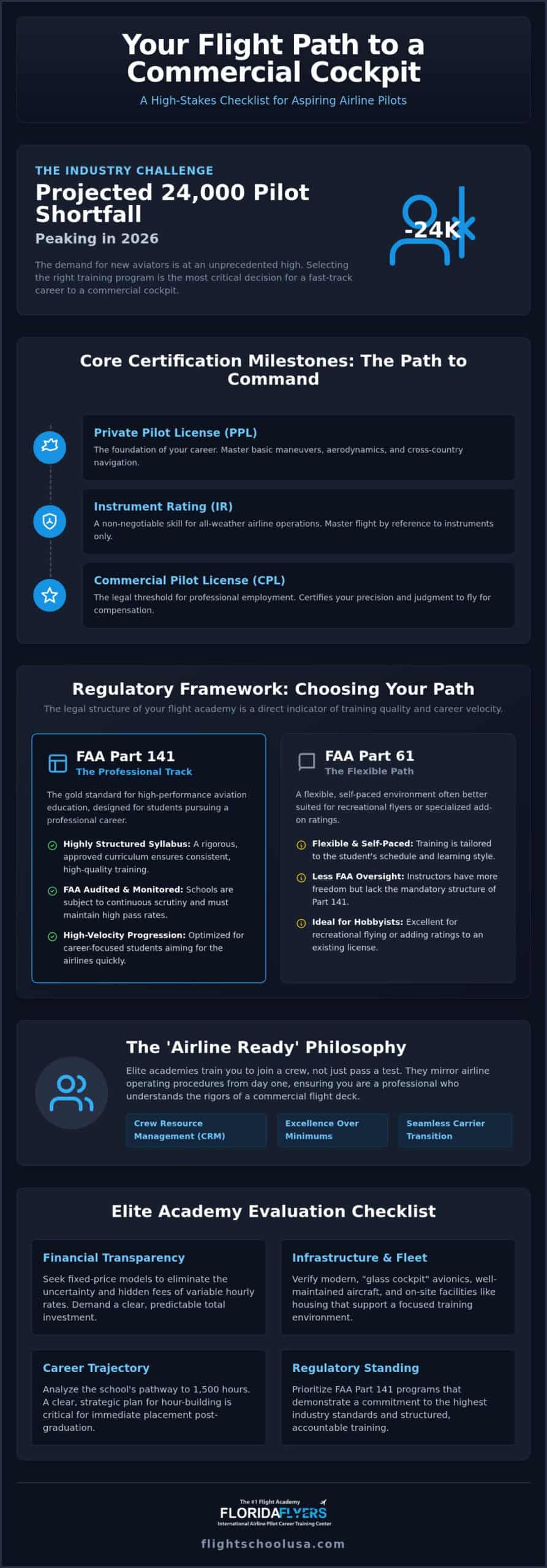
The aviation industry is currently navigating its most significant labor crisis in decades, with a projected shortfall of 24,000 pilots hitting its peak in 2026. You recognize that while the demand for new aviators is unprecedented, the barrier to entry remains a rigorous test of discipline and financial strategy. The fear of being grounded by hidden fees or trapped in a low-performance training environment is a valid concern for any serious candidate. Selecting the right pilot training program is the most critical executive decision you’ll make for your career; it’s the difference between a stalled trajectory and a fast track to a commercial cockpit.
This article provides an authoritative, high-stakes checklist designed to help you evaluate elite flight academies against the strictest industry benchmarks. We’ll demystify the complexities of FAA Part 141 modernization and the 1,500-hour rule, ensuring you have total regulatory clarity before you commit. You’ll gain a roadmap for identifying financial transparency and high-performance training standards, allowing you to secure “Airline Ready” status with precision. From analyzing career speed to predicting total investment, this guide serves as your professional gatekeeper to a successful life in the sky.
Professional aviation is not a hobby. It’s a high-stakes career that demands a rigorous, structured environment. If you treat your education as a series of casual “flying lessons,” you risk your return on investment and your professional safety. A professional pilot training program is a strictly sequenced progression of certifications designed to transform a novice into a commercial asset. Elite programs don’t just teach you how to handle an aircraft; they prioritize regulatory compliance and high-velocity progression to move you into the cockpit of a major carrier.
The distinction between recreational instruction and career-track training is the primary driver of long-term ROI. Amateur environments often lack the discipline required to meet airline standards, which often leads to training delays and increased costs. A professional academy acts as a gatekeeper of industry standards, ensuring that every hour in the logbook contributes to your standing as a commercial aviator. Elite programs prioritize regulatory compliance and high-velocity progression over convenience.
The path to the flight deck is governed by strict FAA Pilot Certification Standards. You must evaluate whether a school treats these milestones as checkboxes or as professional benchmarks. The sequence must be logical and focused on building a professional resume.
Elite academies don’t train you to pass a test; they train you to join a crew. A high-performance pilot training program mirrors airline operating procedures from day one. This includes a heavy emphasis on Crew Resource Management (CRM). CRM is the effective use of all available resources, including equipment and people, to ensure flight safety. If a school only targets “minimum standards,” they’re failing you. You should seek an Airline Ready Program that demands excellence. This approach ensures that when you arrive at your first regional carrier, your transition is seamless. You won’t just be a pilot with a license; you’ll be a professional who understands the rigors of a commercial flight deck. This philosophy ensures you’re prepared for the high-stakes environment of a professional cockpit.
Selecting a pilot training program requires an uncompromising understanding of the Federal Aviation Regulations (FARs) that dictate your path to the cockpit. The legal framework governing your flight academy isn’t just administrative red tape; it’s a direct indicator of training quality and career velocity. While many casual observers view flight schools as interchangeable, elite institutions operate under specific FAA certifications that provide vastly different levels of oversight and structure. The National Flight Training Alliance (NFTA) submitted a modernization report to the FAA in April 2026, signaling a shift toward even more centralized oversight for certificated schools, making it vital to choose an academy that stays ahead of these evolving standards.
FAA Part 141 programs represent the gold standard for high-performance aviation education. These schools are highly structured, audited, and specifically designed for students pursuing a professional career. Conversely, Part 61 training offers a flexible, self-paced environment that’s often better suited for recreational flyers or specialized add-on ratings. Most premier academies utilize a hybrid approach, leveraging the rigor of Part 141 for core certifications while using Part 61 flexibility where it serves the student’s timeline. This strategic balance ensures you aren’t just logging hours, but meeting the elite standards required by major carriers.
To maintain Part 141 status, an academy must subject itself to continuous scrutiny. This regulatory burden acts as a quality filter, ensuring that only the most disciplined organizations survive. Look for these specific markers:
Your choice of regulation should align with your ultimate career objectives. If your goal is to reach the flight deck of a major airline, airline pilot career training under Part 141 provides the necessary discipline. This structure is often preferred by recruiters because it mirrors the training environments found at the airlines. According to Pilot Career Outlook Data, the demand for commercial aviators continues to surge, making the speed and efficiency of a Part 141 program a significant competitive advantage. You should also verify if an academy holds “Self-Examining Authority,” which allows them to conduct checkrides in-house, drastically reducing wait times and accelerating your progression. For those seeking maximum financial predictability alongside this regulatory rigor, exploring a Fixed-Price Career Program is the logical next step in your evaluation process.
Professional flight training is a capital-intensive investment. You must treat it with the same fiscal discipline as any corporate acquisition. Many candidates fall into the “hourly rate trap,” lured by seemingly lower entry costs that mask a lack of structure. However, variable rates often lead to catastrophic budget overruns when weather delays or training plateaus occur. A premier pilot training program mitigates this risk through a fixed-price model. This structure shifts the financial risk from the student to the academy, ensuring that your path to the cockpit remains predictable and fully funded from day one.
Beyond the base rate, you must audit for hidden operational costs that can inflate your total spend by thousands of dollars. Elite academies provide comprehensive transparency, but lesser schools often obscure expenses like fuel surcharges, FAA examiner fees, and mandatory ground school materials. While the FAA Part 141 regulations mandate strict standards for training curriculum, they don’t enforce financial disclosure formats. You must demand a line-item breakdown of every anticipated expense to protect your return on investment. If a school cannot provide a guaranteed cost, they’re asking you to sign an open-ended check.
Before committing your capital, verify the scope of the financial agreement. A truly fixed-price flight training program should provide a definitive guarantee against market volatility. Use this checklist to evaluate any offer:
For those with military service, leveraging GI Bill benefits is a strategic necessity. While you should verify the specific GI Bill reimbursement caps for 2026, these funds remain a powerful tool for financing advanced ratings like the CFI or Multi-Engine certifications. High-performance academies often provide specialized support for these funding pathways to ensure you maximize your available assets. When calculating the ROI of an accelerated flight training program, consider the “seniority dividend.” In the airline industry, seniority dictates everything from pay to scheduling. Reaching the flight deck just a few months earlier can result in significantly higher lifetime earnings, making career velocity the ultimate metric of success for any pilot training program.
A professional pilot training program necessitates a high-performance aeronautical ecosystem that mirrors the operational environment of a major airline. Elite training requires more than a simple hangar and a handful of aircraft; it demands a comprehensive campus designed for total immersion. When you evaluate an academy, you aren’t just looking at the runway. You’re auditing the technological and logistical infrastructure that will support your transition from student to commercial commander. Substandard facilities lead to training delays and operational fatigue, which directly compromise your career velocity.
The technical sophistication of the training environment is a non-negotiable benchmark for 2026. High-fidelity simulators and advanced avionics suites are essential for safety and proficiency. Furthermore, international candidates must verify the academy’s ability to provide specialized support, such as M1 Visa Admission Services, to ensure their legal standing remains impeccable throughout their residency. A fragmented campus is a liability; a professional academy is a powerhouse of industry knowledge and efficiency.
The aircraft you fly today dictate your readiness for the flight decks of tomorrow. Elite academies maintain a standardized fleet that minimizes the cognitive load during transitions between aircraft types. You must verify that the fleet is equipped with modern glass cockpit technology, as legacy analog gauges are increasingly irrelevant in professional aviation. Use this checklist for your audit:
Success in a rigorous pilot training program depends on your ability to remain focused on the mission. Many competitors ignore the logistical needs of full-time students, forcing them to manage long commutes that induce unnecessary fatigue. Elite programs provide on-site or adjacent Student Housing to eliminate this risk. Living in a “pilot-only” environment fosters peer-to-peer learning and ensures that your downtime is spent in a culture of professional discipline.
If you’re ready to commit to a high-performance career, you must select an institution that provides the infrastructure to match your ambition. Secure your future by enrolling in an airline ready pilot program that prioritizes excellence in every facet of its campus operations.
Completing your initial certifications is a significant milestone, but it isn’t the final destination. The transition from a commercial student to a professional first officer is governed by the “1,500-hour hurdle.” To be eligible for an Airline Transport Pilot (ATP) certificate, which is required to fly for a major carrier, you must bridge the gap between your training hours and the federal minimums. This phase of your career requires a tactical approach to time building that prioritizes professional discipline over simply logging hours. An elite pilot training program doesn’t just leave you with a license; it provides the infrastructure to reach the flight deck with maximum efficiency.
The most effective strategy for high-velocity career growth is the CFI Fast Track Program. By becoming a Certified Flight Instructor, you don’t just build time; you master the material by teaching it. Airlines value this experience because it demonstrates leadership and a deep understanding of regulatory compliance. To finalize your preparation, an airline ready pilot program acts as a finishing school. It introduces you to the complex systems and standardized procedures you’ll encounter at a regional or major carrier, ensuring you aren’t just qualified, but superior to your peers during the hiring process.
Your time as an instructor is a professional audition for the airlines. You should evaluate an academy’s ability to support your transition into a staff role. Use this checklist to audit the instructor pathway:
Before you commit to a start date, you must ensure your administrative and medical standing is beyond reproach. Professional aviation demands a “no-nonsense” approach to every detail. Review the comprehensive how to become a pilot roadmap to ensure no steps have been overlooked. Your first priority must be securing an FAA First-Class Medical Certificate; training without one is a high-risk gamble that could ground your career before it begins.
Once your medical is secured, you must finalize your admission and housing logistics. Elite programs have limited start dates and high demand, making early application a professional necessity. If you’re ready to meet the rigors of an elite career, contact Flight School USA to begin your professional admission process. Securing your spot in a premier pilot training program is the first step toward professional command.
Selecting a pilot training program is the most significant executive decision you’ll make for your career. Elite industry standards require a rigorous adherence to FAA Part 141 regulations and a commitment to financial transparency through fixed-price models. By prioritizing high-performance infrastructure and a clear pathway to 1,500 hours, you ensure that your investment translates into a seat on a commercial flight deck. The distinction between a casual hobby and a high-stakes career is found in the discipline of your training environment.
The aviation industry in 2026 demands pilots who are technically proficient and ready for the rigors of airline operations. As an FAA Part 141 Certified Academy, we provide the structured environment necessary to meet these high-stakes requirements. Our Fixed-Price Career Program Guarantees eliminate cost uncertainty, while our Professional Student Housing Available ensures you remain focused on the mission from day one. You have the ambition; we provide the regulatory gatekeeping to ensure your success.
Secure Your Seat in Our Next Professional Pilot Class. Your trajectory to the flight deck begins with a commitment to excellence. We look forward to seeing you in command.
A professional pilot training program typically requires six to twelve months to complete the core certifications from zero experience to a commercial license. Reaching the 1,500-hour requirement for airline placement generally extends this timeline to approximately two years. Your career velocity depends on weather, aircraft availability, and personal discipline. Elite academies utilize high-density scheduling to ensure you move through the syllabus without the delays found in recreational environments.
FAA Part 141 schools operate under a strictly structured, FAA-approved syllabus that requires frequent audits and inspections. This regulatory oversight allows for lower flight hour minimums for certain certificates. Conversely, Part 61 offers a flexible, self-paced environment better suited for hobbyists. For those pursuing a high-stakes career, the discipline of a Part 141 environment is the industry benchmark for professional development and technical proficiency.
You can typically utilize GI Bill benefits for advanced ratings such as your Instrument Rating, Commercial Pilot License, and CFI certifications at FAA-approved vocational schools. However, the Department of Veterans Affairs generally doesn’t cover the initial Private Pilot License unless it’s part of a degree-granting program. You should verify the current 2026 reimbursement caps to ensure your funding strategy aligns with your specific training milestones and eligibility.
No, a college degree isn’t a requirement to enroll in a professional pilot training program or to earn your FAA certifications. While many major airlines historically preferred four-year degrees, the current pilot shortage has led many carriers to prioritize flight hours and technical excellence. Focusing on reaching the 1,500-hour threshold with a clean safety record is currently the most effective way to secure a position in a commercial cockpit.
Student housing is typically treated as a separate logistical expense rather than being bundled into the base flight training tuition. Elite academies provide on-site or adjacent housing options to eliminate commute fatigue and foster a professional, immersive learning environment. Choosing a program with dedicated student housing allows you to remain focused on the rigors of your ground and flight lessons without the distractions of external living arrangements.
An Airline Ready Program serves as a critical finishing school that bridges the gap between commercial certification and the airline flight deck. It introduces you to advanced jet bridge training, complex systems, and Crew Resource Management (CRM) protocols used by major carriers. This training is necessary because it ensures you’re prepared for the high-intensity environment of airline initial training, reducing the risk of failure during your first professional assignment.
You generally need 1,500 total flight hours to qualify for an Airline Transport Pilot (ATP) certificate and work for a major airline. This requirement, known as the “1,500-hour rule,” is a federal safety standard. Graduates of specific Part 141 programs or military pilots may qualify for a restricted ATP with fewer hours. Building these hours as a flight instructor is the most common professional path to reaching this milestone.
If you fail a checkride, you must undergo remedial training with an instructor to address the specific deficiencies identified by the examiner. Once you’ve regained proficiency, you’ll be cleared for a re-check. While a single failure isn’t a career-ender, airlines scrutinize training records for patterns of non-compliance. Professional academies prioritize rigorous stage checks to ensure you’re fully prepared before the actual FAA practical test occurs.


