
It’s understandable to feel overwhelmed by the complexity of FAA Part 61 versus Part 141 regulations or the daunting 1,500-hour time-building mandate. You likely worry about the financial unpredictability of hourly training rates and hidden costs that ground many aspirations before they take flight. This 2026 guide provides the strategic roadmap you need to move from zero experience to a commercial airliner cockpit. We’ll break down the exact certification sequence, compare fixed-price training against hourly models, and detail a professional plan to reach airline eligibility with absolute certainty.
The transition from a civilian to a professional aviator begins with a rigorous assessment of your physiological and legal standing. Before you commit resources to flight training, you must pass through the industry’s primary gatekeeper: the FAA First-Class Medical Certificate. Understanding how to become a pilot in 2026 requires an immediate focus on these regulatory hurdles. Skipping this step is a strategic failure that can lead to significant sunk costs if a disqualifying condition is discovered mid-training. Professionalism starts with ensuring your eligibility to operate in high-stakes environments before you ever touch the flight controls.
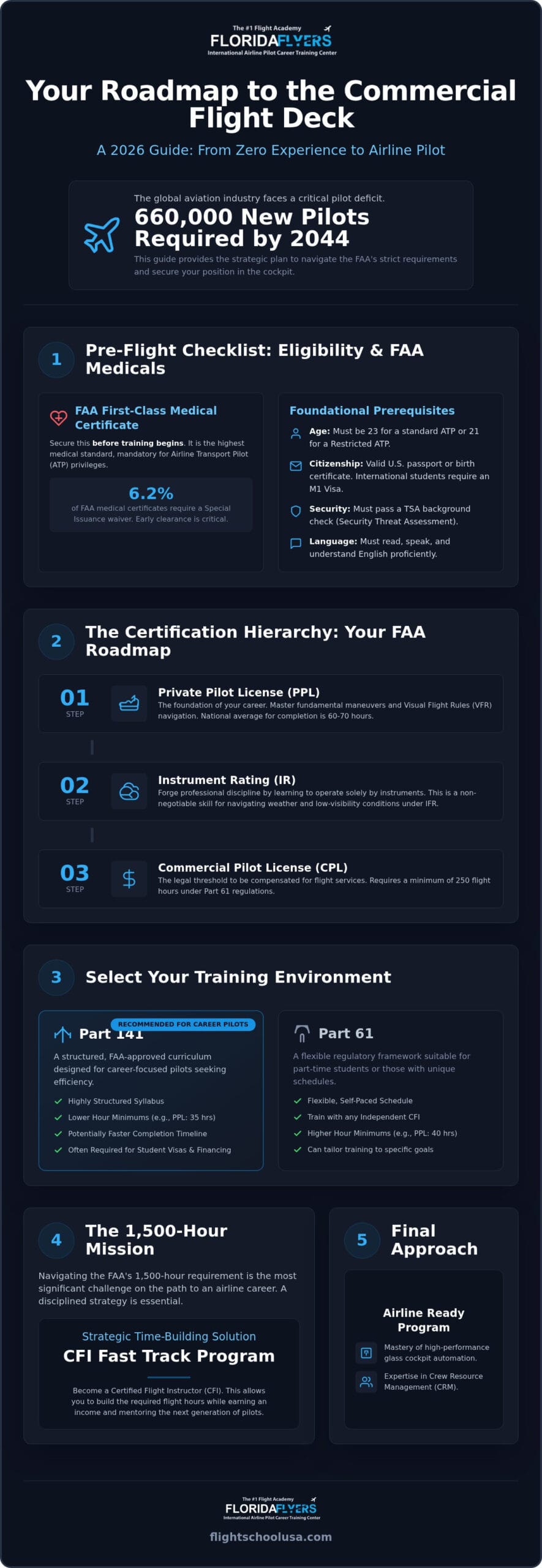
The First-Class Medical Certificate is the highest medical standard in aviation, required for any pilot exercising Airline Transport Pilot (ATP) privileges. This evaluation, conducted by an Aviation Medical Examiner (AME), assesses cardiovascular health, neurological stability, and sensory acuity. In 2026, the FAA has established more defined pathways for candidates with histories of well-managed mental health conditions, such as ADHD or anxiety. However, these pathways demand meticulous documentation. Approximately 6.2% of all FAA medical certificates currently require a Special Issuance waiver. Securing this clearance early is a critical component of your career execution, as it confirms you meet the long-term health standards required to captain a commercial airliner.
Beyond physical health, you must meet specific age and security benchmarks to remain compliant with federal law. While the minimum age to solo an aircraft is 16, you must be 23 to hold a standard ATP certificate, or 21 for a Restricted ATP. The 2026 hiring market has seen a shift in educational requirements; many airlines no longer mandate a four-year college degree, instead prioritizing technical proficiency and flight experience. You must also satisfy the following legal standards:
Adhering to these entry standards is not optional. It is the first test of your discipline as a future professional pilot. By clearing these hurdles early, you establish a secure foundation for the intensive flight training that follows.
Navigating the certification sequence is a test of technical endurance and regulatory discipline. To master how to become a pilot, you must execute each phase of training with precision, as each rating serves as a prerequisite for the next level of operational authority. The FAA structure ensures that your development moves logically from basic airmanship to the management of complex, high-performance aircraft. This hierarchy isn’t a suggestion; it’s a legal mandate that separates recreational flyers from elite commercial aviators.
The Private Pilot License (PPL) is the foundation of your aeronautical career. While FAA Part 61 requires a minimum of 40 flight hours and Part 141 requires 35, the national average for completion typically ranges between 60 and 70 hours. You’ll focus on fundamental maneuvers, takeoffs, landings, and cross-country navigation. Once you’ve mastered Visual Flight Rules (VFR), you must immediately transition to the Instrument Rating (IR). This phase is where professional discipline is forged. You’ll learn to operate the aircraft solely by reference to instruments, a skill that is mandatory for navigating weather and low-visibility environments. Mastering Instrument Flight Rules (IFR) is a high-stakes requirement that demands absolute compliance with Airman Certification Standards.
The Commercial Pilot License (CPL) is the legal threshold that allows you to be compensated for your flight services. Under Part 61, this requires 250 flight hours, though Part 141 programs can compress this to 190 hours. Training at this level focuses on advanced maneuvers and high-altitude operations. Following the CPL, you must secure a Multi-Engine Rating (MER). This rating introduces you to the complexities of asymmetric thrust and multi-engine aerodynamics. Integrating these certifications into a become a commercial pilot fast strategy is the most efficient way to reach the flight deck of a major carrier without sacrificing technical depth.
Veterans possess a unique tactical advantage in the aviation industry. By utilizing GI Bill benefits for professional Part 141 tracks, eligible candidates can significantly offset the costs of advanced ratings and instructor certifications. This isn’t just about financial relief; it’s about leveraging your military discipline in a structured, high-performance environment. Transitioning from service to a civilian flight deck requires a partner that understands the nuances of veteran benefits. If you’re ready to deploy your benefits, exploring an elite flight school that specializes in veteran career tracks is your next mission-critical step.
Choosing the correct regulatory environment is a mission-critical decision that dictates the pace and structure of your professional development. In the United States, flight training is conducted under either FAA Part 141 or Part 61 regulations. While both paths lead to the same pilot certificates, the internal mechanics of each differ significantly. If you’re researching how to become a pilot with the intent of reaching a major airline, you must understand that the training environment is a primary variable in your career execution. Elite academies prioritize structure over flexibility to ensure that every student meets a standardized level of technical proficiency.
Part 141 schools operate under a rigid, FAA-approved syllabus that demands constant oversight and adherence to a specific training sequence. This structured environment is designed for full-time career students who require a high-performance academy setting. The primary advantage of this path is the reduction in required flight hours for certain certificates. For example, while Part 61 requires 250 hours for a Commercial Pilot License, an approved Part 141 program can reduce this to 190 hours. This efficiency is why serious candidates choose the structured oversight of an elite institution. For a deep analysis of how these curricula are engineered for success, consult our guide on airline pilot career training.
Traditional flight schools often utilize a pay-as-you-go hourly model. This approach is fraught with financial volatility. Hidden fees, such as fuel surcharges and unexpected maintenance costs, can cause your budget to spiral out of control. When learning how to become a pilot, financial predictability is as important as technical skill. A Fixed-Price Career Program eliminates this uncertainty by providing a guaranteed cost for your entire certification journey. This model allows you to focus entirely on mastery rather than monitoring your bank balance after every flight hour. Total immersion is the final component of this strategy. Utilizing on-site student housing removes the friction of commuting and places you in a 24/7 aviation environment. This level of dedication ensures that you remain focused on the mission: reaching the airline flight deck with maximum efficiency and zero financial surprises. Before committing to any institution, use a rigorous pilot training program checklist to evaluate elite flight academies against the strictest industry benchmarks to ensure your investment is protected.
Earning your Commercial Pilot License is a significant milestone, yet it represents only the midpoint of your professional journey. The FAA 1,500-hour rule, established to ensure maximum safety and proficiency in commercial operations, stands as the final regulatory gateway to the airlines. For those determining how to become a pilot, this phase is often the most challenging to navigate without a structured tactical plan. You must transition from being a student of the air to a professional who can command complex scenarios and mentor the next generation of aviators. This period is not about waiting; it’s about active career execution.
The most efficient and respected method for accumulating the necessary flight time is the CFI Fast Track Program. Working as a Certified Flight Instructor isn’t merely a means to an end; it’s a rigorous professional development phase that builds the “Captain’s Mindset.” By teaching others, you solidify your own understanding of aerodynamics, weather, and regulatory compliance. You’ll master the Fundamentals of Instructing (FOI), which are critical for effective communication and leadership on the flight deck. While alternatives like pipeline patrol or aerial survey exist, they often lack the instructional depth and leadership responsibilities that major airlines prioritize during the hiring process. Instructors typically earn between $30 and $60 per hour while building their totals, providing a sustainable path toward your ultimate career goal.
Reaching the 1,500-hour threshold requires more than just logging time; it requires strategic accumulation of specific flight conditions. You must ensure your logbook reflects the mandatory minimums for the ATP certificate, including 500 hours of cross-country flight time, 100 hours of night flight, and 75 hours of instrument time. Maintaining professional currency and legal standing during this build phase is paramount. Any lapse in discipline or regulatory adherence can jeopardize your eligibility for a Restricted ATP (R-ATP) or a standard ATP certificate. You must treat every hour in the cockpit as a professional operation, regardless of the mission type. If you’re ready to accelerate your progression and secure your seat in the cockpit, enroll in our CFI Fast Track Program to begin your leadership phase today.
The final phase of your career execution is the most demanding transition in the aviation hierarchy. While building time as an instructor provides the necessary hours, the Airline Ready Program serves as the essential finishing school required to operate high-performance transport-category aircraft. You aren’t just learning a new airframe; you’re mastering a fundamentally different operational philosophy. Moving from a single-pilot environment to a multi-crew cockpit requires a sophisticated understanding of Crew Resource Management (CRM) and automated system integration. This is where your individual skill evolves into professional coordination, ensuring you meet the elite standards of a commercial airliner.
Operating at high altitudes requires more than basic airmanship. You must master swept-wing aerodynamics, high-altitude physiology, and the intricate logic of the Flight Management System (FMS). Modern flight decks rely on advanced automation, including sophisticated autopilots and glass cockpit displays that demand precise management rather than just manual manipulation. During this phase, you’ll undergo intensive technical evaluation to ensure you can handle complex system failures while maintaining situational awareness in high-density airspace. For a comprehensive breakdown of these technical objectives and how they prepare you for the jet environment, review our airline ready pilot program.
Securing your First Officer seat is the culmination of years of disciplined training. In 2026, the hiring landscape remains assertive, and technical evaluation is only one component of the selection process. You must be prepared for rigorous HR interviews and simulator assessments that test your decision-making under pressure. Once you’ve secured your position, your progression from First Officer to Captain is governed by seniority and continued excellence in recurrent training. Many elite candidates leverage regional airline flow-through agreements to streamline their path to major carriers, ensuring a predictable career trajectory. Understanding how to become a pilot is only the first step; executing that knowledge in a high-stakes interview is what secures your future.
Your journey to the flight deck is a high-stakes investment in your professional standing. If you’re ready to master the roadmap and understand exactly how to become a pilot through a disciplined, results-oriented curriculum, the time to act is now. Initiating your professional flight training mission today ensures you’re positioned to meet the global demand for elite aviators. Don’t leave your career to chance; choose the path of technical mastery and regulatory certainty.
Mastering the roadmap of how to become a pilot is a high-stakes execution that requires absolute technical discipline and regulatory compliance. You’ve seen that professional success depends on more than just logging flight hours. It requires securing a First-Class Medical early, choosing a structured Part 141 environment, and strategically navigating the 1,500-hour build phase with an elite mindset. The global demand for aviators is clear, but only those who adhere to the highest industry standards will secure a seat on a commercial flight deck.
As an FAA Part 141 Certified Academy, we provide the rigorous training and strategic GI Bill integration needed to reach your professional goals without financial volatility. Our elite Airline Ready finishing programs ensure you’re prepared for the technical demands of modern jet operations from your first day of transition. Don’t leave your career to chance or settle for unstructured training models that lack professional oversight. It’s time to take control of your trajectory and join the ranks of the industry’s elite aviators.
Secure Your Seat in Our Fixed-Price Career Program and begin your journey toward technical mastery today.
The timeline for professional certification typically spans 10 to 12 months for initial ratings, followed by 12 to 18 months of time building to reach the 1,500-hour threshold. Total duration is approximately 2 to 2.5 years for most candidates. Choosing an accelerated Part 141 program is the most efficient method to compress this timeline while maintaining the high technical standards required by major airlines.
Yes, you can operate as a professional pilot provided your vision is correctable to 20/20 in each eye. The FAA First-Class Medical standard requires distant vision to be 20/20 and near vision to be 20/40, with or without corrective lenses. Wearing glasses is standard within the industry. It does not disqualify you from the flight deck as long as you meet these specific sensory benchmarks.
Part 141 schools utilize a rigid, FAA-approved syllabus with strict oversight, while Part 61 offers a flexible, modular training environment. For those determining how to become a pilot for a career, Part 141 is the superior path. It provides a structured progression and allows for reduced flight hour requirements for certain certificates, ensuring you reach the flight deck with maximum efficiency.
The total investment for a professional pilot career ranges between $80,000 and $150,000 in the 2026 market. This covers all certifications from Private through Multi-Engine ratings. When researching how to become a pilot, you must account for the volatility of hourly rates. Utilizing a Fixed-Price Career Program is the only way to ensure financial command and protect your budget from unexpected fee increases.
The 1,500-hour rule is a federal mandate requiring airline first officers to hold an Airline Transport Pilot certificate. It applies to all Part 121 commercial operations. Some candidates qualify for a Restricted ATP at lower thresholds. Military pilots only need 750 hours, while graduates of approved two-year or four-year collegiate programs can qualify at 1,250 or 1,000 hours respectively, provided they meet specific criteria.
Eligible veterans can apply GI Bill benefits toward advanced ratings and instructor certifications at approved Part 141 institutions. This strategic integration allows for significant reimbursement of costs associated with the CFI Fast Track Program. Utilizing these benefits is a tactical advantage for those transitioning from service, as it offsets the financial burden of reaching the professional flight deck while building necessary leadership skills.
A four-year degree is no longer a strict requirement for many major carriers in 2026. While a degree remains a competitive asset, airlines currently prioritize technical proficiency, total flight time, and professional discipline. The high demand for qualified personnel has shifted the focus toward technical mastery and clean regulatory records. Technical excellence in your training program is now the primary driver for successful airline placement.
International candidates must first secure acceptance from an FAA-approved school authorized to issue Form I-20. Once you receive your documentation, you must utilize M1 Visa Admission Services to complete the SEVIS registration and schedule a consular interview. This process ensures legal compliance during your full-time immersion. You must prove you have the financial resources to cover both your training and living expenses during the program.


