

In the high-stakes 2026 aviation sector, the Multi-Engine Instructor rating isn’t a mere addition to your logbook; it’s the definitive benchmark of an elite professional ready for the heavy iron. You’ve likely experienced the professional stagnation caused by unpredictable hourly billing and the logistical failures of checkride delays. The inherent complexity of multi-engine aerodynamics and asymmetric thrust demands a rigorous approach to multi engine instructor training that most flight schools simply can’t provide. We understand that your career momentum depends on precision, efficiency, and absolute regulatory compliance.
This strategic guide provides the blueprint to master technical requirements and regulatory standards so you can secure your MEI certification in under a week. By utilizing our fixed-price career framework, you’ll gain high-quality PIC time while insulating yourself from the financial volatility of traditional training environments. We’ll examine current FAA standards, deconstruct engine-out procedures, and detail how to leverage our CFI Fast Track Program to command a superior position in the pilot job market. Prepare to transition from a student of the sky to a disciplined commander of the classroom.
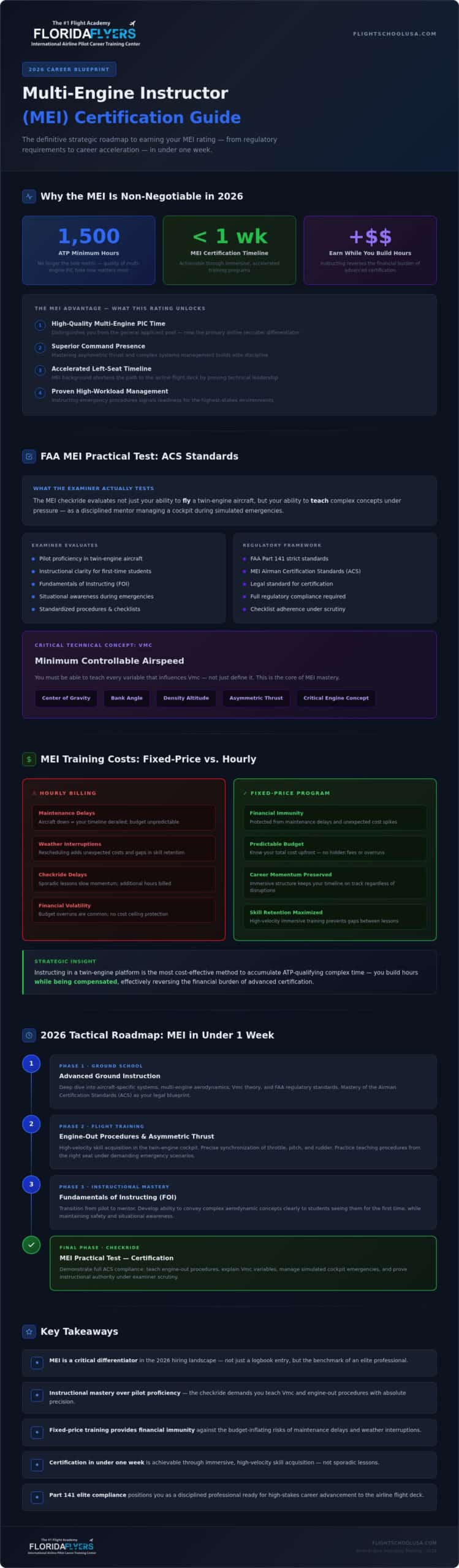
The Multi-Engine Instructor (MEI) rating is the definitive credential that authorizes a Certified Flight Instructor to provide instruction in multi-engine aircraft. It represents a critical evolution in a pilot’s professional trajectory. In the 2026 aviation landscape, simply reaching 1,500 hours is no longer the sole metric for airline readiness. Recruiters now demand high-quality Multi-Engine Pilot-in-Command (PIC) time to distinguish top-tier candidates from the general applicant pool. This rating isn’t a mere add-on; it’s a mandatory requirement for those serious about advancing to the flight deck of a commercial airliner.
Engaging in multi engine instructor training transforms your logbook from a record of basic maneuvers into a testament of advanced command capability. Instructing in a twin-engine platform is the most strategically sound and cost-effective method to accumulate the complex time required for Airline Transport Pilot (ATP) minimums. It allows you to build hours while being compensated, effectively reversing the financial burden of advanced certification. Beyond the hours, this training cultivates a superior command presence. You must master the management of complex systems and the lethal potential of asymmetric thrust, ensuring you possess the elite discipline required for a high-stakes professional career.
As airline hiring patterns stabilize in 2026, the focus has shifted toward candidate quality and technical leadership. Recruiters prioritize applicants with significant multi-engine instructional backgrounds because these pilots have already demonstrated the ability to manage high-workload environments and emergency procedures. Holding an MEI rating on your resume signals that you’ve mastered the transition from single-engine simplicity to the rigors of multi-engine operations. This credential acts as a high-velocity accelerator and is the logical next step for those enrolled in our CFI Fast Track Program, often shortening the timeline to the left seat by proving your foundational understanding of complex aircraft performance.
The transition to a multi-engine cockpit requires a fundamental psychological shift. You’re no longer managing a single point of failure; you’re orchestrating redundant systems where mismanagement can lead to catastrophic loss of control. Professional multi engine instructor training focuses heavily on the technical nuances of Vmc and the critical engine concept. Under the strict regulatory framework of FAA Part 141, candidates must demonstrate an unwavering adherence to standardized procedures and checklists. This environment demands more than just flying skill. It requires the ability to teach the precise synchronization of throttle, pitch, and rudder under the most demanding emergency scenarios.
The MEI checkride isn’t merely a test of your ability to fly a twin-engine aircraft; it’s a rigorous evaluation of your ability to teach complex concepts under pressure. Your examiner won’t just look for pilot proficiency. They’ll scrutinize how you convey the nuances of multi-engine aerodynamics to a student who may be seeing them for the first time. The Multi-Engine Instructor Airman Certification Standards (ACS) serve as the definitive legal standard for certification and the regulatory blueprint for your entire evaluation. Success in multi engine instructor training requires you to pivot from being a performer to becoming a disciplined mentor who can manage a cockpit during simulated emergencies.
Mastering the ‘Fundamentals of Instructing’ (FOI) in a high-performance context is essential. You must demonstrate that you can maintain situational awareness and flight safety while providing clear, actionable guidance to a learner. Core competencies center on the aerodynamics of engine-out operations and the critical understanding of Vmc (Minimum Controllable Airspeed). You don’t just need to know the definition of Vmc; you must be able to teach the variables that influence it, such as center of gravity, bank angle, and density altitude, with absolute precision.
Ground school demands a deep dive into aircraft-specific systems that go far beyond commercial pilot requirements. You’ll need to master the intricacies of fuel crossfeed systems, complex electrical grids, and the mechanics of constant-speed, feathering propellers. A significant portion of the ground evaluation focuses on the ‘Critical Engine’ concept. You must explain the aerodynamic implications of P-factor, accelerated slipstream, spiraling slipstream, and torque with enough clarity to ensure student comprehension. Developing structured, professional lesson plans for multi-engine emergency procedures is a mandatory step in proving your instructional readiness.
In the air, you must master maneuvers like steep turns and stalls while simultaneously narrating the procedure. Stalls in a multi-engine platform are high-stakes maneuvers that require precise rudder coordination to prevent a spin. Engine-out procedures-identification, verification, and feathering-must be performed with robotic accuracy. You’ll also be required to teach single-engine approaches and landings, demonstrating how to maintain the narrow margins of safety required when half your power is gone. This phase isn’t about survival; it’s about demonstrating total command of the aircraft’s performance envelope.
In 2026, FAA examiners are placing increased emphasis on risk management and instructional knowledge rather than just stick-and-rudder skills. Common pitfalls in MEI checkrides include failing to maintain directional control during simulated failures or providing vague, technically inaccurate explanations of aerodynamic theory. Success requires utilizing a school that adheres to Mastering the CFI ACS standards to ensure no regulatory detail is overlooked. To secure your credentials with the highest level of professional discipline, consider the structured environment of our CFI Fast Track Program.
The financial architecture of your multi engine instructor training is as critical as the aerodynamic theory you’ll teach. Traditional flight schools often lure candidates with low base rates, only to subject them to the “price creep” inherent in hourly billing. In the 2026 market, maintenance delays, DPE unavailability, and weather interruptions aren’t just inconveniences. They’re financial liabilities that inflate your budget without warning. Choosing an hourly model means you’re assuming all the operational risk. A structured, fixed-price agreement shifts that risk back to the academy, ensuring your focus remains on instructional mastery rather than your bank balance.
A professional ROI analysis reveals that the MEI rating is an investment in high-yield PIC time. While the upfront cost of multi-engine instruction is higher than single-engine counterparts, the marketability of those hours in 2026 is unparalleled. You’re not just buying a certificate. You’re securing a role where you’re paid to build the specific time airlines demand. For the career-minded pilot, “all-inclusive” in 2026 must mean more than just fuel and flight time. It must encompass student housing, checkride fees, and the administrative support required to navigate Part 141 compliance without hidden surcharges.
Calculating the total expenditure requires looking past the hourly rental rate. You must account for instructor fees, fuel surcharges, and mandatory ground school hours. High-velocity programs often integrate simulator time to refine procedures before burning expensive 100LL fuel. This is why Fixed-Price Flight Training Programs have become the professional standard. They provide a transparent, all-inclusive agreement that protects your capital from the volatility of the training environment. This approach allows you to treat your training as a business transaction with a defined cost and a guaranteed outcome.
The choice of aircraft impacts both your training efficacy and your future instructional capability. The Piper PA-44 Seminole remains a dominant force due to its reliability and standardized systems, while the Beechcraft Duchess offers a different handling profile for those seeking variety. However, the airframe is only half the equation. In 2026, your multi engine instructor training must occur in cockpits equipped with modern avionics, specifically Garmin G500 or GTN 650 integration, to mirror airline-ready standards. Modern pilot training isn’t just about moving levers. It’s about data management. Leveraging Advanced Aviation Training Devices (AATD) allows for the repetitive practice of engine-out flows at a fraction of the cost of the aircraft, ensuring your flight hours are spent on mastery rather than basic memorization.
Achieving success in multi engine instructor training requires a shift from passive learning to total professional immersion. The “Fast Track” mindset isn’t merely about speed; it’s about the intensity of focus required to master complex systems in a condensed timeframe. Sporadic training is the enemy of retention and often leads to the budget inflation discussed previously. For international candidates, our M1 Visa Admission Services provide the regulatory bridge needed to train at a premier U.S. academy, while veterans can leverage military benefits for instructor ratings to strategically offset their career investment.
Your training begins long before you step onto the ramp. Candidates must arrive with a comprehensive mastery of the Pilot’s Operating Handbook (POH) for their specific training airframe. This includes memorizing V-speeds, emergency checklists, and system limitations with robotic precision. Reviewing the CFI Fast Track Program fundamentals ensures you’re aligned with our academy’s rigorous instructional philosophy. Completing all required written exams and administrative filings prior to arrival is a mandatory requirement for maintaining our high-velocity schedule.
The curriculum is designed to move you from theory to command in six days. The first two days focus on intensive ground school and simulator integration to solidify engine-out flows and instructional delivery. Days three through five transition to the aircraft for flight maneuvers and emergency procedure mastery, including Vmc demonstrations and single-engine approaches. Day six is reserved for the final checkride preparation and a comprehensive administrative review to ensure total compliance with Part 141 standards. This structured rhythm ensures you’re not just prepared for the checkride but ready for the demands of professional instruction. Understanding why the flight instructor certification fast track has become the elite standard in 2026 can help you appreciate the competitive advantage this immersive approach delivers over traditional, drawn-out programs.
Once you’ve secured your certificate, the objective shifts to professional integration and hour accumulation. Successful graduates often transition directly into staff instructor roles within our elite network, which is the most efficient strategy for building the 1500 hours required for ATP minimums. Networking within the academy provides direct access to Airline Pilot Career Training pipelines, positioning you for immediate recruitment by major carriers. To begin your ascent, enroll in our Fixed-Price Career Program and secure your position in the 2026 hiring wave.
Flight School USA stands as the definitive institution for pilots who demand excellence and refuse to settle for the mediocrity of casual training environments. Since 2008, we’ve functioned as a high-performance academy and a rigorous gatekeeper of industry standards. Our multi engine instructor training is not merely a course; it’s a professional transformation designed for the high-stakes reality of the 2026 airline market. We combine the absolute rigor of FAA Part 141 certification with the uncompromising transparency of our Fixed-Price Career Program. This strategic alignment ensures that our candidates graduate with superior technical skills and total financial certainty, insulating them from the operational volatility found at lesser institutions.
Our commitment to your career momentum extends beyond the cockpit. We provide a comprehensive support ecosystem that includes M1 Visa Admission Services for our international partners and GI Bill Flight Training for those who have served. By removing the administrative and logistical friction often associated with advanced ratings, we allow you to maintain a singular focus on your professional development. You are joining a powerhouse of industry knowledge that has been transitioning elite pilots into the airline industry for nearly two decades. This is where professional legacies are forged through discipline and precision.
Our fleet represents the pinnacle of modern training technology. We maintain a fleet of multi-engine aircraft equipped with G500 and GTN 650 avionics to ensure you’re training on the systems you’ll eventually command in the airlines. To facilitate a truly immersive professional environment, we offer on-site Student Housing. This eliminates the distractions of external logistics and fosters a culture of constant learning among your peers. Access to our advanced simulators allows for procedural perfection, enabling you to master engine-out flows in a controlled, high-fidelity setting before ever leaving the ground. We provide the tools; you provide the excellence.
The path to the flight deck requires more than just a checkride; it requires a mindset shift toward our “Airline Ready” philosophy. Applying for our specialized MEI and CFI Fast Track programs is a declaration of your intent to lead in the aviation sector. We don’t just train pilots; we mentor future captains who understand the weight of regulatory compliance and the necessity of technical mastery. Contact our admissions team today for a tactical career consultation to determine your trajectory. It’s time to stop navigating the world of amateur training and secure your position within an elite professional pipeline.
The 2026 aviation market doesn’t reward the average; it identifies and elevates the elite. Securing your rating through high-velocity multi engine instructor training is the most decisive action you can take to separate yourself from the applicant pool. We’ve deconstructed the tactical roadmap from mastering asymmetric thrust to navigating the financial advantages of fixed-price agreements. By choosing a path of technical rigor and instructional excellence, you’re not just earning a certificate. You’re securing the high-quality multi-engine PIC time that major carriers demand.
Flight School USA provides the institutional infrastructure necessary for this transition. With our FAA Part 141 Examining Authority, an elite multi-engine fleet, and dedicated student housing, we’ve eliminated every barrier to your success. It’s time to trade the uncertainty of hourly billing for the precision of a professional academy. Take the final step toward the flight deck today.
Secure Your Seat in the 2026 CFI Fast Track Program and join the ranks of pilots who command the skies with absolute authority. Your future in professional aviation begins with a single, disciplined decision.
To obtain your MEI rating, you must hold a Commercial Pilot Certificate or ATP with an airplane multi-engine rating and have at least 15 hours of PIC time in multi-engine aircraft. Candidates must pass a rigorous FAA practical test that evaluates both flight proficiency and instructional knowledge. This certification is a critical component of multi engine instructor training, ensuring you meet the high regulatory standards required for professional advancement in 2026.
An elite fast-track program typically requires four to seven days for completion. This accelerated timeline is only achievable through total immersion and significant pre-arrival study of the aircraft’s Pilot’s Operating Handbook. Our high-velocity curriculum focuses on consolidating ground and flight instruction to maximize efficiency. This ensures you transition from a candidate to a certified instructor without the delays common in traditional, decentralized training environments.
Yes, you can utilize your military benefits for advanced certification. Flight School USA provides GI Bill Flight Training options for eligible veterans seeking to expand their professional credentials. This allows you to leverage earned benefits to cover the costs of multi engine instructor training, effectively accelerating your transition into a commercial airline career. Our admissions team provides dedicated support to ensure your administrative filings comply with VA regulations.
Training costs in 2026 vary significantly based on the billing model chosen. While many schools utilize hourly rates that are subject to fuel surcharges and maintenance delays, we recommend a Fixed-Price Career Program to ensure financial transparency. This model protects your investment from the price creep that often plagues advanced flight training. You should prioritize programs that bundle aircraft rental, instruction, and housing into a single, predictable agreement.
Yes, a practical examination with an FAA-designated pilot examiner is mandatory for the MEI add-on. This checkride is an intensive evaluation of your ability to perform and teach multi-engine maneuvers, emergency procedures, and aerodynamic theory. You must demonstrate mastery of the Airman Certification Standards (ACS) to secure your certificate. There are no shortcuts; every instructor must prove their command capability through this high-stakes regulatory event.
The Piper PA-44 Seminole is the industry standard for multi-engine instruction due to its reliable systems and predictable handling. Some academies also utilize the Beechcraft Duchess, but the Seminole’s prevalence makes it the most strategic choice for future instructors. In 2026, it’s vital to ensure your training aircraft features modern avionics like the Garmin G500 to maintain alignment with the technological standards of major airlines.
The MEI rating is the most efficient tool for accumulating the 1500 hours required for an ATP certificate. Instructing in twin-engine aircraft allows you to build high-quality multi-engine PIC time, which is the primary differentiator for airline recruiters. Instead of paying for hours, you’re compensated to mentor others. This strategic approach accelerates your career timeline while ensuring you possess the technical depth required for the flight deck.
You aren’t required to hold a Certified Flight Instructor Instrument (CFII) rating before starting your MEI training. However, you must already hold a basic CFI certificate or be meeting the requirements for initial instructor certification. Most professional pilots find that holding both ratings increases their marketability and instructional versatility. At our academy, we treat the MEI as a logical progression for those who have already mastered the foundational disciplines of flight instruction. Pilots who are earlier in their certification journey may benefit from first reviewing the commercial pilot license requirements and strategic training pathways that form the foundation of a professional aviation career.


