
The aviation industry must secure 660,000 new pilots through 2044 to sustain global flight operations, yet the journey to a commercial pilot license remains a rigorous gatekeeper of professional standards. You understand that the transition from a private certificate to a professional career is the highest-stakes move you’ll make. It’s common to feel overwhelmed by the technical distinctions between FAA Part 61 and Part 141 hour requirements or the critical necessity of maintaining a second-class medical certificate. These aren’t just administrative hurdles; they’re the benchmarks of an elite career that demands absolute precision.
This guide delivers the definitive roadmap to mastering your professional certification. You’ll gain absolute clarity on the regulatory requirements and strategic training pathways designed to maximize your professional privileges while minimizing wasted time. We will dissect the cost-to-income realities of modern flight training and prepare you for the high-performance transition into a CFI role or an Airline Ready program. By the end of this analysis, you’ll possess the tactical knowledge required to navigate the complex certification systems of 2026 and launch a career defined by excellence and institutional credibility.
The Commercial pilot licence (CPL) represents the definitive legal threshold where aviation shifts from a personal pursuit into a high-stakes professional discipline. While a Private Pilot License (PPL) restricts an airman to recreational flight and pro-rata cost sharing, the commercial pilot license is an FAA-issued certificate that empowers pilots to be legally compensated for their specialized flight services. It’s the non-negotiable prerequisite for any elite career path in the cockpit, including roles in flight instruction, aerial photography, and corporate aviation. The CPL is the legal foundation for any career pilot operating under FAA 14 CFR Part 61 or 141.
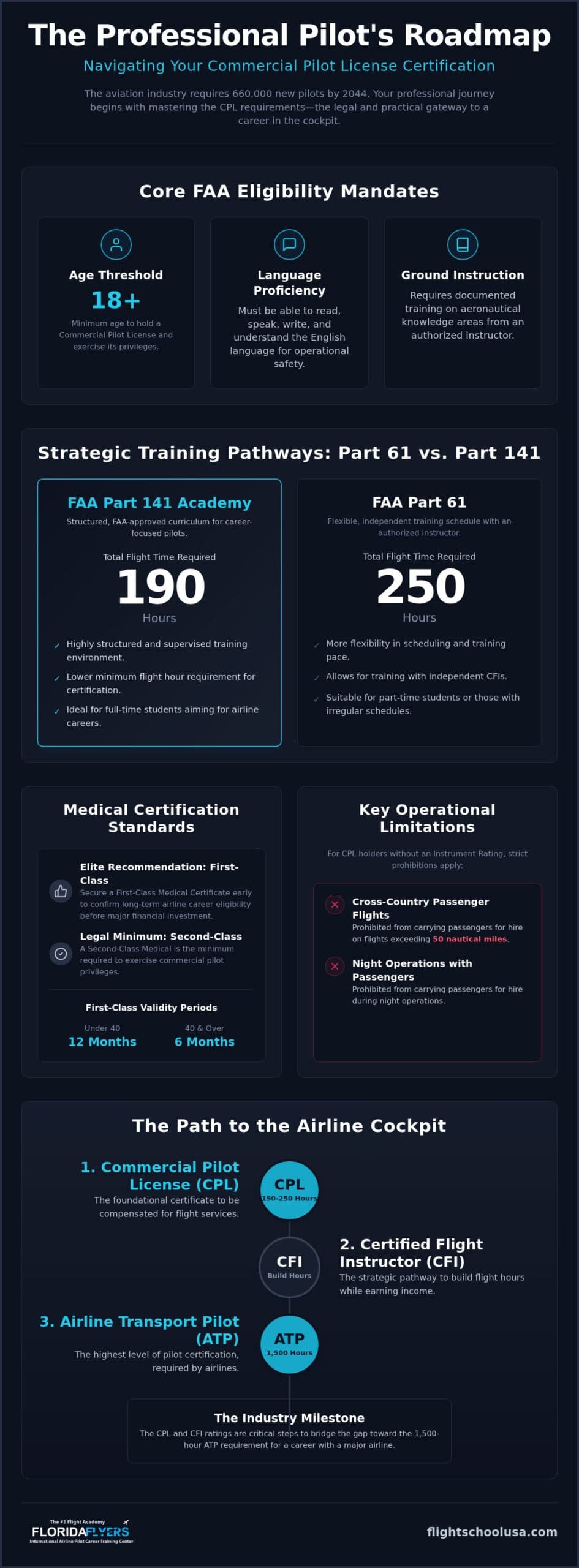
Professional certification grants the authority to act as Pilot-in-Command (PIC) of an aircraft carrying persons or property for compensation. This privilege carries immense regulatory weight and demands a disciplined approach to compliance. You must maintain a sophisticated understanding of the legal distinctions between “Common Carriage” and “Private Carriage” to avoid catastrophic regulatory violations. Common carriage involves the “holding out” of services to the public, a practice that requires specific Part 135 or Part 121 operating certificates. Failure to navigate these boundaries can terminate a career before it truly begins. Operational limitations also apply to those who haven’t yet secured an Instrument Rating. These pilots are strictly prohibited from:
Such restrictions highlight why elite pilots treat the CPL as a critical step toward total operational mastery rather than a final destination.
For pilots targeting a major airline flight deck, the CPL is a critical mid-point milestone. It’s typically earned at the 190-hour mark in a structured Part 141 environment or the 250-hour mark under Part 61 regulations. This certificate serves as the primary gatekeeper to the restricted ATP (R-ATP) requirements and subsequent commercial employment. Most successful candidates recognize the strategic necessity of earning a CPL before pursuing a CFI Fast Track Program. This specific pathway allows you to bridge the significant hour gap between initial commercial certification and the 1,500-hour ATP requirement. It’s the essential mechanism of your career progression. By securing your CPL, you transition from paying for flight hours to being compensated for them, ensuring you meet the industry’s rigorous standards for professional readiness and institutional credibility.
Securing a commercial pilot license requires meeting strict statutory mandates established by the FAA. You must be at least 18 years of age to hold this certificate and exercise its professional privileges. Beyond age, the FAA enforces uncompromising English language standards. Every applicant must read, speak, write, and understand the English language to ensure safety in high-stakes environments. This proficiency is evaluated throughout your training and during the final practical test. Ground instruction is equally vital; you must provide documentation of training from an authorized instructor or an approved home-study course that covers the required aeronautical knowledge areas. This documentation serves as the legal proof that you’ve mastered the theoretical components of professional flight.
While a second-class medical certificate is the legal minimum to exercise commercial privileges, elite pilots secure a first-class certificate before their first flight hour. This strategy confirms you’re medically qualified for the long-term demands of Airline and Commercial Pilots before investing significant capital. You must complete the MedXPress application online before your examination, and the physical must be completed within 60 days of that submission. For pilots under 40, a first-class medical remains valid for 12 months, while those 40 and older must renew every 6 months to maintain privileges. Conditions like hypertension affect 5.7% of the pilot population, but many remain flight-status eligible through the FAA Special Issuance process. Discipline in your personal health is as critical as discipline in the cockpit.
The FAA written exam is a 100-question assessment of your technical expertise. It covers advanced aerodynamics, complex federal regulations, and precise navigation calculations. You must achieve a minimum score of 70%, but professional credibility demands a higher standard. Scoring in the high 90s signals to future employers that you possess the academic rigor required for a professional career. Completing the written exam before starting intensive flight maneuvers is a strategic necessity. It allows you to focus entirely on the physical execution of maneuvers without the distraction of unmastered theory. If you’re ready to begin this rigorous transition, selecting an elite flight school is your first step toward securing your professional standing.
The decision between training under Part 61 or Part 141 is the most significant strategic choice an aspiring professional will make. These two pathways represent fundamentally different approaches to achieving a commercial pilot license. While Part 61 provides a flexible, self-paced environment, it mandates a minimum of 250 total flight hours. In contrast, Part 141 academies operate under a highly structured, FAA-approved curriculum that permits certification in as few as 190 hours. This 60-hour reduction isn’t arbitrary; it reflects the rigorous oversight and audited training standards that Part 141 institutions must maintain. For career-focused students, the efficiency of Part 141 translates directly into faster entry into the workforce. The financial implications are clear: while Part 61 offers flexibility, the cost of funding an additional 60 hours of flight time often outweighs any perceived savings from a less structured environment.
Airlines often prioritize graduates from audited Part 141 environments due to the standardized quality of their instruction. These institutions function as a high-performance academy, ensuring that every student adheres to a strict, methodical syllabus that mirrors airline operating procedures. The prestige factor of a Part 141 certificate signals to recruiters that the pilot has thrived in a disciplined, high-intensity environment. The regulatory requirements for these programs are codified in 14 CFR Part 61 Subpart F, which defines the aeronautical knowledge and flight proficiency standards required for the commercial certificate. Mastery of these regulations is a critical component of your professional legal standing.
Part 141 programs provide an elite level of oversight that ensures uniform professional quality across all training stages. This structure is designed specifically to accelerate the transition to the airline pilot career training stage. By utilizing a fixed price flight training program, students can eliminate the volatility of training costs while benefiting from a syllabus that meets the highest industry standards. This pathway is the premier choice for those demanding excellence and efficiency. It doesn’t just teach you to fly; it trains you to operate within a complex, professional system.
Part 61 remains a superior choice for pilots who already possess significant flight time or require a non-standard training schedule to accommodate professional transitions. It allows for a customized approach while still demanding the same high-level discipline expected of a professional airman. Veterans, in particular, can leverage this flexibility by using gi bill for cfi training provisions to subsidize their progression. Even in a non-structured environment, maintaining professional standards is a personal mandate. The quality of your logbook reflects your commitment to the rigors of the industry. Discipline isn’t optional; it’s the foundation of your career.
Earning a commercial pilot license requires the execution of specific aeronautical milestones that test both endurance and technical precision. You must complete at least one 2-hour day VFR cross-country flight and one 2-hour night VFR cross-country flight. These missions aren’t merely about logging time. They require navigating specific distances while maintaining professional standards of fuel management and situational awareness. Night proficiency is further validated by mastering takeoffs and landings to a full stop at an airport with an operating control tower. This ensures you’re prepared for the high-workload environments of commercial hubs. The final evaluation, the Commercial Practical Test, demands that you demonstrate mastery of the cfi acs standards at a commercial level, proving your readiness for the responsibilities of a commercial cockpit.
A critical component of modern training is the 10-hour requirement for advanced aircraft systems. While legacy programs focused on “Complex” aircraft with retractable landing gear, elite academies have shifted toward Technologically Advanced Aircraft (TAA). A TAA is defined by the integration of an Electronic Primary Flight Display (PFD), a Multi-Function Display (MFD), and a two-axis autopilot. Mastering these systems early in your career is a strategic advantage. It prepares you for the glass cockpits of modern regional and major airlines. Integrating this technology into your professional skill set ensures you aren’t just flying; you’re managing complex systems with the efficiency required by the industry. If you seek this level of technical training, enrolling in a premier flight school is the most direct path to professional competency.
Commercial maneuvers demand a level of aircraft control far beyond the private pilot level. You must master the Chandelle, Lazy Eights, and Eights-on-Pylons to strict commercial tolerances. These maneuvers aren’t just for show. They develop the coordination and energy management skills essential for professional flight. The “Power-Off 180” landing is perhaps the most critical milestone. It requires you to glide the aircraft from the downwind leg to a specific point on the runway without engine power, demonstrating absolute command over the aircraft’s energy profile. Maintaining professional cockpit management during these high-workload maneuvers is what separates an amateur from a commercial professional. Success in these areas confirms your readiness to transition from a student to a compensated pilot.
The acquisition of a commercial pilot license isn’t the culmination of your journey; it is the strategic threshold of your professional career. While the certificate legally permits compensation, you still face the 1,250-hour gap required to reach the 1,500-hour Airline Transport Pilot (ATP) milestone. This phase demands a disciplined tactical plan to accumulate high-quality flight time while maintaining your professional standards. Entry-level opportunities such as pipeline patrol, skydiving operations, and banner towing offer specialized experience, but they’re often secondary to the most efficient hour-building mechanism in the industry: flight instruction. You aren’t just logging time; you’re building a professional reputation that recruiters will eventually scrutinize.
Transitioning from a student to an instructor within an elite academy environment is the most effective way to master advanced aviation concepts. A CFI rating transforms your commercial pilot license into a revenue-generating asset immediately. Teaching forces a level of systems knowledge and situational awareness that solo flight cannot replicate. It demands a no-nonsense attitude toward safety and regulatory adherence. With the initial CFI practical exam failure rate reaching a four-year high, pursuing a structured flight instructor certification fast track has become the elite standard for commercial pilots who refuse to let a stagnating career drain their resources and time. For those aiming for the highest tier of professional command, multi engine instructor training is a critical addition. It allows you to log complex multi-engine time while being compensated, significantly accelerating your timeline to a regional or major airline cockpit. This is where your career moves from a series of lessons to a high-performance operation.
Securing the 1,500 hours is only half the battle; you must also build a resume that survives the scrutiny of elite recruiters. This requires maintaining a pristine FAA record and a meticulously organized professional pilot logbook. Any deviation from regulatory compliance can be a career-ending event before you even reach a heavy aircraft. Networking within professional pilot organizations and leveraging academy alumni networks provides the institutional credibility needed to secure competitive interviews. Every flight hour you log after earning your CPL should be viewed as a brick in the foundation of your future Type Ratings. By the time you apply for an Airline Ready Program, your record should reflect the rigors of a seasoned veteran. Excellence is the only acceptable standard for those who intend to command heavy aircraft in global operations.
The journey to a commercial pilot license is a rigorous validation of your technical precision and professional discipline. You’ve analyzed the strategic advantages of FAA Part 141 training pathways and the critical importance of mastering modern milestones like Technologically Advanced Aircraft. By treating this certificate as a tactical foundation rather than an end goal, you position yourself to navigate the 1,500-hour transition with elite efficiency. Every flight hour logged from this point forward is a direct investment in your long-term credibility within the global aviation industry.
Flight School USA provides the high-performance environment required to meet these exacting standards. As an FAA Part 141 Certified Professional Academy, we offer comprehensive international M1 Visa support and dedicated student housing to ensure your focus remains entirely on training excellence. Don’t leave your career progression to chance. You have the roadmap; now you must execute the plan. Apply for the Elite Fixed-Price Career Program Today and take command of your future in the cockpit. The flight deck is waiting for those who refuse to settle for anything less than excellence.
In 2026, the investment required to secure a commercial pilot license varies significantly based on your previous experience and the training pathway you select. Total costs fluctuate depending on aircraft rental rates, fuel surcharges, and whether you choose a Part 61 or Part 141 curriculum. Elite academies often provide structured career programs that help mitigate the volatility of these expenses. You should consult with an admissions officer to receive a detailed breakdown tailored to your specific career goals.
A commercial certificate is the legal threshold for receiving compensation, but it doesn’t authorize you to act as a captain for a major airline. The Airline Transport Pilot (ATP) certificate is the highest level of aircraft certification, requiring a minimum of 1,500 flight hours and a minimum age of 23. While the CPL allows you to fly for hire in various roles, the ATP is the mandatory requirement for Part 121 airline operations.
You can technically obtain a commercial certificate without an instrument rating, but it imposes severe operational limitations that hinder professional employment. Under FAA regulations, pilots without an instrument rating are prohibited from carrying passengers for hire on cross-country flights exceeding 50 nautical miles or during night operations. Most professional institutions mandate the rating as a prerequisite to ensure graduates possess the technical versatility required by elite aviation employers.
Under a highly structured FAA Part 141 program, you can secure a commercial pilot license with a minimum of 190 total flight hours. This is a significant reduction from the 250 hours required under Part 61 regulations. This efficiency is permitted because Part 141 schools follow an audited, standardized curriculum that ensures rigorous training quality. It’s the preferred pathway for career-track students who demand a methodical and accelerated route to professional certification.
The commercial checkride is significantly more demanding than the private pilot evaluation because it tests your ability to operate at professional tolerances. While the private checkride focuses on basic safety and competence, the commercial practical test requires absolute precision during high-workload maneuvers like the Power-Off 180 and Lazy Eights. You’re no longer being evaluated as a student; the examiner is assessing your readiness to be a compensated professional in a high-stakes environment.
Veterans can utilize GI Bill benefits to fund professional flight training at FAA Part 141 certified institutions. This financial support typically applies to advanced ratings, including the commercial certificate and flight instructor programs, once a private pilot license has been obtained. It’s a strategic way for service members to transition into high-level aviation careers. You must ensure the flight school is VA-approved to maintain eligibility and maximize your educational entitlements.
A commercial certificate opens immediate doors to professional roles such as aerial photography, banner towing, and pipeline patrol. Many pilots also find employment in skydiving operations or agricultural aviation. However, the most strategic move for those targeting the airlines is to obtain a flight instructor rating. This allows you to build the 1,500 hours required for the ATP while gaining valuable experience in a disciplined, high-performance instructional environment.
A college degree isn’t a regulatory requirement for obtaining a commercial certificate or working in many sectors of the industry. While some major legacy airlines traditionally preferred a four-year degree, many have recently adjusted their hiring criteria to focus more on flight experience and technical proficiency. You can launch a successful career and reach the flight deck of a regional carrier with only your FAA certifications and a pristine professional record.


