

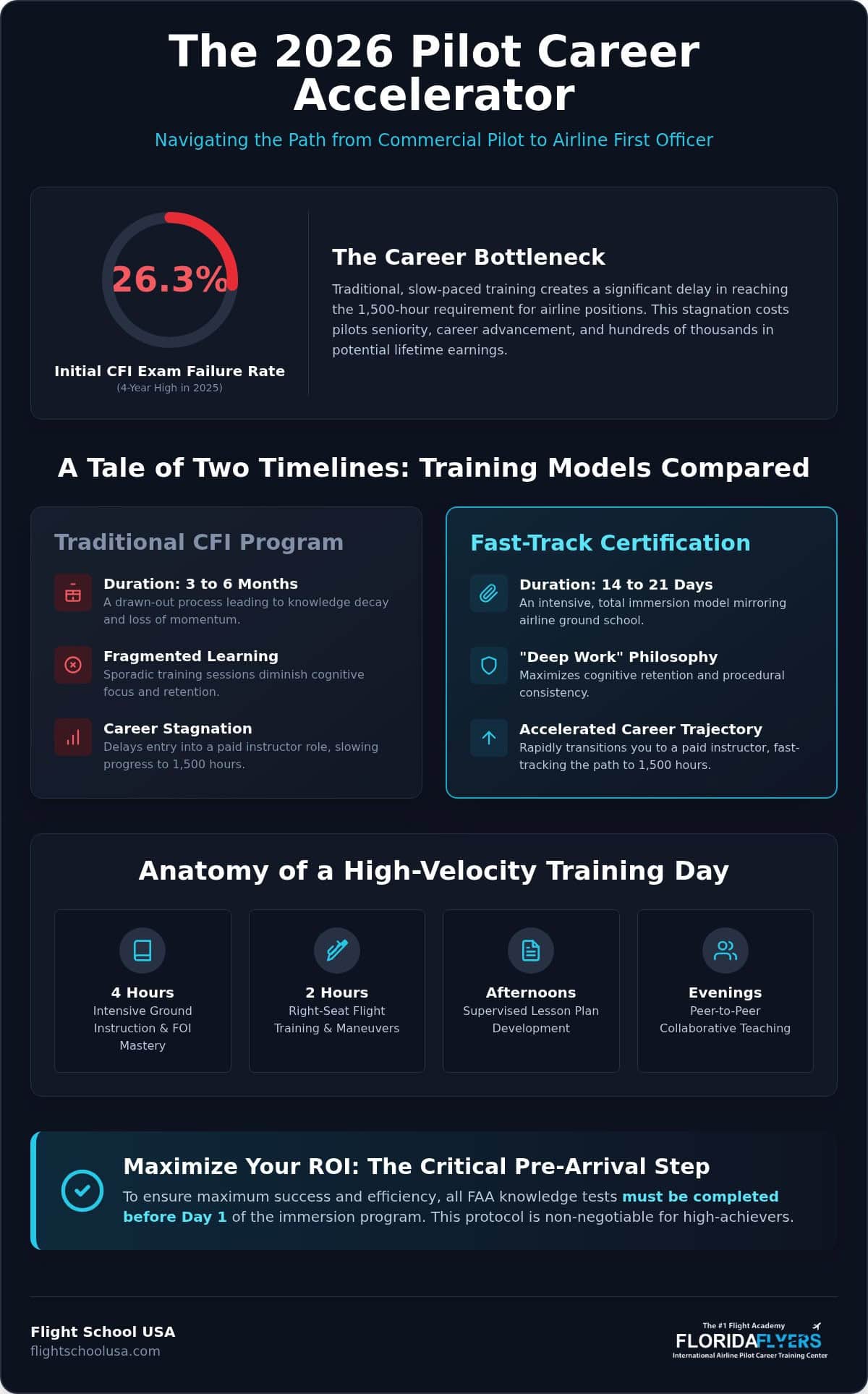
With the initial CFI practical exam failure rate hitting a four-year high of 26.3 percent in 2025, the margin for error in professional pilot development has never been thinner. You’ve likely felt the frustration of a stagnating career while watching traditional, drawn-out programs drain your resources and your time. The complexity of the CFI ACS isn’t just a hurdle; it’s a gatekeeper that demands absolute technical mastery and a no-nonsense approach to regulatory compliance.
This strategic analysis reveals why the flight instructor certification fast track has emerged as the elite standard for commercial pilots who refuse to wait for their airline transition in 2026. High-velocity training is no longer a mere convenience. It’s a professional necessity for those aiming to command respect in a competitive industry. You’ll discover how to transition rapidly from a commercial pilot to a paid instructor, securing your path to the flight deck of a major carrier.
We’ll provide a comprehensive overview of the FOI and technical subject areas required for success. By the end of this guide, you’ll understand how to navigate the 1,500-hour requirement with the precision and discipline that airline recruiters demand from top-tier candidates.
The 1,500-hour rule remains the definitive gatekeeper of the 2026 pilot labor market. For the career-track aviator, the window between earning a commercial rating and securing a seat at a major airline represents a high-stakes professional bottleneck. Traditional CFI training, which typically drags on for three to six months, has become an obsolete relic. It fails to meet the urgency of the current hiring environment. Professional pilots now recognize that a flight instructor certification fast track isn’t a shortcut; it’s a strategic immersion that prepares them for the rigors of the industry.
Modern academies have transitioned toward immersion-based learning because it produces a superior grade of instructor. These high-velocity training cycles are designed to mirror the intensive ground schools of major air carriers. By condensing the curriculum, candidates maintain a higher level of cognitive focus and procedural consistency. This methodology ensures that the transition from student to professional educator is seamless, disciplined, and strictly aligned with the performance expectations of elite flight decks.
Seniority is the primary currency of the aviation industry. In 2026, the opportunity cost of a delayed certification is measured in lost seniority numbers and hundreds of thousands of dollars in lifetime earnings. A pilot who languishes in a drawn-out program for six months is essentially surrendering their competitive edge. Market demand for instructors is so high that premier academies are actively recruiting their own graduates to ensure a steady pipeline of talent. Data shows a strong correlation between the discipline required to succeed in accelerated programs and the high pass rates seen during airline Initial Operating Experience (IOE).
Navigating a high-velocity environment requires a foundation of absolute regulatory compliance. Your commercial pilot license serves as the prerequisite bedrock for this advanced training. In 2026, the FAA has streamlined Part 141 accelerated training approvals, allowing for more efficient paths to certification without sacrificing the integrity of the airman certification standards. Maintaining this delicate balance of speed and accuracy is critical. A flight instructor certification fast track at a top-tier institution ensures that you are trained under the most current federal mandates, protecting your professional standing and ensuring you’re ready for the scrutiny of a DPE checkride from day one.
A flight instructor certification fast track is not a passive educational experience; it’s a 14-to-21 day total immersion program designed for the serious professional. This timeframe is mathematically structured to maximize retention while minimizing the cognitive fatigue associated with fragmented, long-term training. We apply a “Deep Work” philosophy to the curriculum, requiring candidates to eliminate distractions and focus entirely on the transformation from pilot to educator. It’s a high-stakes environment where every hour is accounted for in a master schedule of professional development.
The daily schedule is both rigorous and methodical. Success in this environment depends on your ability to maintain a high-performance rhythm. A typical day involves four hours of intensive ground instruction followed by two hours of specialized flight maneuvers performed from the right seat to develop instructional reflexes. Afternoons are dedicated to supervised lesson plan development, while evenings focus on peer-to-peer teaching. This collaborative element is critical; by teaching your colleagues, you expose your own knowledge gaps and refine your delivery before facing a Designated Pilot Examiner.
The Fundamentals of Instructing (FOI) represent the psychological foundation of all flight instruction. This subject area is often the primary hurdle in fast-track programs because it demands a shift from technical execution to cognitive analysis. You aren’t just learning how to fly; you’re learning how the human brain processes information under stress. We utilize tactical approaches to learning theory and human behavior, ensuring you can diagnose student plateaus and provide effective corrective feedback. Mastery of these concepts is what separates a technician from a professional educator.
Building a professional library of instructional materials in record time is a non-negotiable requirement. You don’t have the luxury of months to slowly curate your resources. The cfi acs serves as the definitive roadmap for technical mastery, providing the exact standards for every maneuver and subject area. We focus on streamlining complex aerodynamics and systems knowledge so you can deliver clear, student-level comprehension without sacrificing technical accuracy. For those prepared for this level of intensity, the CFI Fast Track Program provides the professional framework necessary to succeed.
The divide between traditional instruction and high-velocity certification is defined by more than just a calendar. Traditional CFI training is frequently an inefficient, six-month endurance test. It’s often characterized by sporadic scheduling, inconsistent mentor availability, and the constant erosion of technical knowledge. In contrast, a flight instructor certification fast track condenses the entire process into a precise, three-week window of professional development. This strategic compression ensures that you remain within the “peak performance” window, where your mastery of the FOI and technical maneuvers is at its absolute sharpest during the checkride.
The upfront investment of an accelerated track is a transparent, strategic allocation of resources. Traditional programs often mask their true cost through extended durations and the need for frequent “refresher” flights to regain proficiency lost between sessions. By choosing an elite, high-velocity environment, you eliminate the financial drain of inefficiency and secure your seniority in the airline pipeline months ahead of your peers. It’s a calculated move for pilots who value their time as much as their credentials.
There’s a persistent misconception that accelerated training is a shortcut. The data suggests the opposite. In 2025, the national fail rate for the initial CFI practical exam climbed to 26.3 percent, yet premier immersion programs maintained pass rates near 80 percent. This superior performance is a direct result of instructional intensity. When you live and breathe the curriculum for 21 days, retention is significantly higher than when lessons are spaced weeks apart. We don’t just teach you to pass; we prepare you to lead with authority from the right seat.
Total immersion requires a controlled environment. Access to on-site student housing is not a luxury; it’s a tactical necessity that removes domestic distractions and fosters a 24/7 professional mindset. This level of support extends to logistics, ensuring dedicated aircraft availability and pre-scheduled DPE slots. We operate with an “Airline Ready” philosophy, treating your certification as the first step in a high-stakes career rather than just another rating. You’re training for the job you want, not just the test you need to take.
Success in a flight instructor certification fast track is determined weeks before you step onto the academy grounds. This is a high-performance environment that demands a disciplined, 12-hour-a-day training tempo. If you arrive unprepared, you aren’t just falling behind; you’re jeopardizing a significant professional investment. Mental preparation is paramount. You must assemble a comprehensive “Instructor Kit” before Day 1 to ensure your focus remains on delivery rather than administrative assembly. A professional kit should include:
Arriving with these materials allows you to engage in “Deep Work” from the first hour. It transforms the training from a scramble for resources into a polished refinement of your instructional capabilities. You’re here to master the art of teaching, not to spend your nights highlighting textbooks.
The regulatory foundation of your training must be flawless. Ensure all commercial pilot license endorsements are current and properly logged in your permanent record. Completion of the FAA knowledge tests, specifically the Flight Instructor Airplane (FIA) and the Fundamentals of Instructing (FOI), is a non-negotiable prerequisite. For international students, maintaining TSA compliance and up-to-date medical certification is a critical administrative task that must be resolved prior to arrival. Failure to secure these documents will result in an immediate grounding, as the accelerated timeline leaves zero room for bureaucratic delays.
The most difficult transition for a commercial pilot is moving from “doing” a maneuver to “explaining” it with authority. You must master the right-seat transition before formal training begins. This involves more than just comfort with the sight picture; it requires a synchronized verbalization of every control input and power setting. Utilize the cfi acs to self-audit your knowledge gaps. If you can’t explain the aerodynamic principles behind a power-on stall while performing it to commercial standards, you aren’t yet ready for the intensity of an immersion program.
Prepare for the rigors of professional instruction by ensuring your prerequisites are finalized through our cfi fast track program portal. Arriving ready is the only way to guarantee the professional outcome your career demands.
Flight School USA executes the flight instructor certification fast track with a level of procedural precision that competitors cannot replicate. We don’t just teach; we mentor. By choosing our specialized flight instructor certification fast track, you’re investing in a professional ecosystem designed for the high-stakes transition to the airlines. We utilize an elite instructor cadre of seasoned veterans who command respect for their deep understanding of the 2026 regulatory environment. This leadership ensures that every candidate is held to the highest standards of the FAA Part 141 and Part 61 frameworks. Upon successful completion of the initial rating, we offer a seamless integration into multi engine instructor training. This provides the advanced career leverage necessary to dominate the pilot labor market and accelerate your path to the flight deck.
Our commitment to your progression doesn’t end with a checkride. Graduates who demonstrate superior instructional ability and a no-nonsense attitude are frequently invited to join the Flight School USA team. This provides an immediate solution to the 1,500-hour requirement, allowing you to build time in a professional, high-volume environment. You’ll be working alongside the best in the industry, refining your command skills while earning a professional income.
Success in an accelerated environment requires a facility that operates with the same intensity as its students. We provide access to a fleet of standardized, professionally maintained aircraft to ensure that mechanical variables never interfere with your training momentum. Our dedicated student housing is a critical component of this strategy; it removes domestic distractions and fosters a professional community of like-minded aviators. Our academy functions as a high-performance gateway to commercial aviation.
The transition from certification to command requires a clear financial and professional roadmap. Our fixed price flight training program options provide the absolute financial certainty required for long-term career planning. You aren’t just earning a rating; you’re entering the airline pilot career training pipeline with a prestigious institution that prioritizes your results. Contact our admissions department to schedule a strategic career consultation and secure your slot in our next immersion cycle.
The transition from commercial pilot to professional instructor is a high-stakes evolution that demands absolute technical precision. Choosing a flight instructor certification fast track is a strategic decision to bypass the inefficiencies of traditional training and secure your seniority in the airline pipeline. This immersion-based model ensures that your mastery of the FOI and technical subject areas is sharp, disciplined, and ready for immediate application in a professional cockpit environment.
Flight School USA provides the elite infrastructure required for this transformation. Our FAA Part 141 accredited curriculum, supported by a high-performance fleet, maintains the rigorous standards that major air carriers expect from top-tier candidates. With on-site student housing available, you can focus entirely on your professional development without the distraction of domestic logistics. The road to the 1,500-hour requirement is paved with discipline; don’t let a slow training cycle stall your career progression.
Secure Your Slot in the Elite CFI Fast Track Program
Your future on the flight deck depends on the actions you take today. We’re ready to help you take command of your career.
A professional flight instructor certification fast track typically requires a 14 to 21 day commitment of total immersion. Unlike traditional programs that languish over several months, this timeline is designed to maximize cognitive retention and procedural consistency. You’ll engage in a rigorous daily rhythm of ground instruction and right-seat flight maneuvers. This compressed schedule ensures you remain in the peak performance window required to meet the stringent standards of a 2026 DPE checkride.
Enrollment requires a Commercial Pilot Certificate with an instrument rating and a minimum of 250 logged flight hours. You must be at least 18 years old, hold a valid medical certificate, and demonstrate English proficiency. Crucially, you should complete the FAA Fundamentals of Instructing (FOI) and Flight Instructor Airplane (FIA) knowledge tests before arrival. Arriving with these administrative prerequisites finalized is a mandatory requirement for maintaining the high-velocity pace of an elite academy environment.
Pass rates in elite immersion programs are historically higher than the national average for traditional training. In 2025, the national failure rate for the initial CFI practical exam reached 26.3 percent, highlighting the inadequacy of sporadic, long-term instruction. Accelerated tracks succeed because they eliminate the knowledge gaps that occur between infrequent lessons. The intensive, daily focus on the CFI ACS ensures that candidates possess the technical mastery and instructional authority necessary to secure a first-attempt pass.
Yes, eligible veterans can utilize GI Bill Flight Training benefits for instructor certification at approved Part 141 institutions. This provides a strategic financial advantage for former service members transitioning into commercial aviation. You must verify that your chosen academy maintains the necessary VA approvals for their specific flight instructor certification fast track curriculum. Our admissions department can provide a detailed compliance review to ensure your benefits are applied correctly toward your professional development goals in 2026.
Airlines prioritize candidates who demonstrate the discipline and cognitive capacity to succeed in high-intensity training environments. Successfully completing an accelerated CFI program signals to recruiters that you can handle the rigorous ground school cycles of a major carrier. In 2026, the industry views these immersion programs as the gold standard for professional development. It proves you’re not just a technician but a disciplined educator who can perform under the high-stakes pressure of professional aviation.
An accelerated program requires a concentrated upfront investment, but it often results in a lower total cost than traditional training. Traditional paths frequently suffer from proficiency drift, requiring expensive refresher hours to recover lost skills between sporadic lessons. By condensing the training into a three-week window, you eliminate these inefficiencies and the associated aircraft rental fees. This strategic allocation of resources allows you to begin earning a professional salary as a paid instructor through a flight instructor certification fast track months earlier.
Failure is a distinct possibility for any candidate who arrives without the required technical foundation or mental discipline. These programs aren’t certificate mills; they’re high-performance academies that demand excellence. If you haven’t mastered commercial maneuvers from the right seat or completed your written exams, you won’t keep pace with the curriculum. We maintain a protective stance regarding regulatory adherence and will not endorse a candidate who fails to meet the rigorous FAA standards for professional instruction.
Arriving with a pre-drafted library of lesson plans is a critical component of your pre-arrival protocol. While we provide the framework for instructional delivery, you shouldn’t spend your limited immersion time on basic administrative assembly. Developing your own materials allows you to internalize the technical subject areas and refine your instructional voice before Day 1. This level of preparation ensures you can focus entirely on the high-level application of the Fundamentals of Instructing during your time at the academy.


