

Treating the CFI ACS as a mere checklist for your checkride is the fastest way to undermine your professional authority before you even step into the oral exam. For many aspiring instructors, the density of FAA-S-ACS-25 feels like an insurmountable barrier rather than a tool for success. It’s common to feel overwhelmed by the transition from the old Practical Test Standards or to experience significant anxiety regarding the depth of the oral portion. This regulatory framework isn’t just a set of rules; it’s the standard by which the FAA separates mediocre pilots from true aviation professionals.
You’re here because you demand excellence and refuse to leave your certification to chance. This guide provides a definitive understanding of the cfi acs to streamline your instructor checkride preparation and ensure you command the flight deck with absolute confidence. We’ll examine the integrated approach to risk management, provide a clear roadmap for your lesson plans, and detail the specific performance-based standards required in 2026. By the end of this blueprint, you’ll possess the professional-grade clarity needed to meet the highest bar of instructor certification and secure your place in the industry.
The FAA has transitioned beyond traditional maneuver-based testing to a comprehensive, mission-oriented evaluation system. This shift represents a fundamental change in how the aviation industry defines instructional excellence. The cfi acs serves as the regulatory architecture for this new era, ensuring that every applicant demonstrates not just technical proficiency, but the ability to manage complex operational risks in real-time. By moving away from isolated tasks, the FAA has created a standard that prepares you for the high-stakes environment of professional flight instruction.
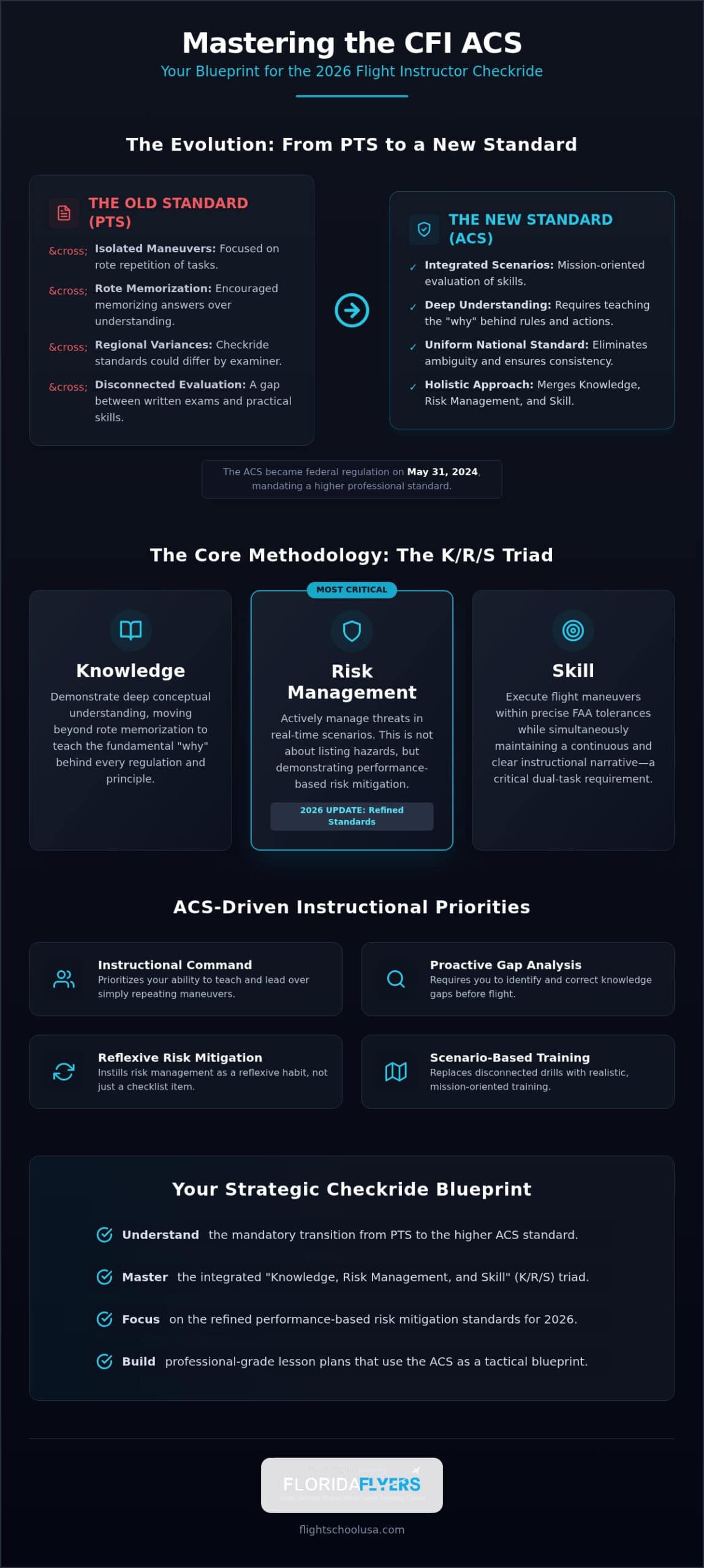
For decades, the Practical Test Standards (PTS) governed flight testing with a focus on isolated maneuvers and rote memorization. This legacy model often created a disconnect between knowledge exams and practical flight proficiency. Examiners frequently operated with a degree of discretion that led to regional variances in checkride conduct. The FAA addressed these inconsistencies by incorporating the Airman Certification Standards into federal regulation as of May 31, 2024. This move ensures a uniform, national professional standard for every flight instructor candidate. By standardizing the requirements for knowledge, risk management, and skills, the FAA has eliminated ambiguity. You’re no longer guessing what an examiner might ask; you’re following a rigid, regulatory code designed to produce elite educators.
The current version of the cfi acs functions as a binding contract between the applicant and the examiner. It explicitly defines the tasks, the performance metrics, and the specific risk elements that must be addressed during the certification process. This document isn’t merely a guide for the checkride day. It’s a strategic tool for developing professional teaching habits that will endure throughout a pilot’s career. This strategic alignment ensures that:
Success in the modern aviation environment requires more than just meeting the minimum tolerances. It demands an integrated approach where scenario-based training replaces repetitive, disconnected drills. The 2026 standards prioritize the instructor’s ability to analyze a student’s performance and provide corrective action that aligns with safety and regulatory compliance. Every administrative task is treated as a critical component of your professional standing.
The CFI ACS is the mandatory regulatory standard that defines the knowledge, risk management, and skill requirements for flight instructor certification in 2026.
The cfi acs methodology represents a structural evolution in aviation training. It moves beyond the binary pass or fail maneuvers of the past. Every task is now evaluated through the K/R/S triad: Knowledge, Risk Management, and Skill. This three-pronged approach ensures that an instructor candidate possesses the cognitive depth to explain a concept, the tactical awareness to manage threats, and the physical precision to demonstrate flight maneuvers simultaneously. This is the engine of the modern checkride.
Knowledge (K) elements require you to move beyond rote memorization. You must demonstrate a deep conceptual understanding of why a specific aerodynamic principle or regulation exists. On the oral exam, an examiner will look for your ability to teach the “why” to a student who has never flown. Skill (S) remains the foundation of flight proficiency. You must execute maneuvers within the tight tolerances defined by the FAA while maintaining a continuous instructional narrative. This dual-task requirement is often where unprepared candidates fail.
Risk Management (R) is the most critical addition to the testing standard. The FAA’s April 2026 refinement to the Risk Management sections mandates that candidates demonstrate performance-based risk mitigation in real-time scenarios. You’re no longer just listing hazards; you’re actively managing them. If a simulated engine failure occurs, you must identify the risk, evaluate the consequences, and execute a solution while explaining the decision-making process. This level of integrated command is what defines an elite flight instructor. Mastery of these elements is a core component of the CFI Fast Track Program, which prioritizes high-velocity proficiency over mere hours in a logbook.
Every requirement in the Official FAA Airman Certification Standards is assigned a unique alphanumeric code. For example, a code like FI.I.A.K1 identifies a specific Knowledge element within the first Area of Operation. These codes are not just for examiners. They are your tactical map for study and lesson plan development. By using these codes, you can precisely cross-reference FAA Handbooks and Federal Regulations to ensure your teaching material is technically accurate and compliant.
Strategic use of these codes allows for rigorous self-evaluation. If you struggle to explain the “Risk Management” portion of a steep turn, you can use the code to find the exact regulatory source for that requirement. This level of precision eliminates the “hidden costs” of inefficient training. It ensures that every hour spent in the classroom or cockpit is directed toward a specific, measurable outcome. Creating professional-grade lesson plans that mirror this coding structure signals to the examiner that you are prepared for the rigors of a professional pilot career.
The cfi acs framework organizes the instructor checkride into 17 distinct Areas of Operation. While your previous certifications focused on your ability to fly the aircraft, this standard shifts the burden of proof to your “Instructional Knowledge.” It’s no longer enough to be a high-performance pilot; you must prove you’re a high-performance educator. This means you have to dissect every maneuver, explain the underlying aerodynamics, and diagnose student errors before they become safety hazards. The FAA’s objective is to ensure you can maintain tactical command of the cockpit while simultaneously delivering a professional-grade lesson.
One of the most significant shifts in the 2026 standards is the introduction of “Demonstration of Flight Characteristics.” This task requires you to move beyond rote performance and show a deep understanding of how the aircraft behaves in various configurations. You’re expected to teach the student the “feel” of the aircraft, ensuring they recognize the subtle cues that precede a loss of control. This emphasis on instructional depth ensures that the next generation of pilots is trained by experts who understand the nuances of flight, not just the mechanics of the controls.
The 2026 updates have refined the Slow Flight tasks to better reflect real-world instructional scenarios. Task A requires maneuvering at airspeeds where any further increase in angle of attack would result in an immediate stall, while Task B focuses on demonstrating flight characteristics at various airspeeds and configurations. This distinction is critical for your checkride preparation. You must be able to explain why the aircraft responds differently in these regimes and how a student might inadvertently enter a dangerous state. The 2026 ACS prioritizes stall awareness and the identification of precursors over the mere mechanical execution of recovery procedures. This shift demands that you teach your students to avoid the stall entirely through superior situational awareness and risk mitigation. Instructors who pursue multi engine instructor training will find these same principles of asymmetric thrust management and loss-of-control awareness extend directly into the complex aerodynamic environment of twin-engine aircraft.
Area of Operation I, the Fundamentals of Instructing (FOI), remains the cornerstone of the entire certification process. Many candidates treat the FOI as a separate, theoretical portion of the oral exam, but the cfi acs requires you to integrate these principles into every technical task. If you can’t apply the laws of learning or the levels of understanding to a lesson on steep turns, you’re failing to meet the professional standard. Common pitfalls include a lack of preparation in the “Instructor Responsibilities” section, which the FAA has highlighted as a high-stakes area for 2026. You must demonstrate that you aren’t just a pilot with a certificate, but a disciplined mentor committed to the highest levels of regulatory compliance and student safety.
Treating the cfi acs as a final exam study guide is a tactical error that often leads to checkride failure. To command the oral examination, you must use the standards as the foundational architecture for your entire instructional portfolio. This means your CFI binder isn’t just a collection of notes; it’s a high-performance database organized strictly by the 17 Areas of Operation. A disciplined applicant presents an organized, professional presence that signals to the Designated Pilot Examiner (DPE) that they’re already operating at an airline-ready level. You aren’t just showing you can fly; you’re proving you can manage a complex regulatory environment.
Every lesson plan you develop must be a precise mirror of the FAA’s requirements. You can’t afford to use generic, off-the-shelf templates that lack the specific K, R, and S coding. Your plans must explicitly address the Knowledge, Risk Management, and Skill elements for every task. To satisfy the 2026 risk management standards, you must incorporate scenario-based training (SBT) into every briefing. Instead of just teaching how to perform a steep turn, you must create a scenario where a steep turn is a necessary tactical decision. Candidates who adhere to the CFI Fast Track Program standards understand that this level of detail is what separates a professional instructor from a hobbyist.
You shouldn’t wait for the DPE to find your weaknesses. You must use the ACS as your own grading rubric long before the checkride date. Recording your ground instruction is a non-negotiable requirement for self-refinement. When you playback your explanation of aerodynamic principles or weather theory, you’ll hear the gaps in your instructional delivery before they cost you a certificate. This methodical approach allows you to identify personal knowledge gaps and develop a tactical plan for the flight portion. You must ensure every maneuver is executed within the exact tolerances defined by the FAA while maintaining a continuous, clear instructional narrative. If you can’t teach it while you’re doing it, you haven’t mastered the task.
The transition from pilot to professional instructor requires a disciplined, high-velocity approach to training. Before pursuing your CFI, ensuring your commercial pilot license foundation is built on elite standards will directly accelerate your progression through the instructor certification process. Secure your success by joining our CFI Fast Track Program to ensure your preparation meets the elite standards of the modern aviation industry.
Mastering the cfi acs requires more than just access to an aircraft; it demands an environment of absolute discipline and regulatory rigor. Traditional, hourly-based flight schools often suffer from fragmented instruction and hidden costs that stall professional progression. At Flight School USA, we eliminate these inefficiencies through a high-velocity training model. Our programs are designed for pilots who view aviation as a high-stakes career rather than a secondary pursuit. By aligning every training hour with the strategic requirements of the ACS, we ensure our graduates are prepared for the immediate demands of the checkride and the long-term expectations of the airline industry. You aren’t just earning a certificate; you’re establishing your professional authority.
Our CFI Fast Track Program utilizes an immersion-based curriculum that far exceeds the minimum FAA requirements. While the cfi acs provides the baseline for certification, our academy standards are calibrated to the rigorous demands of commercial flight decks. This elite environment forces you to develop the instructional command and risk management habits necessary for high-level professional roles. You’ll move seamlessly from initial instructor certification into specialized tracks, including multi engine instructor training and our comprehensive Airline Pilot Career Training track. This progression is methodical, ensuring that your transition to complex turbine aircraft is supported by a foundation of instructional excellence. We don’t just teach you to pass; we train you to lead.
The path to a major airline cockpit begins with the strategic use of your instructor certificate. A CFI rating is your primary tool for building the high-quality flight time required for commercial roles. Choosing a Fixed-Price Career Program allows you to manage your professional investment with precision, protecting you from the financial volatility inherent in less structured environments. In the 2026 regulatory landscape, the ROI of an elite academy is measured in both time and technical proficiency. We provide the following strategic advantages to ensure your success:
Every administrative task and flight hour at Flight School USA is treated as a critical component of your professional legal standing. We function as a rigorous gatekeeper of industry standards, demanding excellence because the airlines demand it. Don’t leave your career to chance in a disorganized training environment. The final step in your professional evolution is enrolling in our next high-velocity CFI cohort. Contact our admissions team today to secure your place in a program that treats your certification as the critical legal and professional milestone it is.
The 2026 aviation landscape demands instructors who function as disciplined gatekeepers of safety and regulatory compliance. Mastery of the cfi acs is the primary differentiator between a pilot who simply flies and a professional who commands the instructional environment with absolute authority. You’ve seen how the K/R/S framework and refined task standards serve as a strategic blueprint for your career progression. Success in this high-stakes industry requires more than individual effort; it requires a structured environment that mirrors the rigors of commercial aviation.
Flight School USA provides the elite infrastructure needed to secure your future. As an FAA Part 141 Certified Academy, we offer elite fixed-price career tracks and professional student housing to ensure your focus remains entirely on your certification goals. Don’t leave your professional standing to chance in a fragmented or disorganized training program. It’s time to secure your command and lead the next generation of pilots toward excellence. Accelerate your career with our CFI Fast Track Program and join the ranks of elite aviation professionals.
The primary difference is the integration of Knowledge, Risk Management, and Skill elements into a single task-based framework. While the legacy PTS focused on isolated maneuver performance, the cfi acs mandates a holistic assessment of an applicant’s ability to identify and mitigate hazards in real-time. This structural shift ensures that instructors possess the cognitive depth to teach complex scenarios rather than just demonstrating physical proficiency in the aircraft.
The ACS coding system uses an alphanumeric string to identify specific requirements for the flight instructor checkride. For instance, in the code FI.I.A.K1, “FI” represents Flight Instructor, “I” indicates the Area of Operation, “A” denotes the specific Task, and “K1” identifies the first Knowledge element. Mastering this system is essential for cross-referencing FAA Handbooks and ensuring your instructional material remains strictly compliant with federal regulatory standards.
There aren’t entirely new maneuvers, but the 2026 standards introduce refined tasks such as the “Demonstration of Flight Characteristics.” This requirement forces applicants to teach the aircraft’s behavior at various airspeeds and configurations rather than just performing basic stalls. These refinements prioritize stall awareness and precursor identification over rote recovery procedures. Every task now requires a higher level of instructional knowledge to meet the rigorous performance-based standards of the current year.
You should build your lesson plans by mirroring the specific Knowledge, Risk Management, and Skill elements found in each ACS task. Using these elements as headers ensures that your teaching material covers every potential area of evaluation. This methodical approach demonstrates to the examiner that you’re prepared to deliver professional-grade instruction. It also aligns your training with the elite standards of a structured career program, eliminating the hidden costs of disorganized study.
Yes, you can fail a checkride based solely on a deficiency in the Risk Management section. The cfi acs treats risk mitigation as a mandatory performance element, not an optional discussion. If an applicant fails to identify a hazard or demonstrates poor judgment during a scenario-based task, the examiner is required to issue a notice of disapproval. This underscores the high-stakes nature of the 2026 standards, where safety and decision-making are as critical as flight precision.
The CFI ACS is strictly mandatory for all flight instructor practical tests in 2026. The FAA officially incorporated these standards into federal regulation on May 31, 2024, replacing the legacy Practical Test Standards. This transition means that the ACS is now the legal benchmark for certification. Any applicant attempting to use outdated PTS materials will be unprepared for the integrated Knowledge, Risk Management, and Skill requirements demanded by modern examiners and the aviation industry.
The ACS shifts the oral portion from rote memorization to a scenario-based evaluation of your instructional depth. Examiners now use the Knowledge and Risk Management elements to probe your ability to apply theory to real-world flight operations. You must demonstrate that you can teach the “why” behind every regulation and aerodynamic principle. This level of integrated command requires a disciplined preparation strategy that treats every administrative and technical task as a critical component of your professional standing.
Common mistakes include treating the document as a mere checklist rather than a teaching blueprint and neglecting the Risk Management elements during ground prep. Many applicants also fail to properly cross-reference the alphanumeric codes with the appropriate FAA Handbooks. This lack of precision results in shallow lesson plans that don’t meet the professional-grade standards expected of an elite instructor. Success requires a high-velocity approach where every ACS task is mastered through rigorous self-evaluation and mock checkrides.


