
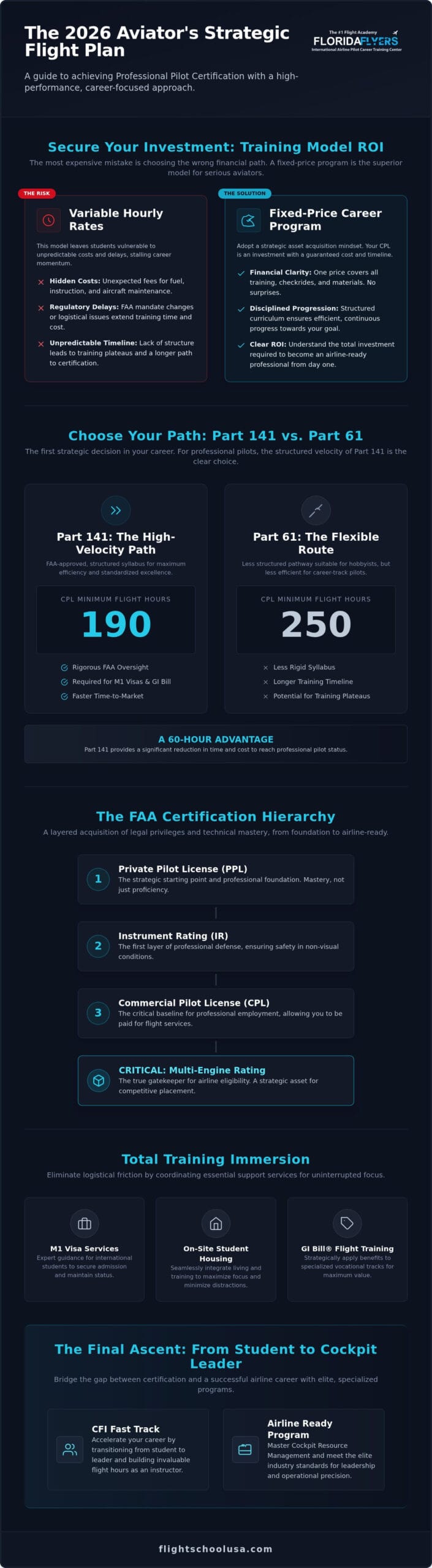
The most expensive mistake an aviator can make in 2026 isn’t a technical error in the cockpit; it’s selecting a training model that prioritizes hourly billing over professional outcome. While many schools operate on variable rates that leave students vulnerable to hidden costs and regulatory delays, securing your professional pilot certification requires a strategic asset acquisition mindset. You likely recognize that the current aviation environment demands more than just basic proficiency. It requires navigating complex FAA mandates and overcoming logistical barriers like housing shortages or M1 visa restrictions that often stall career momentum.
We agree that the path to a Commercial Pilot License should be a disciplined progression, not a series of unpredictable expenses. This guide empowers you to master the regulatory requirements and career pathways necessary to secure your credentials through high-performance training structures. You’ll gain a clear understanding of the ROI offered by fixed-price career programs and the tactical advantages of an airline-ready environment. We will preview the essential milestones for 2026, from CFI fast-tracking to specialized GI Bill support, ensuring your transition from student to professional pilot is executed with surgical precision and institutional authority.
The FAA Certification Hierarchy is a rigid regulatory sequence designed to filter for excellence. Obtaining your professional pilot certification isn’t a singular event but a layered acquisition of legal privileges and technical mastery. For the 2026 aviator, understanding this progression is vital as the FAA continues to modernize standards through initiatives like Proposal FAA-2026-7163. This hierarchy moves from the foundational Private Pilot License (PPL) through the Instrument Rating (IR), culminating in the Commercial Pilot License (CPL). While the Airline Transport Pilot (ATP) certificate remains the ultimate goal for major carriers, the CPL serves as the critical baseline for professional employment, allowing pilots to legally receive compensation for their flight services.
The necessity of specialized ratings cannot be overstated. An Instrument Rating is the first layer of professional defense, ensuring safety in non-visual conditions. However, the true mark of a career-track pilot is the addition of a Multi-Engine Rating. In the current 2026 hiring climate, a single-engine commercial certificate is often insufficient for competitive placement. Every rating added to your professional pilot certification acts as a strategic asset, increasing your marketability and reducing the time required to reach airline-ready status.
The Private Pilot License is the strategic starting point for every professional track. It’s often where the divide between hobbyists and professionals becomes apparent. In our high-performance environment, we treat the PPL as a professional internship. Candidates don’t just learn to fly; they begin mastering the discipline required for complex airline operations. Meeting the prerequisites for entering a Fixed-Price Career Program requires a PPL that demonstrates more than just basic proficiency. It requires a commitment to the rigors of full-time, immersive training and a refusal to accept mediocre standards.
A professional pilot certification is incomplete without specialized ratings that expand operational capacity. The Multi-Engine Rating is the true gatekeeper for airline eligibility. Most professional-grade CPLs must include multi-engine privileges to satisfy modern carrier requirements. Training at this level focuses on several critical pillars:
The 2026 regulatory environment demands strict adherence to these standards. Failure to meet the ACS criteria doesn’t just result in a failed checkride; it signals a lack of professional readiness that elite academies do not tolerate. Success at this stage secures your CPL, the legal foundation of your entire aviation career.
The selection between Part 141 and Part 61 is the first major strategic hurdle in securing your professional pilot certification. While Part 61 offers flexibility for hobbyists, the high-performance demands of commercial aviation prioritize the structured velocity of Part 141. Elite academies utilize Part 141 because it follows a rigid, FAA-approved syllabus that guarantees a standardized level of excellence. This structure isn’t just about compliance; it’s about efficiency. Under Part 141, the minimum flight hour requirement for a Commercial Pilot License is reduced to 190 hours, compared to the 250 hours mandated under Part 61. This 60-hour difference represents a significant reduction in time-to-market for aspiring professionals.
FAA oversight under Part 141 ensures that every training hour aligns with Official FAA Pilot Requirements. This rigorous auditing process is why international students on M1 visas and veterans utilizing vocational benefits are typically required to train under this framework. A structured syllabus is the backbone of successful airline pilot career training. It eliminates the training plateaus often found in less formal environments, ensuring that every sortie builds toward specific cockpit leadership objectives. To ensure your trajectory remains on schedule, enrolling in a Fixed-Price Career Program provides the cost certainty required for high-velocity training.
Part 61 remains a tactical tool for specific add-on certifications. For example, once the primary professional pilot certification is secured, some candidates use Part 61 for their CFI certificate to allow for a more personalized schedule while building time. It serves as a superior choice for pilots who’ve already mastered the core curriculum and need to target specific skill gaps without the rigidity of a full syllabus. However, for those seeking the fastest ROI, the integration of Part 141 remains the gold standard. Balancing speed and structure requires a hybrid mindset, but the foundation must always be rooted in institutional discipline to ensure long-term career viability.
Many aspiring aviators view flight training as a series of disparate expenses rather than a consolidated capital investment. The pay-as-you-go model, while appearing accessible, is a financial trap that exposes students to the volatility of aviation inflation. Securing your professional pilot certification requires a strategic hedge against rising operational costs. A Fixed-Price Career Program eliminates the variable risks of fuel price spikes and sudden instructor rate increases, transforming training from an unpredictable expense into a manageable asset. By locking in costs, you protect your capital and focus exclusively on the technical proficiency required to reach a high-earning airline pilot salary. Before committing to any program, reviewing a detailed ATP flight school vs fixed price program cost analysis for 2026 will clarify exactly where your tuition liabilities begin and end.
Calculating the true cost of certification involves more than just aircraft rental. Professional students must account for Designated Pilot Examiner (DPE) fees, which in 2026 range from $750 to $1,200 for single-engine checkrides. Additionally, FAA knowledge test fees average approximately $175 per attempt. When these costs are bundled into a high-performance training structure, the financial friction of “checkride day” is mitigated, allowing the pilot to perform under high-stakes conditions without the distraction of administrative debt.
Hourly students often face “billable hour creep” caused by fuel surcharges and aircraft maintenance delays. When a training aircraft is grounded, the hourly student loses both momentum and capital. In contrast, an all-in pricing structure provides a psychological advantage that directly correlates with higher checkride pass rates. Students don’t waste mental energy calculating the cost of a missed approach; they focus on mastery. Beyond flight hours, budgeting for professional-grade equipment is critical. This includes high-performance digital flight bags and noise-canceling headsets, which are essential tools for any pilot seeking professional pilot certification. For a comprehensive breakdown of every expense involved, review our pilot course price guide for 2026 to ensure your capital is allocated with precision.
Choosing the right funding vehicle is as important as choosing the right aircraft. While personal loans may offer lower initial rates, institutional financing often provides deferred payment structures tailored to the pilot’s career trajectory. For those with military backgrounds, the GI Bill for Flight Training serves as an elite resource, covering vocational training costs that would otherwise require significant personal debt. Maximizing training hours per dollar is best achieved through immersive residency. Utilizing on-site Student Housing allows for full-time focus, reducing the total calendar time to certification and accelerating your entry into the workforce. This efficiency is the ultimate protector of your investment.
Securing a professional pilot certification requires clearing the highest regulatory hurdle before any flight hours are logged: the FAA First-Class Medical Certificate. This examination, costing approximately $150, is the only medical standard accepted for airline transport operations. In 2026, the FAA has implemented progressive “Fast Track” pathways for specific conditions, but the baseline physical requirements for vision, hearing, and cardiovascular health remain uncompromising. For international applicants and veterans alike, this certificate is the non-negotiable legal foundation of a commercial career. High-intensity training tracks demand total commitment, and institutional barriers like visa processing or funding must be managed with surgical precision to maintain momentum.
International candidates face unique regulatory hurdles that can stall a career before it begins. The M1 Visa is the specific vocational vehicle for flight training in the United States. The admission process is methodical, requiring a Form I-20 from an FAA Part 141 certified institution. Applicants must account for the $185 DS-160 fee and the $350 SEVIS I-901 fee as part of their initial capital outlay. Beyond the paperwork, ICAO English language proficiency is a mandatory safety standard. US-based FAA certification holds immense prestige in the global market, often serving as a superior credential for pilots returning to their home countries because it signals training under the world’s most rigorous oversight.
Veterans transitioning to command find that vocational flight schools offer a tactical advantage over degree-granting programs. For the 2026-2027 academic year, the Post-9/11 GI Bill annual cap for vocational flight training is $17,661.89. This funding is specifically designed for using the GI Bill for flight training at academies that prioritize speed and professional placement over traditional academic timelines. Converting military flight experience to civilian FAA certificates requires a deep understanding of regulatory equivalencies and a school that understands the discipline of a veteran student.
Full-time immersion is the only way to maintain the high-velocity pace required for Part 141 success. On-site Student Housing eliminates the logistical friction of daily commuting, allowing pilots to remain in a “cockpit mindset” throughout their residency. This immersive environment is critical for mastering complex systems and preparing for the rigors of airline operations. To ensure you are utilizing your benefits effectively, review our strategic guide for GI Bill flight training to maximize your career trajectory.
The 1,500-hour requirement for an Airline Transport Pilot (ATP) certificate represents the final regulatory chokepoint in an aviator’s career. While the Commercial Pilot License permits compensation, it doesn’t satisfy the entry-level mandates of major carriers. The CFI Fast Track Program is the ultimate strategic tool to bridge this gap. By becoming a Certified Flight Instructor, you don’t just build time; you master the nuances of the National Airspace System while being paid to fly. This phase is critical for refining the technical skills acquired during your professional pilot certification and proving your readiness for the high-stakes environment of a Part 121 cockpit.
Transitioning from a student to an instructor is a profound professional milestone. It requires a shift from “learning to fly” to “learning to teach,” a process that demands absolute mastery of FAA regulations and aeronautical knowledge. Elite academies utilize accelerated tracks for CFI, CFII (Instrument), and MEI (Multi-Engine) ratings to ensure rapid career advancement. This standardization doesn’t just produce instructors; it creates future captains. High-performance instruction forces you to anticipate errors and manage cockpit resources with a level of authority that solo time-building simply cannot replicate. It’s the most disciplined path to meeting the 1,500-hour rule.
The final transition involves moving beyond basic certification into cockpit leadership. Our Airline Ready Program philosophy focuses on the practical application of Crew Resource Management (CRM) and high-altitude operations. These are not merely endorsements; they’re the final checklist items for a professional first officer. You’ll master complex multi-engine turboprop or jet environments, ensuring that your first day at a major airline is a continuation of your training rather than a shock to your system. This immersive preparation is what separates a candidate from a future airline captain.
The path to the majors concludes with the ATP CTP (Certification Training Program) and the final checkride. By the time you reach the 1,500-hour threshold, your professional pilot certification has evolved into a comprehensive portfolio of elite credentials. You aren’t just a pilot with hours; you’re a seasoned professional with the institutional discipline required to command a commercial aircraft. This methodical approach ensures that your placement in an airline-ready environment is the inevitable result of your high-performance trajectory.
The transition from an aspiring student to a commercial first officer requires more than just flight hours; it demands a rigorous adherence to institutional standards and financial foresight. By prioritizing the structured Part 141 pathway and utilizing fixed-price models, you insulate your career against the volatility of the modern aviation market. Your professional pilot certification is the ultimate credential in a high-stakes industry that rewards precision and elite training. Success at this level is not accidental. It’s the result of a methodical approach to regulatory compliance and technical mastery.
Flight School USA stands as a premier leader in this field, functioning as a rigorous gatekeeper of industry standards. As an FAA Part 141 Certified Academy, we provide the specialized infrastructure necessary for success, including dedicated international student M1 visa support and on-site professional student housing. These assets ensure you remain in a high-performance mindset throughout your residency. The time for variable costs and training delays has passed. Secure your future by choosing a partner that demands excellence and delivers results. Apply for the Fixed-Price Career Program at Flight School USA today and accelerate your trajectory toward the flight deck. Your career in the clouds is ready for takeoff.
The most efficient route to professional pilot certification is through an FAA Part 141 accelerated track. These programs utilize a structured syllabus that reduces the minimum flight hour requirement for a Commercial Pilot License to 190 hours. By contrast, Part 61 requires 250 hours. Full-time immersion in a high-performance academy environment ensures that technical proficiency is achieved without the delays common in flexible, part-time training models.
You can utilize Post-9/11 GI Bill benefits for professional pilot certification at vocational flight schools without pursuing a college degree. For the 2026-2027 academic year, the annual cap for vocational flight training is $17,661.89. It’s important to note that the GI Bill does not cover the initial Private Pilot License for non-degree programs; veterans must secure their PPL independently before applying benefits to advanced ratings.
In 2026, the national average cost to transition from zero experience to a Commercial Pilot License ranges between $70,000 and $100,000. This includes the Private Pilot License, which averages $15,000 to $20,000, and subsequent advanced ratings. Beyond flight hours, candidates must budget for FAA knowledge tests at approximately $175 per attempt and Designated Pilot Examiner (DPE) fees, which typically range from $750 to $1,200 for single-engine checkrides. For a detailed breakdown of every line item in your training investment, consult our pilot course price breakdown for 2026 to plan your capital allocation with confidence.
Securing an M1 Visa requires a Form I-20 issued by an FAA Part 141 certified institution. Applicants must provide documented proof of financial support for the entire duration of their program. Essential administrative steps include filing the DS-160 form with its $185 fee and paying the $350 SEVIS I-901 fee. International students are generally prohibited from working in the U.S. while training under this vocational status.
Part 141 schools are superior for commercial pilot candidates because of their FAA-approved curriculum and rigorous oversight. This pathway allows for a 190-hour minimum flight time for the CPL, providing a faster ROI than the 250-hour Part 61 requirement. The disciplined environment of a Part 141 academy mirrors the training standards found at major airlines, ensuring graduates are prepared for the high-stakes demands of cockpit leadership.
A Commercial Pilot License (CPL) is the baseline credential that allows an aviator to legally receive compensation for flight services. It is the tactical foundation of a career. Conversely, the Airline Transport Pilot (ATP) certificate is the highest level of certification, requiring 1,500 flight hours and specific testing. While the CPL gets you into the professional workforce, the ATP is the mandatory requirement for serving at a major airline.
The most effective method for reaching the 1,500-hour airline requirement is through a CFI Fast Track Program. Becoming a Certified Flight Instructor allows you to accumulate hours while earning an income and mastering complex instructional standards. This phase is not merely about time-building; it’s about refining technical knowledge and cockpit resource management. Many Part 141 schools hire their own graduates to facilitate this rapid transition to airline-ready status.
Dedicated student housing significantly improves certification success rates by providing a total immersion environment. Eliminating the logistical friction of a daily commute allows pilots to maintain a constant “cockpit mindset” and fosters peer-to-peer learning with other professional candidates. This high-intensity focus is critical for staying compliant with the rigorous timelines of a Part 141 syllabus and ensures that training momentum is never compromised by external distractions.


