

The “fixed cost” estimate provided by a high-volume flight factory is often the most volatile variable in a pilot’s professional development. Many students enter accelerated programs expecting a clear financial runway, only to find their progress stalled by undisclosed examiner fees and mandatory “overage” hours that exceed their loan limits. When comparing the atp flight school vs fixed price program models for 2026, the primary risk isn’t the duration of the training, but the lack of a contractual ceiling on your tuition liabilities.
It’s understandable to feel anxious about the transition from student to professional when the financial requirements remain a moving target. This analysis delivers a definitive financial roadmap, promising a clear path to your 1,500-hour goal without the threat of hidden costs. We’ll examine why a Fixed-Price Career Program acts as a financial shield for your future and how our Airline Ready Program sets the elite benchmark for commercial readiness. By prioritizing proficiency over mere throughput, you’ll gain the confidence that your investment covers every requirement necessary to reach CFI status and beyond.
The global demand for commercial aviators has reached a critical threshold in 2026, transforming flight training from a sequence of skill-based lessons into a high-stakes professional investment. Aspiring pilots can no longer afford to treat their education as a casual pursuit. The current market rewards those who approach their training with the same rigor required in a commercial cockpit. Analyzing the atp flight school vs fixed price program landscape reveals that “zero to hero” roadmaps must be viewed as professional investments rather than a series of individual lessons. This requires a level of financial discipline that matches the technical precision expected by major air carriers.
Major airlines increasingly prioritize candidates who have completed their training within high-intensity, structured environments. These institutions function as professional filters, ensuring that only those capable of adhering to strict regulatory standards reach the flight deck. Utilizing FAA Part 141 certification is no longer optional for those seeking an accelerated timeline; it is a necessity for maintaining compliance with modern industry expectations. This shift demands a transition from a hobbyist mindset to an elite professional standard where every flight hour is a data point in a broader career trajectory. Airlines aren’t just looking for licenses; they’re looking for graduates of programs that mirror the discipline of a professional flight department.
Economic factors in 2026 have introduced unprecedented volatility into the aviation sector. Fluctuating fuel surcharges and a competitive market for qualified flight instructors mean that “pay-as-you-go” models often lead to financial exhaustion before a student reaches their commercial checkride. When evaluating the atp flight school vs fixed price program models, the distinction between an estimate and a guarantee becomes the difference between career success and a stalled certification process. Most high-volume factories provide tuition estimates based on a perfect-world scenario, but they fail to account for inflationary pressure on hourly rates if a student exceeds the minimum syllabus requirements.
Establishing a “budget ceiling” is the most critical tool in a pilot’s financial arsenal. Relying on estimated hourly rates in a high-inflation environment is a tactical error that can leave a student with unfinished ratings and depleted loan funds. A professional training strategy must account for several critical factors:
Choosing a training path is a strategic decision that determines your long-term ROI. The Fixed-Price Career Program serves as a financial shield, ensuring that your tuition is an investment in a result, not just a purchase of time. This approach allows you to focus on achieving proficiency without the constant anxiety of a moving financial target.
The term “fixed cost” in a pilot factory contract often serves as a marketing anchor rather than a financial guarantee. High-volume academies operate on a throughput model, where the advertised price assumes a student will master complex maneuvers within the absolute minimum hours required by the syllabus. When comparing the atp flight school vs fixed price program models, candidates must recognize that a “fixed cost” estimate often excludes the inevitable variables of professional flight training. If you require additional time to reach proficiency in a specific stage, the financial burden shifts entirely to you, often leading to tuition exhaustion before you reach the flight deck.
Pilot factories manage high-volume throughput by prioritizing the schedule over the individual. This creates a significant financial risk for the student. While their initial quotes appear competitive, they frequently function as a baseline that ignores the reality of remedial training or weather delays. A true professional investment requires a model that prioritizes competency over time-stamped progression.
Understanding the legal distinction between tuition and total training liability is essential for long-term budgeting. Many large-scale programs present a tuition figure that excludes critical components such as ground school, pre-flight briefings, and technological subscriptions. These “not included” lists create a substantial financial gap that can derail a career path. If you struggle with a specific maneuver, you are often billed at a premium hourly rate that was not clearly defined in the initial agreement. You must scrutinize the refund and termination clauses of any academy; a lack of transparency here is a direct threat to your professional security. Elite programs eliminate these variables by integrating all necessary training into a single, predictable price point.
A Fixed-Price Career Program acts as a financial shield, absorbing market volatility and operational risks on behalf of the student. This “all-in” philosophy ensures that your tuition covers everything from training materials and professional housing to administrative support and regulatory compliance. By removing the anxiety of hourly billing, you can focus entirely on achieving the elite standards required for the Airline Ready Program. This level of financial command is what separates a premier academy from a standard flight school. It establishes a foundation of trust and allows for a training environment that prioritizes your mastery of the aircraft. To secure your future in the cockpit, you should evaluate our comprehensive career tracks that emphasize transparency and results.
The primary failure point in professional flight training isn’t typically a lack of pilot skill; it’s the depletion of capital due to unforeseen variables. Most students focus exclusively on the sticker price of a program, neglecting the “hidden” expenses that can add thousands to the final cost. When analyzing the atp flight school vs fixed price program landscape, you must recognize that many high-volume factories treat examiner fees, remedial hours, and administrative tech fees as external liabilities. This approach places the financial risk entirely on the student, often leading to a situation where loan funds are exhausted before the commercial checkride is even scheduled.
Administrative and technology fees represent another incremental erosion of your budget. Electronic flight bag subscriptions, specialized ground school software, and mandatory briefing materials are frequently omitted from initial quotes. While these may seem like minor expenses, they contribute to a cumulative financial strain that distracts from the primary goal of flight proficiency. A professional training environment should offer a “Total Command” solution that integrates these costs into a single, transparent structure.
The reality of the 1,500-hour path is that most students will exceed the minimum FAA requirements at some point in their training. In a standard hourly model, every struggle with a complex maneuver or a failed stage check becomes a profit center for the school. They have no financial incentive to ensure you reach proficiency within the syllabus timeline. Conversely, fixed-price programs incentivize training efficiency and instructor performance. Choosing professional pilot certification tracks that include built-in buffer hours ensures that a single difficult week doesn’t derail your entire career trajectory. It’s the difference between paying for time and paying for a result.
One of the most significant “traps” in the atp flight school vs fixed price program comparison is the handling of Designated Pilot Examiners (DPEs). In 2026, the costs for these independent contractors have reached new heights, yet they are rarely included in a pilot factory’s “fixed” quote. You’re often responsible for the examiner’s fee and the aircraft rental for the duration of the checkride, which can span several hours. If a school requires you to travel off-site for testing due to examiner availability, you may also bear the cost of travel and accommodation. An elite academy eliminates this uncertainty by providing a clear framework for practical test logistics, ensuring your focus remains on regulatory compliance and technical excellence rather than administrative fees.
Finally, housing and logistics represent an overlooked but critical expense. Residential flight schools that offer dedicated student housing provide a logistical advantage that supports a high-intensity training rhythm. Attempting to manage independent housing while pursuing a full-time career track adds unnecessary complexity and cost to an already demanding schedule.
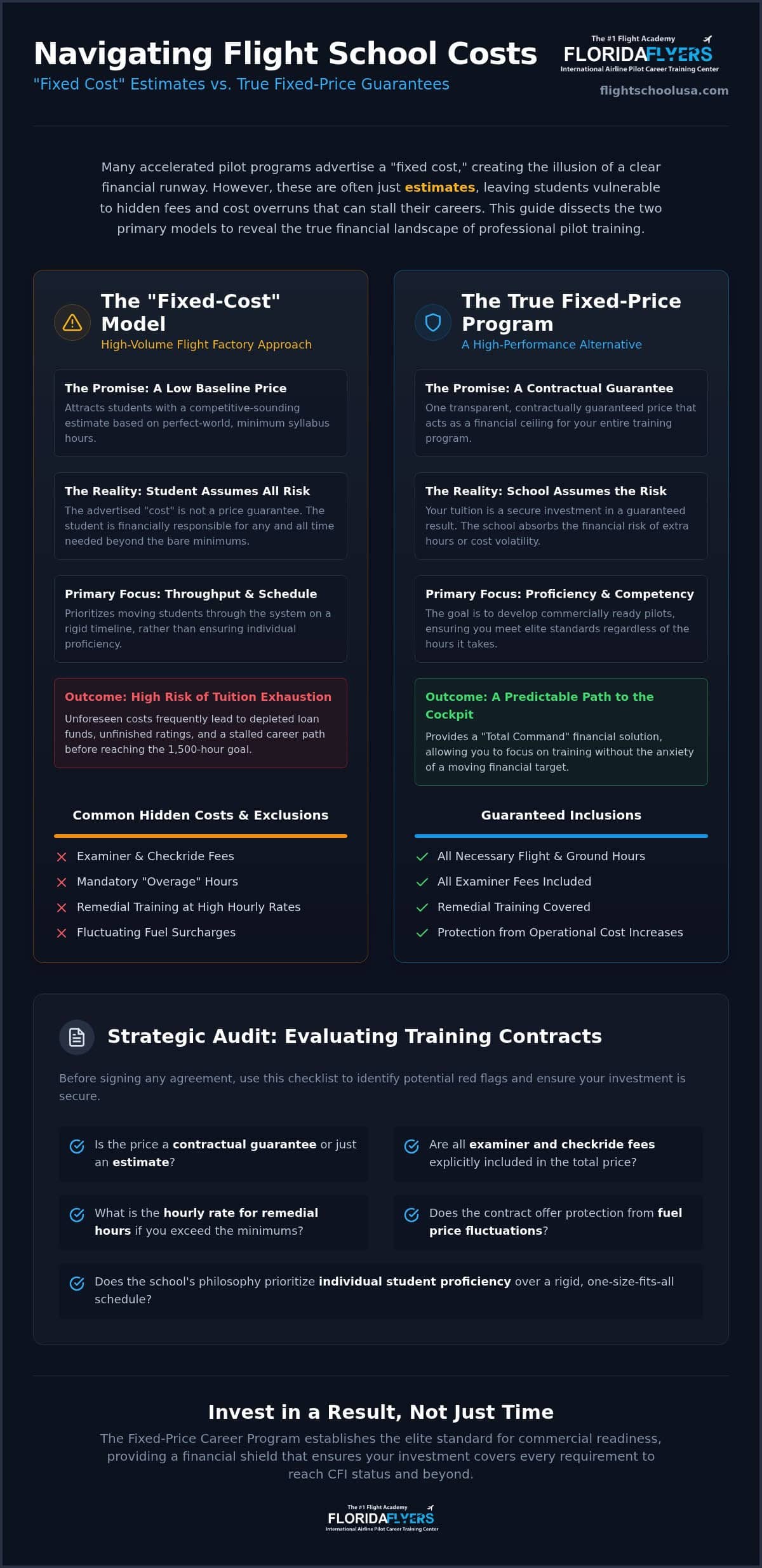
A professional pilot career is a high-stakes investment that demands a rigorous strategic audit of every training contract. Marketing brochures often obscure the technical reality of legal obligations. When evaluating the atp flight school vs fixed price program options, you must look beyond the initial quote to identify “red flag” terminology. Words like “estimated,” “hourly baseline,” or “subject to market adjustment” indicate that the financial risk remains with the student. A premier academy provides a contract that functions as a financial shield, not a series of open-ended liabilities. You should calculate the true cost per hour by integrating all tech fees, ground school requirements, and briefing sessions into your final assessment.
Assessing the pilot course price against the quality of the fleet and instructor-to-student ratio is vital. A low price point is irrelevant if aircraft availability is poor or if instructors are spread too thin to provide elite mentorship. High-performance academies maintain a strict ratio to ensure that every student receives the dedicated attention required to master complex regulatory standards. This discipline ensures that your training remains on schedule, protecting your ROI from the erosion caused by institutional inefficiency. For professionals considering a second career in the cockpit, understanding the full landscape of aviation career transition programs is an essential first step in building a financially sound training strategy.
The “Extra Hour” clause is a common failure point in standard agreements. You must demand a clear definition of what happens if a stage check requires a second attempt. Does your agreement include the use of advanced flight training devices for remedial work, or are you billed at a full aircraft rate? Fuel surcharge loopholes are another critical concern; a true fixed-price agreement absorbs these market shifts rather than passing them to the student. Verifying these details prevents the “checkride trap” where undisclosed costs surface at the most critical moments of your certification.
The ultimate metric of ROI is the time it takes to reach the flight deck. Delaying your entry into a major carrier by just two months can represent a loss of significant potential earnings when considering the current airline pilot salary benchmarks. While “pilot factories” emphasize speed, they often lack the depth of a structured career program that ensures first-attempt success. Programs that offer a CFI Fast Track Program allow you to start earning and building hours immediately after certification, drastically reducing the time to the 1,500-hour milestone. This efficiency is the cornerstone of a high-performance career strategy. To secure a training contract that prioritizes your financial command and professional results, you should apply for our Fixed-Price Career Program today.
We prioritize financial command and regulatory discipline as the dual pillars of professional success. While the atp flight school vs fixed price program debate often centers on duration, the true differentiator is the stability of the training environment. Our Fixed-Price Career Program functions as a powerhouse of industry knowledge, ensuring that students are never distracted by fluctuating costs or administrative uncertainty. This allows for a singular focus on the Airline Ready Program, which bridges the gap between basic certification and the rigorous demands of a commercial flight deck. By providing dedicated student housing, we eliminate the logistical friction that often slows down high-intensity career tracks, ensuring that your focus remains strictly on the flight line.
Our curriculum is engineered to produce elite candidates who are prepared for the high-stakes world of commercial aviation. By eliminating the anxiety of variable billing, we create a training atmosphere where proficiency is the only metric that matters. We focus heavily on checkride readiness, utilizing a methodical approach that minimizes the need for remedial training hours and ensures first-attempt success. Once certified, students can leverage our CFI Fast Track Program to reach the 1,500-hour milestone with professional precision. It’s not just a flight school; it’s a high-performance academy that demands excellence from every student who enters the program.
Navigating US training as an international student requires specialized support and procedural accuracy. We offer comprehensive M1 Visa admission services to ensure that our global candidates remain compliant with all regulatory requirements while pursuing their professional goals. This level of institutional credibility is vital for international pilots who need a reliable partner to navigate complex immigration and training systems. For those who have served, the tactical deployment of GI Bill flight training assets is a critical component of maximizing training ROI. We treat every veteran’s transition as a critical mission, providing the structured environment necessary to translate military discipline into a successful commercial career. Whether you’re a corporate professional or a former service member, a well-structured set of aviation career transition programs can provide the regulatory framework and financial certainty needed to accelerate your path to the flight deck.
Choosing your training path is a career-defining decision that determines your trajectory for years to come. If you’re ready to move beyond the limitations of a standard flight factory and embrace a model built on transparency, elite status, and professional results, it’s time to act. The aviation industry doesn’t wait for the unprepared. Apply for the Elite Fixed-Price Career Program and secure your future in the cockpit today.
Navigating the 2026 aviation landscape requires more than just technical skill; it demands a tactical approach to your professional investment. You’ve seen how “fixed-cost” estimates from high-volume factories often function as floating targets, leaving students vulnerable to tuition exhaustion and undisclosed examiner fees. By contrast, a structured Fixed-Price Career Program provides a definitive financial shield, ensuring that your capital is used to achieve results rather than just purchasing hours. When you analyze the atp flight school vs fixed price program options, the choice becomes a matter of professional command versus institutional throughput.
Our academy remains a rigorous gatekeeper of industry standards, offering FAA Part 141 Accredited Excellence and an Elite CFI Fast Track Path designed for rapid career progression. Whether you’re an international student requiring M1 Visa support or a veteran utilizing Comprehensive International & Veteran Support, our mission is to ensure your transition to the flight deck is seamless and secure. Don’t leave your commercial career to chance or variable billing models. Secure Your Career with Our Fixed-Price Program and join the ranks of elite aviators today. Your future as a professional pilot starts with a commitment to excellence and financial discipline.
The tuition structure at a high-volume flight factory is typically based on an estimate of minimum flight hours required by the FAA. While the initial quote appears stable, it assumes perfect progression through the syllabus. If you require additional time to master a maneuver or experience weather delays, you’re usually billed for overage hours at current market rates. This creates a variable financial liability that can exceed your original loan amount.
A fixed-cost model is an estimate based on a set number of hours, while a fixed-price program is a contractual guarantee for a specific result. When comparing the atp flight school vs fixed price program models, the latter acts as a financial shield. It absorbs operational risks and market volatility, ensuring your tuition covers the entire path to certification regardless of minor fluctuations in training hours or fuel costs.
Most large-scale academies exclude examiner fees from their initial quotes, treating them as external liabilities paid directly to independent contractors. These checkride costs are significant and can occur multiple times if a student requires a re-test. High-performance programs prioritize transparency by clearly defining these logistics, whereas throughput-focused factories use these exclusions to lower their advertised sticker price, shifting the financial risk entirely to the student pilot.
An elite fixed-price program integrates a buffer of hours into the curriculum to ensure every student reaches the required proficiency levels. The institution incentivizes instructor efficiency and student success rather than profiting from remedial training. If you need additional time to meet regulatory standards, the academy absorbs those costs. This model prioritizes your mastery of the aircraft over maintaining a high-volume schedule, providing total financial command during your training.
Veterans can utilize GI Bill benefits for flight training if the academy is FAA Part 141 certified and maintains VA approval for its career tracks. This requires a tactical deployment of benefits to maximize your return on investment. We provide specialized support for veterans to ensure their transition into commercial aviation follows a strict regulatory path. This structured environment allows former service members to apply their discipline toward reaching the 1,500-hour milestone.
A comprehensive career track integrates professional student housing and all necessary training materials into a single price point. This “all-in” philosophy is designed to eliminate logistical friction and maintain a high-stakes focus on your professional development. By including these essentials, the program prevents the incremental budget erosion common in pay-as-you-go models. It ensures that your living arrangements and technological tools are fully aligned with the rigors of a full-time flight schedule.
Excluding checkride costs allows a flight factory to present a more competitive initial price to prospective students. This strategy shifts the financial consequence of a failed stage check or practical test onto the student’s shoulders. It reflects a business model focused on volume and throughput rather than individual student proficiency. Elite academies avoid these traps by providing clear financial roadmaps that account for the technical and administrative realities of the certification process.
The most efficient route to a commercial flight deck is through a program that combines a CFI Fast Track with an Airline Ready Program. While speed is a priority, it must be balanced with the technical depth required for first-attempt checkride success. Programs that emphasize financial stability and regulatory discipline allow you to build hours consistently. This methodical approach ensures you reach the 1,500-hour requirement without the delays caused by tuition exhaustion or remedial training gaps.


