
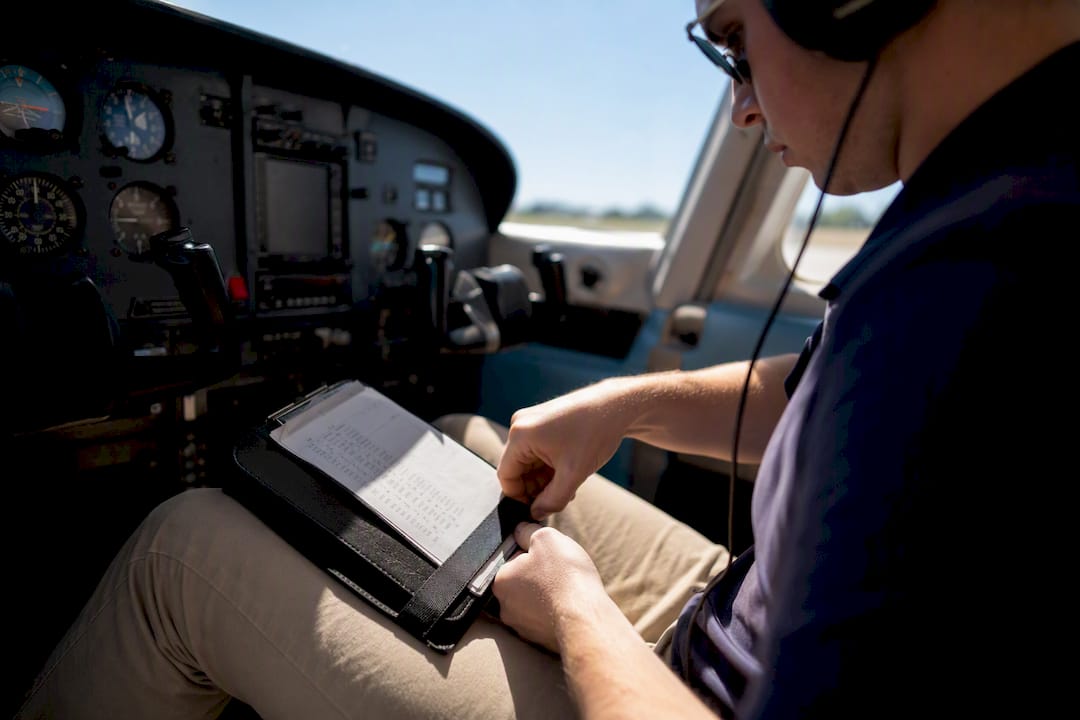
The DPE will test five maneuver groups: takeoffs and landings in their normal, short, soft, and crosswind variants, performance maneuvers like steep turns and ground reference work, slow flight and stalls, basic instrument maneuvers, and emergency operations including go-arounds. The single fastest route to a pass is training every maneuver to half the ACS tolerance using a repeatable four-part flow, so ordinary checkride stress never pushes your numbers outside the standard.
TL;DR:
- Training to half the ACS tolerance, roughly ±50 feet on altitude, provides a better cushion for adrenaline and minor deviations during the test.
- Examiners evaluate your risk management ability by asking you to explain aerodynamic risks and decision processes in addition to observing your flying skills.
- A consistent four-phase flow—setup, entry and callouts, primary references, and recovery—applies to every maneuver and simplifies performance under pressure.
- Accurate use of performance numbers from the POH, oriented around ranges instead of exact values, aligns with examiner expectations and grading.
- Completing all preflight documentation and demonstrating proficiency in ground operations like taxi and run-up significantly impacts initial impressions and success.
Passing your checkride comes down to discipline in a handful of repeatable habits, not raw stick-and-rudder talent. Here’s what matters most before you ever call for your practical test.
Pro Tip: A DPE would rather watch you go around cleanly than watch you salvage a bad approach. A go-around demonstrates judgment; a hard landing demonstrates the opposite.
The FAA notes that ACS tolerances are the outer edge of acceptable performance, not a target. Training to half those numbers, roughly ±50 feet on altitude instead of ±100, gives you a cushion for the adrenaline that shows up on test day.

The FAA Private Pilot Airplane ACS organizes the checkride into Areas of Operation, from Preflight Preparation through Postflight Procedures, and breaks each Area into individual Tasks. Steep turns, slow flight, power-on and power-off stalls, ground reference maneuvers, basic instrument maneuvers, and every takeoff and landing variant each get their own Task listing.
Every Task carries three components the DPE must evaluate: Knowledge, Risk Management, and Flight Skills. You can fly a mechanically perfect steep turn and still fail the Task if you can’t explain the aerodynamic risks of exceeding the bank angle or identify how you’d recognize an accelerated stall. Examiners are trained to probe all three, often verbally, right in the middle of a maneuver.
The ACS didn’t just add a checklist of numbers to hit. It added an expectation that you narrate your thinking, so the examiner can see risk management happening in real time, not just watch the airplane fly a nice pattern.
Numeric tolerances still matter. Altitude holds to ±100 feet, headings to ±10 degrees, airspeed to ±10 knots, and landing touchdown points fall within specific distances depending on whether you’re flying a normal, short-field, or soft-field landing. But a single momentary deviation rarely fails a Task by itself. Sustained deviation, or deviation paired with poor awareness, is what triggers a Notice of Disapproval.
Every maneuver on the checkride, from steep turns to soft-field landings, breaks down into the same four phases. Training this flow instead of memorizing each maneuver separately cuts your cognitive load dramatically when the pressure is on.
A kneeboard or EFB note page built around this flow should list target airspeeds, entry and recovery altitudes, flap and power settings, and your personal go-around triggers for every maneuver on the ACS. Pull your target speeds directly from the POH or AFM rather than rules of thumb passed down from other students; published performance numbers are what the DPE expects you to know cold.
Pro Tip: Write your kneeboard numbers as ranges, not single values (68 to 70 knots, not “69 knots”). It matches how the ACS actually grades you and keeps you from fixating on a number that’s already slipping.
The checkride begins well before engine start. Areas of Operation I and II cover preflight preparation and procedures, and DPEs treat weak performance here as a preview of weak performance in the air.
FAA safety guidance specifically calls out runway incursion avoidance and proper radio readbacks as risk management items examiners watch for on the ground, long before the airplane ever leaves the pavement.
Landings decide more checkrides than any other maneuver group, largely because each variant demands a different sight picture and a different tolerance for error.

Normal takeoffs and landings require a stabilized approach on centerline, touchdown at approach speed within a reasonable distance of your aim point, and no ballooning or porpoising on rollout.
Short-field takeoffs and landings ask for maximum performance technique: full power before brake release on takeoff, and on landing, touchdown within 200 feet beyond a specified point at approach speed. Coming in too fast is the single most common short-field failure. Extra speed on final turns directly into extra float, and float eats the runway distance you were trying to save.
Soft-field procedures keep weight off the nosewheel throughout taxi, takeoff, and landing, using back pressure and a smooth transition to a shallow climb without a hard break from the surface.
Forward slips correct excess altitude on final without adding airspeed, and demand smooth, coordinated rudder and aileron inputs rather than a jerky recovery back to normal approach attitude.
Go-arounds need to happen the instant an approach becomes unstable, executed with full power, pitch for climb, and a clean configuration change, not a last-second bailout from a landing that’s already going wrong.
These four maneuver families make up the heart of the checkride’s flight skills evaluation, and they follow a predictable pattern of entry, hold, and recovery that rewards deliberate practice.
The FAA Airplane Flying Handbook frames stall recognition around aerodynamic cues, buffet, mush, and control mushiness, rather than waiting for a horn or light. Examiners want to see you catch the airplane at the first cue, not after the full break.
Simulated emergencies test your decision process as much as your stick-and-rudder response, and the DPE is grading how methodically you work the problem.
Treat the entire day, not just the flight portion, as the checkride. Examiners form impressions during the oral that carry into how closely they scrutinize your flying.
A handful of maneuvers account for most checkride failures, and each one responds to a specific, targeted drill rather than generic repetition.
Short-field landings fail most often from excess approach speed, which pushes touchdown well past the 200-foot standard. Steep turns fail from altitude bleed during the back half of the turn, usually from relaxed back pressure. Stalls fail from delayed recognition or an over-aggressive recovery that trades one problem for another.
Pro Tip: Sequence your 30-day plan from low workload to high: slow flight and stalls in week one, steep turns in week two, ground reference in week three, and performance landings in week four. Stacking skills this way keeps each new maneuver built on a foundation you’ve already proven.
Flightschoolusa built its private pilot syllabus directly around ACS Areas of Operation, sequencing every lesson through the same four-part flow covered above: setup, entry and callouts, primary references and tolerances, recovery and cleanup. Because the academy holds Self Examining Authority, checkrides happen in-house rather than waiting on outside DPE availability, which keeps students moving through their PPL to ATP pathway in as few as 111 hours of total flight training.
That structure shows up in results: Flightschoolusa reports a first-time pass rate well above average on FAA practical exams, well above what disorganized, ad-hoc maneuver practice typically produces. Combined with competitive program pricing, the syllabus gives students a clear, examiner-aligned path instead of a patchwork of borrowed study guides.
[Author bio and student case studies to be added by the editorial team.]
Most checkride advice treats maneuvers as isolated skills to drill in whatever order feels comfortable. That’s backward. The ACS itself groups every Task around three shared components, knowledge, risk management, and flight skills, which means a candidate who narrates their thinking clearly can absorb a minor tolerance slip that would sink a silent, mechanically perfect flight.
The conventional wisdom oversells stick-and-rudder polish and undersells the oral exam. A missing endorsement or a shaky cross-country briefing ends a checkride before the propeller turns, yet plenty of students spend their final week rehearsing steep turns instead of their weather logic.
If you take one thing from this guide, make it the half-tolerance training standard. Flying to ±50 feet in practice instead of the ACS’s ±100 feet builds the margin that anxiety, wind gusts, and an unfamiliar airplane will inevitably eat into on test day. Everything else, the kneeboard template, the 30-day plan, the four-part flow, exists to protect that margin.
— Rainer
Flightschoolusa gives you something a study guide can’t: an in-house checkride, so you’re not waiting weeks for outside DPE availability once your training is complete. Because the academy holds Self Examining Authority, your private pilot practical exam happens on the same syllabus you trained on, evaluated against the exact ACS Areas of Operation covered in this guide.

That alignment between training and testing is why Flightschoolusa’s first-time pass rate runs above 90 percent, and it’s part of why students can move from private pilot through ATP in a relatively low number of total flight hours. If you’re ready to put a structured, examiner-aligned syllabus behind your checkride prep instead of assembling one from scattered resources, visit Flightschoolusa to review program options and request a training schedule.


