

The most expensive mistake an aspiring aviator can make in 2026 isn’t choosing a high-prestige academy; it’s failing to account for the hidden variables that transform a quoted hourly rate into a financial dead end. You understand that the stakes of professional aviation demand more than just a casual hobbyist’s budget. You’re likely concerned about the volatility of a pilot course price that fluctuates with every fuel surcharge or remedial lesson. This uncertainty often leads to the most critical failure in training: stalling out mid-program because the capital simply ran dry before the certification was secured.
This guide provides the definitive financial roadmap you need to navigate this high-stakes investment with precision. This breakdown moves beyond vague estimates to offer a clear understanding of the total capital required to transition from zero experience to a professional airline career. You’ll learn how to identify the most efficient training tracks, evaluate the ROI of elite certification, and demystify the complex financial requirements of the GI Bill and M1 Visa systems. By the end of this analysis, you’ll possess a predictable strategy to reach the airlines without the risk of financial insolvency.
The fiscal environment for aviation training in 2026 is defined by a paradox of record-breaking demand and intensifying operational overhead. Evaluating a pilot course price today requires a granular understanding of how fuel volatility, aircraft maintenance cycles, and the global instructor deficit converge to set the baseline for professional entry. For the serious candidate, this isn’t merely a tuition payment. It’s a strategic deployment of capital into a high-yield professional asset. Success requires distinguishing between the fragmented costs of recreational flying and the comprehensive investment required for an airline career. Efficiency is no longer just a training goal; it’s the primary mechanism for cost mitigation in an era of rising logistical expenses.
Recreational training often prioritizes convenience, whereas professional tracks prioritize velocity and regulatory compliance. FAA Part 141 programs offer a structured curriculum that often reduces the total flight hours required for Pilot licensing and certification compared to the more flexible, but often less efficient, Part 61 model. While a Part 61 school might appear cheaper on an hourly basis, the lack of a rigid syllabus frequently leads to skill degradation and redundant lessons. Choosing a professional track ensures that every dollar spent is a direct step toward the flight deck, rather than a contribution to the “hourly trap” of unfocused training. High-stakes training demands a rigorous, summary-first approach to technical mastery to avoid the financial drain of remedial flight hours.
The sustained pilot shortage has fundamentally altered the economics of flight instruction. As airlines aggressively recruit active instructors, flight schools must offer competitive compensation packages to retain elite talent, which is reflected in the modern pilot course price. However, this same shortage has catalyzed the expansion of tuition reimbursement programs and flow-through agreements that can mitigate the initial financial burden. Candidates must view these costs through the lens of a professional’s legal standing and future earning potential. Career velocity is the most critical factor in pilot course ROI, as entering the airline seniority list just one year earlier can result in millions of dollars in additional lifetime earnings. Professional programs are designed to navigate these complex economic systems with a no-nonsense focus on results and efficiency.
Securing an airline seat requires a disciplined progression through five distinct regulatory milestones. Each phase represents a strategic layer of expertise, moving from basic airmanship to the complex systems management required by major carriers. Understanding how these certifications stack is essential for any candidate evaluating the total pilot course price for a professional track. This is not a fragmented hobby; it’s a rigorous, sequential career path where each rating builds the legal and technical standing necessary for high-stakes commercial operations.
Establishing the bedrock of your career begins with the Private Pilot Certificate (PPL). While the FAA mandates a minimum of 40 flight hours, the national average for 2026 remains between 55 and 70 hours. Failing to account for this discrepancy is a common cause of mid-training budget exhaustion. Beyond the cockpit, candidates must invest in professional-grade ground school, high-fidelity headsets, and digital flight bags. Technical proficiency in all-weather environments follows with the Instrument Rating (IR). This phase is the most intellectually demanding, requiring absolute mastery of the national airspace system and IFR procedures. For a comprehensive analysis of these initial phases, consult our Professional Pilot Certification guide. Reliable data on the general Pilot License Cost highlights that the IR is the critical pivot point where students transition from visual flyers to technical navigators.
The transition to professional-grade maneuvers occurs during the Commercial Pilot License (CPL) phase. This certification demands a higher level of precision and a deeper understanding of aircraft systems, typically requiring 250 total flight hours, or 190 hours under a structured Part 141 curriculum. The most significant increase in the pilot course price often occurs during the Multi-Engine Rating (ME). Operating twin-engine aircraft is an absolute requirement for airline-track progression, as it introduces the complexities of asymmetric thrust and advanced emergency procedures. This time-building phase must be managed with extreme efficiency to avoid unnecessary expenditures on high-performance aircraft rentals. You can review the mandatory standards for these ratings in our Airline Pilot Career Training breakdown. Candidates seeking to eliminate the volatility of these individual costs often find that a Fixed-Price Career Program provides the most secure financial ceiling.
The final strategic milestone is the Certified Flight Instructor (CFI) rating. While this requires an additional upfront investment, it serves as the primary mechanism for reaching the 1,500-hour airline minimum. By instructing, you stop paying for flight time and begin earning a professional wage while refining your technical expertise. This high-velocity approach ensures you remain sharp and compliant while the industry pays for your final steps toward the flight deck.
The “Hourly Trap” represents the single greatest threat to a student’s flight training completion. While a competitive hourly rate initially appears attractive, it often masks a volatile financial structure that shifts with every weather delay or maintenance discrepancy. In 2026, the traditional pay-as-you-go model exposes candidates to significant risk, as a fluctuating pilot course price can exceed original projections by 30% or more. This variability isn’t just a financial burden; it’s a strategic liability that can stall a professional career before it begins. Success in this industry requires a no-nonsense approach to capital management that prioritizes predictability over low-entry estimates.
Variable pricing models are subject to hidden stressors that most candidates fail to quantify. Fuel price volatility and sudden instructor turnover are the primary drivers of cost inflation that can hit a budget mid-course. Additionally, the true hourly cost of training extends far beyond the time the engine is running. Professional pilots must budget for intensive pre-flight and post-flight briefings, which are frequently billed at separate instructor rates. When you consider the FAA hourly requirements for certification, it’s clear that even a minor increase in rental rates creates a massive deficit over the life of a program. Relying on variable rates in a high-inflation environment is a gamble that elite aviators don’t take.
A Fixed-Price Flight Training Program functions as a definitive financial ceiling, shielding your capital from the unpredictability of the open market. This model aligns the school’s objectives with your own; the institution is incentivized to ensure you progress efficiently through the curriculum rather than lingering in the time-building phase. Contrast this with national average hourly tracks, where delays often result in additional revenue for the provider. For a detailed breakdown of how these models compare against high-volume accelerated programs, our ATP flight school vs fixed price program strategic cost analysis provides a definitive 2026 financial comparison. By locking in your pilot course price, you eliminate the fear of running out of money mid-training. This predictability offers a critical psychological advantage. In the high-stress environment of professional aviation, removing financial anxiety allows for total focus on technical mastery and regulatory compliance. It’s the difference between merely flying and training for an elite career.
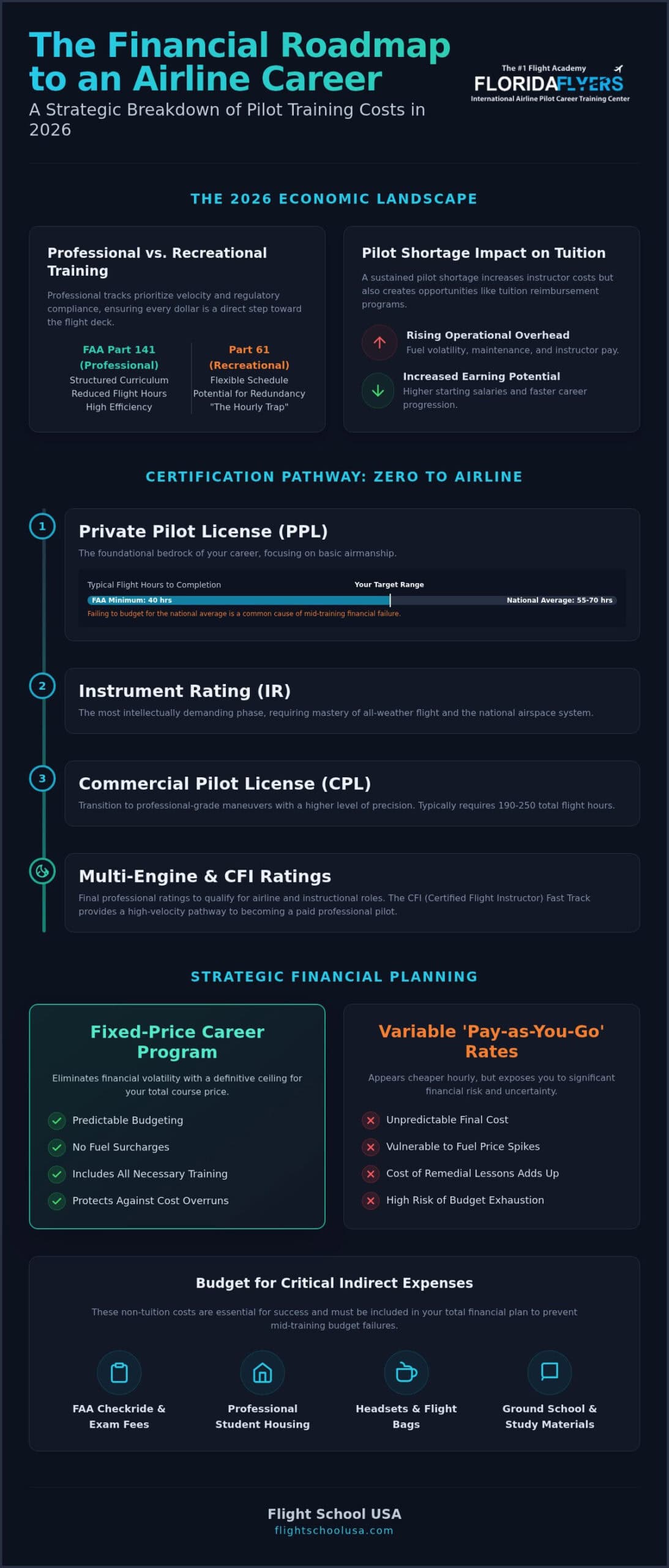
A comprehensive financial strategy for 2026 requires looking beyond the flight line. While the primary pilot course price often covers aircraft and instruction, the total cost of attendance encompasses every fiscal requirement from regulatory fees and medical certificates to housing and subsistence for the duration of the training track. Aspiring professionals must account for mandatory FAA checkride fees, which typically range from $500 to over $1,500 depending on the complexity of the certification. These fees are paid directly to Designated Pilot Examiners (DPEs) and represent a significant out-of-pocket expense that is rarely included in basic tuition quotes. Failing to budget for these administrative realities can create critical friction points during the final stages of your certification.
Strategic relocation is a primary driver of training efficiency. For full-time students, choosing an academy with dedicated Student Housing is not a matter of convenience; it is a tactical decision to minimize external cost variables. On-site residency eliminates the logistical burden of commuting and allows for total immersion in the high-stakes environment of professional aviation. Proximity to the flight line ensures you are available for every weather window and maintenance opening, maximizing your aircraft utilization and reducing the time required to reach your goals. International candidates should consult our 2026 US Flight School Guide for International Students to understand how housing integration impacts their specific training timelines and budget requirements.
Navigating the financial requirements for specific career tracks demands rigorous attention to regulatory detail. For veterans, the GI Bill for CFI Training represents a powerful mechanism to offset the investment required for advanced ratings. It is essential to understand which components of your training qualify for these benefits to ensure your capital is deployed with maximum efficiency. International students face a different set of challenges, specifically the financial proof requirements for M1 Visa admission services. The Department of State requires clear documentation of available funds to cover the entire pilot course price plus living expenses before a visa is issued. This high-level discipline in financial planning ensures that no student is forced to terminate their training due to foreseeable capital shortages. If you are ready to secure your financial future in the cockpit, you should apply for a professional career track today.
Ultimately, your success depends on a no-nonsense evaluation of the entire investment. Professional aviation rewards those who approach their training with the same precision they apply to a flight plan. By accounting for examiner travel, medical certifications, and subsistence costs early, you maintain the professional gravity necessary to navigate the complexities of an elite aviation career.
Professional aviation is a high-stakes investment where the true measure of success is the velocity of your career transition. While the initial pilot course price is a critical consideration, the most successful candidates focus on the return on investment (ROI) generated by entering the airline seniority list as early as possible. Flight School USA functions as a high-performance academy, providing the rigorous training and regulatory compliance necessary to secure elite status in the industry. Our Airline Ready Program is engineered to bridge the gap between commercial certification and the demanding environment of a professional flight deck, ensuring you possess the technical mastery required by major carriers.
The most effective strategy for reaching the 1,500-hour airline minimum is to transform your training from a cost center into a revenue stream. The CFI Fast Track Program is designed for high-performance students who seek to build professional flight time while earning a wage. By securing your instructor ratings through a structured Part 141 curriculum, you benefit from reduced hour requirements and the prestige of an elite institution. The break-even point for instructor certification is reached rapidly, as you transition from paying for aircraft rental to being compensated for your expertise. This methodical approach ensures you maintain the professional discipline required for long-term career success while maximizing your financial efficiency.
The 2026 economic landscape rewards those who prioritize risk mitigation and career speed. When you compare the total pilot course price to the projected Airline Pilot Salary, the financial logic of elite training becomes undeniable. A single year of lost seniority can result in a significant deficit in lifetime earnings, making a high-velocity training track the only rational choice for serious aviators. Candidates with prior corporate or military experience should review the structured aviation career transition programs available in 2026 to identify the most efficient pathway from their current credentials to the airline flight deck. Whether you are navigating the complexities of M1 Visa admission services or deploying GI Bill benefits, our admissions team operates with a no-nonsense commitment to your professional standing.
Flight School USA projects the authority of a powerhouse institution, acting as a protective gatekeeper for industry standards. We do not offer a casual hobby; we provide a rigorous pathway for those who demand excellence from themselves and their mentors. High-performance candidates ready to initiate their professional journey should contact our admissions department to begin the certification process. Your career in the flight deck starts with the discipline to choose the most efficient and prestigious training partner available.
Navigating the 2026 aviation landscape requires more than just technical aptitude; it demands a rigorous commitment to financial discipline and career velocity. You’ve identified the inherent risks of the hourly trap and the strategic necessity of a structured, Part 141 environment. By securing a definitive pilot course price through a fixed-price model, you eliminate the volatility that stalls less-prepared candidates. Success in this high-stakes industry is reserved for those who view their training as a high-yield professional asset rather than a recreational expense. Every decision, from choosing elite housing to leveraging the CFI Fast Track, must move you closer to the airline seniority list with maximum efficiency.
Flight School USA stands as a prestigious gatekeeper of industry standards, offering the elite fixed-price career tracks and dedicated veteran and international support required for your transition. As an FAA Part 141 Certified Academy, we provide the high-performance environment necessary for those who demand excellence. It’s time to stop calculating variables and start executing your professional flight plan. Secure Your Career: Apply for the Fixed-Price Career Program. Your future in the cockpit is a matter of discipline; we’re ready to help you command it.
Industry data for 2026 suggests that a full professional pilot program typically ranges between $70,000 and $100,000. This aggregate figure represents the total investment required to transition from zero experience to commercial certification. Individual costs fluctuate based on student aptitude and training frequency. A pilot course price at this level is a high-stakes investment in a professional career. Candidates should evaluate these figures against the long-term ROI of early airline seniority.
Fixed-price programs establish a definitive financial ceiling for your training, whereas hourly rates fluctuate based on external variables. Hourly models expose students to the “hourly trap” where weather delays or maintenance issues inflate costs. A Fixed-Price Career Program aligns the interests of the academy and the student. It prioritizes efficient progression through the curriculum. This model provides the financial predictability required for high-stakes professional development, shielding your capital from market volatility and fuel surcharges.
Eligible veterans can utilize GI Bill benefits to offset a significant portion of their professional training costs at FAA Part 141 certified institutions. These benefits are typically applied to advanced ratings beyond the Private Pilot Certificate, such as Instrument and Commercial certifications. Our GI Bill Flight Training track is specifically designed to help veterans navigate these complex regulatory requirements. This ensures that your earned benefits are deployed with maximum efficiency to reach the 1,500-hour airline minimum.
Candidates must budget for several indirect expenses that are frequently omitted from initial tuition quotes. These include FAA Knowledge Test fees, which are approximately $175 per attempt, and FAA Medical Certificate costs ranging from $100 to $250. Additionally, you should account for professional-grade equipment such as aviation headsets and digital flight bags. A comprehensive pilot course price analysis must include these administrative and technical requirements to prevent mid-training capital shortages and ensure regulatory compliance.
Student housing is typically treated as a separate logistical component rather than a default inclusion in the base tuition. However, elite academies offer dedicated Student Housing to enhance training efficiency and reduce external cost variables. On-site residency allows for total immersion in the high-performance environment of a professional academy. While it represents an additional line item, the proximity to the flight line often results in a faster completion timeline and overall cost savings.
You should budget between $500 and $1,500 per checkride for Designated Pilot Examiner (DPE) fees in 2026. These costs vary based on the complexity of the exam, with multi-engine checkrides typically commanding higher rates. Because DPEs are independent contractors, these fees are paid directly to the examiner and are not included in the standard school tuition. Accurate financial planning requires accounting for these mandatory regulatory milestones to maintain your professional legal standing.
Professional career tracks generally include ground school instruction, but specific flight materials and digital tools may be billed separately. Candidates should verify if their program includes access to high-fidelity simulators and online learning management systems. At elite institutions, ground school is integrated into the structured Part 141 curriculum to ensure absolute compliance with FAA standards. Always review the itemized breakdown of your investment to confirm that all technical and instructional resources are covered.
International students must provide documented proof of available funds to cover the entire training program and living expenses before receiving M1 Visa authorization. The Department of State requires this financial transparency to ensure students can complete their professional certifications without seeking unauthorized employment. Our M1 Visa Admission Services provide rigorous guidance through this procedural landscape. Demonstrating high-level financial discipline is a critical component of securing your legal standing as a professional student in the United States.


