

Your military transition is a high-stakes mission where regulatory precision determines your financial survival. While the promise of a commercial flight deck is lucrative, many veterans exhaust their benefits prematurely because they fail to navigate the rigid boundary between Part 61 and Part 141 institutions. You’ve likely found that the technicalities of VA reimbursement are as complex as any tactical manual. It’s a common frustration to see hard-earned benefits wasted on programs that don’t align with federal funding caps.
This article delivers a tactical roadmap to mastering airline pilot program requirements while maximizing your federal assets. You’ll learn to leverage FAA Part 141 structures to minimize out-of-pocket costs and secure a commercial license with professional speed. We’ll break down the 2026 reimbursement rates, the strategic necessity of fixed-price training, and the exact timeline to enter a market where major airlines must hire over 8,000 pilots this year alone to offset mandatory retirements. Excellence in the cockpit begins with an elite strategy on the ground.
Transitioning from military service isn’t merely a career change; it’s a strategic redeployment of elite skills. The modern flight deck demands the same high-level discipline and procedural accuracy found in the armed forces. Veterans who fail to leverage their background often struggle with the lack of structure in civilian schools, which leads to wasted benefits and delayed careers. Mastering airline pilot program requirements within a structured environment is the first step in this high-stakes operation. You’ve already been tested in environments where compliance is a matter of survival. This background makes you a prime candidate for the rigors of commercial aviation.
Military training provides a foundation of situational awareness and technical proficiency that civilians often struggle to replicate. Veterans excel in translating standardized radio communication and rigid procedural adherence to the civilian flight deck. While the shift from mission-based flying to commercial safety requires a refined psychological pivot, the core discipline remains identical. This inherent structure allows veterans to move through accelerated programs with greater efficiency than their civilian counterparts. You don’t just learn to fly; you learn to manage complex systems under pressure. This professional gravity ensures that veterans often reach certification milestones ahead of schedule, saving both time and resources during the transition.
The 2026 aviation landscape presents an unprecedented opportunity for high-performance individuals. Major U.S. airlines are projected to hire over 8,000 pilots this year to offset the 4,500 to 5,000 mandatory retirements of captains reaching age 65. When comparing the return on investment, professional flight training offers a more direct path to high-earning potential than many traditional four-year degrees. Veteran status provides a distinct competitive edge; airlines prioritize the reliability and leadership proven during military service. Starting salaries for regional pilots have surged, making the transition financially lucrative from day one. You’re entering a market where your specific background is highly valued by recruiters seeking stability in their pilot ranks.
Your federal benefits are a tactical asset, not just a passive entitlement. The History of the GI Bill demonstrates a legacy of transforming veterans into industry leaders through specialized vocational training. Using these resources to fulfill airline pilot program requirements ensures you enter the commercial sector with maximum momentum. You aren’t just seeking a job; you’re securing a position within an elite professional class. The objective is clear: maximize your benefits, adhere to the regulatory roadmap, and claim your seat in the cockpit.
Regulatory choice is the difference between a funded career and a financial dead end. Most veterans don’t realize that the VA strictly prohibits funding for vocational flight training at Part 61 schools. To meet the airline pilot program requirements for federal reimbursement, you must enroll in an FAA-approved Part 141 environment. These academies undergo rigorous oversight, ensuring every hour of flight time is accounted for and directed toward a specific certification goal. Choosing a non-certified academy is a tactical failure that risks your entire career trajectory and leaves you responsible for massive out-of-pocket expenses.
Part 141 programs operate under FAA-approved lesson plans that mandate specific stage checks and progress evaluations. This structure mirrors the training pipelines found in military aviation, where every maneuver is graded against a standardized rubric. You’ll benefit from a standardized fleet and a robust Safety Management System (SMS) that prioritizes operational integrity over mere flight hours. Elite academies often possess self-examining authority. This allows internal examiners to conduct practical tests, which significantly accelerates your timeline to the commercial flight deck by bypassing the wait times associated with external Designated Pilot Examiners (DPEs).
Compliance is the backbone of your funding security. To utilize Post-9/11 GI Bill benefits, your chosen institution must maintain a dedicated VA certifying official. This individual is responsible for the meticulous record-keeping required by federal law, ensuring your training hours remain legally eligible for reimbursement. Any lapse in documentation can result in a suspension of payments, creating an immediate financial crisis. A professional academy manages these administrative burdens on your behalf, allowing you to focus strictly on flight proficiency. It’s essential to verify that your school is not only FAA-certified but also actively approved by the State Approving Agency (SAA) for veteran education.
Navigating these regulations requires an institution that functions as a high-performance academy rather than a casual flight club. Veterans should seek out programs that offer specialized GI Bill flight training support to ensure every regulatory hurdle is cleared before the first takeoff. Before committing to any institution, consult the 2026 veteran’s checklist for selecting an elite GI Bill flight school to confirm your chosen academy meets every compliance and performance standard. By aligning your training with Part 141 standards, you satisfy the core airline pilot program requirements while securing the maximum federal support available for your transition.
Choosing between the Post-9/11 GI Bill (Chapter 33) and the Montgomery GI Bill (Chapter 30) is a critical decision that dictates your financial endurance. For most veterans, Chapter 33 provides a superior tactical advantage due to its comprehensive coverage of tuition and housing. However, the most significant barrier to entry isn’t the choice of bill, but the “Private Pilot Hurdle.” Under current federal regulations, the VA does not fund the initial Private Pilot Certificate for vocational flight training. You must secure this rating independently before you can utilize benefits for subsequent ratings. This requirement ensures that candidates are committed to the professional path before the government commits significant capital.
Understanding the official FAA pilot certification requirements is essential before you deploy your benefits. For the 2026 to 2027 academic year, the Post-9/11 GI Bill cap for vocational flight training is set at $17,661.89. This figure represents the maximum reimbursement for non-degree programs. If your training costs exceed this amount within a single academic year, you’ll be responsible for the difference unless you’ve strategically selected an academy that participates in the Yellow Ribbon Program. This program can bridge the gap between VA funding and the actual cost of high-performance flight training, protecting your personal capital. For a comprehensive breakdown of how to tactically deploy every dollar of your entitlements, the veteran pilot training benefits 2026 strategic guide provides an authoritative analysis of the $17,661.89 vocational cap and the PPL out-of-pocket hurdle.
The primary benefit of Chapter 33 is the Monthly Housing Allowance (MHA). This stipend is calculated based on the Basic Allowance for Housing (BAH) for an E-5 with dependents in the school’s ZIP code. For a full-time student, this provides the financial stability needed to focus exclusively on meeting airline pilot program requirements without the distraction of external employment. Your eligibility percentage depends on your length of active-duty service, with 100% eligibility requiring at least 36 months of service. It’s a powerhouse benefit that covers books, supplies, and a significant portion of your technical training.
The Montgomery GI Bill operates on a different reimbursement model, providing a flat 60% reimbursement of approved charges. While this sounds less appealing than the Chapter 33 structure, it can be advantageous for veterans who have already exhausted a portion of their Post-9/11 benefits or who prefer direct payments. However, Chapter 30 does not provide a housing stipend. You must calculate your total out-of-pocket costs against the 60% reimbursement rate to determine if this path is viable. Relinquishing one chapter for another is a permanent decision; consult with a certifying official to ensure your choice aligns with your long-term commercial aviation objectives. Mastering these airline pilot program requirements requires a clear understanding of which financial engine will power your career.
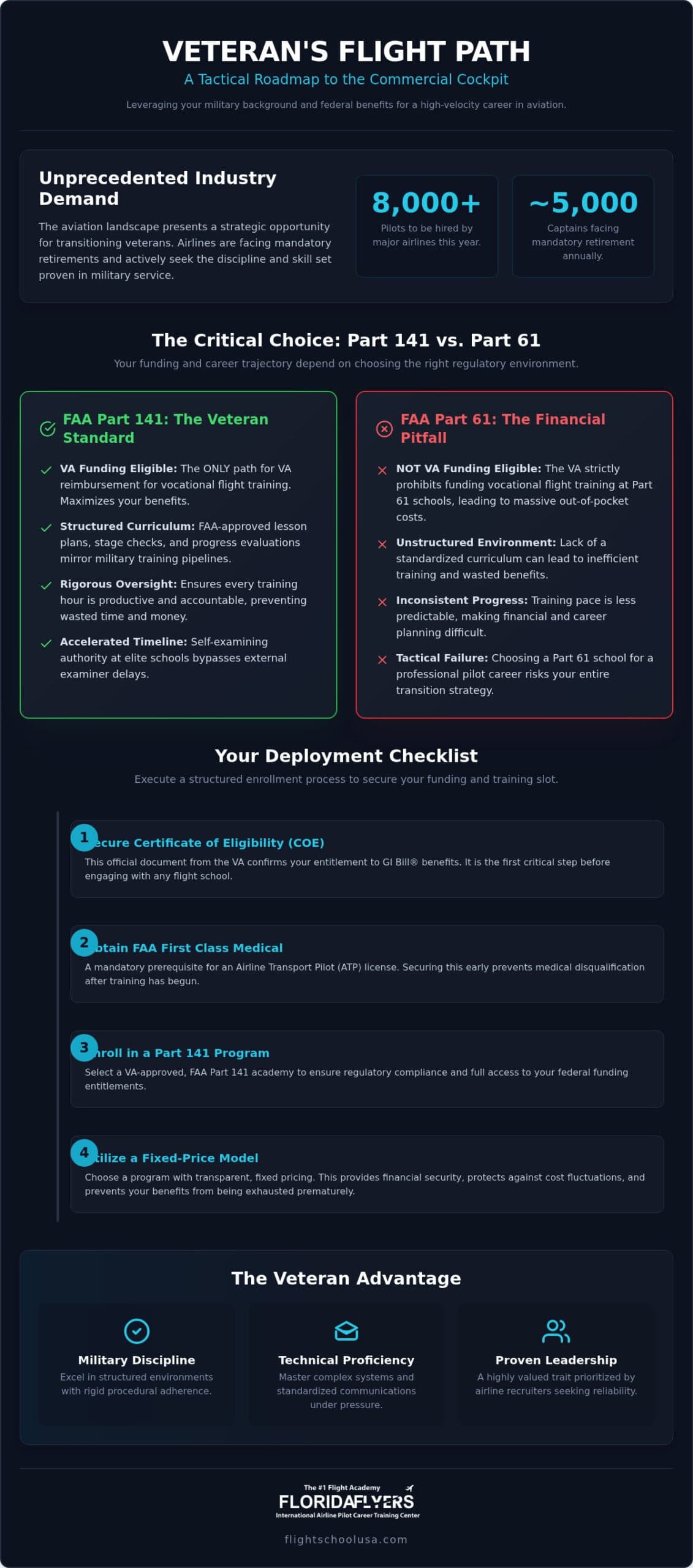
Deploying your federal benefits for flight training is a tactical operation that requires strict adherence to sequence. A single administrative oversight can result in a funding gap that halts your progression. You must treat the enrollment process with the same level of detail as a pre-flight inspection. By following a structured five-phase roadmap, you ensure that your transition remains financially viable and professionally sound. This process is designed to satisfy both VA regulations and the core airline pilot program requirements necessary for commercial certification.
The first phase involves securing your Certificate of Eligibility (COE) through the VA’s digital portal. This document serves as your official proof of funding and dictates your maximum reimbursement levels. Simultaneously, you must clear the second phase: obtaining an FAA First Class Medical Certificate. Without this medical clearance, your career is grounded before it begins. Phase three requires selecting a career-track program that aligns with the annual vocational caps of $17,661.89 for the 2026 academic year. In phase four, you’ll coordinate directly with the academy’s VA Certifying Official to submit your enrollment certification. Finally, phase five is the execution of your training, where you must maintain a consistent flight cadence to satisfy the VA’s progress standards.
The FAA First Class Medical Certificate serves as the primary gatekeeper for all commercial pilots. You must clear this rigorous physical evaluation to confirm you meet the long-term health standards of the airline industry. Beyond medical readiness, gather your military transcripts and your DD-214 discharge papers immediately. These documents are essential for the school to evaluate any prior credit and for the VA to verify your service history. You must verify your remaining months of entitlement with absolute certainty before signing any training contracts. A tactical failure in accounting for your remaining benefits will lead to unexpected out-of-pocket expenses that could have been avoided with proper planning.
Timing your entry into a flight program is a matter of financial survival. The VA fiscal year resets every August 1st, meaning your annual reimbursement cap is refreshed at this time. To maximize your benefits, align your most intensive training phases with the start of the fiscal year. You must also plan for the reimbursement gap; the VA typically processes payments in arrears, which requires you to have a financial buffer for initial costs. This strategy is particularly vital when using gi bill for cfi training to bridge the gap between your commercial license and the 1,500-hour requirement for airline hiring. Mastering these airline pilot program requirements ensures you remain on an elite trajectory toward the flight deck.
Secure your mission profile and ensure full regulatory compliance by speaking with our GI Bill Flight Training specialists today.
Flight School USA operates as a high-performance academy for individuals who demand excellence in their professional transition. We don’t merely offer flight hours; we provide a rigorous, structured pathway to the commercial flight deck. While meeting airline pilot program requirements is the baseline for any candidate, our institution functions as a gatekeeper of industry standards, ensuring you possess the technical precision required by major carriers. Established in 2008, we’ve refined our programs to serve the specific needs of the veteran community, focusing on efficiency, discipline, and financial security.
Traditional flight schools often utilize hourly billing models that expose students to significant financial risk. Market volatility, such as sudden fuel surcharges or unexpected maintenance delays, can quickly deplete your GI Bill benefits before you achieve your ratings. This uncertainty is a tactical vulnerability that can ground your career prematurely. Our fixed price flight training program provides a definitive solution to this problem. By establishing a set cost for your training syllabus, we eliminate the threat of budget overruns and allow you to focus entirely on procedural mastery. You’ll move through your certifications with the security of knowing your funding is sufficient to reach the objective.
Securing your commercial license is only the first phase of the mission. To meet the 1,500-hour requirement for airline hiring, you must bridge the gap between initial certification and professional employment. Our CFI Fast Track Program is designed for this specific purpose. By deploying as a Certified Flight Instructor within our academy, you gain the leadership experience and flight time necessary to command a commercial aircraft. This isn’t just about logging time; it’s about refining your skills through instruction and mentorship within an elite professional network. Our Airline Ready Program further polishes your performance, preparing you for the high-stakes environment of a regional or legacy carrier’s flight deck.
For veterans seeking a full-time, immersive environment, we offer on-site Student Housing. This allows you to live and train among peers who share your commitment to excellence, minimizing distractions and maximizing your daily training cadence. This level of immersion is critical for those who intend to fast-track their entry into the aviation industry. You aren’t just attending a school; you’re joining a high-velocity career track built on a foundation of institutional credibility and procedural accuracy. Mastering the airline pilot program requirements is only the beginning of your journey toward professional command.
The transition from military service to a commercial cockpit is a high-stakes operation that demands absolute regulatory precision. You’ve learned that navigating the boundary between Part 61 and Part 141 institutions is the primary determinant of your financial survival. By prioritizing VA-certified Part 141 training, you ensure that every hour of flight time is an investment supported by your federal benefits rather than a drain on your personal capital. Mastering the airline pilot program requirements is not merely a checklist; it’s a strategic mission to secure your future in an industry with unprecedented demand.
Flight School USA provides the institutional infrastructure necessary for this elite career track. Our Fixed-Price Career Program eliminates the threat of market volatility, while our student housing offers the immersive environment required for rapid progression. You have the discipline; we provide the roadmap to the airlines. The path to 1,500 hours and a major airline seat is clear for those who execute with precision. Secure Your Career Path: Contact Our Veteran Admissions Team to initiate your enrollment. Your next mission begins at the hold short line.
No, federal benefits rarely cover the entire cost of professional pilot training. While the GI Bill is a powerful asset, it’s subject to annual reimbursement caps for vocational flight programs. For the 2026 academic year, the Post-9/11 GI Bill cap is $17,661.89. Veterans must also fund their initial Private Pilot Certificate independently before vocational benefits can be triggered for advanced ratings and commercial certifications.
VA regulations generally prohibit the use of vocational flight benefits for an initial Private Pilot Certificate. You must obtain this rating as a prerequisite using personal funds or other resources. Once you possess this certificate, you can deploy your benefits to satisfy advanced airline pilot program requirements, including instrument ratings and commercial multi-engine certifications, provided you train at an approved Part 141 institution.
For the academic period effective August 1, 2026, through July 31, 2027, the Post-9/11 GI Bill pays a maximum of $17,661.89 per academic year for vocational flight training. If you’re enrolled in a degree-granting program at a public university, the VA may cover full in-state tuition and fees. Veterans using the Montgomery GI Bill receive a flat 60% reimbursement of all approved charges for their training.
The distinction is a matter of legal eligibility for federal funding. The VA strictly mandates that vocational flight training must occur at FAA-approved Part 141 schools. These institutions follow a rigid, structured curriculum with frequent stage checks. Part 61 programs offer more flexibility but don’t meet the oversight standards required for GI Bill reimbursement, making them a tactical dead end for veterans relying on federal assets.
Yes, you must secure an FAA First Class Medical Certificate before the VA will authorize your training. This medical clearance is the primary gatekeeper for the industry; it confirms you meet the physical standards required for a commercial career. Without this certificate, you cannot legally exercise the privileges of a commercial pilot, and the VA will not risk capital on a candidate who isn’t medically qualified.
Veterans utilizing the Post-9/11 GI Bill are eligible for a Monthly Housing Allowance (MHA) during their training. This stipend is calculated based on the Basic Allowance for Housing (BAH) for an E-5 with dependents in the school’s ZIP code. It provides the financial stability needed for full-time immersion. Note that the Montgomery GI Bill does not include a housing allowance, which often makes Chapter 33 the superior choice.
If your benefits are exhausted, you’ll be personally responsible for all subsequent training costs. This underscores the necessity of choosing an academy with a fixed-price model to avoid cost overruns. You must verify your remaining months of entitlement before signing a contract. Running out of funds mid-program is a significant risk that can be mitigated through disciplined financial planning and adherence to airline pilot program requirements.
Yes, Flight School USA is an FAA-approved Part 141 institution that maintains full compliance with VA training standards. We provide specialized support for veterans using their GI Bill benefits to ensure all administrative and regulatory hurdles are cleared. Our academy is designed for high-performance individuals who require a structured environment to transition from military service into a high-earning commercial aviation career with maximum efficiency.


