

Most veterans treat their flight training benefits like a standard tuition check, but in 2026, passive enrollment is the fastest route to benefit exhaustion before you ever reach a commercial flight deck. You’ve spent years following a chain of command and executing high-stakes missions, so the transition to a civilian cockpit should feel like a natural progression. Securing your veteran pilot training benefits requires a level of precision that most generic programs simply don’t provide. The friction between FAA Part 141 requirements and the current funding caps can make your career path feel grounded before takeoff.
This strategic guide will show you how to master the tactical deployment of your funding to bridge the gap between military service and a professional ATP certificate. We’ll analyze the $17,661.89 vocational cap, the strategic necessity of the PPL out-of-pocket hurdle, and how our CFI Fast Track serves as the ultimate force multiplier for your flight hours. Success in this industry demands elite performance; it’s time to apply that same discipline to your career strategy.
The aviation industry is entering a period of unprecedented operational demand. With approximately 18,200 annual pilot job openings projected through 2034 and nearly 5,000 mandatory retirements scheduled for 2026 alone, the commercial cockpit represents the premier destination for transitioning service members. Strategic deployment of your veteran pilot training benefits is the only way to secure a seat in this competitive environment. You must view your education assets as tactical resources that require precise management to avoid financial exhaustion before reaching the 1,500-hour milestone.
The primary pillars of funding remain the Post-9/11 GI Bill (Chapter 33) and the Montgomery GI Bill (Chapter 30). While the History of the GI Bill demonstrates a long-standing commitment to veteran education, the 2026 regulatory environment is more complex than previous eras. Accessing these funds requires enrollment in an FAA Part 141 certified program. This certification ensures the training meets the rigorous, structured standards the VA demands for vocational reimbursement. Without this specific institutional status, your benefits remain locked.
VA reimbursement follows a strict academic year cycle that resets every August. For the academic year spanning August 1, 2026, to July 31, 2027, the maximum reimbursement for flight training at a standalone vocational pilot school is $17,661.89. This cap is a hard limit. If your training costs exceed this amount within a single cycle, you’re responsible for the deficit. Mastering this cycle is essential for maintaining training momentum. Veterans who fail to account for these caps often find their progress halted mid-rating, a consequence that can be avoided through disciplined financial planning and phase-based enrollment. Before committing to any institution, reviewing a comprehensive GI bill flight school selection checklist ensures your chosen academy has the administrative infrastructure to manage these reimbursement cycles without disrupting your training tempo.
Regulatory adherence is the bedrock of a professional aviation career. While Part 61 schools offer flexibility, they lack the rigorous oversight required for VA approval. Veterans must prioritize FAA Part 141 institutions to utilize their funding. These schools operate under strict certificates that mandate specific curricula and training schedules, ensuring every hour of flight time contributes directly to certification. Understanding the nuances of VA flight training benefits is critical for maintaining your legal and financial standing throughout the program.
The Private Pilot License is the tactical gateway to your career. The VA does not reimburse for the PPL when training at a standalone vocational flight school. This requirement acts as a filter; you must possess the license before your veteran pilot training benefits can be deployed for advanced ratings. Deploying personal capital for your PPL is a strategic move. By funding the initial 40 to 60 hours yourself, you preserve your high-value benefits for the more expensive Instrument, Commercial, and Multi-Engine modules. This approach ensures you don’t exhaust your funding before reaching the finish line. It’s a calculated investment in your long-term success. Understanding the full scope of securing a pilot license for veterans — including how to navigate the Private Pilot Gap and the $17,661.89 vocational cap — is essential before you commit your earned benefits to any program.
A second-class medical certificate is the minimum regulatory requirement to begin commercial training, but an elite candidate aims higher. You should secure an FAA first-class medical certificate immediately. This certificate is required to act as pilot-in-command with an Airline Transport Pilot (ATP) certificate, the final objective of your training. For pilots under 40, a first-class certificate remains valid for 12 months. Those 40 and older must renew every 6 months to maintain privileges. Don’t risk starting a program only to discover a disqualifying condition later. VA disability ratings don’t automatically disqualify you, but they require disclosure and specific FAA review. Timing your medical exam to coincide with your enrollment ensures you are mission-ready from day one.
Selecting the correct funding pillar is a mission-critical decision that dictates your training tempo. Your veteran pilot training benefits function differently under Chapter 33 and Chapter 30. While many advisors suggest the Post-9/11 GI Bill is universally superior, elite candidates analyze their specific financial liquidity and training timeline before committing. This choice impacts not just your immediate tuition coverage but your long-term viability in pursuing FAA careers for veterans. You must treat your entitlement as a strategic reserve that requires careful liquidation.
The Post-9/11 GI Bill (Chapter 33) remains the primary asset for most aviators. For vocational flight training in 2026, the VA pays the lesser of the actual net cost for tuition and fees or the annual cap of $17,661.89. A significant advantage of this program is the Monthly Housing Allowance (MHA). This payment is calculated based on the Basic Allowance for Housing (BAH) for an E-5 with dependents at the flight school’s zip code. The annual “Books and Supplies” stipend provides up to $1,000, which serves as a secondary asset for essential flight gear like headsets and electronic flight bags. It’s vital to recognize that the Yellow Ribbon Program generally doesn’t apply to standalone vocational flight academies; it’s a provision reserved for degree-granting institutions.
The Montgomery GI Bill (Chapter 30) operates on a 60% reimbursement model. You pay the flight school directly for each stage of training, and the VA subsequently reimburses 60% of the approved charges. This path requires higher initial liquidity but lacks the restrictive annual funding cap found in Chapter 33. If you possess the capital to accelerate your training, Chapter 30 allows you to complete ratings faster than the academic year cycle might otherwise permit. Tactical candidates often utilize the $600 buy-up option, which can increase the monthly benefit yield by up to $150. This small upfront investment provides a higher return over the 36 months of entitlement.
Effective benefit management requires mapping your 36 months of entitlement against the specific ratings you need. An Instrument Rating might consume four months of eligibility, while a Commercial Multi-Engine program could take six. If you exhaust your months before reaching 1,500 hours, your progress will stall. Disciplined pilots track their remaining entitlement with the same rigor they apply to their fuel reserves. Every month of benefits must be treated as a finite resource that brings you one step closer to a professional commercial cockpit.
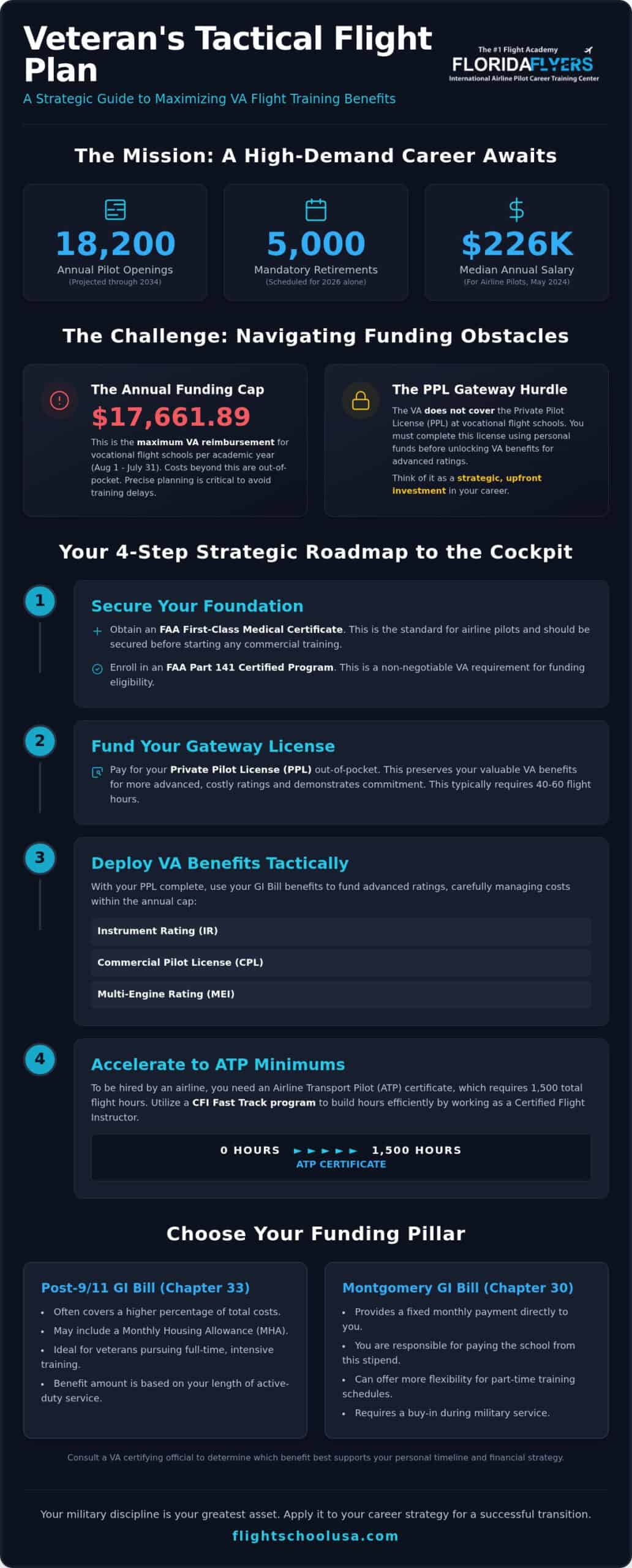
Transitioning from military service to a commercial cockpit isn’t a passive process; it’s an operational deployment. You must execute a multi-stage roadmap to maximize your veteran pilot training benefits before they expire. The sequence begins with securing your FAA first-class medical and Private Pilot License out-of-pocket to satisfy VA prerequisites. Once these foundations are met, you must obtain your 2026 Certificate of Eligibility (COE) to lock in your funding. From there, you’ll move into a Part 141 Instrument and Commercial track, followed by a CFI Fast Track program. The final phase is our Airline Ready Program, which prepares you for the rigorous standards of an ATP certificate and major airline recruitment.
The 1,500-hour requirement remains the most significant barrier to entry for aspiring airline pilots. The CFI pivot is the most efficient solution for clearing this hurdle. By utilizing your remaining benefits for Certified Flight Instructor (CFI), CFII, and MEI ratings, you transform from a student into a professional. This allows you to build necessary flight time while receiving a paycheck, effectively converting your education assets into career momentum. It’s a high-ROI strategy that ensures you reach the ATP minimums without personal financial strain. Mastering the art of instruction also reinforces your own technical knowledge, making you a more competitive candidate during airline interviews.
Active-duty pilots often possess significant flight time but lack the specific civilian certifications required for commercial operations. You can utilize military competency checkrides to bypass certain civilian training requirements, but gap training is often necessary to align military experience with civilian commercial standards. Selecting an academy with FAA self-examining authority is a tactical advantage. This authority allows for internal checkrides, eliminating the weeks of delay often associated with scheduling Designated Pilot Examiners (DPEs). It accelerates your timeline to the cockpit and ensures your benefits are spent on training rather than administrative waiting periods.
Our specialized flight training programs are engineered for veterans who demand elite results and a direct path to the airlines. Don’t leave your career progression to chance; follow a proven roadmap designed for high-performance aviators.
Flight School USA functions as a high-performance academy specifically engineered to handle the complexities of veteran pilot training benefits. Generic schools often lack the administrative infrastructure to navigate VA compliance, leading to payment delays or certification errors. Our institution acts as a rigorous gatekeeper, ensuring that every hour flown is a direct investment in your career objective. By aligning our Part 141 syllabus with the tactical needs of transitioning service members, we provide a structured environment that mirrors the discipline of military life. We don’t just offer lessons; we provide a mission-driven path to the commercial flight deck.
The most significant risk to a veteran’s career timeline is the sudden exhaustion of funds due to fuel surcharges or unexpected aircraft maintenance costs. Our Fixed-Price Career Program eliminates this volatility by providing cost certainty from day one. This model ensures that your 36 months of entitlement are mapped precisely to your ratings, protecting your assets from the hourly price fluctuations common in the broader aviation market. The Fixed-Price Career Program is the most stable path for veterans in 2026 because it locks in training costs against a fixed budget, preventing the financial overages that often ground student pilots before they reach their commercial checkride. The Airline Ready Program provides a transparent roadmap for the final tactical phase, ensuring you transition into regional or major airline cockpits with a clear understanding of your remaining financial and time requirements.
Professional development requires total immersion. Flight School USA provides dedicated Student Housing to ensure that your focus remains strictly on the rigors of flight training. By living on-site, you eliminate the distractions and logistical friction of a standard commute, allowing for more time in the simulator and ground school. This environment fosters a unique high-stakes network, where you’ll train alongside fellow veteran pilots and high-performing international students. This camaraderie is a force multiplier for your education; it builds a professional foundation of shared standards and mutual accountability. You aren’t just learning to fly; you’re preparing for command in a facility that demands excellence. Ready for command? Apply for Veteran Flight Training at Flight School USA and secure your position in the next generation of professional aviators.
Securing a position in a commercial cockpit requires more than just flight hours; it demands a calculated strategy for your veteran pilot training benefits. You’ve seen how to navigate the 2026 funding caps and the critical necessity of the Private Pilot License as a tactical gateway. By selecting a Part 141 academy that offers cost certainty, you eliminate the financial volatility that often grounds aspiring aviators. Success in this industry is reserved for those who treat their transition with the same discipline they applied in uniform. It’s time to stop researching and start executing.
Flight School USA stands as a premier institution for this transition. As an FAA Part 141 Certified Academy, we provide the Fixed-Price Career Program to secure your financial assets and on-site Student Housing to maintain your professional focus. Our CFI Fast Track program remains the most efficient force multiplier for reaching the 1,500-hour requirement. Launch your commercial aviation career with Flight School USA’s Veteran Programs. Your next mission starts here. Take command of your professional trajectory and join the elite ranks of commercial pilots today.
No, you can’t use GI Bill benefits for an initial Private Pilot License at a vocational flight school. The VA classifies the PPL as a prerequisite for professional training. You must secure this license independently before deploying your veteran pilot training benefits for advanced ratings. Funding this phase out-of-pocket is a strategic requirement to unlock subsequent VA-funded modules like Instrument and Commercial ratings.
For the 2026 academic year, the Post-9/11 GI Bill annual reimbursement cap for vocational flight training is $17,661.89. This limit applies to standalone flight schools and resets every August 1. If you’re enrolled in a private degree-granting institution, the cap increases to $30,908.34. You must manage these caps with precision to avoid out-of-pocket expenses during high-tempo training phases.
You legally need at least a second-class medical certificate to initiate flight training using VA benefits. However, we command our students to obtain a first-class medical certificate before enrollment. This ensures you meet the physical standards required for an Airline Transport Pilot certificate. Discovering a disqualifying medical condition after exhausting your benefits is a catastrophic failure in career planning.
FAA Part 141 schools follow a rigid, VA-approved syllabus that allows for lower flight hour requirements for certain ratings. Part 61 programs offer more flexibility but don’t qualify for vocational GI Bill reimbursement. For veterans, Part 141 is the elite choice because it provides the regulatory structure and financial oversight required to maintain benefit eligibility throughout your professional progression.
Yes, you can receive the Monthly Housing Allowance under the Post-9/11 GI Bill while attending a vocational flight school. The VA calculates your MHA based on the school’s location and your rate of pursuit. Unlike degree programs, vocational flight MHA is paid based on the actual hours of training completed each month. This requires disciplined attendance to ensure your housing stipends remain consistent.
You can convert military flight experience through FAA military competency checkrides to secure civilian Commercial and Instrument ratings. This process bypasses many entry-level requirements. However, most veterans still require civilian gap training to master FAA-specific regulations and procedures. Utilizing your veteran pilot training benefits for this transition ensures you meet the high-performance standards demanded by major airline recruiters.
If your benefits expire before you reach the 1,500-hour ATP requirement, you must pivot to a professional instructor role. We design our programs to include CFI ratings before your entitlement is exhausted. Working as a flight instructor allows you to build the remaining hours while earning a paycheck. This tactical shift prevents a total halt in your career progression when VA funding reaches its limit.
Yes, our CFI Fast Track program is fully eligible for GI Bill reimbursement under FAA Part 141 standards. This program is a critical component of our career roadmap. It allows you to utilize your remaining education assets to gain the certifications necessary for employment. Completing your CFI, CFII, and MEI ratings is the most efficient way to transition from a student pilot to a professional aviator.


