

Your GI Bill is a finite, mission-critical asset that demands a strategic deployment plan rather than a series of administrative gambles. Most veterans recognize that the transition from military service to a commercial cockpit is often sabotaged by bureaucratic friction and shifting reimbursement regulations. You’ve likely felt the frustration of deciphering Chapter 33 eligibility while facing the 2026-2027 vocational cap of $17,661.89 for non-degree programs. The fear of exhausting your hard-earned benefits on a sub-par academy is a legitimate threat to your professional timeline and financial security.
This guide provides the definitive checklist to ensure you maximize every dollar of your entitlement at an elite gi bill flight school. We’ll cut through the confusion surrounding private versus commercial coverage and the strict FAA Part 141 requirements that govern your funding. You’ll gain a clear, tactical roadmap that covers everything from securing your medical certification to enrolling in a high-performance Airline Ready Program. By following this professional framework, you can stop worrying about VA paperwork and start focusing on the rigors of your professional flight training.
Executing a successful transition into commercial aviation requires a meticulous audit of your available resources. Your primary tactical asset is likely the Post-9/11 GI Bill, known as Chapter 33, which offers substantial funding for advanced ratings. Some veterans may still hold eligibility under Chapter 30, the Montgomery GI Bill, which utilizes a 60% reimbursement model. Selecting an elite gi bill flight school is only possible once you’ve secured your Certificate of Eligibility (COE). This document serves as your official ‘orders’ for flight training. Without a verified COE, your enrollment remains stalled and your funding remains locked. You must understand that the VA does not fund exploratory training; they fund professional outcomes.
The Department of Veterans Affairs maintains a strict mandate regarding vocational flight training: you must already possess a Private Pilot License (PPL) before activating your benefits. This requirement ensures that federal funds are reserved for candidates who have already demonstrated the aptitude required for professional flight. Consequently, the PPL phase must be self-funded or covered through third-party scholarships. The PPL prerequisite is the gateway to federal funding. Smart veterans use this initial phase to vet the operational tempo and maintenance standards of their chosen gi bill flight school. If a school’s dispatch reliability is low during your PPL training, it’s a clear indicator of future delays during your funded ratings. For a comprehensive breakdown of how to navigate this critical first phase and every step that follows, review the pilot license for veterans 2026 strategic roadmap before committing to any training program.
A professional pilot’s career is only as secure as their medical standing. While the VA may technically permit training with a Second-Class Medical Certificate, aspiring airline captains should secure an FAA First-Class Medical Certificate immediately. This higher standard is the legal requirement for Part 121 airline operations. Securing this clearance early prevents the catastrophic waste of benefits on a career that could be medically disqualified later. Schedule your examination to ensure it’s valid on your first day of enrollment. Common disqualifiers often involve vision, cardiovascular health, or specific neurological conditions. If a disqualifier arises, the FAA waiver process is available, but it requires a disciplined, methodical approach to resolve before your training timeline is compromised.
Selecting a gi bill flight school is a high-stakes decision that dictates the trajectory of your commercial aviation career. While Part 61 schools offer a decentralized, flexible approach, veterans must prioritize FAA Part 141 academies. These institutions operate under a rigid, FAA-approved curriculum that mirrors the structured training environments of major airlines. This structure is not just a preference; it is often a prerequisite for maximizing your federal funding and ensuring your training hours are documented with the precision required by the VA.
Your reconnaissance must extend to the school’s aircraft fleet and maintenance standards. Assess the ‘mission-readiness’ of the equipment. A school with aging airframes or frequent maintenance cancellations will ground your progress, wasting your limited benefits on avoidable downtime. Investigate the instructor-to-student ratios to ensure you aren’t sidelined by scheduling bottlenecks. Elite academies often provide on-site Student Housing, creating an immersive training environment that allows you to maintain the high-level discipline required for professional advancement.
Before committing your benefits, you must confirm the school’s specific programs are active in the VA WEAMS database. Every approved gi bill flight school employs a VA Certifying Official (VCO) who acts as the gatekeeper for your funding. You should ask the VCO direct questions regarding their reporting frequency and their experience with the 2026 reimbursement caps. It’s critical that the veteran pilot training benefits you expect align perfectly with the school’s specific Training Course Outline (TCO). You can verify the latest regulatory updates on VA flight training benefits directly through official government channels.
A premier academy provides more than just flight hours; it provides a direct bridge to a commercial cockpit. Look for a robust Airline Ready Program that utilizes high-fidelity simulators to teach complex procedural flows and crew resource management. These simulators are essential for mastering modern avionics without the high hourly cost of flight time. Furthermore, ensure the academy offers a CFI Fast Track. This is your primary tactical tool for building the 1,500 hours required for an Airline Transport Pilot (ATP) certificate. If you’re ready to begin your transition, exploring a Fixed-Price Career Program can provide the cost certainty and professional structure you need to succeed.
Managing your flight training budget is a mission-critical responsibility that requires precise calculation and a clear understanding of federal reimbursement limits. For the 2026-2027 academic year, the Post-9/11 GI Bill annual cap for vocational flight training is set at $17,661.89. This figure represents the maximum amount the VA will pay toward your advanced ratings at a standalone gi bill flight school between August 1, 2026, and July 31, 2027. Veterans must recognize that this cap applies to vocational programs; it differs significantly from the higher limits allocated to degree-granting institutions. You can verify these specific rates and eligibility tiers through official VA information on flight training benefits to ensure your financial planning is based on verified data.
While the Post-9/11 GI Bill is the most common asset, some veterans may find the Montgomery GI Bill (Chapter 30) more advantageous depending on their specific service history. Under Chapter 30, the VA reimburses 60% of approved flight charges, but the veteran must pay the school upfront and seek reimbursement afterward. This model requires significant liquid capital but may offer more flexibility for certain high-tempo training schedules. Regardless of the benefit chapter used, you must prioritize cost certainty. Hourly rates at a standard gi bill flight school are subject to fuel surcharges and instructor availability shifts. Selecting a Fixed-Price Career Program mitigates these risks, providing a stable financial environment that allows you to focus on performance rather than fluctuating invoices.
The delta between the annual VA cap and the actual cost of professional flight training is a reality that disciplined veterans must address early. Successful candidates often utilize specialized pilot training loans or personal savings to maintain training momentum once the annual cap is exhausted. It is vital to align your financial strategy with the specific airline pilot program requirements to ensure you aren’t underfunded during critical phases like your Multi-Engine Rating. Allowing your training to stall due to funding gaps often leads to skill degradation and increased overall costs.
Strategic timing is your most effective tool for maximizing benefit longevity. The VA fiscal year resets every August 1st, which is the date when your annual vocational cap is replenished. Strategic timing of your enrollment to coincide with the August 1st fiscal reset allows you to access a fresh annual cap mid-training, potentially saving you thousands in out-of-pocket costs. By accelerating your training immediately following the reset, you can complete multiple ratings within a single benefit cycle, ensuring the most efficient use of your entitlement.
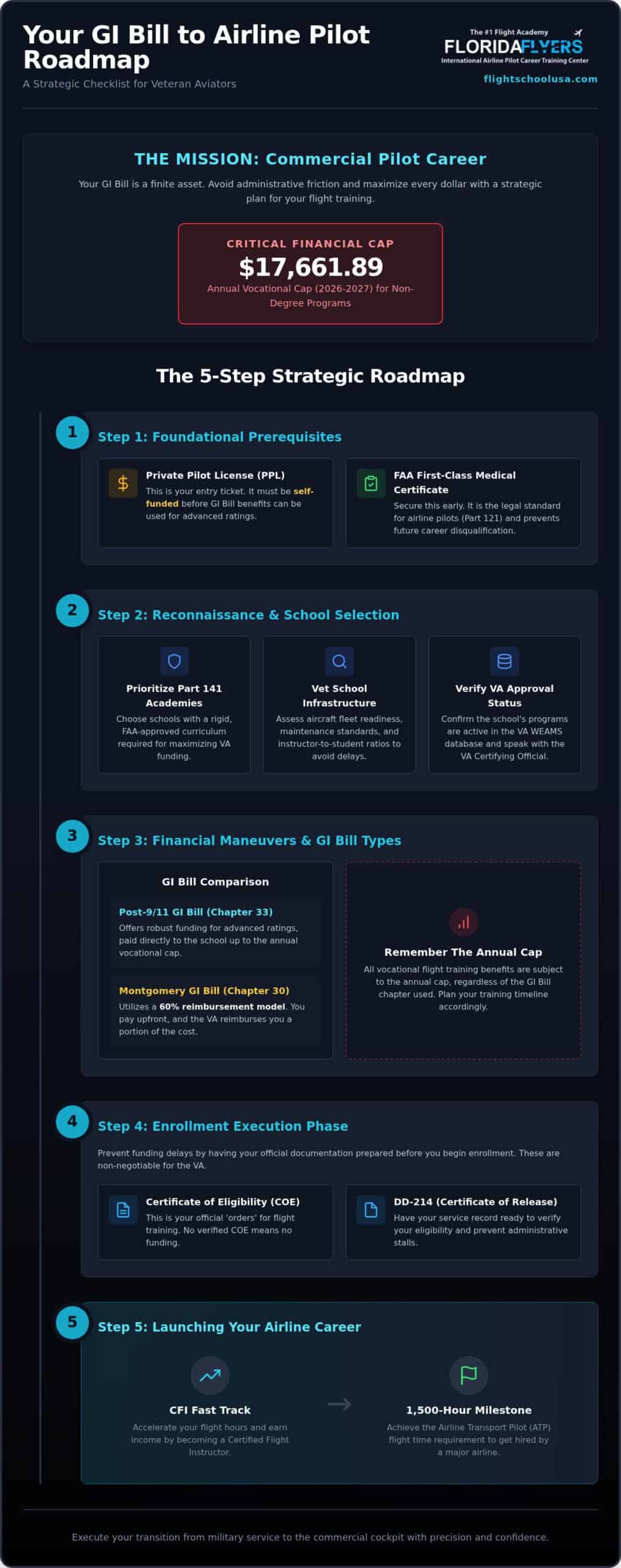
The administrative execution phase is where many veterans falter. Precision in your paperwork is just as critical as precision on a final approach. To ensure a seamless transition into your chosen gi bill flight school, you must execute a sequential enrollment plan that leaves no room for bureaucratic error. This stage is not about exploration; it’s about the disciplined processing of your professional credentials.
Evaluation of your military flight transcripts is a mandatory step for those with prior service experience. These records can often be credited toward specific training requirements, potentially reducing your overall timeline and benefit consumption. You must also verify the ‘Effective Date’ on your COE. If your training begins even one day before this date, the VA won’t provide retroactive coverage, resulting in significant out-of-pocket liabilities. For veterans transitioning from international backgrounds, ensuring your M1 Visa status is current is a prerequisite that cannot be delayed. Every document must be verified for accuracy to prevent a funding freeze mid-rating.
Success at an elite academy requires more than just administrative compliance. You must arrive with the necessary flight gear, including a high-quality noise-canceling headset and an iPad equipped with an Electronic Flight Bag (EFB). Beyond equipment, mental preparation is paramount. Transitioning from a military to a civilian professional aviation mindset involves adapting to different regulatory frameworks and crew resource management styles. Review the school’s Standard Operating Procedures (SOPs) before your first day of instruction. This proactive approach ensures you’re mission-ready the moment you step onto the flight line. If you’re prepared to begin your professional journey, you can apply for GI Bill flight training to secure your spot in the next intake.
Reaching the 1,500-hour milestone is the final objective in your flight training campaign. This phase represents the transition from a student mindset to that of a professional aviator. For most veterans, the journey through a gi bill flight school culminates in a period of intense hour-building. You don’t just “wait out” these hours. You command them. The transition from a controlled training environment to the high-stakes world of commercial aviation requires a final, disciplined push. Success here is measured by your ability to maintain the same level of professional gravity you held during your military service.
Networking within the veteran pilot community is your most potent tool for airline placement. Many major carriers prioritize candidates who demonstrate the reliability and leadership inherent in military backgrounds. By leveraging the connections made at an elite Part 141 academy, you gain access to a powerhouse of industry knowledge. Engaging with former service members who have already successfully navigated the Airline Ready Program provides you with a distinct competitive advantage during recruitment cycles. This isn’t just about finding a job; it’s about securing a seat in a commercial cockpit through a proven, professional network.
The CFI Fast Track Program is the primary tactical tool for veterans who need to bridge the hour gap rapidly. By using gi bill for cfi training, you transform from a consumer of flight hours into a professional who is paid to build them. This pivot allows you to refine your own skills while mentoring the next generation of pilots. You should prioritize obtaining a Multi-Engine Instructor (MEI) rating to maximize your competitiveness for regional and major airlines. The CFI role is the final tactical bridge to an ATP certificate. It demands the highest level of discipline and instructional accuracy, traits that are already deeply ingrained in the veteran persona.
Transitioning from military service to a commercial cockpit is a high-stakes mission that requires tactical precision. Success hinges on clearing the PPL hurdle early, selecting a premier gi bill flight school with Part 141 certification, and timing your enrollment to maximize the 2026-2027 annual caps. Bureaucracy shouldn’t ground your career. By following this professional framework, you ensure that every hour logged is a strategic step toward the 1,500-hour milestone.
Flight School USA functions as an FAA Part 141 Certified Elite Academy, employing dedicated Veteran Certifying Officials to navigate complex VA systems on your behalf. Our Professional Pilot Career Tracks provide the cost certainty of fixed-pricing, allowing you to focus entirely on your training objectives without the distraction of fluctuating invoices. We demand excellence because the industry demands it of you.
Secure Your Command: Apply for GI Bill Flight Training at Flight School USA
Your commercial career is waiting for a disciplined leader. Execute your enrollment plan today and take command of your future in the skies.
No, the VA doesn’t fund the Private Pilot License (PPL) for vocational training programs. You must possess a valid PPL and a medical certificate as a mandatory prerequisite for activating benefits at a gi bill flight school. This mandate ensures that federal funding is reserved for advanced ratings that lead directly to commercial employment. Veterans must self-fund this initial phase before transitioning to VA-funded instrument or commercial ratings.
Total coverage depends on your eligibility tier and the specific program structure. For the 2026-2027 academic year, the vocational flight training cap for Post-9/11 benefits is $17,661.89. If your training costs exceed this annual limit, you’re responsible for the remaining balance. Degree-granting programs at public institutions may offer higher reimbursement levels, but standalone vocational academies are strictly bound by these federal annual caps.
FAA Part 141 schools utilize a rigid, agency-approved curriculum that is mandatory for GI Bill eligibility. Part 61 training is more decentralized and doesn’t meet the VA’s strict requirements for vocational benefit reimbursement. Veterans must prioritize a Part 141 gi bill flight school to ensure their training hours are recognized and funded. This structured environment mirrors the professional standards required by major commercial airlines.
Payment timelines typically range from four to eight weeks after the school’s VA Certifying Official submits your enrollment certification. The VA processes payments in arrears, meaning they reimburse costs after the training has occurred. To prevent delays, you must ensure your Certificate of Eligibility is current and that your school’s VCO maintains a disciplined reporting schedule. Administrative errors in your file can stall funding for several months.
Yes, active duty service members can utilize their benefits, but specific restrictions apply. You must meet the same prerequisites as veterans, including holding a Private Pilot License. However, active duty personnel aren’t eligible for the Monthly Housing Allowance (MHA) since they already receive a military housing allowance. It’s critical to coordinate with your education office to ensure your training doesn’t conflict with your primary mission requirements.
Failing a checkride doesn’t automatically terminate your benefits, but it does create financial friction. The VA generally funds the hours required to complete a syllabus, but they may not cover the additional remedial hours needed to retake an examination. You must maintain satisfactory academic progress as defined by the school’s Training Course Outline. Frequent failures can lead to a suspension of benefits due to a lack of professional progression.
No, you don’t need to maintain full-time status for vocational flight training, but your reimbursement is tied directly to your training activity. The VA pays based on the actual flight and ground hours logged and certified by the school. While part-time training is possible, it often leads to skill degradation and longer overall timelines. Elite academies recommend a high-tempo, immersive schedule to maximize benefit efficiency and maintain professional momentum.
Standalone vocational flight training under the Post-9/11 GI Bill doesn’t typically include a Monthly Housing Allowance (MHA). This benefit is generally reserved for veterans enrolled in degree-granting programs at colleges or universities. To mitigate this, successful candidates often utilize personal savings or specialized loans to cover living expenses. Selecting an academy with on-site Student Housing can provide a more cost-effective and immersive residential training environment.


