
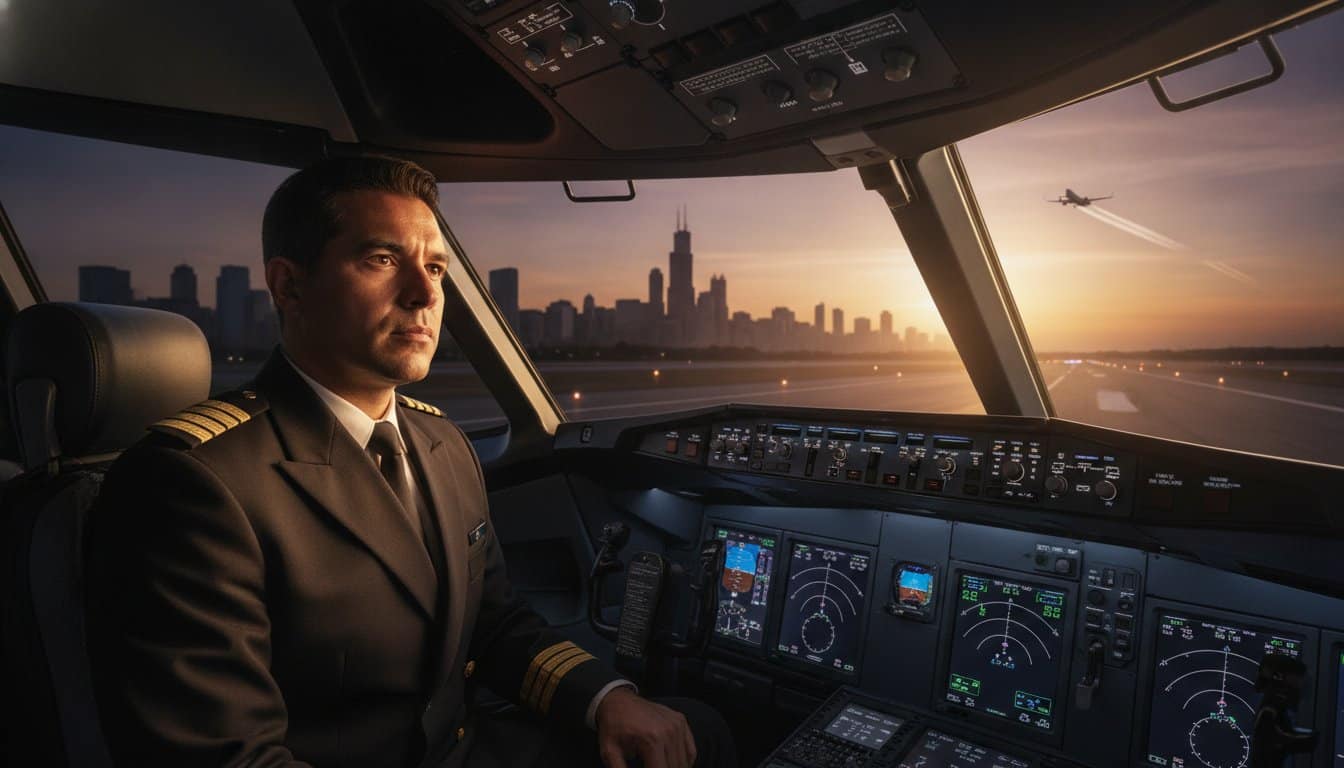
Your military benefits are a tactical asset, yet thousands of service members exhaust their GI Bill on fragmented training that never reaches a commercial flight deck. Securing a pilot license for veterans is not a matter of simple enrollment; it’s a high-stakes operation where administrative errors result in career-ending financial gaps. You’ve likely discovered that the VA does not fund the initial Private Pilot License at standalone vocational schools, creating a “Private Pilot Gap” that forces many to abandon their ambitions. Failure to plan for the $17,661.89 vocational cap or the specific requirements of Part 141 schools often leads to wasted eligibility and stalled professional progress.
This guide provides the definitive 2026 strategic roadmap to ensure you maximize every dollar of Chapter 33 or Chapter 31 funding to reach the 1,500-hour airline requirement. We’ll master the transition from military service to professional aviation by deploying your earned assets with precision. You’ll learn how to navigate the current reimbursement caps, bridge the initial training hurdle, and secure placement in an elite airline-ready program that commands respect in the industry. This is your blueprint for moving from the barracks to the cockpit with the discipline and authority your new career demands.
The transition from a military environment to the flight deck is more than a career change; it’s a tactical shift in operational focus. For those pursuing a pilot license for veterans, the inherent discipline and situational awareness cultivated during service are your primary assets. While the civilian sector lacks the rigid command structures of the military, the FAA Part 141 training environment demands a similar level of precision and adherence to standardized operating procedures. Understanding the GI Bill and its various iterations is the first step in treating your flight training as a mission critical objective rather than a casual pursuit.
Success in this field requires identifying the “Command Gap” early. Military personnel are accustomed to complex systems and high-stakes decision making, yet the regulatory framework of civilian aviation presents unique administrative and legal hurdles. Your objective is clear: navigate the path to 1,500 flight hours to secure an Airline Transport Pilot (ATP) certificate while maintaining maximum benefit efficiency. This requires a professional academy mindset that treats every hour in the logbook as a step toward airline command.
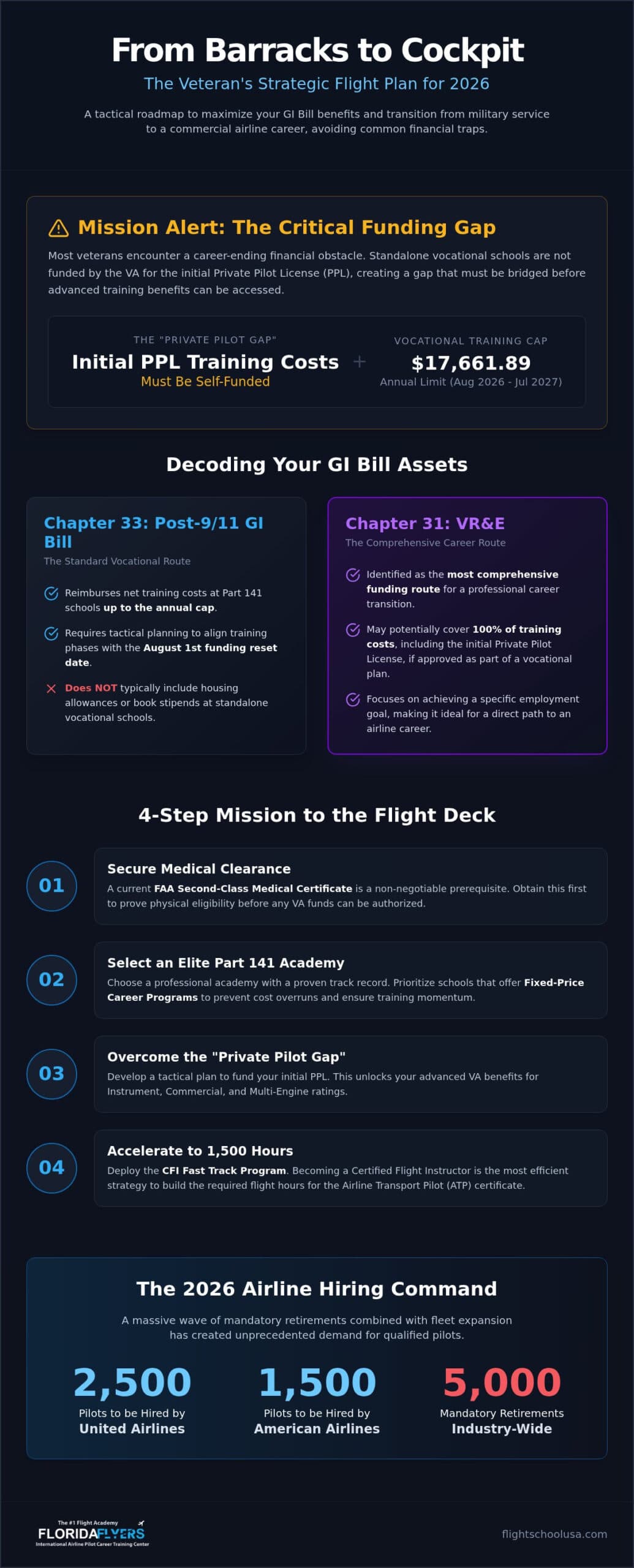
A commercial pilot license is a high-level professional credential that carries significant legal responsibilities. It’s not a hobby or a secondary skill; it’s the gateway to an industry where safety and compliance are the only acceptable standards. In 2026, the urgency for qualified pilots has reached a critical peak. Major carriers like United Airlines and American Airlines are projected to hire approximately 2,500 and 1,500 pilots respectively this year alone. With nearly 5,000 mandatory retirements expected across the industry in 2026, veterans who enroll in career-track programs gain a significant competitive advantage. You don’t have time for casual flight lessons that lack a structured progression toward these elite hiring windows.
You must establish an “Airline Ready” mindset from day one. This means choosing between a Commercial Pilot License (CPL) focus or a strategic CFI Fast Track Program to build hours rapidly. Your strategy should account for the timeline of benefit exhaustion against certification milestones. Waiting until your benefits are depleted to plan for the 1,500-hour hurdle is a failure of leadership. Veterans who succeed utilize GI Bill Flight Training within a Fixed-Price Career Program to ensure they reach the flight deck without the risk of cost overruns or training delays. Your timeline must be aggressive, methodical, and focused on the final objective of professional airline placement.
Deploying your earned benefits for a pilot license for veterans requires a rigorous understanding of the 2026 regulatory environment. You can’t afford to treat these assets as a generic scholarship; they’re tactical reserves that must be deployed with precision. For the academic year spanning August 1, 2026, to July 31, 2027, the VA has established the maximum reimbursement for vocational flight training at $17,661.89. This cap applies specifically to standalone Part 141 schools and doesn’t include housing allowances or book stipends. Before a single dollar is authorized, you must secure a current FAA Second-Class Medical Certificate. This is a non-negotiable prerequisite that proves your physical eligibility for commercial operations and signals your commitment to the professional track.
The Post-9/11 GI Bill (Chapter 33) serves as the primary engine for your vocational progression. When training at a non-degree granting institution, the VA reimburses the actual net cost of training up to the annual cap. Strategic planning is essential here. Because the cap is a fraction of the total cost to reach a Commercial Pilot License, you must phase your training to avoid massive out-of-pocket spikes. Elite veterans often coordinate their training starts with the August 1 reset date to maximize available funds across two academic years. Reviewing the VA Flight Training Benefits ensures your paperwork meets the strict regulatory standards required for Part 141 approval.
Navigating these two paths requires an authoritative grasp of how the VA interacts with flight school registries. Choosing the wrong chapter or failing to account for the annual cap can result in a total halt of your training momentum. Securing a pilot license for veterans through these channels is a complex administrative operation. To ensure your strategy aligns with these complex regulations, enrolling in a dedicated GI Bill Flight Training program is the most reliable way to protect your assets. We act as your administrative command center, ensuring every certification milestone is met within the framework of your available benefits.
The most significant barrier to securing a pilot license for veterans is the “Private Pilot Gap.” While degree-granting collegiate programs may bundle initial training into tuition, vocational Part 141 schools require you to hold a Private Pilot License (PPL) before benefits activate. This regulatory hurdle often stalls promising careers, yet elite candidates view this as a necessary screening phase rather than a dead end. Consulting the official VA Flight Training Benefits portal confirms that vocational flight training reimbursement is strictly reserved for advanced ratings. You must treat this initial certification as a strategic buy-in for a high-value career.
Execution of this phase must be swift and disciplined. First, you must obtain an FAA First or Second-Class Medical Certificate. Do not spend a dollar on flight hours until a medical examiner confirms your long-term eligibility for commercial flight. Second, enroll in an accelerated PPL program designed to move you from zero hours to certification in weeks, not months. This minimizes the time spent in the “unfunded” zone. Finally, align your PPL completion with the start dates of a Fixed-Price Career Program. This ensures a seamless handoff to VA-funded training modules without administrative delays.
The VA’s requirement for a pre-existing PPL at vocational schools serves as a filter for professional commitment. It ensures that the veteran is both medically fit and mentally prepared for the rigors of flight before the government commits significant funding. This milestone proves you possess the basic aeronautical knowledge required for the Instrument Rating, which is your first true “VA-funded” mission. Reaching this stage demonstrates that you’re no longer a student pilot, but a professional aviator executing a career-track objective. Your pilot license for veterans journey truly begins the moment you clear this initial hurdle and enter the Part 141 environment.
Choosing where to earn a pilot license for veterans is a high-stakes decision that dictates the efficiency of your benefit usage. Most schools operate on hourly rates, which exposes veterans to the risk of “benefit bleed” where unforeseen delays or price hikes exhaust VA funds before certification is reached. An elite Part 141 academy functions as a professional command center, providing a structured environment that mirrors the rigors of an airline flight department. You demand a fleet with high dispatch reliability and maintenance standards that exceed minimum FAA requirements. This level of instruction ensures that when you reach the hiring phase, your transition to a regional jet is a matter of procedure, not a struggle to adapt to professional standards.
Veterans must prioritize Fixed-Price Career Programs to eliminate budget anxiety. These programs provide a contractual guarantee on training costs, protecting your Chapter 33 or Chapter 31 assets from the volatility of fuel surcharges or maintenance delays. Pay-as-you-go models are inherently risky; they lack the accountability of a career-track contract. By locking in a fixed rate, you ensure your training timeline remains synchronized with your VA housing allowance (BAH) windows. This prevents financial gaps during the intensive training phases and ensures your pilot license for veterans journey isn’t derailed by administrative or financial volatility.
The mission requires total immersion. Utilizing a residential flight school allows you to live and train in a dedicated environment alongside other career-focused veterans. On-site student housing reduces the daily friction of commuting, which directly translates to higher completion rates and faster progression. You aren’t just renting a room; you’re building a professional network with peers who share your discipline and end-goal. Reducing logistical friction is essential for maintaining the high-tempo schedule required to exhaust your ratings before your benefits expire. This immersive approach is the hallmark of an “Airline Ready” mindset, treating your education as a full-time professional deployment.
Securing your future in the cockpit requires a school that respects the discipline you bring from military service. If you’re ready to move beyond casual flight lessons and into a structured, high-performance environment, explore our Fixed-Price Career Program to lock in your professional timeline today.
The 1,500-hour Airline Transport Pilot (ATP) requirement is the final gatekeeper in your professional transition. While you’ve successfully navigated the path to a commercial pilot license for veterans, you now face a significant experience gap that separates you from the airline flight deck. Major carriers like United and American are aggressively recruiting to fill thousands of seats in 2026, but they demand the technical maturity that only comes with significant time in the cockpit. This isn’t a period for casual flying; it’s a phase that requires a command-level strategy to reach the hiring threshold before the current wave of nearly 5,000 annual retirements subsides.
The CFI Fast Track Program is the elite path to bridge the experience gap. By becoming a Certified Flight Instructor, you stop paying for flight time and start earning a professional salary while building the hours necessary for your ATP certificate. You’ll deploy your remaining GI Bill assets to secure advanced ratings, including Certified Flight Instructor Instrument (CFII) and Multi-Engine Instructor (MEI). This instructional path is the ultimate mastery of flight principles. It forces a level of technical precision that mere time-building cannot provide, ensuring your pilot license for veterans leads to a position of high-level professional respect.
Transitioning to a major airline requires an “Airline Ready” mindset that goes beyond the 1,500-hour mark. You must refine your military precision for the specific demands of commercial multi-crew operations. Leveraging your veteran pilot training benefits allows you to focus on interview preparation and advanced systems training without the distraction of financial instability. The 2026 hiring environment is the most favorable in decades, but it’s reserved for those who treat their training as a high-stakes mission. Your roadmap ends at the flight deck of a major carrier, but the transition begins with a single administrative decision. Apply for your VA-approved flight training mission today and secure your seat in the cockpit.
Securing a pilot license for veterans is a complex operation that demands the same level of discipline you maintained during your military service. You’ve identified the tactical necessity of bridging the Private Pilot Gap and the strategic importance of maximizing your Chapter 33 or Chapter 31 assets within an elite Part 141 framework. Success in the 2026 hiring landscape requires moving beyond casual training and into a structured environment where every flight hour serves a professional objective. By utilizing a CFI Fast Track Program, you ensure a methodical progression toward the 1,500-hour airline requirement while maintaining financial security.
Our institution functions as your administrative and instructional command center. With FAA Part 141 self-examining authority, Specialized Fixed-Price Career Programs, and Dedicated Veteran Housing and Support, we provide the infrastructure necessary for a seamless transition to the flight deck. The mission is clear, and the airline industry is ready for your leadership. Take the definitive step toward your professional command today.
Launch Your Aviation Career: Apply for Veteran Flight Training
No, the Post-9/11 GI Bill does not cover the initial Private Pilot License at standalone vocational flight schools. You must hold a PPL and a valid medical certificate before utilizing Chapter 33 benefits for advanced ratings. This requirement serves as a professional filter; veterans typically self-fund this phase or utilize scholarship assets to bridge the gap before entering a VA-approved Part 141 environment.
The VA does not cover the full cost at standalone vocational schools due to annual reimbursement caps. For the 2026-2027 academic year, the maximum reimbursement is $17,661.89. Because a commercial pilot license for veterans can cost between $80,000 and $100,000, you must plan for supplemental funding or phase your training across multiple benefit years to minimize personal expenditure.
FAA Part 141 schools follow a rigid, FAA-approved curriculum required for VA benefit eligibility. Part 61 schools offer more flexibility but don’t qualify for GI Bill reimbursement. For a veteran, Part 141 is the professional standard because it provides the structured oversight and administrative compliance necessary to ensure your military benefits are deployed correctly and legally.
You receive a Monthly Housing Allowance (MHA) by maintaining more than half-time enrollment in a vocational flight program. This allowance is calculated based on the military Basic Allowance for Housing (BAH) for an E-5 with dependents at the school’s zip code. You must remain in active flight status and meet monthly hour requirements to ensure uninterrupted payments from the VA.
Yes, VR&E Chapter 31 can be used for flight training if a VA counselor approves it as part of your rehabilitation plan. Unlike the standard GI Bill, Chapter 31 may cover the entire cost of training, including the Private Pilot License. Approval is determined on a case-by-case basis and requires demonstrating that a pilot career is a viable vocational goal for your specific situation.
You must hold a valid FAA Second-Class Medical Certificate to use GI Bill benefits for vocational flight training. While a Second-Class is the legal minimum for commercial operations, we recommend obtaining a First-Class Medical Certificate immediately. This ensures you meet the more stringent physical standards required for the Airline Transport Pilot (ATP) certificate before you commit your benefits to this career path.
The VA limit for vocational flight lab fees in 2026 is $17,661.89 per academic year. This cap resets every August 1. Professional veterans often time their training milestones to align with this reset, allowing them to access a new block of funding just as they transition into more expensive multi-engine or instructor rating phases to earn their pilot license for veterans.
It generally takes 2 to 3 years to transition from zero experience to a regional airline seat. This timeline accounts for approximately 6 to 12 months of intensive training to earn your commercial and instructor ratings, followed by 18 to 24 months of time-building. Using a CFI Fast Track Program is the most efficient way to reach the 1,500-hour requirement while earning a professional salary.


