
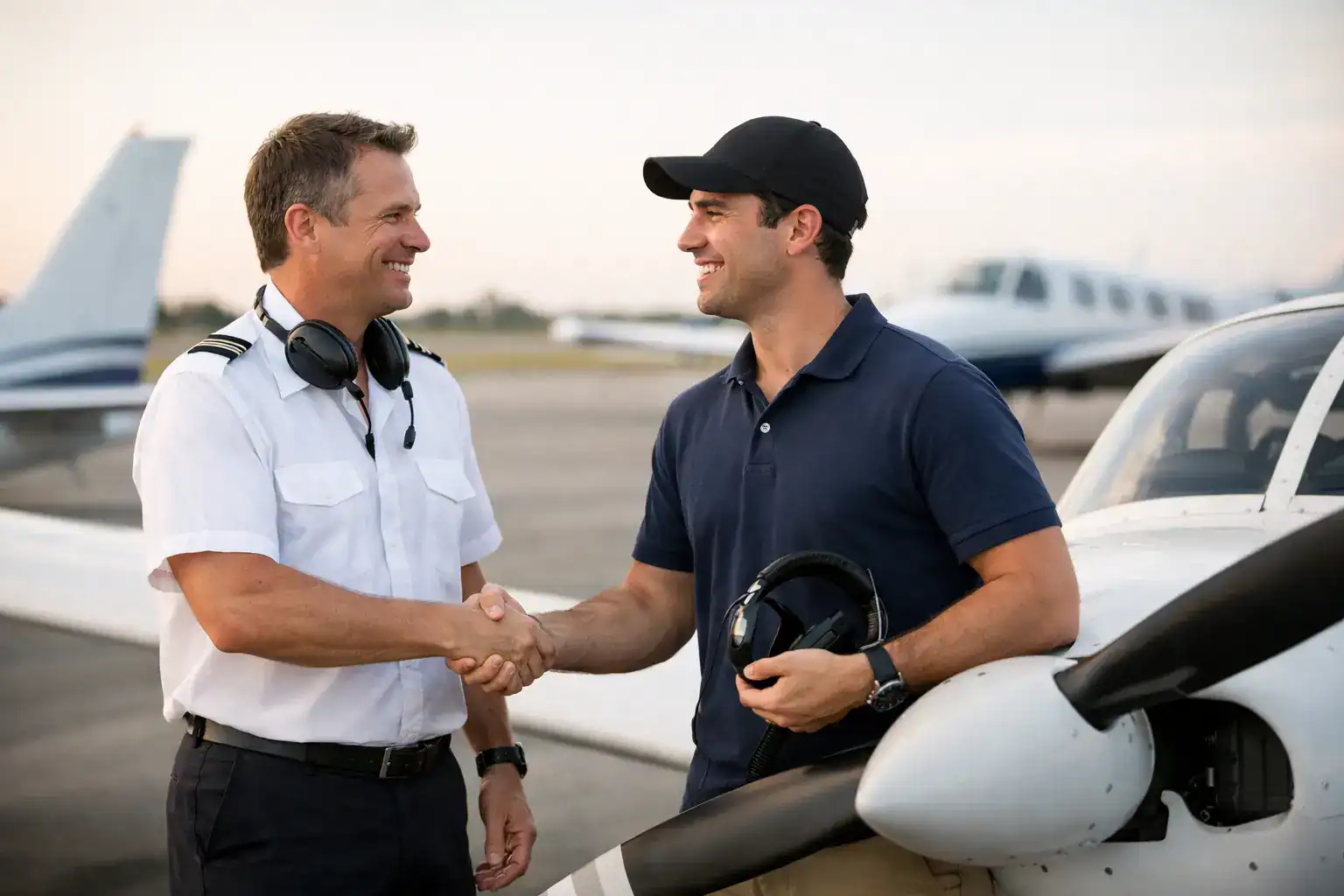
A checkride is not won when the examiner opens the door. It is won weeks earlier, when a pilot stops treating each lesson as an isolated event and starts training for a standard. The strongest checkride success stories are rarely about luck, easy questions, or a perfect weather day. They are about preparation that holds up when the pressure is real.
For aspiring professional pilots, that distinction matters. A passed practical test is more than a certificate in your file. It is evidence that you can plan, make decisions, manage risk, communicate clearly, and operate an aircraft to FAA standards. Those habits carry from the Private Pilot checkride into instrument flying, commercial maneuvers, multi-engine operations, instructor training, and eventually an airline career.
Pilots who pass on the first attempt usually do not claim that they felt no nerves. Most were nervous. The difference was that their preparation gave those nerves somewhere productive to go. Instead of wondering what the examiner might ask, they had already practiced explaining aircraft systems, weather decisions, regulations, cross-country planning, emergency procedures, and maneuver standards.
The common thread is simple: they trained beyond the minimum needed to complete a lesson. They arrived able to connect knowledge to action.
A private pilot candidate, for example, may know the required documents for a flight. A checkride-ready candidate can explain why those documents matter, identify what is missing, and decide whether the flight should proceed. An instrument candidate may memorize approach chart symbols. A prepared instrument pilot can brief an approach, anticipate threats, set up the avionics, and respond if the plan changes.
That level of readiness does not come from cramming the night before. It comes from an organized training sequence, regular study, honest self-evaluation, and instructors who hold students to professional standards before test day arrives.
A first-time pass often looks effortless from the outside. The pilot arrives on time, has an organized application and logbook, completes the oral portion with confidence, flies within standards, and walks away with a new certificate or rating. What no one sees is the work behind it.
The best candidates have usually made mistakes in training on purpose or under close supervision. They have missed a radio call, become temporarily disoriented under the hood, struggled through a soft-field landing, or had to recover from a poor commercial maneuver. Training is where those problems belong.
A successful checkride does not require a flawless pilot. The FAA is evaluating whether the applicant meets the applicable Airman Certification Standards and manages the flight safely. A pilot who recognizes an error, corrects it promptly, and continues with sound judgment can demonstrate more professionalism than someone who tries to hide a mistake.
This is a critical lesson for career-focused students. Airlines and professional operators do not expect perfection. They expect disciplined decision-making, standardization, and a willingness to use available resources. The checkride is an early opportunity to build those habits.
More flight hours can help, but flight time alone does not guarantee a pass. A student can repeat the same weak habits for dozens of hours if training lacks structure. On the other hand, a focused Part 141 program can create accountability through a defined syllabus, stage checks, progress benchmarks, and a clear path from one rating to the next.
The right pace depends on the student. Accelerated training can be highly effective for pilots who can commit to consistent flying and studying because skills remain current from lesson to lesson. A slower schedule can work well for students balancing a job or family obligations, but it requires more deliberate review between flights. The trade-off is straightforward: interruptions tend to create rust, and rust adds time, cost, and pressure before a practical test.
Consistency is what turns information into judgment. That is why serious students treat ground preparation with the same priority as time in the cockpit.
The oral portion of a checkride is where unstructured preparation gets exposed. Examiners are not looking for a student to recite disconnected answers. They want to see whether the applicant can apply regulations, aircraft knowledge, weather information, and aeronautical decision-making to a realistic flight.
A commercial applicant might be asked to explain the difference between carrying passengers and carrying property for compensation. A CFI applicant may need to teach a maneuver, not merely perform it. An instrument applicant may be presented with changing weather, a failed system, or an alternate-airport question and asked to make a decision.
The most reliable approach is to study in scenarios. Rather than asking, “What is the answer?” ask, “What would I do if this happened before or during this flight?” That shift builds practical understanding and makes the oral exam feel like a professional conversation rather than a quiz.
Candidates should also practice speaking their answers out loud. Knowing a concept silently is different from explaining it clearly under scrutiny. A mock oral with an instructor is valuable because it reveals weak areas before the checkride, when there is still time to fix them.
During the flight portion, pilots can get trapped by the urge to impress the examiner. That is the wrong target. The objective is not to fly aggressively or show off. The objective is to demonstrate safe, controlled, standards-based performance.
That means using checklists, making timely callouts, briefing each maneuver, scanning outside, maintaining situational awareness, and correcting deviations without drama. It also means making conservative decisions when conditions warrant them. A strong applicant does not press into an unsafe situation just to avoid inconvenience.
For commercial and instructor candidates, professionalism becomes even more visible. The evaluator is looking for precision, but also for maturity. Can you manage the airplane while explaining what you are doing? Can you teach a maneuver accurately? Can you identify a developing problem early enough to prevent it from becoming a larger one?
These are skills developed through repetition with standards, not through last-minute heroics.
The training environment affects checkride performance long before the test begins. Aircraft availability, instructor continuity, weather planning, maintenance coordination, scheduling discipline, and access to stage checks all shape whether a student can train consistently.
Florida Flyers Flight Academy gives career-track students the advantage of FAA Part 141 training and Self-Examining Authority, allowing eligible FAA checkrides to be conducted in-house. That can reduce the uncertainty created by outside examiner availability and help students move through a structured training pipeline without unnecessary scheduling delays.
Still, an in-house checkride is not a shortcut. The standard remains the standard. The real advantage is operational control: a student can prepare within a system designed around progression, receive feedback early, and reach the practical test with fewer avoidable disruptions.
For international students, organization is especially valuable. Managing an M-1 visa process, TSA requirements, housing, U.S. address needs, and FAA training expectations can be demanding. A school that understands the full process lets the student focus more attention on what ultimately earns the certificate: preparation and performance.
Start with an honest question: if your checkride were tomorrow, could you explain your decisions as clearly as you could fly the airplane? If the answer is no, that is not failure. It is a training target.
Review your weak areas before they become avoidance habits. Ask for mock oral questioning. Practice every required maneuver to the point that you can recover calmly from an imperfect entry. Keep your paperwork organized. Study the Airman Certification Standards throughout training, not just during the final week. Most of all, show up ready to be coached.
The pilots with the best checkride success stories do not wait for confidence to appear. They build it through disciplined preparation, one standard, one lesson, and one smart decision at a time. Your next certificate can be the result of that same approach – and a serious step toward the cockpit career you came to aviation to pursue.


You May Like

