

Top Pilot Schools in USA

The aviation industry faces an unprecedented opportunity in 2025. Airlines across the nation are actively recruiting pilots, creating a competitive market that favors qualified candidates more than any time in recent decades. Your choice among the top pilot schools in usa has never carried more weight for your future career prospects. The top pilot schools in usa are increasingly becoming the preferred choice for aspiring aviators.
The current pilot shortage has reshaped how airlines approach recruitment and compensation. Since 2020, major carriers have introduced innovative cadet programs while flight training technology has advanced significantly with new simulator capabilities and modernized aircraft fleets. These developments directly benefit today’s aspiring pilots.
Flight training represents a substantial financial commitment. Training costs typically range from $15,000 to $100,000, though some programs can reach $70,000 to $150,000 when factoring in comprehensive tuition and flight lab fees. The investment becomes more attractive when considering current market conditions—regional airlines now offer starting first-officer salaries between $60,000 and $90,000, reflecting the industry’s urgent need for qualified aviators.
The United States maintains its position as a premier destination for flight training. FAA-approved flight schools operate with stringent safety standards while providing access to modern training aircraft and experienced instructors. Boeing projects the global aviation industry will need 763,000 new pilots worldwide, prompting airlines to invest directly in training partnerships at levels not witnessed since the post-war aviation boom.
When considering your options, it’s essential to evaluate the top pilot schools in usa that offer comprehensive training programs and state-of-the-art facilities. Each of the top pilot schools in usa provides unique advantages that can significantly impact your aviation career.
Career changers and lifelong aviation enthusiasts alike can choose from over 100 colleges and universities offering specialized aviation degree programs nationwide. This guide examines 15 exceptional pilot schools across the United States, each selected for their proven ability to prepare students for successful aviation careers in today’s dynamic industry.
Florida Flyers Flight Academy

Image Source: Air Force Academy
For those aiming to join the ranks of the aviation elite, the top pilot schools in usa provide rigorous training and valuable industry connections.
The United States Air Force Academy (USAFA) offers a completely different approach to aviation education among the best aviation schools in USA. Located in Colorado Springs, this prestigious military academy provides a commission-based pathway that combines rigorous academic study with comprehensive officer development.
USAF Academy military training model
USAFA operates on a unique 47-month development framework that simultaneously challenges cadets academically, militarily, physically, and morally from their first day. The Academy’s training model differs fundamentally from civilian flight schools—it prepares future Air Force and Space Force officers through an immersive leadership development environment. Every aspect of cadet life builds toward commissioning officers of character who can assume leadership responsibilities immediately upon graduation.
USAF Academy tuition and benefits
With so many outstanding options, finding the right fit among the top pilot schools in usa can be a daunting task. Comprehensive research into the top pilot schools in usa will yield significant insights.
The Academy provides an education valued at over $416,000 at zero cost to cadets or their families. This comprehensive package includes tuition, room and board, medical care, and monthly pay throughout the four-year program. Graduates commit to serve as commissioned officers in return for this investment. Second lieutenants begin their careers with base pay exceeding $3,100 monthly, plus housing and sustenance allowances, along with access to government-sponsored life insurance.
USAF Academy aviation programs
Aviation exposure begins immediately with first-year cadets taking Aviation 100, covering fundamental principles of aviation and powered flight. The Academy operates America’s largest soaring program, conducting over 30,000 sorties annually with cadets learning to fly gliders. Advanced airmanship opportunities include parachuting, where approximately 500 cadets each year complete five freefall jumps to earn their parachutist badge.
USAF Academy fleet and simulators
The Academy maintains a diverse training fleet featuring TG-15 and TG-16 sailplanes, UV-18B Twin Otter aircraft, Cirrus SR-20 (T-53A), and various Cessna models. The state-of-the-art Multi-Domain Laboratory spans 7,000 square feet and houses 24 educational flight simulators, 12 remotely piloted simulators, and 40 operations command center workstations.
USAF Academy career outcomes
Graduating cadets receive guaranteed commissioned officer positions with 100% job placement rates. While graduates serve a minimum five-year active duty commitment, career opportunities span pilot training, combat systems officer roles, space operations, cyber warfare, and intelligence positions. Cadets selected for pilot training continue to Specialized Undergraduate Pilot Training at Air Force bases nationwide following graduation.
Hallmark University

Image Source: Hallmark University
Aviation maintenance professionals keep the industry flying safely. While pilots capture the spotlight, skilled technicians ensure every aircraft meets rigorous airworthiness standards before takeoff. Hallmark University has focused exclusively on this critical side of aviation since 1969, establishing itself among the best aviation schools in USA for maintenance training.
Hallmark aviation campus and location
The dedicated Aeronautics Campus sits strategically adjacent to San Antonio International Airport, providing immediate access to live aviation operations. Students work directly with actual aircraft and cutting-edge equipment in this real-world environment. Professional training hours mirror industry standards, with campus operations running weekdays from 7:30 AM to 5:00 PM.
Hallmark tuition and program costs
Despite accelerated timelines, Hallmark delivers exceptional value for aspiring technicians. The Associate of Applied Science (AAS) in Airframe/Powerplant Technologies requires $435 per credit hour, totaling $41,760 plus $1,350 in specialized lab fees. Bachelor’s degree completion programs in Aviation Maintenance Management cost approximately $26,100. Active military personnel and spouses receive substantial discounts of $250-$275 per credit hour across most programs.
Hallmark aviation programs and certifications
Four distinct pathways prepare students for FAA Airframe and Powerplant certifications:
- AAS in Airframe/Powerplant Technologies (16 months)
- AAS in Airframe Technology (10 months)
- AAS in Powerplant Technology (10 months)
- BS in Aviation Maintenance Management (completion program)
The accelerated format enables completion in under two years versus national averages of 24-43 months.
Hallmark fleet and simulator access
Hands-on learning defines the Hallmark experience. Students master technical skills using live jet engines and operational aircraft at the aviation campus. The comprehensive curriculum covers safety wiring, specialty tool usage, soldering, inspection techniques, troubleshooting, and engine operations.
Hallmark job placement and industry links
Career outcomes speak to program quality—93% of graduates secure positions within one year. Strong industry partnerships with Flexjet, Bombardier, PSA Airlines, Lockheed Martin, Standard Aero, and GulfStream Aviation create direct pathways to employment. Starting annual salaries typically exceed $40,000, with many graduates receiving job offers upon program completion.
Inflight Pilot Training

Image Source: inflightpilottraining.com
Nestled in Minnesota’s Twin Cities region, Inflight Pilot Training has established itself among the top pilot schools in USA through its distinctive community-based approach and comprehensive training facilities.
Inflight training model and location
Nestled in Minnesota’s Twin Cities region, Inflight Pilot Training has established itself among the top pilot schools in usa through its distinctive community-based approach and comprehensive training facilities. The commitment to excellence at the top pilot schools in usa is reflected in their training methodologies.
Flying Cloud Airport (KFCM) in Eden Prairie serves as Inflight’s operational base, providing students with a real-world training environment featuring parallel runways and steady aviation traffic. The school operates as a complete aviation ecosystem rather than a traditional flight training facility—integrating flight instruction, maintenance services, fixed-base operations, and social networking under one roof. Their membership-only model preserves fleet quality while building a supportive aviation community that extends well beyond initial training.
Inflight tuition and program pricing
While specific program costs remain private, Inflight positions pilot training as an investment comparable to purchasing a boat or quality used vehicle. Students benefit from a pay-as-you-go structure that eliminates large upfront financial commitments. Simulator training begins at $130 per hour, providing cost-effective opportunities to build skills and confidence.
Inflight aviation programs and certifications
The curriculum covers essential pilot certifications including Private Pilot License, Instrument Rating, Commercial Pilot License, and Flight Instructor qualifications. Each pathway adheres to FAA requirements while incorporating clearly defined prerequisites such as minimum age standards and flight hour thresholds.
Inflight fleet and simulator access
Students train on modern aircraft including Cirrus SR20 and SR22 models equipped with Garmin G1000 Perspective+ avionics systems. The school also maintains several Cessna aircraft alongside advanced simulation technology, including the Cirrus ALSR-20 AATD. FAA-approved simulators enable students to log up to 50 hours toward commercial certificates and 20 hours toward instrument ratings.
Inflight student support and outcomes
Choosing among the top pilot schools in usa requires careful consideration of various factors such as cost, location, and reputation.
The school achieves an remarkable 80% program completion rate—effectively reversing the aviation industry’s typical 80% dropout statistic. This success stems from their proprietary “Inflight Matching Method,” which pairs students with instructors based on compatible learning styles and personalities. The membership model creates a focused learning environment where students receive individualized attention throughout their training journey.
ATA Flight School

Image Source: www.ataflightschool.com
Experience matters in aviation training. ATA Flight School has spent over 17 years refining its “pilots training pilots” philosophy at North Perry Airport in South Florida, establishing itself among top pilot schools in USA through hands-on instruction from active industry professionals.
ATA campus and training environment
Located at North Perry Airport (KHWO) in Pembroke Pines, Florida, ATA places students directly into a dynamic airport environment that mirrors real-world aviation operations. The campus features an on-site maintenance facility staffed by certified A&P mechanics, providing students with valuable exposure to aircraft maintenance procedures. South Florida’s consistent weather patterns support year-round flight operations, eliminating seasonal training delays that can extend program completion times.
ATA tuition and program costs
ATA maintains straightforward pricing structures with flexible payment options. Private Pilot training costs $9,400 with approximately $1,945 in additional expenses, while the complete Commercial Pilot License with Instrument Rating totals $60,075. International students benefit from structured four-installment payment plans designed to accommodate varying financial circumstances.
ATA aviation programs and certifications
The school offers a complete progression from Private Pilot through Airline Transport Pilot certifications, adhering to FAA training standards. Their Commercial Pilot program encompasses 260 flight hours with individualized instruction tailored to each student’s learning pace. All curricula maintain FAA approval and recognition by international aviation authorities including DGCA.
ATA fleet and simulator access
Students train on a varied aircraft fleet designed to build diverse flying skills:
- High-wing aircraft (Cessna 172s with advanced avionics)
- Low-wing aircraft (Piper PA-28 Warriors and Archers)
- Multi-engine training aircraft (Piper PA-34 Seneca)
- Rotorcraft (Robinson R44)
- RedBird FMX simulator for instrument training
ATA career support and job placement
The instructional team brings over 10,000 combined flight hours to student training. Many instructors maintain active Part 121 airline experience, creating valuable industry connections that benefit graduates seeking airline positions. This professional network often translates into career opportunities for qualified graduates.
Epic Flight Academy

Image Source: epicflightacademy.com
Epic Flight Academy has built an impressive reputation since 1999, growing into the largest FAA Part 141 flight school network in the United States with nine strategically located campuses. The academy’s reach extends far beyond domestic training, having prepared pilots from more than 110 countries who now operate for over 300 airlines worldwide.
Epic location and international reach
The primary campus in New Smyrna Beach, Florida, capitalizes on proximity to NASA facilities where weather conditions support consistent year-round training. Epic’s expansion strategy places additional campuses across Colorado, Utah, Alabama, Texas, and Arizona. This multi-state presence allows students to choose optimal training locations based on their specific needs and preferences.
Epic tuition and program pricing
Epic structures its programs with upfront cost transparency. The Professional Airline Pilot Program requires $75,043 in tuition, though total program expenses reach $83,646.85 when factoring in additional costs. Students can also pursue individual certifications: Private Pilot training costs $28,822, Instrument Rating adds $17,052.50, and Commercial Multi-Engine certification runs $24,617.50. While Epic cannot offer scholarships to international students, the school provides guidance on loan eligibility options.
Epic aviation programs and certifications
The academy’s accelerated approach can take students from zero flight experience to airline-ready certification within one year. All training curricula meet both FAA standards and international Civil Aviation Authority requirements. Graduates achieve ICAO Level IV English proficiency certification, ensuring global career mobility.
Epic fleet and simulator access
Epic maintains a young fleet averaging just five years in age, consisting primarily of Cessna 172 Skyhawks and Piper PA-44 Seminoles. The school purchases all aircraft new from manufacturers and equips them with distinctive red tails for enhanced visibility during training operations. Simulation training utilizes multiple platforms, including Frasca Truflite and Precision Flight Control GTX Max systems.
Epic international student support
International students receive comprehensive support services covering visa processing, housing arrangements, and English language tutoring when needed. The Virtual Flight Academy program connects incoming students with instructors before campus arrival. This structured support system has successfully guided thousands of international students through their aviation career transitions.
Skyborne Airline Academy

Image Source: Skyborne Airline Academy
Skyborne Airline Academy brings a truly international perspective to American flight training. With facilities spanning the UK, US, and India, this academy ranks among the best pilot schools in USA by offering students exposure to global aviation standards and practices.
Skyborne training model and location
The academy’s Vero Beach, Florida campus capitalizes on 320 days of annual sunshine for consistent training conditions. What sets Skyborne apart is its Progressive Continuous Learning methodology—a structured approach that weaves theoretical knowledge directly into practical flight exercises within an airline-focused environment. Students can take advantage of comprehensive on-site housing that includes recreational facilities like swimming pools and basketball courts, all within a short drive of Florida’s coastline.
Skyborne tuition and program costs
Skyborne structures its comprehensive FAA 141 Program at $97,079, breaking this investment into five manageable installments of $19,415.80 spread throughout the training timeline. Students choosing on-campus housing face an additional $7,800, with required materials adding $1,305 to the total. The academy partners with Sallie Mae to provide financing solutions, making this substantial commitment more manageable for qualified applicants. Most students complete the full progression in approximately 12 months.
Skyborne aviation programs and certifications
Training follows a carefully sequenced pathway from Private Pilot fundamentals through Instrument Rating, Commercial Multi-Engine, and ultimately Certified Flight Instructor (CFI) credentials. Each phase builds deliberately upon previous learning, ensuring graduates possess airline-standard competencies whether they pursue careers in Part 121 scheduled service, Part 135 charter operations, or Part 91 corporate aviation.
Skyborne fleet and simulator access
The school operates an impressive fleet of 55 Piper aircraft, including Warriors, Arrows, and Seminoles, all maintained by their in-house engineering team operating under strict FAA Part 145 standards. Advanced simulation technology enhances the learning experience through Redbird simulators and a Boeing 737 MAX simulator that introduces students to commercial airline procedures and systems.
Skyborne airline partnerships and job placement
Direct career pathways distinguish Skyborne from many competitors through partnerships with established carriers:
- JSX offers experienced flight instructors opportunities to advance as First Officers on Embraer 145 aircraft
- SkyWest, America’s premier regional airline, provides specialized career development programs
- Avelo Airlines maintains a Preferred Hiring Pathway for qualified graduates
These partnerships reflect the academy’s strong industry reputation, with graduates successfully securing positions at carriers worldwide.
L3Harris Flight Academy

Image Source: Pilot Aptitude Test
L3Harris Flight Academy operates as the aviation training division of aerospace giant L3Harris Technologies, bringing corporate-level precision to pilot education at its Sanford, Florida facility.
L3Harris corporate training model
The academy functions on an industry-integration model that spans multiple international locations. Their Florida campus welcomed 34 new cadet pilots in July 2024, reflecting a structured approach that mirrors airline training environments from the first day of instruction. This corporate methodology prepares students for the realities of commercial aviation through systematic progression.
L3Harris tuition and financing options
Annual first-year expenses average $115,511 after financial aid, positioning L3Harris among the premium training options. The academy works with Sallie Mae to provide financing covering up to 100% of program costs with adaptable repayment structures. Meritize loan programs factor in post-graduation earning potential, recognizing the strong career prospects for qualified pilots.
L3Harris aviation programs and certifications
The curriculum adheres to FAA Part 141 standards while progressing students from zero experience to commercial readiness. The training methodology allocates 30% to classroom theory, 30% to simulation work, and 40% to actual flight experience, creating a balanced foundation for professional aviation careers.
L3Harris fleet and simulator access
Students train on an extensive fleet comprising 44 Cessna 172 Skyhawks, 26 Cirrus SR20s, 5 Piper Arrows, and 24 Piper Seminole twin-engine aircraft. This diverse aircraft selection exposes students to various flight characteristics essential for commercial operations.
L3Harris airline cadet programs
The academy maintains strategic partnerships offering direct career pathways with major carriers:
- Air Wisconsin (leading to American Airlines positions)
- Atlas Air (operating Boeing 747, 777, 767, and 737 fleets)
- Avelo Airlines (First Officer opportunities at 1,000-1,200 flight hours)
These partnerships provide graduates with clear routes to airline cockpits, reflecting the academy’s industry connections.
Phoenix East Aviation (PEA)

Image Source: Phoenix East Aviation
Phoenix East Aviation (PEA) represents five decades of aviation training excellence, having prepared thousands of pilots from nearly every nation for careers in professional aviation. This institutional legacy places PEA among the top pilot schools in USA through sustained educational quality and international recognition.
PEA location and training environment
Operating from Daytona Beach International Airport with an auxiliary facility in Palm Coast, PEA provides students with authentic airline-environment training. The Class Charlie airport setting exposes students to complex air traffic patterns and communication procedures that mirror real-world airline operations. Florida’s favorable weather conditions support over 300 flying days annually, ensuring consistent training progression.
PEA tuition and affordability
PEA works with multiple financial partners including SLM to provide accessible training options. Veterans benefit significantly through VA eligibility, with the Montgomery GI Bill typically covering 60% of training costs. The school has also established a partnership with Purdue Global, offering students a 20% tuition reduction on undergraduate programs.
PEA aviation programs and certifications
The school operates under FAA Part 141 and Part 61 approved programs with self-examining authority—a designation that streamlines the testing process. PEA has secured special FAA approval for an innovative “Commercial ‘train to proficiency'” course that requires only 50 flight hours compared to the standard 120 hours.
PEA fleet and simulator access
Students train on a modern fleet of 65+ aircraft, including Cessna 172s and Diamond DA42s equipped with Garmin G1000 glass cockpit systems. Ground-based training incorporates Redbird FMX Full Motion and TD2 simulators, providing cost-effective instrument and procedural training.
PEA international student support and job placement
PEA holds authorization to issue both F-1 and M-1 visas, making it one of only four flight schools nationwide with this dual capability. The F-1 visa pathway includes 12 months of Optional Practical Training (OPT) following graduation, enabling international graduates to work as flight instructors while building the flight hours necessary for airline employment.
Florida Flyers Flight Academy

Image Source: Florida Flyers Flight Academy
Florida Flyers Flight Academy has built its reputation on training international pilots who go on to fly for major carriers worldwide. Based in historic St. Augustine, this specialized academy attracts aspiring aviators from across the globe seeking accelerated, comprehensive flight training.
Florida Flyers location and weather benefits
St. Augustine’s coastal location provides Florida’s ideal flying conditions with minimal weather disruptions throughout the year. Students can maintain consistent flight schedules with back-to-back lessons, eliminating the seasonal training delays common in northern climates. The academy capitalizes on over 300 clear flying days annually, enabling students to progress through certifications significantly faster than programs in weather-variable regions.
Florida Flyers tuition and program costs
The academy’s accelerated Commercial Pilot License pathway requires only 111 flight hours compared to the industry standard 191 hours. Complete zero-to-CPL training packages range from $70,000 to $120,000 based on individual program selections. Students pursuing a Commercial Pilot License with multi-engine rating can expect costs around $43,200, representing substantial savings compared to traditional university aviation programs.
Florida Flyers aviation programs and certifications
Operating as an FAA Part 141 approved flight school, Florida Flyers structures training pathways from Private Pilot through Commercial and Flight Instructor certifications. The academy holds EASA European Pilot training certification, making it one of only five US-based schools with this internationally recognized credential. This dual certification enables graduates to pursue aviation careers in both American and European markets.
Florida Flyers fleet and simulator access
Flight training utilizes a diverse fleet of up to 30 aircraft spanning multiple aircraft types including Piper Seminoles, Beechcraft Duchess, and Cessna 172s equipped with Garmin 1000 avionics alongside traditional Cessna 152s. Advanced training incorporates high-quality Redbird motion simulators featuring wrap-around visual systems and fully enclosed cockpit environments.
Florida Flyers student support and outcomes
The academy maintains an instructional team of 50 experienced FAA-certified flight instructors, ensuring personalized attention throughout training. Graduates have secured positions with over 60 airlines globally, including major carriers such as American Airlines, Delta, and Emirates. International students benefit from comprehensive visa processing assistance and housing coordination services.
Bridgewater State University
!Image
Image Source: Bridgewater State University
New England’s aviation training landscape offers limited options for aspiring pilots seeking comprehensive four-year programs. Bridgewater State University fills this critical gap as the only four-year aviation science program with flight training in New England, establishing itself as a cornerstone among top pilot schools in USA for regional students.
Bridgewater aviation campus and location
The Aviation Training Center operates at New Bedford Regional Airport, approximately 30 minutes from the main campus. First-year aviation students receive special permission to have vehicles on campus due to this distance. BSU has established a commanding presence at the airport, with more than half of all flights at New Bedford originating from the university’s training program.
Bridgewater tuition and program costs
Tuition structure favors in-state students significantly. Massachusetts residents pay approximately $24,000 annually for tuition and room/board, while out-of-state students face costs around $34,000. Flight training expenses are additional, yet remain competitive at approximately $50,000 total for all ratings. Breaking down individual certifications: obtaining a Private Pilot License costs $12,646.50, an Instrument Rating adds $13,055, and Commercial Pilot certification requires another $11,195.
Bridgewater aviation programs and certifications
The Department of Aviation Science offers two distinct bachelor’s degree concentrations: Flight Training and Aviation Management. Both programs emphasize critical thinking, analytical skills, and effective communication. BSU maintains AABI accreditation for both concentrations, with flight training accredited since 2014.
Bridgewater fleet and simulator access
The training fleet features 10 Cessna 172R Skyhawks for primary instruction and 3 technologically advanced aircraft (TAA) equipped with Garmin 430W GPS. Simulation training utilizes two Redbird LD AATDs and one Redbird FMX simulator.
Bridgewater job placement and industry links
Graduate employment outcomes demonstrate strong industry connections. Alumni secure positions with major carriers including American Airlines, Delta, Endeavor Airlines, and Cape Air. During 2022 alone, 15 flight graduates found industry placement, reflecting solid employment prospects. The university maintains formal partnerships with JetBlue, Cape Air, and Endeavor Airlines.
Delaware State University

Image Source: Delaware State University
Cost-conscious aviation students will find Delaware State University offers exceptional value among the top pilot schools in USA. Operating from Delaware Airpark (KDVX) just minutes from its Dover campus, DSU provides quality flight training without the premium price tags found at many competing institutions.
Delaware State aviation campus and location
The aviation program operates from a dedicated facility at Delaware Airpark in Cheswold, Delaware. Students benefit from training at an active general aviation airport while maintaining access to comprehensive academic support services at the main campus. This dual-location approach creates an integrated educational experience that combines practical flight operations with traditional university resources.
Delaware State tuition and program costs
DSU stands out for offering some of the most affordable aviation training on the East Coast. Private Pilot certification requires 32 hours of dual instruction at $8,200, representing significant savings compared to industry averages. The university also provides unique opportunities for military-bound students through its Helicopter Flight Training Program, valued at up to $220,000 with full tuition and flight fee coverage.
Delaware State aviation programs and certifications
The Bachelor of Science degree program offers three specialized tracks:
- Aviation Management
- Professional Pilot
- Professional Helicopter Pilot
Each concentration provides focused preparation for specific career paths within the aviation industry.
Delaware State fleet and simulator access
The school maintains a diverse 26-aircraft fleet featuring 11 Vulcanair V1.0 single-engine trainers, 7 Piper Warriors, 2 Piper Arrows, and a Piper Seneca multi-engine aircraft. Students gain experience on the CR-12 Advanced Aviation Training Device, which replicates the handling characteristics of the entire DSU fleet.
Delaware State student support and outcomes
Graduates successfully transition into aviation careers across the industry spectrum, finding positions with regional carriers and major airlines alike. The university’s combination of affordable training and comprehensive degree programs creates pathways for students seeking both immediate employment and long-term career advancement in aviation.
Arizona State University
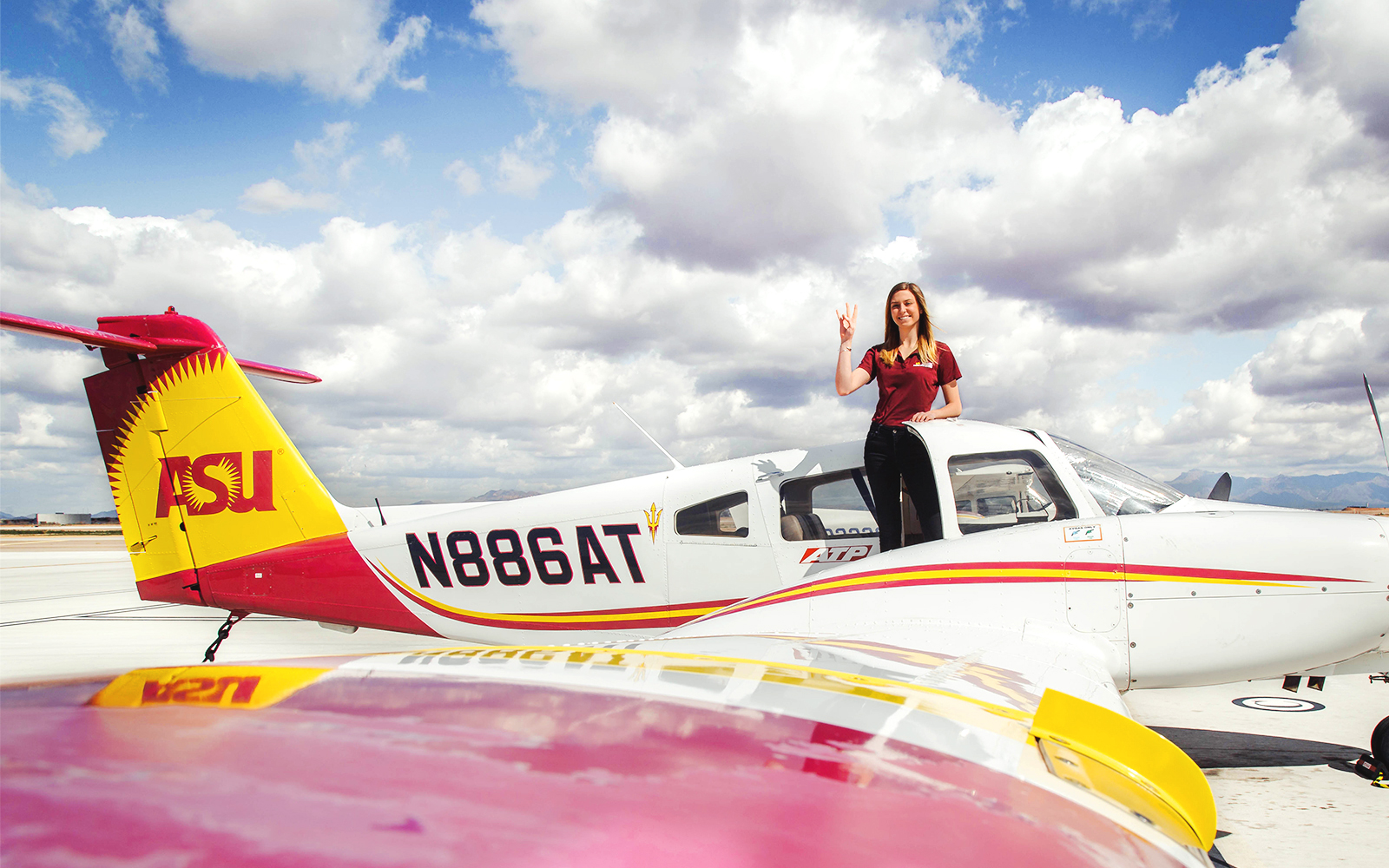
Image Source: Faculty Hub – ASU Engineering – Arizona State University
Arizona State University harnesses the desert’s endless blue skies to create an exceptional training environment. Students here experience something most flight schools cannot offer—the reliability of Arizona’s clear weather combined with cutting-edge aviation technology.
ASU aviation campus and location
The aviation program operates from ASU’s Polytechnic campus in Mesa, with flight training conducted at Chandler Municipal Airport, approximately 25 minutes from campus. The Valley of the Sun delivers one of the nation’s most consistent flying environments with over 300 days of sunshine annually. This weather advantage eliminates the frustrating delays that plague schools in less favorable climates, allowing students to maintain steady progress toward their certifications.
ASU tuition and program costs
Arizona residents benefit from in-state tuition of approximately $13,000 annually, while out-of-state students invest around $32,000. Flight training expenses add significantly to this base cost, reaching an additional $90,000 to complete all certifications. Students should budget approximately $114,480 for the complete flight training progression from Private Pilot through CFI certifications. Though substantial, this investment reflects the comprehensive nature of university-level aviation education.
ASU aviation programs and certifications
The Professional Flight concentration within the Bachelor of Science in Aeronautical Management Technology shapes graduates for airline careers. The program holds accreditation from the Aviation Accreditation Board International (AABI), providing industry recognition that opens doors with major carriers. This accreditation signals to employers that graduates possess both theoretical knowledge and practical skills essential for professional aviation.
ASU fleet and simulator access
Modern aircraft form the backbone of ASU’s training program, including Cessna 172s equipped with Garmin G1000 avionics and Piper Seminoles. The dedicated Simulator Building houses five flight simulators, featuring advanced equipment such as a level 5 regional jet flight simulation training device and specialized facilities like a high-altitude simulation chamber. These resources expose students to airline-standard technology before they enter the workforce.
ASU career support and airline links
Strong industry partnerships create direct pathways to employment. ASU maintains valuable relationships with carriers including Endeavor Air, Southwest Airlines, and Hawaiian Airlines—which consistently hires 30-40 ASU graduates annually. These connections demonstrate the program’s reputation within the industry and provide students with clear career progression opportunities upon graduation.
Colorado Northwestern Community College

Image Source: The Herald Times
Colorado Northwestern Community College represents over fifty years of proven aviation education, delivering exceptional value for students seeking quality flight training without the premium price tag associated with larger institutions.
CNCC aviation campus and community model
The college operates its aviation program at Rangely Airport, positioned just two miles from the main campus in Colorado’s expansive airspace. Students benefit from an impressive 8:1 student-to-instructor ratio, which guarantees at least three scheduled flights weekly per student. This personalized attention recently earned CNCC recognition from Fly magazine as Colorado’s leading program for developing workforce-ready pilots.
CNCC tuition and affordability
The program delivers remarkable value with in-state students paying approximately $111,558 total for both degree completion and comprehensive flight training. Out-of-state students can expect costs around $118,686. Individual certification costs break down to $21,603 for Private Pilot training, $16,329 for Instrument Rating, and $23,870 for Commercial certification.
CNCC aviation programs and certifications
The Associate of Applied Science in Aviation Technology condenses extensive training into an efficient two-year program. Students progress through private license, instrument rating, commercial license, and flight instructor certificate requirements. All training adheres to FAA Part 141 standards.
CNCC fleet and simulator access
The college maintains complete ownership and operational control of its training fleet, supported by a full-time FAA-certified A&P mechanic. Students provide personal equipment including pilot headset, logbook, and iPad Mini.
CNCC student support and transfer options
Graduates can transfer seamlessly to Metropolitan State University in Denver to complete a four-year Aviation and Aerospace Science degree. The Rangely campus provides on-campus housing options for students.
Embry-Riddle Aeronautical University

Image Source: Embry-Riddle Aeronautical University
When aviation professionals discuss premier flight training institutions, Embry-Riddle Aeronautical University consistently emerges as the gold standard. The nation’s largest and oldest aeronautical university distinguishes itself among top pilot schools in USA through its unparalleled aviation focus and industry-leading resources that span decades of educational excellence.
Embry-Riddle campus locations and environments
Embry-Riddle operates two major residential campuses strategically positioned in optimal flying environments. The 185-acre Daytona Beach campus sits adjacent to Daytona Beach International Airport, serving approximately 7,200 undergraduate and 800 graduate students from 50 states and nearly 100 countries. The Prescott campus offers students a distinctive mountain setting with direct access to Ernest A. Love Field. Each location provides unique advantages for aviation training while maintaining the university’s rigorous academic standards.
Embry-Riddle flight training investment
Students actively pursuing flight training should budget between $20,000-$30,000 per academic year while flying. Individual flight courses reflect the program’s comprehensive approach: Private Single-Engine Flight costs $23,091, Instrument Single-Engine Flight adds $10,159, Commercial Single-Engine Flight requires $16,577, and Commercial Multi-Engine Add-On runs $9,797. However, graduates benefit from the FAA’s 500-hour ATP reduction, significantly shortening their path to airline careers.
Embry-Riddle academic programs and specializations
The institution offers over 50 degree programs spanning associate to doctoral levels. Students can pursue diverse paths including Aeronautical Science for professional pilots, Aerospace Engineering, Air Traffic Management, and specialized fields like Aerospace Physiology. This breadth enables students to tailor their education to specific career objectives within the aviation industry.
Embry-Riddle aircraft fleet and simulation technology
The university maintains a combined fleet exceeding 100 aircraft, primarily consisting of Cessna 172 Skyhawks and Diamond DA42-VIs. Flight training incorporates cutting-edge simulation technology, including Level 6 flight training devices with 220-degree panoramic visual theaters that closely replicate actual flight sensations. This technology integration prepares students for modern cockpit environments they’ll encounter in professional aviation.
Embry-Riddle career outcomes and industry connections
The university achieves remarkable career placement success with 96% of graduates securing employment or continuing education within one year. Strong industry relationships include partnerships with carriers like SkyWest and Frontier Airlines, while support from aviation giants like Boeing and FedEx provides scholarship opportunities. These connections create direct pathways from classroom to cockpit for qualified graduates.
School Comparison Overview
The following comparison table consolidates key information from the 15 featured flight schools, enabling you to evaluate options based on your specific priorities and budget requirements.
| Flight School | Location | Program Costs | Fleet | Key Programs | Notable Features |
|---|---|---|---|---|---|
| Leopard Aviation | Scottsdale & Mesa, AZ | $259/hr dual instruction (C172), $579/hr multi-engine | Cessna 172S, Piper Seminole | Part 61 Programs | Pay-as-you-go model, 300+ sunny days annually |
| USAF Academy | Colorado Springs, CO | Full scholarship ($416,000 value) | TG-15/16 sailplanes, UV-18B, Cirrus SR-20, Cessnas | Military Officer Training | 5-year service commitment, guaranteed job placement |
| Hallmark University | San Antonio, TX | $41,760 (AAS program) | Real aircraft & engines for maintenance training | Airframe/Powerplant Programs | 93% job placement rate, 16-month completion |
| Inflight Pilot Training | Eden Prairie, MN | Pricing varies by program | Cirrus SR20/SR22, Cessnas | Private, Instrument, Commercial, CFI | 80% program completion rate |
| ATA Flight School | Pembroke Pines, FL | $60,075 (Commercial + Instrument) | Cessna 172s, Piper Warriors/Archers/Seneca, R44 | Private to ATP Certifications | 17+ years experience, international student support |
| Epic Flight Academy | New Smyrna Beach, FL | $83,646.85 (Professional Program) | Cessna 172s, Piper PA-44 Seminoles | FAA Part 141 Programs | Students from 110+ countries |
| Skyborne Airline Academy | Vero Beach, FL | $97,079 (FAA 141 Program) | 55 Piper aircraft | Private through CFI | Airline partnerships with JSX, SkyWest, Avelo |
| L3Harris Flight Academy | Sanford, FL | $115,511 (first year) | 44 C172s, 26 Cirrus SR20s, 5 Piper Arrows, 24 Seminoles | FAA Part 141 Programs | Corporate-structured training |
| Phoenix East Aviation | Daytona Beach, FL | Varies by program selection | 65+ aircraft including C172s, Diamond DA42s | Part 141 & 61 Programs | F-1 and M-1 visa authorization |
| Florida Flyers | St. Augustine, FL | $70,000-$120,000 (zero to CPL) | 30 aircraft including Seminoles, Duchess, C172s | 111-hour CPL Program | EASA certification, 300+ flying days |
| Bridgewater State | New Bedford, MA | $50,000 (flight training total) | 10 C172R Skyhawks, 3 TAA aircraft | BS in Aviation Science | Only 4-year program in New England |
| Delaware State | Dover, DE | $8,200 (Private Pilot portion) | 26 aircraft including Vulcanair V1.0, Piper Warriors | BS Aviation degrees | Military helicopter program available |
| Arizona State | Mesa, AZ | $114,480 (comprehensive training) | Cessna 172s, Piper Seminoles | BS in Aeronautical Management | 300+ sunny days, airline partnerships |
| CNCC | Rangely, CO | $111,558 (in-state total) | College-owned training fleet | AAS in Aviation Technology | 8:1 student-instructor ratio |
| Embry-Riddle | Daytona Beach, FL & Prescott, AZ | $59,624 (flight courses total) | 100+ aircraft (C172s, Diamond DA42-VIs) | 50+ aviation degree programs | 96% employment rate, largest aviation university |
Cost Analysis: Program expenses range dramatically from Delaware State University’s accessible $8,200 Private Pilot training to L3Harris Flight Academy’s premium $115,511 first-year investment. Weather-favorable locations like Arizona and Florida typically command higher prices but offer year-round training availability.
Fleet Considerations: Most schools operate modern Cessna 172 and Piper aircraft fleets. Larger institutions like Embry-Riddle and Phoenix East Aviation maintain extensive fleets exceeding 65-100 aircraft, while smaller programs focus on quality over quantity.
Specialization Focus: Several schools cater to specific career paths—Hallmark University excels in maintenance training, the Air Force Academy provides military officer preparation, and multiple Florida-based academies specialize in international student services.
Conclusion
Your flight training decision shapes not just your career trajectory, but your entire professional future in aviation. The 15 schools featured in this guide represent the pinnacle of American flight training, each offering distinct pathways to cockpit success. Whether you’re drawn to Leopard Aviation’s student-centered flexibility, the Air Force Academy’s prestigious military route, or Embry-Riddle’s comprehensive aviation education, the right choice depends on matching your goals with each school’s unique strengths.
Financial considerations remain important, yet the investment perspective has shifted dramatically. While training costs span from budget-friendly community college programs to premium academy experiences, today’s pilot shortage has created unprecedented earning potential that justifies careful investment in quality education. The key lies in selecting a school that maximizes both your training value and career preparation.
Geographic advantages matter more than many prospective pilots realize. Year-round flying weather can accelerate your progress significantly, while strong industry connections open doors that remain closed to graduates from less-connected programs. Each school’s fleet modernization, instructor quality, and airline partnerships directly influence your transition from student to professional aviator.
The current aviation landscape rewards decisive action. Airlines are actively recruiting, compensation packages continue improving, and career advancement opportunities abound for well-trained pilots. The schools highlighted here have proven track records of preparing students for this dynamic industry through rigorous training standards, modern equipment, and industry-relevant curricula.
Your aviation journey begins with selecting the right training foundation. Take time to visit campuses, speak with current students, and evaluate how each program aligns with your career timeline and learning preferences. The investment in quality flight training pays dividends throughout your entire aviation career, making this decision one of the most important you’ll make as an aspiring pilot.
Contact the Florida Flyers Flight Academy Team today at (904) 209-3510 to learn more about how to transfer flight schools.

Table of Contents
Contact the Florida Flyers Flight Academy Team today at (904) 209-3510 to learn more about how the top pilot schools in usa can help you achieve your aviation dreams.


