
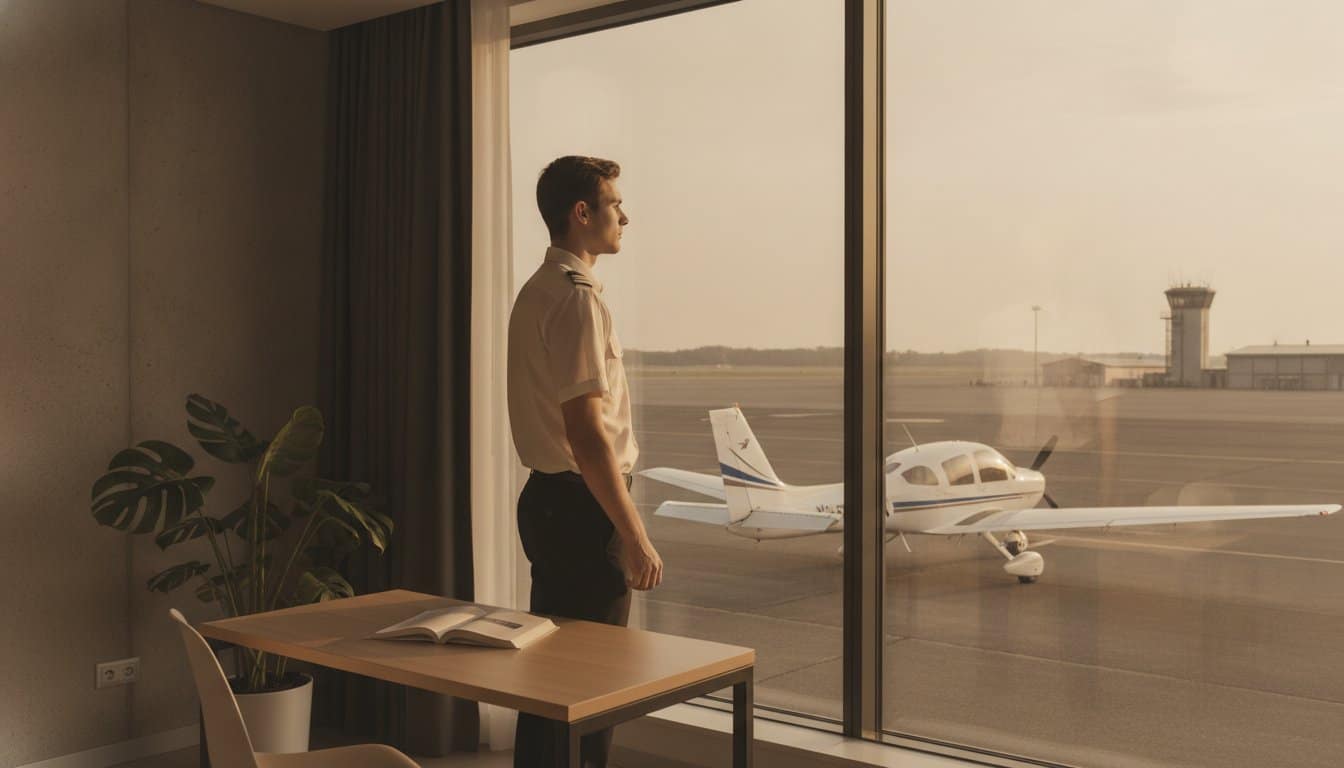
The difference between a standard pilot and an elite aviator isn’t just found in the cockpit; it’s forged in the environment where they rest, study, and strategize. Professional training is a high-stakes endeavor that demands total focus, yet many students waste critical cognitive energy on the logistical friction of finding short term rentals or navigating daily commutes. When you select a flight school with student housing, you aren’t just booking a room; you’re securing a tactical advantage that prioritizes your professional development over administrative distractions.
This article demonstrates how immersive residential solutions serve as a high-performance accelerator for your career. We will detail how these turnkey living environments eliminate the complexity of M1 Visa housing requirements and provide the built-in networking required for elite industry success. You’ll learn to leverage strategic housing to minimize logistical drag and maximize your training velocity toward the flight deck.
Professional pilot training is an unforgiving discipline where every minute of cognitive capacity must be reserved for technical mastery. A flight school with student housing transforms the residential experience from a mere logistical necessity into a high-performance catalyst. This immersive training environment ensures that candidates remain physically and mentally locked into their career objectives, eliminating the distractions that derail less disciplined students. It’s the difference between a casual interest and a professional commitment.
Choosing to commute from a private residence often signals a hobbyist mindset. It introduces volatile variables, such as traffic congestion and external domestic stressors, that compromise the integrity of the pilot training process. Conversely, the professional approach utilizes on-site accommodations to maintain a “Flight Deck” atmosphere twenty-four hours a day. This total immersion is essential for those enrolled in accelerated career tracks where information retention is non-negotiable.
We define training friction as the sum of all non-aviation stressors that impede student progress. In high-intensity Part 141 environments, fatigue is both a regulatory risk and a primary cause of training delays. A five-minute commute allows students to maximize their rest cycles, which is critical for safety and performance during early-morning flight blocks or late-night simulator sessions. Proximity to the flight line ensures that you arrive in the cockpit with zero cognitive load from external travel, allowing for total focus on the mission at hand.
The aviation ecosystem thrives on shared knowledge and professional proximity. Living among peers facilitates a constant state of learning where complex ground school topics are reinforced through spontaneous study groups and peer-to-peer mentoring. This environment provides junior candidates with the opportunity to network directly with senior students who are already transitioning into CFI roles. This interaction provides a direct preview of the professional hierarchy you’ll encounter in the airlines. By choosing a flight school with student housing, you’re cultivating the crew resource management and professional discipline required in future airline crew environments from day one.
Selecting the correct residential model is a critical decision that dictates your training cadence and career velocity. Not all accommodations are created equal, and a premier flight school with student housing will offer solutions that prioritize professional standards over simple convenience. There are three primary models in the industry: school-owned on-site housing, managed partner apartments, and referral-based housing. While referral-based options might seem flexible, they often place the burden of logistics on the student, leading to administrative distractions that can stall your progress.
Professional pilots must account for the hidden costs of private rentals, which frequently include heavy security deposits, furniture procurement, and the complex setup of utilities. These variables create unnecessary “training friction.” Elite programs utilize “Aviation-First” lease terms that align perfectly with the intensive timelines of commercial pilot training usa standards. These agreements ensure you aren’t trapped in a twelve month contract when your program concludes in eight months. Additionally, managed housing provides the high-speed, low-latency internet infrastructure required for real-time ForeFlight updates and virtual ground school sessions, which are technical requirements in the modern cockpit.
Managed partner apartments represent the gold standard for candidates who demand a turnkey living solution. These units offer a zero-day setup, meaning you move into a fully furnished environment designed for immediate immersion. Utility management is handled by the institution, preventing the sober reality of service interruptions or billing disputes from interrupting your study schedule. This all-inclusive model is particularly beneficial for those coordinating veteran education benefits, as it simplifies the financial oversight of your training budget. Security and professional maintenance are also guaranteed, protecting your high-value career investment from the volatility of the standard rental market.
The risk of social and professional isolation is a significant threat in off-campus referral housing. When you’re physically separated from your cohort, you lose the accountability and spontaneous mentoring that occur in a dedicated aviation community. On-site or school-managed solutions provide a structured support system that mirrors the crew environment of a major airline. This level of immersion is a core component of the total investment strategy detailed in our guide to Fixed-Price Flight Training Programs: A Strategic Guide to 2026 Pilot Costs. Choosing a flight school with student housing ensures that your living environment remains a disciplined extension of the flight line rather than a distraction from it.
To ensure your training environment matches the rigors of the industry, you should evaluate our residential professional programs to see how we eliminate logistical drag from your career path.
Success in professional aviation isn’t a result of luck; it’s the outcome of controlled variables. An elite flight school with student housing must provide more than a bed and a kitchen. It must provide an operational base. High-performance pilot accommodations are defined by their ability to preserve a student’s cognitive energy for the flight deck. This requires a rigorous evaluation of every amenity through the lens of training efficiency and career velocity. If an environment doesn’t actively contribute to your certification, it’s a liability.
The “10-minute rule” serves as the industry benchmark for proximity. Elite housing must be located within a ten-minute radius of the flight line to allow for maximum flexibility. This proximity is critical when weather windows open unexpectedly or when a simulator session becomes available on short notice. Minimizing transit time ensures that your primary focus remains on operational readiness rather than the logistics of travel. Every minute spent in traffic is a minute stolen from the cockpit.
The transition from student to professional pilot requires a shift in social environment. Elite housing provides shared lounge spaces that are specifically designed to function as informal briefing rooms. These areas facilitate spontaneous weather briefings and flight planning sessions among peers, reinforcing the collaborative nature of airline crew environments. Living in a “No-Distraction Zone” ensures that your residential life is populated by individuals with identical professional goals. Proximity to essential services, such as fitness centers and high-quality nutrition, further minimizes non-training transit. This level of specialization ensures that a flight school with student housing functions as a high-performance academy rather than a standard dormitory.
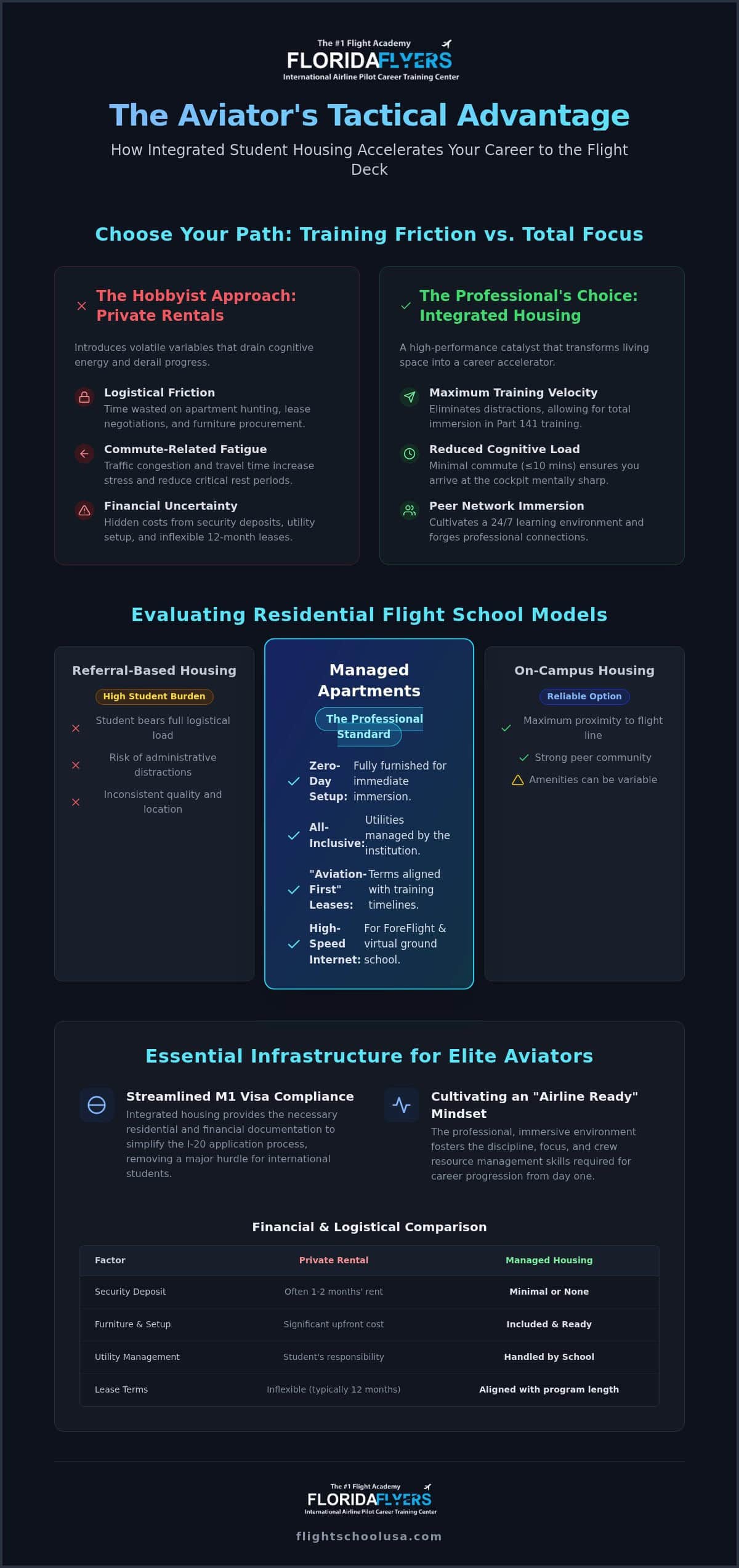
Navigating the complex regulatory landscape of international aviation training requires more than technical skill; it requires administrative precision. For candidates arriving from outside the United States, a flight school with student housing is often a prerequisite for a successful visa interview. Insufficient financial documentation remains a primary trigger for Requests for Evidence (RFEs), accounting for 41% of cases in 2026. By securing school-managed accommodations, you provide definitive proof of residence and cost-of-living solvency, which are critical components of the M1 Visa application process. This strategic preparation minimizes the risk of processing delays, which currently average 8 to 12 months for standard applications.
School-managed housing provides the “Proof of Accommodation” necessary to satisfy consular officers and secure your status. This eliminates the uncertainty of the I-20 application process by presenting a verified residential plan that aligns with your training timeline. For students arriving from overseas, turnkey housing is essential for immediate operational focus. You cannot afford to spend your first week in the U.S. negotiating leases or purchasing furniture when you should be in ground school. For a comprehensive breakdown of these requirements, consult our M1 Visa Flight School USA: The 2026 Strategic Admission Roadmap. This resource details the exact documentation required to avoid the common pitfalls that stall international careers.
Transitioning from military service to a commercial flight deck requires a tactical approach to your GI Bill assets. For the 2026 to 2027 academic year, the maximum payment for approved flight training is capped at $17,661.89. It’s critical to understand that students using the Post-9/11 GI Bill for flight training only are not eligible for a housing allowance unless they take at least one qualifying in-person class. Selecting a flight school with student housing that offers integrated, in-person ground school modules ensures you meet these requirements, unlocking the location-based housing rate. This residential immersion facilitates a disciplined transition into commercial aviation standards while maximizing your earned benefits.
To ensure your international or veteran status is fully supported, you should contact our admissions team to verify your residential eligibility.
Integrating your residential choice into your broader professional strategy is the final step in securing a competitive advantage in the aviation industry. At Flight School USA, we don’t view accommodations as an optional add-on; we view them as a critical component of our high-performance training architecture. Selecting a flight school with student housing that is specifically engineered for professional development allows you to maintain an unwavering focus on your certification timeline. This strategic alignment ensures that every hour outside the cockpit is spent in an environment that reinforces the technical and professional standards required by major carriers.
Our institution functions as an elite academy that demands excellence from every candidate. Selecting a flight school with student housing at our facility means you’re opting for a no-friction path that moves you from zero experience to a professional flight deck with maximum efficiency. Residential students at our academy consistently demonstrate higher proficiency and superior checkride pass rates compared to those who commute. This success is the direct result of total peer immersion and the elimination of domestic distractions. For candidates navigating the complexities of global relocation, our 2026 US Flight School Guide for International Students provides the comprehensive overview required for a seamless transition into our professional ecosystem.
Securing your position within our residential community is a tactical necessity during high-demand training cycles in 2026. We strongly recommend bundling your housing reservation with your enrollment in the Professional Pilot Career Program to ensure total cost predictability. This proactive approach ensures your living conditions remain a disciplined extension of the flight line rather than a distraction from it. You aren’t merely finding a place to stay; you’re choosing an elite environment that cultivates the “Airline Ready” mindset from day one. Contact our admissions team today to finalize your elite training and housing package and secure your slot in our next high-performance cohort.
Success in the aviation sector is determined by the variables you control before you ever reach the cockpit. Proximity to the flight line and high-speed digital infrastructure aren’t luxuries; they’re operational requirements for the modern aviator. Selecting a flight school with student housing ensures your training environment mirrors the discipline of a commercial flight deck, effectively eliminating the logistical friction that frequently stalls professional progression. By prioritizing a residential model, you secure the cognitive capacity required to master complex Part 141 standards.
Flight School USA stands as the premier FAA Part 141 Certified Academy for candidates who demand an elite, immersive experience. As M1 Visa admission specialists, we provide the turnkey residential solutions and Fixed-Price Career Program Guarantee necessary to navigate the high-stakes training landscape of 2026 with absolute certainty. Don’t leave your career velocity to chance when a strategic residential foundation is within reach.
Secure Your Professional Training Slot and Housing Today and begin your journey toward a commercial flight deck. Your future in the skies starts with the tactical environment you build on the ground.
Housing fees are typically managed as a separate billing component from the core tuition to allow for maximum flexibility in residential selection. However, we integrate these costs into our comprehensive career tracks to ensure total financial predictability for the student. Bundling these services through our Fixed-Price Career Program ensures that candidates maintain a strict budget while securing elite accommodations adjacent to the flight line.
International candidates are strongly encouraged to utilize school-managed residences to satisfy specific M1 Visa regulatory requirements. This arrangement provides the definitive “Proof of Accommodation” necessary for a successful consular interview and I-20 processing. It streamlines the transition by demonstrating financial solvency and a verified residential plan within a flight school with student housing, reducing the risk of visa processing delays.
All residential units are delivered in a fully furnished, turnkey condition to facilitate immediate immersion into the training syllabus. We eliminate the logistical friction of furniture procurement by providing study environments specifically engineered for high-intensity pilot development. Each unit includes dedicated desks and ergonomic seating designed to support the 40 plus hours of weekly study required for advanced ratings and certifications.
Commute times are strictly managed to remain within a ten minute radius of our flight operations center. This proximity is a non-negotiable standard for our professional pilot candidates because it maximizes availability for short-notice simulator sessions. Minimizing transit ensures you arrive for early morning flight blocks without the cognitive drag of a standard commute, preserving your mental energy for the cockpit.
VA regulations for the 2026 to 2027 period dictate that housing allowances are only accessible when students take at least one qualifying in-person class. While flight training alone does not trigger a housing stipend under the Post-9/11 GI Bill, our integrated residential programs are structured to meet these specific VA compliance standards. Veterans should verify their eligibility for the location-based housing rate through our dedicated benefits coordinators.
All-inclusive utility packages, including high-speed internet and electricity, are standard components of our professional residential contracts. We prioritize high-speed infrastructure to ensure seamless ForeFlight synchronization and uninterrupted virtual ground school sessions. This model prevents administrative distractions and billing disputes, allowing you to focus exclusively on technical mastery and the rigors of your career progression.
We offer both shared and private residential configurations to suit the specific professional requirements of our students. Shared units are designed to foster the “Aviation Ecosystem” where peer-to-peer mentoring and crew resource management are naturally developed. Private accommodations are reserved for candidates who require an isolated, zero-distraction environment for maximum concentration during high-stakes rating phases and FAA checkrides.
Reservations must be finalized at least 60 days prior to your scheduled start date to ensure availability in our premier flight school with student housing. High-demand training cycles in 2026 often result in full occupancy for on-site and managed units well before the class start date. Early commitment secures your slot within our high-performance academy and simplifies the administrative transition to full-time professional training. For overseas candidates mapping out every milestone from visa compliance to the 1,500-hour ATP standard, our detailed resource on the pilot career path for international students provides the authoritative roadmap needed to plan your reservation alongside your broader training strategy.


