

With a projected shortage of 24,000 pilots in the US by the end of 2026, the path to the flight deck has never been more lucrative or more demanding. You understand that the stakes are high, yet you’re likely feeling the pressure of managing complex FAA requirements, M1 visa logistics, and the financial risks of opaque training costs. It’s a high-stakes professional crossroad where procedural precision is mandatory. This strategic guide from Flight School USA will demonstrate why commercial pilot training usa remains the premier global standard for those pursuing an elite aviation career. We’ll provide a rigorous roadmap to airline employment, moving from the technicalities of Part 141 certification to the discipline required for international candidates. You’ll gain a clear understanding of the US training advantage and the confidence to select a structured program that treats your professional development with the seriousness it deserves. We’ll preview the 2026 landscape, showing how the Airline Ready philosophy has become the new benchmark for excellence in a competitive global market.
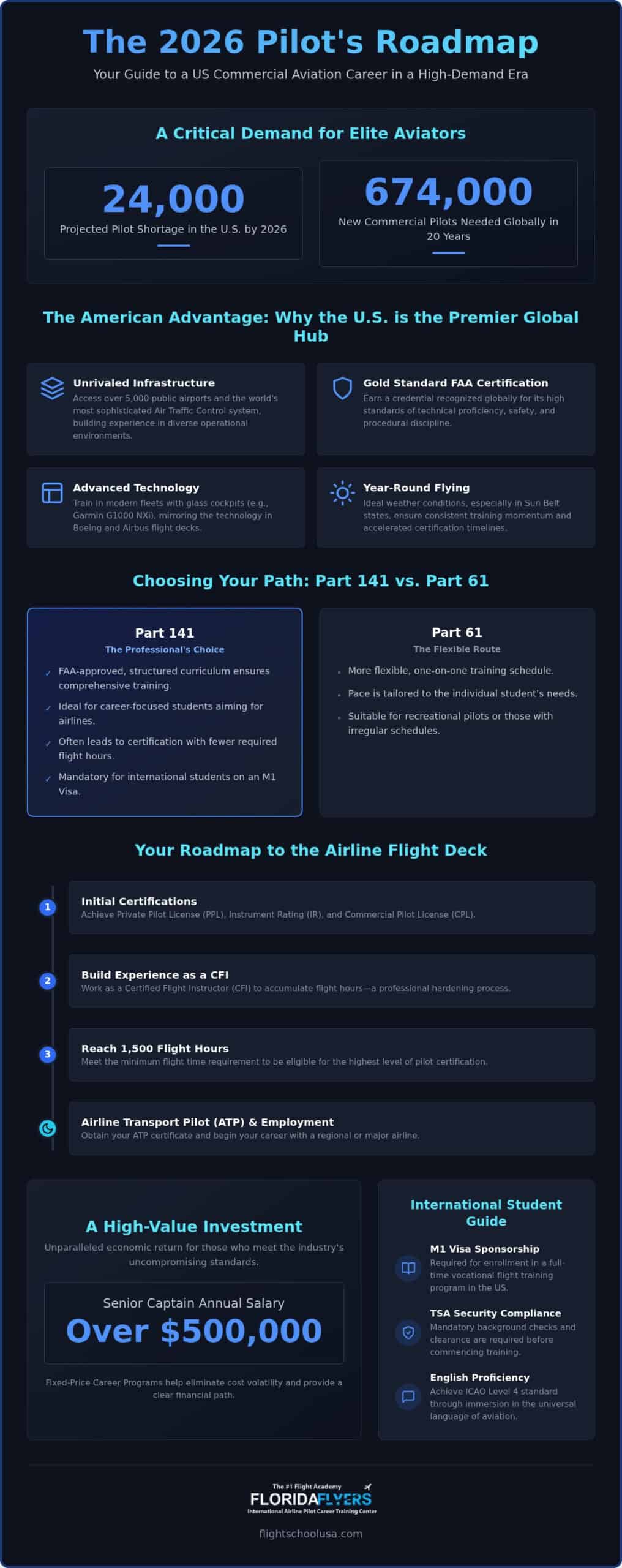
The 2026 aviation sector is defined by a critical personnel deficit. Boeing’s current outlook confirms a global requirement for 674,000 new commercial pilots over the next two decades. In the United States, the pilot shortage is projected to peak at 24,000 this year, creating an unprecedented vacuum in flight decks. This supply-demand imbalance has transformed commercial pilot training usa into a high-velocity career engine. Recruitment is no longer a passive exercise. Airlines are aggressively hunting for candidates who have mastered the world’s most rigorous regulatory environment. Training in the US also secures the linguistic advantage of immersion in English, the universal language of aviation. This ensures every graduate meets the ICAO Level 4 Aviation English Language Standard as a baseline, not an afterthought.
International air carriers view FAA credentials as the gold standard of technical proficiency and safety discipline. The FAA Pilot Certification Process demands a level of procedural accuracy that few other civil aviation authorities can match. This prestige is rooted in a safety culture that prioritizes risk mitigation and comprehensive systems knowledge over mere flight hours. In 2026, an FAA Commercial Pilot License serves as a high-status global passport that validates a pilot’s ability to operate within the world’s most complex and crowded airspace systems. Elite institutions act as gatekeepers, ensuring that only those who demonstrate unwavering discipline survive the transition from student to professional aviator.
The United States doesn’t merely offer flight lessons; it provides a comprehensive ecosystem designed for rapid professional advancement. While other regions struggle with restrictive airspace or seasonal grounding, the US maintains a vast network of over 5,000 public-use airports. This density allows students to experience diverse operational environments, from quiet uncontrolled strips to complex Class B international hubs. It’s this variety that builds the situational awareness required for a career in the airlines. Year-round flying capabilities across the Sun Belt states ensure that training momentum isn’t lost to weather, allowing for a predictable and accelerated timeline toward certification.
The United States possesses the most sophisticated air traffic control system on the planet. Students training here have immediate access to advanced navigation aids and satellite-based procedures. This infrastructure isn’t just about safety; it’s about efficiency. When you’re pursuing commercial pilot training usa, you can’t afford delays. The sheer volume of training-ready airports means less time waiting for clearances and more time accumulating the 1,500 flight hours necessary for airline eligibility. You’ll operate in a system that mirrors the procedural rigors of major commercial carriers, ensuring your transition to a professional flight deck is seamless. Understanding the Official FAA Pilot Requirements is the first step in mastering this complex network. The accessibility of this system is what makes commercial pilot training usa the preferred choice for those who demand a high-performance training environment.
The US market’s competitive nature forces flight schools to innovate or fail. In 2026, training fleets are no longer comprised of outdated analog trainers. Modern academies utilize aircraft equipped with integrated glass cockpit avionics, such as the Garmin G1000 NXi, which provide the same data visualization found in a Boeing 787 or Airbus A350. High-fidelity simulators have also become a critical component of the curriculum. These devices allow for the intensive practice of emergency procedures and instrument approaches in a controlled environment, significantly reducing the financial burden of training while increasing safety margins. It’s a high-performance environment where technology serves as a force multiplier for your skills. For those ready to commit to this level of professional intensity, exploring a structured Airline Ready Program ensures you’re training to the highest industry standards from day one.
Selecting the correct regulatory framework is the most critical administrative decision in your aviation career. In the United States, the FAA provides two distinct paths for pilot certification: Part 141 and Part 61. While both lead to the same elite credentials, the methodology of delivery differs significantly. For those pursuing commercial pilot training usa, this choice dictates your daily schedule, your financial commitment, and your timeline for meeting the requirements outlined in the Global Pilot Demand Forecast. A persistent fallacy suggests that one path is inherently easier. This is false. Every candidate, regardless of their training path, must meet the exact same Airman Certification Standards during their final checkride. The difference lies in the level of institutional structure and FAA oversight applied to the curriculum.
Part 141 schools function as high-performance academies. They operate under a strict, FAA-approved syllabus that leaves no room for procedural ambiguity. This environment is designed for students who can commit to a full-time, rigorous training schedule. Because of this high level of oversight, the FAA allows for reduced flight hour requirements for certain certifications. Airlines prioritize Part 141 graduates because the structured environment mirrors the training footprint of a major air carrier. It’s a system built for those who thrive under discipline and demand a clear, sequential path to the flight deck. If you require a predictable, high-stakes training environment, this is the standard.
Part 61 offers a personalized pace. It’s the preferred route for candidates who need to balance training with existing professional obligations or those who require a non-traditional schedule. While it lacks the rigid syllabus of a 141 program, it demands a higher degree of self-discipline from the student. Part 61 is often utilized for specialized ratings or targeted time building. It allows you to tailor your commercial pilot training usa to your specific performance needs. However, flexibility shouldn’t be mistaken for a lack of rigor; the technical requirements for mastery remain uncompromising.
Professional candidates often find that Fixed-Price Flight Training Programs offer a superior hybrid advantage. These programs provide the budgetary certainty of a structured academy while allowing for the tactical adjustments required to meet individual performance benchmarks. By eliminating the volatility of hourly billing, you can focus entirely on the procedural accuracy required for an “Airline Ready” career. This model ensures that your progression is based on merit and mastery, not just the number of hours logged in a logbook.
For the global elite, pursuing commercial pilot training usa is the only logical path to a high-status aviation career. However, the administrative complexity of entering the US system is a significant barrier for the unprepared. You cannot treat visa logistics as a secondary concern; they are a critical component of your professional legal standing. Success requires a partnership with a dedicated International Student Flight Academy that understands the nuances of federal compliance. From TSA security threat assessments to SEVIS monitoring, every administrative step must be executed with procedural precision to avoid career-stalling delays.
The M1 visa is the mandatory legal instrument for vocational flight training in the United States. The process begins with the issuance of a Form I-20 from a SEVP-certified institution, which serves as the foundation for your embassy interview. Many candidates fail at this stage because they lack a clear, strategic roadmap. Utilizing professional M1 Visa Flight School USA services ensures that your documentation meets the highest standards of scrutiny. You must avoid common pitfalls that lead to visa denials, such as:
In 2026, the Student and Exchange Visitor Information System (SEVIS) mandates that all M1 flight students maintain a full course of study and report any change in residential address within 10 days to remain compliant. This level of oversight ensures that only the most disciplined and serious candidates remain in the program.
Professional training is an intensive, high-stakes endeavor that leaves no room for the friction of daily logistics. Strategic Flight School Housing is not a luxury; it is a performance-enhancing necessity. By living in a pilot-centric community, you eliminate the distractions of traditional housing and immerse yourself in a culture of discipline. This environment fosters peer-to-peer learning and ensures you’re surrounded by individuals who share your commitment to excellence. Reducing the friction of transportation and housing allows you to dedicate 100% of your cognitive resources to mastering the complexities of commercial pilot training usa. For those arriving from abroad, a turnkey residential solution is the final piece of a successful admission strategy.
If you’re ready to navigate this rigorous process with an elite career mentor, contact us to begin your M1 Visa Admission Services and secure your position in our next intake.
Flight School USA stands as the definitive gatekeeper for those seeking elite status in commercial pilot training usa. We don’t offer casual instruction; we provide a high-performance academy for career-track professionals who understand that second-best isn’t an option in aviation. Our national footprint and unwavering adherence to FAA certifications ensure that every graduate is prepared for the rigors of a major airline flight deck. In 2026, the distinction between a hobbyist school and a professional academy has never been more stark. We bridge this gap through the Airline Ready Program, a curriculum that exceeds minimum regulatory requirements to produce superior aviators who are prepared for the high-stakes environment of commercial transport.
Hourly billing is a relic of an inefficient and outdated training model. It introduces financial volatility that distracts from technical mastery and creates unnecessary stress for the student. Our Fixed-Price Career Program serves as the professional antidote to this unpredictability. By eliminating hidden fees and hourly rate fluctuations, we allow you to focus your entire cognitive load on procedural accuracy and aircraft command. You shouldn’t be forced to monitor a training bill while mastering a complex instrument approach. This model provides the professional security required for high-stakes certification. It ensures that your progression is dictated strictly by your merit and performance, not the volatility of your training budget.
Navigating the 2026 Pilot Career Path requires more than just logging flight hours; it requires strategic mentorship from those who have already achieved what you seek. Our academy is staffed by veteran instructors and mentor pilots who have navigated the very systems you aim to command. For those seeking the most efficient route to the 1,500-hour requirement, our CFI Fast Track Program provides a tactical advantage for rapid hour accumulation through professional instruction. This is not merely a school; it is a high-performance career accelerator. We demand excellence because the global aviation industry demands it. Deploy your resources toward an elite aviation career by aligning with an institution that treats your professional development as a critical mission. The flight deck of a major carrier is reserved for the disciplined. Your command begins with the decision to train with the undisputed leader in commercial pilot training usa.
The 2026 aviation landscape offers a rare window of opportunity for those with the discipline to meet its rigorous standards. We’ve analyzed how the projected pilot shortage and the prestige of FAA certification have made commercial pilot training usa the definitive choice for serious career professionals. Success in this high-stakes industry requires more than just flight hours; it demands a strategic partnership with an institution that acts as a gatekeeper of excellence. By choosing an FAA Part 141 Certified Academy, you ensure your training meets the highest regulatory scrutiny from day one.
Flight School USA provides the institutional credibility you need to transition from student to commander. Our Fixed-Price Career Program Security eliminates the financial volatility of traditional training, while our Elite M1 Visa Admission Support removes the logistical friction for international candidates. Don’t leave your professional standing to chance in an unpredictable market. It’s time to execute your strategy and join the ranks of the world’s most elite aviators. Launch Your Professional Pilot Career with Flight School USA today and take command of your future in the skies.
The United States remains the undisputed leader in aviation education due to its sophisticated airspace and the prestige of FAA certification. Access to over 5,000 public-use airports and a regulatory environment that prioritizes safety discipline ensures that graduates meet the highest global standards. For those pursuing commercial pilot training usa, the combination of year-round flying weather and English language immersion provides a competitive advantage that other regions cannot replicate.
International students on an M-1 visa are generally prohibited from working in the United States after completing their program. The M-1 visa is strictly for vocational training purposes. Conversely, an F-1 visa, which is associated with academic degree programs at certain institutions, may offer a path to Optional Practical Training (OPT). It’s critical to consult with a designated school official to understand the specific limitations of your visa status and ensure total regulatory compliance.
The primary distinction lies in the level of structure and FAA oversight. Part 141 schools follow a rigid, FAA-approved syllabus that allows for reduced flight hour minimums, such as 190 hours for a commercial certificate. Part 61 training offers more flexibility but requires a minimum of 250 hours for the same certification. Both paths require students to meet identical Airman Certification Standards during their final practical examination, ensuring no compromise in professional quality.
A dedicated student in an accelerated program can typically obtain a Commercial Pilot License within 6 to 12 months. This timeline assumes a full-time commitment and consistent flying weather. Achieving the 1,500-hour requirement for airline eligibility requires additional time, often spent working as a flight instructor. This phase is a professional prerequisite that builds the technical proficiency and command experience necessary for commercial pilot training usa to translate into a major airline career.
A college degree is not a legal FAA requirement for pilot certification. However, major US airlines frequently prioritize candidates with a four-year degree during the competitive recruitment process. While regional airlines may hire pilots without a degree to address immediate staffing needs, those seeking an elite career at a major carrier should consider a degree as a strategic prerequisite for long-term advancement and professional standing within the industry.
You must hold a valid second-class medical certificate issued by an FAA-authorized Aviation Medical Examiner to exercise commercial pilot privileges. This examination ensures you meet specific standards for vision, hearing, and overall physical health. Pilots intending to transition to airline operations must eventually obtain a first-class medical certificate. This higher standard involves more stringent cardiovascular and neurological assessments to ensure you’re fit for the rigors of heavy jet operations.
Eligible veterans can utilize GI Bill benefits for professional flight training at VA-approved institutions. This funding typically applies to advanced ratings after the Private Pilot License has been obtained. It’s mandatory for veterans to possess a valid medical certificate and meet specific service requirements to access these resources. Our academy provides the necessary administrative support to ensure compliance with Department of Veterans Affairs regulations, allowing you to deploy your benefits toward an elite career.


