

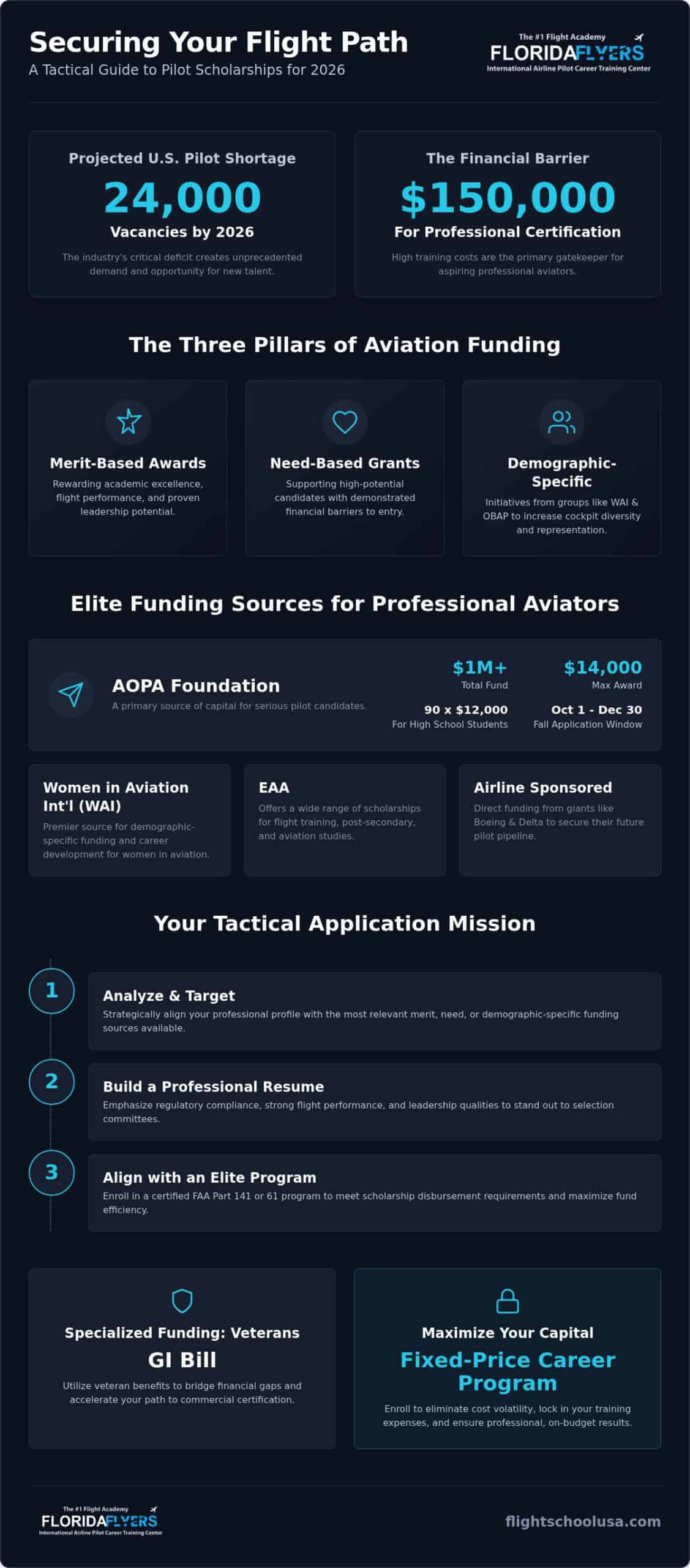
With the U.S. pilot shortage projected to peak at 24,000 vacancies in 2026, the aviation industry is desperate for new talent, yet the $150,000 price tag for professional certification remains a formidable gatekeeper. You’re likely feeling the pressure of these high training costs and the confusion of navigating contradictory eligibility requirements. It’s a high stakes environment where the fear of excessive debt can easily overshadow your career ambitions. This authoritative guide is designed to eliminate that uncertainty by providing a tactical roadmap to securing scholarships for student pilots for your professional career.
We’ll master the strategic landscape of aviation funding together, moving beyond simple lists to analyze the specific requirements of elite organizations like Women in Aviation International and the AOPA Foundation. You’ll gain a comprehensive list of high value awards for the 2026 cycle and a methodical process for aligning these funds with a professional training program. By the end of this brief, you’ll have the intelligence necessary to treat your funding search as a professional mission rather than a lottery, ensuring your path to the flight deck is both disciplined and solvent.
Viewing scholarships for student pilots as mere financial aid is a fundamental error in career planning. In the high-stakes environment of professional aviation, these funds represent strategic capital designed to fuel your progression through the rigorous regulatory requirements of flight certification. The 2026 market is defined by a critical shortage, with the industry facing a peak deficit of 24,000 pilots in the United States alone. This scarcity has forced major organizations to invest heavily in human capital, transforming scholarship programs into a competitive recruitment tool for the next generation of professional aviators.
Aviation funding is not a monolith. It is a complex ecosystem controlled by national associations, private foundations, and major airlines. To navigate this landscape, you must distinguish between merit-based awards, which reward academic and flight performance, and demographic-specific funding designed to diversify the flight deck. Understanding these distinctions allows you to target the capital that most effectively aligns with your professional profile and career trajectory.
The path to a commercial flight deck requires a significant financial commitment, often reaching $150,000 for a comprehensive professional program. Securing prestigious funding mitigates the risk of excessive debt and serves as a badge of excellence that signals your potential to future employers. An aviation scholarship is a merit-based grant for regulatory flight training. When airlines review a pilot’s resume, the presence of awards from national associations indicates a history of high-level discipline and technical aptitude. This is essential context for those seeking a comprehensive overview of flight training and its associated professional milestones.
Industry giants like Boeing and Delta have expanded their financial support frameworks to ensure a steady pipeline of qualified candidates. These organizations, alongside governing bodies like the AOPA Foundation and Women in Aviation International (WAI), control the majority of available capital in 2026. Funding is generally categorized into three distinct sectors:
Professional academies like Flight School USA interface with these external providers by maintaining the rigorous FAA Part 141 and Part 61 standards required for fund disbursement. By aligning your training with an elite institution, you ensure that your scholarships for student pilots are utilized with maximum efficiency. This strategic alignment moves you toward an airline career with precision, ensuring that every dollar of capital is deployed toward your ultimate mission of commercial certification.
Successful navigation of the funding environment requires a hierarchical understanding of the capital available. While general aviation enthusiasts often focus on small, local grants, professional candidates must prioritize elite organizations that offer substantial financial backing. These categories are divided into national associations, airline-sponsored programs, and private foundations. Each sector has distinct eligibility criteria and application windows that demand strict adherence to professional standards and official FAA pilot certification requirements. Unlike the disorganized lists provided by government agencies, a tactical approach identifies which awards provide the highest return on your application effort. Targeting the right scholarships for student pilots ensures that your training momentum remains uninterrupted by capital shortfalls.
The AOPA Foundation remains a primary source of capital for serious candidates. For the fall 2026 cycle, the application window opens on October 1 and closes on December 30. They manage a fund exceeding $1 million, with individual awards ranging from $250 to $14,000. This includes 90 specific scholarships of $12,000 each designated for high school students. Younger aviators should also target the EAA Ray Aviation Scholarship, which provides up to $12,000 for students aged 16 to 19. Organizations like Women in Aviation International (WAI) are equally critical; their 2027 scholarship cycle application period ends on September 1, 2026. These associations value candidates who demonstrate a history of high-level discipline and technical proficiency.
Major carriers use scholarships as a tactical recruitment tool to secure future first officers amid the peak pilot shortage of 2026. Programs like Delta Propel and United Aviate integrate financial support with defined career pathways. Regional airlines have also introduced flow-through scholarships, which provide capital in exchange for a commitment to fly for the carrier upon completion of training. These programs are highly competitive and require applicants to be airline-ready from day one. To maximize your chances, you should align your funding with an elite Fixed-Price Career Program to ensure you meet the rigorous standards expected by major carriers.
Don’t overlook regional and local chapter awards, which often feature lower competition and high value. While the national applicant pools are massive, local chapters frequently struggle to find qualified applicants who meet all regulatory standards. Private aviation foundations and corporate flight departments often provide niche grants for advanced ratings or specific demographic groups. These entities serve as excellent secondary sources of scholarships for student pilots, providing the necessary capital to bridge the financial gap between initial solo flights and professional commercial certification. Securing these smaller, high-probability awards creates a diversified funding portfolio that protects your career trajectory from economic volatility.
Winning scholarships for student pilots requires a multi-phase operational strategy that treats the application process as a professional mission. It starts with intelligence gathering. By January, your 2026 scholarship calendar must be fully populated with critical deadlines, such as the December 30 cutoff for the AOPA flight training scholarships or the September 1 deadline for WAI. Missing a single window is a failure of planning that can delay your professional progression by an entire year. Successful candidates track these dates with the same precision they apply to flight planning.
Asset preparation focuses on curating a professional resume that signals your readiness for the cockpit. Committees look for evidence of discipline, such as obtaining your FAA third-class medical certificate early or maintaining a clean regulatory record. Leadership roles in aviation organizations or community service projects demonstrate the character required of a future airline captain. You must present yourself as a low-risk, high-reward investment for the awarding organization.
The narrative mission involves crafting an essay that clearly articulates your commitment to an airline pilot career training track. This is not the place for vague dreams of flight; it’s a platform to demonstrate your understanding of the industry’s demands and your specific plan to meet them. Finally, verify your credentials through high-ranking endorsements. A letter of recommendation from a Chief Flight Instructor or a Designated Pilot Examiner carries significantly more weight than a generic reference. These endorsements serve as professional verification of your technical aptitude and potential.
Your narrative must align perfectly with the provider’s mission statement. If the organization prioritizes safety, emphasize your meticulous approach to pre-flight inspections and regulatory compliance. Detail your exact flight hours and progress toward specific ratings like your Instrument or Commercial certificates. Committees often favor candidates enrolled in elite academies because it reduces the risk of fund mismanagement. Choosing a rigorous training environment proves you are serious about your professional standing and ensures your scholarships for student pilots are utilized effectively.
Finalists must approach interviews with professional gravitas. Whether virtual or in-person, your presentation should mirror that of an airline pilot candidate. Expect technical questions regarding FAA regulations or emergency procedures; committees use these to gauge your aptitude and preparation level. After the session, a formal follow-up is mandatory. This maintains your position on the committee’s radar while adhering to professional norms. Success in this final phase transforms you from an applicant into a funded professional ready for the rigors of commercial aviation.
For veterans and international candidates, the search for scholarships for student pilots is not just about finding capital. It is about the strategic deployment of specialized resources. Veterans possess a unique advantage through federal entitlements, while international students must navigate complex regulatory frameworks to secure US-based training funds. In 2026, the industry has prioritized these groups to ensure a diverse and highly disciplined pipeline of professional aviators. Success in these categories requires a deep understanding of how to combine government benefits with private grants to eliminate the high cost of professional certification.
Veterans must distinguish between the Post-9/11 GI Bill and the Montgomery GI Bill, as the reimbursement structures for flight training differ significantly. Utilizing GI Bill for CFI training allows former service members to bypass the initial financial barriers of commercial certification. This funding is most effective when combined with the CFI Fast Track Program, which leverages military discipline to achieve instructor ratings at an accelerated pace. Organizations like RTAG (Rotary to Airline Group) provide additional scholarship support for those transitioning from rotor to fixed-wing platforms. By stacking these professional resources, veterans can achieve an airline-ready status without the burden of excessive debt.
International students on M1 Visas face a more restrictive funding environment but still have access to strategic capital. Certain US-based scholarships, such as those from the Whirly-Girls or the 99s, accept international members. You must present a ‘US Mission’ plan to international scholarship boards, demonstrating how your US-based training will meet the regulatory standards of your home country’s civil aviation authority. Many candidates also successfully utilize home-country government grants that specifically target the Boeing-projected need for 119,000 new pilots in North America by 2044. These scholarships for student pilots are designed to bridge the financial gap for candidates who meet the highest professional standards regardless of their country of origin.
If you are ready to deploy your veteran benefits with precision, apply for our GI Bill Flight Training program to begin your professional transition immediately.
Securing scholarships for student pilots is only the initial phase of your mission; the secondary phase is deploying that capital within a training framework that guarantees a return on investment. Many candidates squander their funding in hourly training models that are inherently volatile. Fuel surcharges, maintenance delays, and instructor turnover can drain your capital before you reach your checkride. In contrast, a Fixed-Price Flight Training Program eliminates this uncertainty. It allows you to budget your scholarship funds with surgical precision. You know exactly how far your awards will take you, which protects you from the financial bleed common in disorganized flight schools.
Professional results require total immersion. Utilizing dedicated student housing for full-time training ensures that your scholarship dollars are spent on high-intensity skill acquisition rather than commuting or logistical distractions. This immersive approach increases your scholarship ROI by significantly accelerating your timeline to commercial certification. When you treat your training as a high-stakes professional commitment, you align yourself with the rigorous standards expected by major carriers. This level of discipline is exactly what scholarship committees and airline recruiters look for in 2026.
The financial logic is clear when comparing hourly rates against fixed-price professional tracks. While hourly schools may seem cheaper upfront, the lack of structure often leads to remedial training and extended timelines. A structured airline pilot salary roadmap justifies the initial investment by showing the rapid transition from student to high-earning professional. With major US airlines projected to hire 8,000 pilots in 2026, the speed of your progression is your greatest asset. Flight School USA’s Airline Ready Program serves as the ultimate conclusion to your funding mission, ensuring your technical skills match your financial preparation.
Closing the final funding gap requires a combination of scholarships for student pilots, personal capital, and external financing options. You should research specialized aviation lenders who understand the career trajectory of a commercial pilot and offer terms aligned with professional training timelines. Before you begin, follow this final checklist to ensure your mission readiness:
Treat your pilot training as a high-performance academy mission. Excellence is the only acceptable standard for those who intend to lead on the flight deck. Your path to the airlines is a calculated deployment of capital and skill; execute it with the precision it deserves.
Mastering the landscape of scholarships for student pilots is the first step in a high-stakes professional career. You’ve learned that funding is a tactical asset, requiring precise intelligence gathering and a disciplined application strategy to secure. By aligning these awards with elite training frameworks, you eliminate the financial volatility that often stalls aspiring aviators. As a premier FAA Part 141 Accredited Academy, we provide the rigorous environment necessary to transform that capital into professional certification. Our specialized GI Bill support and on-site student housing ensure that every dollar of your funding is deployed with maximum efficiency. The path to the flight deck is reserved for those who treat their development with the seriousness it demands.
Secure your future in the cockpit with our Fixed-Price Career Program
The 2026 pilot shortage presents an unprecedented opportunity for those ready to execute their mission with precision. Your career in the skies is waiting; take command of your funding and your training today. We look forward to seeing you excel in the cockpit.
You can absolutely utilize multiple scholarships for student pilots to cover different phases of your training. This technique, known as stacking, allows you to apply separate grants toward your Private Pilot License, Instrument Rating, and Commercial certification. Professional academies support this approach because it demonstrates your initiative and fiscal responsibility. It’s essential to track the reporting requirements for each provider to ensure you remain compliant with their specific disbursement regulations.
Coverage varies strictly by the awarding organization’s bylaws. Many primary flight training grants are restricted to aircraft rental and instructor fees, but certain high-value awards from private foundations may be applied toward student housing and FAA written or practical exam fees. You must review the disbursement terms of each scholarship to confirm if they allow for these ancillary costs. Using a Fixed-Price Career Program helps you allocate these funds with greater accuracy.
The AOPA Foundation scholarships and the Women in Aviation International (WAI) awards are widely considered the most prestigious in the 2026 landscape. These programs offer significant capital, often exceeding $10,000 per recipient, and provide an elite status that signals your professional potential to airline recruiters. Securing one of these awards requires a history of high-level discipline and a clear commitment to a commercial career path. They are the gold standard for competitive funding.
Specialized funding exists for advanced certifications like our CFI Fast Track Program. Organizations such as the National Association of Flight Instructors (NAFI) and various regional airline initiatives provide grants specifically for those transitioning into instructional roles. Additionally, veterans can utilize their GI Bill benefits to fund these ratings, which serves as a primary financial engine for professional development. These scholarships for student pilots focus on candidates who demonstrate the leadership required for flight instruction.
Proving financial need requires a methodical submission of official documentation, such as recent tax returns or a completed FAFSA summary. Some private foundations also require a detailed personal financial statement and a narrative explaining your specific financial barriers. You must present this data with professional accuracy and transparency. Committees look for candidates who are high-potential but lack the immediate capital to complete their rigorous training programs.
Most prestigious scholarship providers disburse funds directly to your FAA-certified flight school to ensure regulatory compliance and proper fund management. This direct-to-institution model is standard for Part 141 programs and helps maintain the integrity of the award. In rare cases, smaller private grants may issue a check directly to the student, but you will still be required to provide receipts or logbook entries as proof of training progress.
Failing a checkride is a serious regulatory event that can impact your scholarship status. While most providers understand the rigors of flight training, a failure may trigger a review of your funding or require a formal remedial training plan to be submitted by your Chief Flight Instructor. Maintaining a clean training record is a critical component of your professional standing. Persistent non-compliance with training standards often results in the immediate termination of the award.
Most AOPA Foundation scholarships are restricted to U.S. citizens or permanent residents holding a valid FAA medical certificate. However, international students on M1 Visas can target other organizations like the Ninety-Nines or Whirly-Girls, which frequently offer awards to their global membership base. It’s vital to verify the residency requirements in the scholarship’s eligibility criteria before beginning the application process. International candidates should focus on programs that prioritize global aviation talent.


