The private pilot checkride is only one part of earning a certificate. In the United States, private pilot license requirements include at least 40 hours of aeronautical experience, according to the Electronic Code of Federal Regulations, and applicants must be at least 17 years old on the date of the practical test, also according to the Electronic Code of Federal Regulations. Candidates must pass an aeronautical knowledge test and a practical test that assesses their flying skills.
It’s natural to focus on the flight test, where your knowledge and aircraft handling are evaluated together. But eligibility, training, and the knowledge exam are also essential parts of certification, and overlooking any of them can delay your progress.
This guide explains what a private pilot certificate allows you to do, who can qualify, and what the FAA knowledge exam and checkride involve. It also covers flight-time minimums and the difference between the oral examination and the in-aircraft demonstration, so you can understand the requirements before training begins.
A private pilot certificate authorizes personal flying and carrying passengers within the certificate’s ratings and operating limits. Understanding the private pilot license requirements means distinguishing experience minimums from the skills and privileges the certificate provides.
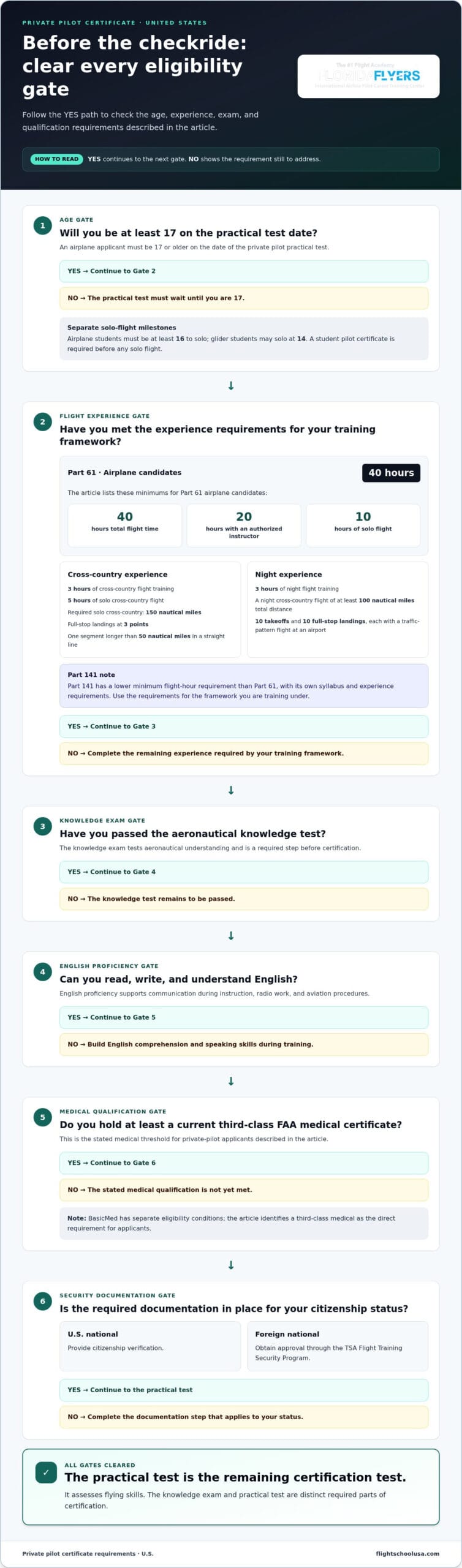
Flight-hour requirements establish the minimum experience and instruction needed before certification. In the United States, the minimum aeronautical experience is 40 hours of flight time, according to the Electronic Code of Federal Regulations. The same code requires at least 20 hours of flight training from an authorized instructor and 10 hours of solo flight time.
Under Part 61, airplane candidates also need 3 hours of cross-country flight training and 5 hours of solo cross-country flight time. The required solo cross-country flight covers 150 nautical miles, with full-stop landings at three points and a segment exceeding 50 nautical miles in a straight line. Part 141 has a lower minimum flight-hour requirement than Part 61, with its own syllabus and experience requirements. These distinctions are central to comparing private pilot license requirements across training frameworks.
Age rules set separate thresholds for solo flight and the private pilot practical test. An airplane student must be at least 16 years old to solo, while a glider student may solo at 14. For an airplane applicant, certification has a higher age threshold: the practical test cannot take place before the applicant turns 17.
These milestones affect when a student can fly independently and when certification can be completed. Someone who begins training before age 16 can receive instruction with an instructor but cannot solo an airplane until eligible. Knowing these age-based private pilot license requirements helps students plan training around solo practice and the test date.
A private pilot may fly an airplane weighing 12,500 pounds or less, subject to the category, class, and ratings held. The certificate permits carrying multiple passengers for noncommercial purposes when the pilot holds the appropriate ratings.
Private pilot privileges do not allow you to act as pilot in command for compensation or hire. You may share certain operating expenses equally with passengers, limited to fuel, oil, airport expenditures, or aircraft rental fees. When planning a flight with passengers, remember that sharing eligible costs is different from being paid to pilot.
For airplane candidates, required experience includes 3 hours of night flight training, including a cross-country flight of at least 100 nautical miles total distance. Night training also requires 10 takeoffs and 10 full-stop landings, each involving a traffic-pattern flight at an airport.
Private pilot training typically takes three months, and total flight time commonly reaches 60 to 80 hours. Lesson frequency, weather interruptions, and the time required to demonstrate proficiency affect the timeline. Training costs depend on aircraft and instructor use, training frequency, and any flight time beyond the minimum.
Eligibility for a U.S. private pilot certificate depends on age, English proficiency, medical qualification, and required security documentation. These conditions apply alongside flight experience and testing, so understand them before planning your practical test.
An airplane student must be at least 16 years old to fly solo; a glider student may solo at 14. A student pilot certificate is required before any solo flight during training. These thresholds govern solo privileges, not the age for earning a private pilot certificate, which has a separate minimum.
In the United States, an applicant for a private pilot certificate must be at least 17 years old on the date of the practical test, according to the Electronic Code of Federal Regulations. An applicant turning 17 later cannot take that test beforehand, even if training and exams are complete. Planning around the test date helps avoid a preventable delay.
Private pilot applicants must be able to read, write, and understand English. This requirement supports communication during instruction, radio work, and aviation procedures. If aviation terminology is challenging, build your comprehension and speaking skills during training rather than treating English proficiency as a last-minute paperwork issue.
Security-documentation steps also differ according to citizenship. U.S. nationals must provide citizenship verification, while foreign nationals must obtain approval through the TSA Flight Training Security Program. These steps are separate from the FAA knowledge exam and practical test, so include them in your preparation plan.
A private pilot applicant must hold at least a current third-class FAA medical certificate. This is the stated medical threshold for private-pilot eligibility. BasicMed is another option pilots may encounter, but it has separate eligibility conditions; the third-class certificate remains the direct requirement for applicants described here.
Private pilot eligibility should not be confused with airline career eligibility. A restricted airline transport pilot certificate may be available at age 21, depending on training or military pilot service. It is a later career qualification, not a substitute for the private certificate or its practical test.
Before starting aviation training, organize age milestones, English readiness, medical qualification, and citizenship or TSA documentation. International students can also plan practical matters, such as student housing arrangements, alongside their training schedule.
Certification involves separate knowledge and practical tests. The written exam assesses aeronautical knowledge, while the checkride evaluates how well you apply it in flight.
The FAA private pilot knowledge test is taken by appointment at an FAA-approved testing facility. Before scheduling, an applicant needs an instructor or course-provider endorsement. The test has 60 multiple-choice questions, lasts 2 hours, and requires a score of at least 70% to pass. These conditions make preparation and scheduling distinct parts of the process.
Ground study should connect regulations and aviation concepts to decisions made in the airplane. A course may cover airspace, weather, navigation, aircraft performance, and operating procedures. The knowledge test tests applicable aeronautical knowledge areas under § 61.105(b). An endorsement confirms preparation, but the applicant must still demonstrate understanding on the test itself.
The practical test, commonly called the checkride, has two parts: an oral examination and an airplane demonstration. An FAA inspector or designated pilot examiner evaluates the applicant against the applicable flight-proficiency areas in the Private Pilot Airmen Certification Standards. Section § 61.107(b) identifies the applicable areas of operation. The examiner assesses demonstrated performance, not simply time spent flying.
Practical-test preparation includes at least 3 hours of flight training with an authorized instructor within the preceding 2 calendar months from the month of the test. The applicant also needs an instructor endorsement confirming readiness. This final preparation should address the areas the applicant must demonstrate, including decision-making, procedures, and aircraft control. Review the applicable standards with the instructor, then practice the required maneuvers in the airplane.
Applicants may fail if their performance falls short of the required proficiency in any area of operation, during either the oral examination or flight demonstration. A medical certification delay may also arise if an applicant lacks the required current third-class FAA medical certificate, which is required to exercise private pilot privileges.
Keep the knowledge exam and checkride requirements separate in your preparation plan. Passing the written test does not replace flight training or the practical test, and logging 40 hours alone does not establish checkride readiness. Organize the endorsement, test appointment, instructor preparation, and required medical certificate before the practical-test date. This keeps paperwork and proficiency preparation aligned with the certification process.
Aeronautical knowledge preparation connects classroom or home study with the decisions pilots make before and during a flight. The FAA knowledge test assesses that foundation before practical certification.
Ground school is structured study of the knowledge areas required for a private pilot certificate. It matters because pilots must apply those concepts, not simply memorize answers. Ground programs commonly include 36-40 hours of classroom instruction.
You can prepare through classroom instruction or an online home-study course. Before taking the knowledge test, applicants need a logbook endorsement confirming completion of ground training or an online course. The endorsement documents your preparation, but does not replace the exam.
Use practice scenarios to connect study material with flight decisions. For example, reviewing airport procedures alongside navigation concepts shows how separate subjects work together. Give aircraft systems focused attention too: understanding how an engine works supports informed decisions during flight training.
A rating determines which aircraft privileges a pilot may exercise, while medical qualification is a separate matter. Keep the concepts distinct in your ground study. Glider operations, for example, involve a different aircraft category from airplanes, so study material relevant to your intended certificate and rating.
The written knowledge test is the FAA exam covering applicable aeronautical knowledge areas under § 61.105(b). It matters because passing this exam is a required step toward certification, separate from demonstrating flight proficiency.
The test contains 60 multiple-choice questions, lasts 2 hours, and requires a score of 70% or higher. Applicants must receive an endorsement from an instructor or course provider and take the test by appointment at an FAA-approved testing facility. Plan the appointment after completing the required preparation and endorsement.
Questions assess how you apply aviation knowledge, not just whether you can repeat definitions. An airport scenario, for example, may ask you to interpret information and choose an appropriate action. When reviewing missed practice questions, identify the underlying concept and apply it to a new example.
Keep the knowledge test separate from the practical test. The written exam assesses aeronautical understanding; the practical test assesses flight skills and includes an oral examination. A flight school or independent study course can organize your learning, but you are responsible for mastering the tested material and bringing the required endorsement.
After the exam, keep your results as part of the certification process. Use areas that need more review to guide further ground study and discussion with an instructor. This targeted review connects the written assessment with later flight preparation, without mistaking a passing score for complete pilot readiness.
Age eligibility is tied to the practical test date, not simply the start of training. In the United States, an applicant for a private pilot certificate must be at least 17 years old on the date of the practical test, according to the Electronic Code of Federal Regulations. A student may begin training before reaching that age, but certification must wait until the threshold is met.
This distinction separates three milestones: beginning instruction, flying solo, and taking the certification test. For an airplane, a student must be at least 16 years old to solo. A glider student may solo at 14. Those solo ages do not lower the 17-year minimum for an airplane private pilot certificate.
For example, an airplane student who begins lessons before age 16 can receive instruction with an instructor, but cannot conduct an airplane solo until reaching the minimum. Once eligible to solo, the student continues building experience and preparing for the practical test. The age rule applies on the test date, so completing other preparation early does not permit an early test.
Plan around the date of birth and the practical-test appointment. If a student turns 17 shortly before a planned checkride, the test must take place on or after the birthday. Training progress, test preparation, and examiner scheduling still shape the appointment, but none changes the legal age threshold. Treat the birthday as an eligibility milestone, not a guarantee of immediate certification.
Age rules also differ across aviation certificates and career stages. A restricted airline transport pilot certificate may be available at age 21, depending on training or military pilot service. That later qualification is separate from the private pilot certificate. An aspiring airline pilot should therefore distinguish the initial certificate’s minimum from later career credentials.
Use a clear planning sequence: identify the certificate sought, note the applicable solo age, and then schedule the practical test no earlier than the required certification age. For an airplane private certificate, that means distinguishing the age 16 solo threshold from the age 17 test threshold. A glider student follows a different solo-age threshold, while the certificate sought determines the relevant practical-test rules.
Meeting the minimum age answers only one eligibility question. Applicants must also complete the required training, demonstrate proficiency, and pass the practical test. Reaching the age threshold makes the test legally possible, but does not replace any knowledge, experience, or skill requirement. Schedule the practical test only when you meet the age requirement and are ready.
Flight School USA provides flight training for aspiring pilots ready to turn certification goals into a structured aviation pathway. Once you have reviewed eligibility, exams, and practical-test standards, career-minded students can explore the Fixed-Price Career Program as a path toward longer-term pilot goals.
The right next step depends on your intended path. The CFI Fast Track Program supports students pursuing flight-instructor training, while GI Bill Flight Training serves eligible veterans. International students can explore M1 Visa Admission Services as part of planning flight training in the United States. Each option connects training plans with a distinct student need.
Contact Flight School USA to discuss your training path and the program that fits your goals.
Understanding the private pilot license requirements gives you a foundation for planning. Your next decision is how the certificate fits your broader aviation goals. Consider whether you want to fly for personal reasons or work toward an instructor or airline career. That direction can shape your training path and your priorities after certification.
Flight School USA offers a Fixed-Price Career Program for career-focused training, a CFI Fast Track Program for aspiring flight instructors, and GI Bill Flight Training for eligible veterans. Each option supports a different goal, so identify the path you want to pursue before choosing your next step.
Ready to discuss how your training goals align with these programs? Contact Flight School USA to explore your options and plan your next move. A disciplined start can help turn your interest in aviation into purposeful progress.
Start by identifying the certificate and flying goals you want to pursue, then discuss a training plan with a flight instructor. Someone aiming to fly for personal reasons, for example, can begin with private pilot training, while a career-focused student may plan for additional certificates and ratings. Review medical eligibility early, gather identification documents, and understand the difference between flying with an instructor and flying solo.
Applicants must meet the applicable age and English-language criteria, hold the required medical qualification, complete aeronautical experience and instruction, and pass knowledge and practical tests. For airplane applicants, the practical test must occur at age 17 or older. A current third-class FAA medical certificate is required to exercise private pilot privileges. The specific flight experience depends on the training rules and aircraft category.
The listed minimum is 40 flight hours under Part 61 and 35 under Part 141. These are regulatory minimums, not a forecast of how much training an individual will need. Part 61 students follow training under that rule, while Part 141 students train through an approved course. Compare the applicable syllabus and required experience, rather than choosing solely by the minimum hour figure.
Applicants complete ground preparation, receive the required endorsement, pass the FAA knowledge test, and demonstrate proficiency during a practical test. The knowledge exam assesses aeronautical knowledge, so applicants should prepare for the material and question format. Flight training includes instruction and solo experience. The practical test combines an oral examination with an airplane demonstration, so preparation must address both explaining decisions and performing flight tasks.
Private pilot applicants must be able to read, write, and understand English. Citizenship documentation is a separate security step: U.S. nationals provide citizenship verification, while foreign nationals obtain approval through the TSA Flight Training Security Program. These are not interchangeable requirements for issuing a student pilot certificate. Identify which documentation applies before planning solo training.
Part 61 and Part 141 are different FAA training frameworks, and their minimum experience requirements differ. Part 141 has a lower minimum flight-hour requirement than Part 61. The choice also affects how training is organized: students should compare the program’s syllabus, progression structure, and required flight experience against their learning needs. The smallest legal minimum alone doesn’t determine which training format is the better fit.
Begin flight training with an instructor, then complete the student pilot certificate application and provide the required identity information. Follow the application through to issuance, as you need a student pilot certificate before flying solo. During instructor-led training, study the applicable procedures and prepare for solo authorization. Keep your certificate and training records organized as you progress toward solo flights.


