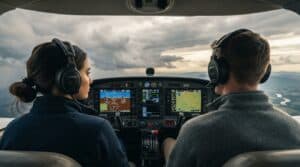
As a layman, when you hear the word instrument, you probably think of music such as guitars, pianos, or violins. But in aviation, instruments mean something entirely different.
We are not talking about musical instruments inside an airplane. Instrument flight rules are a special set of regulations that guide pilots when they cannot see outside the cockpit.
When thick clouds block the horizon or fog covers the runway, these rules take over. Every turn, altitude, and course correction depends on the readings from the aircraft’s instruments and the guidance of air traffic control.
In this article, you will discover how instrument flight rules make flying safe even when visibility is zero and how pilots master the art of navigating without visuals.
Instrument flight rules are the foundation of modern aviation. They are a set of procedures that tell pilots how to fly safely when they cannot rely on visual cues outside the cockpit.
In simple terms, when the weather turns bad or visibility drops, pilots switch from using their eyes to using instruments. These instruments show altitude, direction, speed, and attitude, allowing the pilot to control the aircraft precisely even when surrounded by clouds.
Under instrument rules, a pilot depends on air traffic control for instructions. Air traffic controllers provide routes, headings, and altitudes to keep every aircraft safely separated in the sky.
Every commercial flight you take operates this way. Even when the sky looks clear, many pilots still fly under instrument flight rules because it ensures safety, accuracy, and coordination in busy airspace.
The goal is simple: no guesswork, no uncertainty, just data-driven flying guided by instruments and constant communication with air traffic control.
Flying under instrument flight rules is more than a technical requirement. It is the backbone of safe and reliable air travel around the world.

When visibility drops or weather turns rough, IFR ensures that every movement in the sky remains predictable and organized. Pilots follow detailed procedures that remove guesswork and replace it with precision.
Without IFR, commercial aviation would be impossible on many days. Clouds, storms, or night flights would ground thousands of aircraft. With instrument flight rules, pilots can take off, fly, and land safely even when they cannot see the horizon.
IFR also protects smaller private aircraft. It prevents accidents caused by spatial disorientation, which happens when a pilot loses the sense of balance or direction. The instruments give constant feedback that keeps the airplane level and stable.
In short, the importance of IFR in aviation lies in safety, discipline, and reliability. It turns invisible skies into controlled airways that allow millions of passengers to travel confidently every day.
When a pilot flies under instrument flight rules, eyesight becomes secondary. What matters most are the instruments glowing on the panel. Each one tells a story and together they paint a full picture of where the aircraft is, how it moves, and what comes next.
Here are the key instruments that every pilot depends on:
These instruments work together like an orchestra. One shows altitude, another shows direction, while the others confirm speed and balance.

When visibility disappears, these tools become the pilot’s eyes.
Every glance at the panel is a decision. Pilots learn to read patterns instead of single numbers, interpreting the data as a living system that speaks through rhythm and routine.
Under instrument flight rules, no movement is random. Every climb, descent, or turn is calculated through these instruments and confirmed with air traffic control. This coordination keeps hundreds of aircraft safely separated even in complete cloud cover.
For pilots, trusting the instruments means trusting their training. It is discipline in motion, a skill that grows with hours of repetition until instinct and data become one.
Under instrument flight rules, pilots and air traffic controllers work as one team. Once a pilot files an IFR flight plan, control shifts from visual flying to guided communication. Every altitude, direction, and route adjustment comes through clear radio instructions from air traffic control.
Controllers have a full view of the airspace through radar systems. They monitor each aircraft, maintaining safe distance and ensuring that no two flight paths intersect. Pilots depend on this constant guidance to stay on course, especially when they cannot see other aircraft or terrain.
During each phase of flight, control is handed from one station to another. A pilot may start with ground control, then tower, then approach, and finally en-route controllers who monitor long-distance travel. This coordination keeps air traffic smooth, even when hundreds of aircraft share the same sky.
In the world of instrument flight rules, air traffic control is the invisible hand that guides every movement. It replaces sight with structure and turns complex skies into organized airways where safety is never left to chance.
Learning instrument flight flying begins with one goal to fly confidently when the world outside the cockpit disappears. Every pilot who earns an instrument rating learns to replace visual instincts with discipline, precision, and complete trust in their instruments.
The process starts with classroom lessons where students study weather patterns, airspace systems, and the logic behind IFR communication. They learn how to read charts, understand radio procedures, and plan routes entirely based on instruments.
After theory comes practice. Students spend hours in simulators and real cockpits, learning how to fly through clouds, follow headings, and interpret the language of air traffic control. Each exercise builds accuracy and calm thinking under pressure.
Many flight schools offer this training, but few do it with the structure and focus of Florida Flyers Flight Academy. The academy provides a strong foundation in IFR training, combining real-world scenarios with certified instructors who guide students through every phase of instrument flying. It is a place where pilots gain not just a license, but the confidence to fly safely in any weather condition.
Every flight begins with a decision — to fly by sight or by instruments. These two systems are known as Visual Flight Rules (VFR) and Instrument Flight Rules (IFR). Both serve the same purpose, but they follow very different paths in how a pilot operates and stays safe.
Under VFR, the pilot flies mainly by looking outside. Landmarks, the horizon, and weather conditions guide every move. It is ideal for clear skies, short flights, and simple airspace. The pilot has freedom but must also take full responsibility for staying clear of clouds and other aircraft.
Under IFR, everything changes. The pilot depends on instruments instead of visuals. Air traffic control becomes the guide, managing altitude, direction, and separation between aircraft. It requires more training and certification, but it also allows flights to continue safely through fog, storms, or darkness.
In simple terms, VFR is freedom guided by sight, while IFR is structure guided by precision. Both are essential parts of aviation, but together they form the balance between adventure and safety that keeps the skies open for every kind of pilot.
Modern aviation thrives on precision, and instrument flight rules have evolved alongside technology to make flying safer, smarter, and more efficient. Today’s cockpits look nothing like those of the past. Screens have replaced dials, systems communicate automatically, and navigation has become a seamless blend of data and control.
Here are the key technologies that define modern IFR flying:
Global Positioning System (GPS) technology has transformed how pilots navigate under instrument flight rules. Instead of relying on ground-based signals, aircraft now use satellites for exact positioning. This gives pilots greater accuracy, even across oceans or remote areas where radio coverage is weak.
Old analog gauges have been replaced by high-definition digital screens known as glass cockpits. These systems combine all flight data into one clear visual interface, allowing pilots to monitor altitude, airspeed, heading, and engine performance at a glance.
Automation has taken flight efficiency to a new level. Autopilot systems can now control the aircraft through climb, cruise, and descent while pilots supervise operations. The flight management system (FMS) integrates route planning, navigation, and performance monitoring into one intelligent unit that reduces workload and human error.
Modern aircraft are equipped with radar, sensors, and digital maps that display live weather conditions and terrain details. These tools help pilots make quick decisions when avoiding storms or maintaining altitude in poor visibility.
Advanced data links connect aircraft directly with air traffic control. Messages such as route changes or weather updates can be sent electronically, reducing radio congestion and improving clarity during IFR operations.
The rise of automation has not replaced the pilot’s role. It has simply enhanced it. Modern instrument flight rules flying blends human judgment with digital accuracy, creating a level of safety and reliability that defines today’s aviation standards.
Flying under instrument flight rules looks calm from the outside, but inside the cockpit, it demands constant awareness and focus. The pilot’s attention is divided between instruments, radio calls, and quick decisions that keep the aircraft safe in changing skies. Even with advanced technology, IFR flying comes with challenges that test both skill and discipline.
Here are some of the most common challenges pilots face under instrument flight rules:
An IFR flight involves continuous monitoring of instruments, weather reports, and ATC instructions. Pilots must think several steps ahead, plan for every phase of flight, and handle multiple inputs at once. This workload can feel overwhelming, especially in busy airspace or during unexpected route changes.
Clear communication is vital during IFR operations. Pilots must listen carefully to instructions from air traffic control, respond quickly, and confirm each clearance without error. In crowded skies, even a brief misunderstanding can lead to confusion or loss of separation.
Weather remains one of the greatest challenges in aviation. Flying through storms, turbulence, or dense cloud layers can cause discomfort and disorientation. Pilots rely completely on their instruments during these conditions, which demands confidence, precision, and mental calm.
Without visual reference, the human body can lose its sense of balance. Spatial disorientation makes it hard to tell if the aircraft is climbing, turning, or descending. Long hours of instrument flying can also lead to fatigue, making it harder for pilots to stay sharp and react instantly.
While rare, equipment failures can happen. Losing navigation or communication tools mid-flight requires fast decision-making. Pilots are trained to handle such emergencies using backup instruments and strict procedures that ensure control until landing.
Each of these challenges reminds us that instrument flight rules are not just about reading instruments, but about managing the entire environment of flight. The more a pilot trains under IFR, the more natural these challenges become, turning pressure into practiced precision.
Flying under instrument flight rules is not just a technical process. It is a skill that blends trust, discipline, and precision. When the world outside the cockpit disappears, the instruments become the pilot’s only sense of direction and safety.
Every successful IFR flight proves the beauty of control in uncertainty. It shows how human skill and technology can work together to overcome fear, darkness, and distance.
From training in classrooms to hours of practice in the sky, each pilot learns one timeless lesson — confidence does not come from sight, but from understanding.
That is what makes instrument flight rules more than a system. It is the language that allows pilots to fly safely, even when the sky hides every clue.
Train with Florida Flyers Flight Academy to master instrument flight rules and gain the confidence to fly safely in any weather under expert guidance and real-world conditions.
Instrument flight rules are the set of regulations that guide pilots when flying without outside visual reference. They rely entirely on cockpit instruments and air traffic control to maintain safe altitude, direction, and separation from other aircraft.
Visual flight rules (VFR) allow pilots to navigate by sight when weather and visibility are clear. Instrument flight rules (IFR) are used when visual cues are not available, such as in clouds, fog, or at night. IFR flying depends on instruments and communication with air traffic control for safe navigation.
Pilots use instrument flight rules whenever weather conditions reduce visibility below the minimum required for visual flight. This includes flying through clouds, heavy rain, fog, or during night operations. Most commercial flights operate under IFR conditions for safety and consistency.
An aircraft flying under instrument flight rules must have functioning navigation and communication systems. These include an attitude indicator, altimeter, airspeed indicator, heading indicator, and radio communication equipment approved for IFR operations.
Pilots can learn instrument flight rules through approved flight schools that offer instrument rating programs. Florida Flyers Flight Academy is one example of a professional training center that helps students master IFR procedures through classroom lessons, simulators, and real-world practice.
Instrument flight rules are essential because they make flying possible in all weather conditions. They ensure that pilots can safely operate even when visibility is zero, reducing the risk of accidents and allowing aviation to run safely and efficiently around the world.
Contact the Florida Flyers Flight Academy Team today at (904) 209-3510 to learn more about how to transfer flight schools.


Contact the Florida Flyers Flight Academy Team today at (904) 209-3510 to learn more about how the top pilot schools in usa can help you achieve your aviation dreams.