

Admission to a premier flight academy isn’t a mere registration process; it’s a high-stakes vetting operation designed to filter for professional excellence. You likely recognize that the path to the flight deck is rigorous, yet the gap between FAA legal minimums and the standards of an elite career track often creates paralyzing confusion. Whether you’re navigating the complexities of the 2026 M1 visa rule changes or calculating how to maximize your GI Bill benefits for the current academic year, the administrative burden can feel as demanding as the flight training itself.
Failure to meet a single regulatory standard doesn’t just delay your progress; it can terminate a career before it begins. This authoritative guide eliminates that ambiguity by providing a definitive breakdown of the flight school admission requirements you must master to secure your seat in a professional program. We don’t just list the rules; we provide the strategic framework for compliance. It’s about moving beyond basic eligibility to reach the status of an airline-ready candidate.
By the end of this analysis, you’ll possess a non-negotiable checklist of prerequisites. We’ll examine the critical FAA First-Class Medical standards, the specific documentation required for international and veteran applicants, and the professional benchmarks that separate hobbyists from the next generation of airline captains.
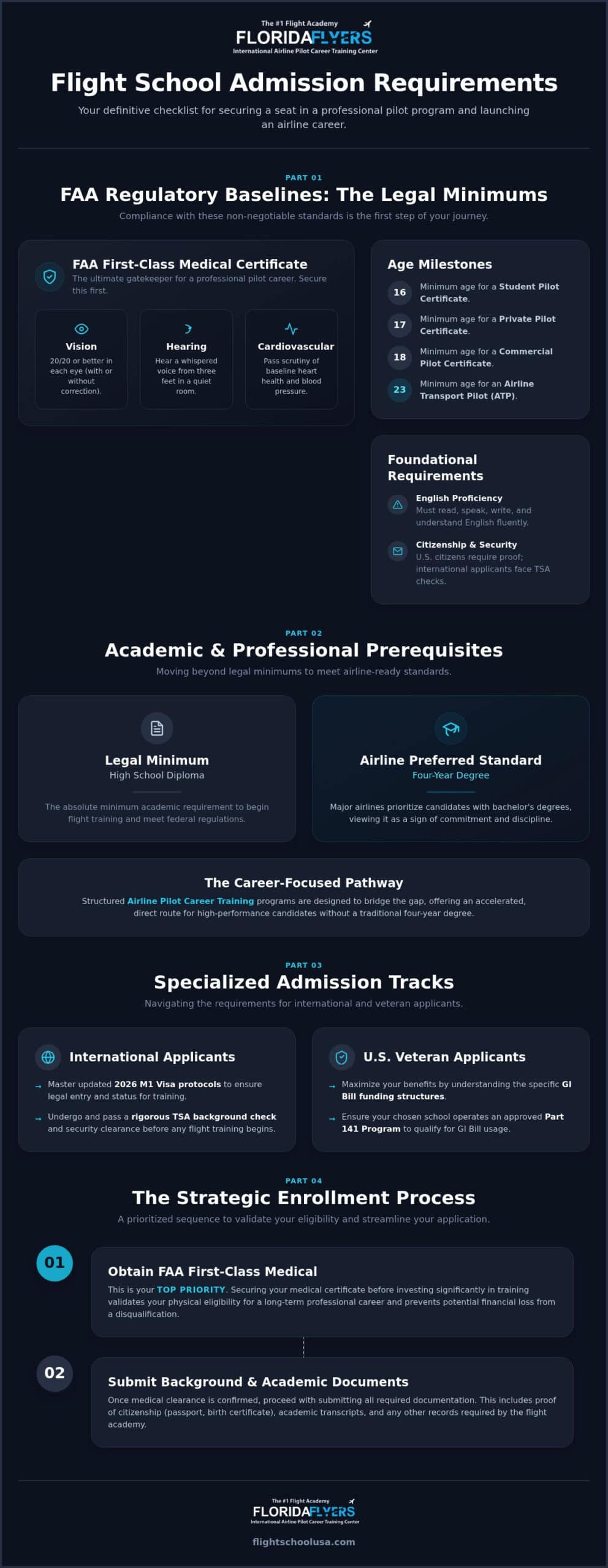
The Federal Aviation Administration (FAA) establishes the uncompromising legal framework that governs all flight school admission requirements. These mandates represent the absolute regulatory floor. Compliance is non-negotiable. For those pursuing an elite career track, these standards align with rigorous international pilot licensing standards, ensuring that your credentials command respect globally. You must demonstrate absolute proficiency in English, as it’s the universal language of aviation safety. This requires the ability to read, speak, write, and understand the language with total clarity under high-pressure conditions. Failure to meet this baseline immediately disqualifies an applicant from professional consideration.
The First Class Medical certificate is the ultimate gatekeeper of a professional pilot’s career. While hobbyist programs may permit Second or Third Class certificates, elite career programs demand a First Class rating from the outset. This standard ensures you possess the physical longevity required for a decades-long career. The examination is comprehensive and leaves no room for ambiguity. It focuses on critical physiological benchmarks that are vital for flight safety.
It’s a strategic error to invest in training hours before securing this certificate. If a medical disqualification occurs, your financial investment is effectively lost. You must secure your medical clearance immediately to validate your eligibility for professional flight school admission requirements and long-term career progression.
Age requirements are strictly tiered based on the level of certification you seek. You don’t want to reach the end of your training only to realize you’re legally barred from taking your checkride. The 2026 standards are precise:
U.S. citizens must provide definitive proof of citizenship, such as a valid passport or an original birth certificate combined with a government-issued photo ID. International applicants must navigate the TSA background check process. This involves a rigorous security clearance before any flight training commences. This vetting is a critical component of national security and a mandatory step for every non-citizen student entering the cockpit.
Meeting the official FAA pilot requirements is merely the entry point for a professional aviation career. While federal regulations establish the legal floor, elite academies and major carriers set a much higher ceiling. You aren’t just applying for a seat in a classroom; you’re entering a high-stakes vetting process that evaluates your potential as a future airline captain. Understanding these flight school admission requirements is the first step in demonstrating the discipline required for the flight deck.
The 2026 hiring landscape has evolved into a two-tier system. While a high school diploma remains the only legal academic mandate, the competitive reality is far more demanding. Major airlines continue to prioritize candidates with four-year degrees as a testament to their long-term commitment and cognitive discipline. However, the current pilot shortage has created a premier pathway for high-performance candidates who choose specialized training over traditional university routes. A structured Airline Pilot Career Training path bridges this gap by providing an immersive, professional environment that mirrors airline operations. This allows non-degree holders to prove their worth through technical excellence and rapid progression.
Technical aptitude is a non-negotiable component of our flight school admission requirements. You don’t need a degree in astrophysics, but you must possess a sharp command of mathematics and physics to manage complex flight planning and emergency procedures. We look for candidates who can perform mental calculations under pressure, as the cockpit is no place for hesitation. Beyond technical skill, your personal history serves as a permanent record of your reliability. Every applicant undergoes a comprehensive background check that scrutinizes criminal records and driving histories. A history of substance abuse or multiple traffic infractions, such as DUIs, is often a terminal disqualifier for airline hireability.
Admissions officers also utilize the initial interview to gauge your professional presence and command. They’re looking for the “Airline Ready” mindset from day one. This includes punctuality, grooming, and the ability to communicate with absolute clarity. If you’re ready to submit yourself to these elite standards, you can explore our professional flight school programs to begin your transition into the cockpit. Professionalism isn’t just a trait; it’s a requirement for those who intend to lead in the skies.
For international applicants and military veterans, the flight school admission requirements extend beyond basic aptitude into the territory of federal immigration law and Department of Veterans Affairs (VA) regulations. These aren’t just bureaucratic steps; they are high-stakes strategic maneuvers that dictate your eligibility for training on U.S. soil. Mastery of these protocols is essential for anyone seeking to enter an elite training environment. Compliance is the only path to the cockpit, and the margin for error is zero.
International students must secure an M-1 vocational visa to train at a U.S. flight academy. The process begins with the issuance of an I-20 form, which serves as the foundational document for your visa application. You must pay the SEVIS I-901 fee, which is $350 as of August 2026, before attending your embassy interview. A critical component of this application is the “proof of funding.” You must demonstrate the immediate availability of funds to cover both tuition and living expenses for the duration of your program. As of September 15, 2026, student visas are now admitted for a fixed period based on program length, replacing the older “duration of status” policy. This shift demands precise scheduling and strict adherence to your training timeline. There is no room for administrative delays when your legal status is tied to a fixed expiration date.
Military veterans possess a significant strategic advantage through the Post-9/11 GI Bill, but accessing these funds requires strict compliance with FAA Pilot Certification Standards under Part 141. The VA does not typically fund flight training under Part 61 regulations due to their less structured nature. For the 2026-2027 academic year, the maximum payment for non-degree flight training is $17,661.89. To initiate this, you must obtain a Certificate of Eligibility (COE) from the VA. Veterans should also note that a valid FAA medical certificate is a prerequisite for benefit activation; the VA will not subsidize training for a candidate who is not medically cleared to fly. Integrating the GI Bill for CFI Training into your long-term plan allows you to build the 1,500 hours required for airline placement while minimizing personal debt. This is a professional career track, and the VA expects the same level of discipline that was required during your active service. Navigating these specialized flight school admission requirements ensures that your transition from the military to the airlines is efficient and fully funded.
Professional pilot training is a high-performance environment where the institution acts as a rigorous gatekeeper of industry standards. Our flight school admission requirements for career tracks are designed to filter for candidates with an unwavering professional trajectory. Unlike flexible, pay-as-you-go models, fixed-price structures demand an upfront demonstration of capability and financial stability. This vetting process ensures that every student in the cockpit possesses the resilience to meet the aggressive timelines required by the major airlines.
Admission into Fixed-Price Flight Training Programs requires more than just meeting FAA minimums. It demands a “Zero to Hero” mindset, where the student commits to a full-time, immersive schedule that leaves no room for outside employment or distractions. We require financial pre-approval or verified proof of funding as a non-negotiable prerequisite. This prevents training interruptions that could compromise the integrity of the fixed-price agreement. Previous flight experience is scrutinized during the application phase; while prior hours can demonstrate aptitude, they must align with our standardized training protocols to ensure you don’t bring “bad habits” into an elite professional environment.
The CFI Fast Track Program is reserved for those who have already achieved Commercial Pilot certification and are ready to transition from student to mentor. The flight school admission requirements for this track focus heavily on instructional potential and command presence. We assess your ability to communicate complex aerodynamic principles with absolute clarity. If you cannot command a classroom or a cockpit with authority, you aren’t ready for the instructor track. Candidates must demonstrate a mastery of the Fundamentals of Instructing (FOI) before they are cleared for this accelerated pathway. This is a high-stakes environment where your performance directly impacts the safety and success of future aviators.
The final tier of our vetting process is the Airline Ready Program, which sets the definitive standard for commercial hireability. We evaluate every candidate for their ability to function within a multi-crew environment, emphasizing CRM (Crew Resource Management) and technical precision. If you’re prepared to meet these elite benchmarks, you can apply for our Fixed-Price Career Program to secure your position in the 2026 training cohort. Excellence is the only acceptable outcome for those who intend to lead in professional aviation.
Navigating the tactical sequence of flight school admission requirements demands the same precision you’ll eventually apply to a pre-flight checklist. This isn’t a casual application; it’s the execution of a professional career plan. To secure your position within an elite training cohort, you must move through a structured five-step process that validates your regulatory compliance and professional aptitude. Each phase is a critical component of your legal and professional standing.
Success in aviation is built on superior timing. You should anticipate a lead time of at least four to six weeks for TSA background checks if you’re an international applicant. Similarly, FAA medical examiners often have limited availability; securing your appointment three months before your desired start date is a strategic necessity. For those requiring on-site Student Housing, early application is critical. Our immersive environment is highly competitive, and housing is allocated on a first-come, first-served basis. International students must also coordinate their travel only after receiving definitive M1 visa approval to avoid costly logistical failures and administrative delays.
Our admissions team doesn’t function as clerical staff; they act as elite career mentors who guide you through our unique “Airline Ready” vetting process. We ensure that every student who enters our academy is positioned for maximum efficiency and professional success from day one. This rigorous approach is why we remain a premier leader in pilot development. This isn’t a hobby; it’s a high-stakes transition into a global industry that demands excellence. If you possess the discipline to meet these flight school admission requirements, the path to the flight deck is open. You can start your professional flight training application today to secure your seat in our next 2026 cohort.
Navigating the administrative phase is your first test of professional discipline. From securing an FAA First-Class Medical to mastering the 2026 M1 visa protocols, meeting these flight school admission requirements is a high-stakes mandate that defines your eligibility for the flight deck. You now possess the tactical knowledge required to move from the classroom to the cockpit with absolute confidence, ensuring your compliance with every federal and institutional standard. This preparation is the foundation of a successful airline career.
Flight School USA serves as the premier gatekeeper of industry excellence. As an FAA Part 141 Certified Academy, we provide specialized veteran and international support alongside the unparalleled security of our Fixed-Price Career Program. We demand excellence because the airlines demand nothing less. Don’t leave your professional trajectory to chance; execute your enrollment strategy now to join the next generation of elite aviators. Apply Now for Professional Flight Training at Flight School USA and command your future in the skies. Your career as a professional pilot begins with this single, decisive action.
You don’t need a college degree to meet flight school admission requirements in 2026. A high school diploma or its equivalent is the legal FAA baseline for entry. While major airlines historically preferred four-year degrees, the current pilot demand has shifted the focus toward high-performance training and technical proficiency. Professional academies now offer structured career paths that prepare you for the flight deck without the four-year university timeline.
Disqualification typically stems from failure to meet FAA First-Class Medical standards. Common hurdles include uncontrolled cardiovascular issues, vision that cannot be corrected to 20/20, or significant hearing loss. Neurological conditions or a history of substance abuse also trigger strict regulatory reviews. You must consult an Aviation Medical Examiner (AME) to address specific concerns. Securing this medical clearance is a non-negotiable prerequisite for any elite career-track training program.
Veteran benefits have specific limitations. For the 2026-2027 academic year, the Post-9/11 GI Bill covers up to $17,661.89 for non-degree flight training at private academies. This funding typically applies to advanced ratings like Instrument or Commercial under Part 141. You cannot use these benefits for initial Private Pilot training unless it’s part of a degree program, which we don’t offer. Veterans must provide a Certificate of Eligibility to begin.
International students must demonstrate the immediate availability of funds to cover the total cost of their program and living expenses. This requirement is a mandate for the I-20 form and M1 visa issuance. You must also account for the $350 SEVIS I-901 fee and TSA processing costs. Failure to provide definitive financial documentation will result in an immediate administrative denial. Precise financial transparency is essential for high-stakes international admissions.
You can legally begin flight training at age 16 to obtain a student pilot certificate. However, professional flight school admission requirements for career tracks usually mandate a minimum age of 18. This aligns with the FAA requirement for a Commercial Pilot Certificate. Most elite programs look for candidates who are ready to commit to a full-time professional schedule, which often requires the maturity and legal standing of an adult applicant.
A comprehensive background check is a mandatory component of the enrollment process. This includes a review of your criminal record and your driving history, specifically looking for drug or alcohol-related offenses. International students must also clear a TSA background check before training commences. These checks ensure you meet the high-stakes hireability standards of the commercial aviation industry. Any history of substance abuse or multiple traffic infractions can terminate your career prospects.
You can absolutely start your training without a Private Pilot License. Many elite programs, such as our Fixed-Price Career Program, are designed for “zero-time” candidates who intend to move directly into a professional role. These tracks take you through every rating from the ground up in a structured, immersive environment. Starting from zero ensures you develop the disciplined habits required for airline operations under a single, rigorous training standard.
The admission process typically takes between four and six weeks to complete. This timeline is largely dictated by the lead times for FAA medical examinations and TSA security clearances. If you are an international student, the M1 visa interview and approval process can add several weeks to this schedule. We recommend initiating your application at least three months before your desired start date to secure your position and student housing availability.


