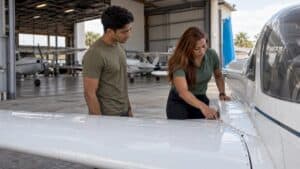
Any U.S. pilot acting as pilot in command (PIC) of a complex airplane must comply with the complex endorsement requirements set out in 14 CFR § 61.31(e): receive and log both ground and flight training from an authorized instructor in a complex airplane or a representative full flight simulator (FFS) or flight training device (FTD), demonstrate proficiency, and receive a one-time logbook endorsement from that instructor. The Federal Aviation Administration (FAA) sets no minimum flight-hour requirement. Training is proficiency-based, the instructor determines when you are ready, and the endorsement is issued once. The Aircraft Owners and Pilots Association (AOPA) confirms this framework and reproduces sample endorsement wording aligned with FAA advisory circular guidance.
Key regulatory facts at a glance:
The single most important fact about complex endorsement requirements is this: the FAA mandates demonstrated proficiency and a one-time logbook endorsement from an authorized instructor, with no minimum flight hours, and training may be completed in a complex airplane or a representative FFS/FTD.
| Point | Details |
|---|---|
| Regulatory basis | 14 CFR § 61.31(e) governs the requirement; all three systems must be present to qualify as complex. |
| No hour minimum | Training is proficiency-based; most pilots need roughly 5–10 hours of dual instruction. |
| Documentation is mandatory | The endorsement must include the pilot’s certificate number, aircraft make/model, and the CFI’s certificate number and expiration date. |
| Pre-1997 exception | Logged PIC time in a complex airplane before August 4, 1997 satisfies the requirement for that category and class. |
| Flightschoolusa | Florida Flyers Flight Academy provides structured complex endorsement training with in-house FAA checkrides and AC 61-65F-compliant documentation. |
The FAA defines a complex airplane in 14 CFR § 61.31(e) as an aircraft equipped with all three of the following: a retractable landing gear, flaps, and a controllable-pitch propeller. All three must be present simultaneously. An aircraft with only two of these features does not meet the regulatory definition, regardless of how sophisticated it appears on the ramp.

One important exception applies to seaplanes. A seaplane equipped with flaps and a controllable-pitch propeller qualifies as complex even without retractable landing gear, because the hull or floats serve the structural role that gear plays in a land-based aircraft.
Common aircraft categories that typically meet the complex definition include:
The controllable-pitch propeller requirement is frequently misunderstood. A fixed-pitch propeller, even on a high-performance aircraft, does not satisfy this criterion. Conversely, a constant-speed propeller always qualifies as a controllable-pitch propeller.
Pro Tip: Confirm complex status before scheduling training. Pull the aircraft’s Pilot’s Operating Handbook (POH) and cross-reference the systems section against all three criteria. You can also verify the aircraft’s equipment list through the FAA Aircraft Registry at registry.faa.gov, which lists avionics and major systems for certificated aircraft.
The requirement is straightforward: any pilot acting as PIC of a complex airplane must hold the endorsement. This applies regardless of certificate level — private, commercial, or ATP — unless a specific regulatory exception applies.
The most significant exception is the pre-August 4, 1997 grandfathering provision. If you logged PIC time in a complex airplane before that date, you satisfy the requirement for that category and class of aircraft without obtaining a formal endorsement. The logged time itself serves as the qualifying record. This exception also extends to pilots who completed training in a representative FFS or FTD before that date under applicable regulations.
Use-case scenarios where the endorsement is mandatory:
AOPA’s endorsement guidance notes that the endorsement is aircraft-category-specific. An endorsement received in a single-engine complex airplane does not automatically authorize PIC operations in a multiengine complex airplane; separate training and endorsement in the multiengine category is required.
The regulatory structure has two distinct components, and both must be completed before the endorsement is valid.
Component 1: Receive and log training. You must receive ground training and flight training from an authorized instructor. “Authorized instructor” means a certificated flight instructor (CFI) holding the appropriate category and class ratings. The training must be logged in your pilot logbook with sufficient detail to demonstrate compliance: date, aircraft make and model (or simulator identifier), total time, dual received, and the specific content covered.
Component 2: Receive the logbook endorsement. Once the instructor determines you are proficient, they enter a one-time endorsement in your logbook. AC 61-65F provides the sample wording and specifies what the endorsement must contain: the instructor’s name, certificate number, certificate expiration date, and a statement that you have received the required training and been found proficient.
Simulator and FTD allowances follow a “representative” standard. The device must replicate the systems of a complex airplane — retractable gear operation, constant-speed propeller control, and flap management — to a degree that provides meaningful training value. Not every Level 1 FTD meets this bar for complex training; confirm the device’s qualification level with the training provider before logging hours toward the endorsement.
Minimum logbook fields for each training flight or simulator session:
| Field | What to Record |
|---|---|
| Date | Calendar date of the session |
| Aircraft/Device | Make, model, and N-number or device identifier |
| Total time | Hobbs or tach time for the session |
| Dual received | Hours logged as dual instruction received |
| Remarks | Systems covered, maneuvers practiced, instructor name |
| Instructor sign-off | CFI signature, certificate number, and expiration date |
Pro Tip: Ask your instructor to write the endorsement in ink directly in your logbook AND provide a signed copy on an AC 61-65F template. A duplicate on file with the flight school protects you if the logbook is ever lost or damaged.
The exact wording matters for legal compliance. AC 61-65F provides the FAA’s recommended sample text, which instructors should follow closely. A properly worded endorsement looks like this:
I certify that [Pilot’s Full Name], holder of pilot certificate number [XXXXXXXX], has received the required ground and flight training in a complex airplane, [Aircraft Make and Model, N-Number], and has been found proficient in the operation and systems of a complex airplane in accordance with 14 CFR § 61.31(e).
[CFI Full Name]
CFI Certificate No. [XXXXXXXX], Exp. [MM/DD/YYYY]
[Date of Endorsement]
Every field in that block carries legal weight. The pilot’s certificate number ties the endorsement to a specific airman record. The aircraft make, model, and N-number document which complex airplane was used. The regulatory citation (§ 61.31(e)) confirms the specific requirement being satisfied. The instructor’s certificate number and expiration date verify that the endorsing CFI held a valid certificate on the date of training.
Instructor proficiency checklist before issuing the endorsement:
A well-structured syllabus divides work between the ground and the aircraft, and the Airplane Flying Handbook Chapter 12 outlines the transition training framework that most experienced CFIs follow.
Ground training topics:
Flight training maneuvers:
Scenario callout: A high-workload go-around is the single maneuver that exposes the most proficiency gaps. At 200 feet AGL on short final with full flaps and gear down, the pilot must simultaneously apply full power, manage manifold pressure and RPM, retract flaps in stages to avoid a sink rate, confirm gear retraction, and maintain directional control. Practicing this scenario at altitude first, then at pattern altitude with an instructor, builds the procedural discipline the endorsement is meant to certify.
Pro Tip: Pilots with prior IFR experience adapt faster to power management in a complex aircraft because they already think in terms of precise power settings and configuration changes. If you have no IFR background, budget extra ground time on the manifold pressure/RPM relationship before your first flight.

The FAA’s device qualification standards establish what constitutes an acceptable FFS or FTD for complex endorsement training. The key word in the regulation is “representative”: the device must replicate the systems and handling characteristics of a complex airplane well enough to provide genuine training value.
What simulators and FTDs can do for your endorsement:
What simulators and FTDs cannot replace:
The eCFR version of § 61.31 mirrors the requirement and confirms that simulator hours must be logged with the device’s identifier and qualification level noted. When recording simulator time, enter the device name, qualification level (e.g., Level 5 FTD), and the training organization’s name alongside the standard logbook fields.
Pro Tip: Use simulator sessions to master the checklist flows and emergency procedures, then validate that muscle memory in the actual aircraft. Two or three simulator sessions followed by three or four aircraft flights is a common and cost-efficient sequence.
Several persistent myths about complex endorsement training create compliance risk. Addressing them directly protects your certificate.
The August 4, 1997 grandfathering exemption. 14 CFR § 61.31(e) explicitly states that a pilot who logged PIC time in a complex airplane before August 4, 1997 satisfies the requirement for that category and class. The logged time is the evidence; no separate endorsement is needed. However, this exception is category-and-class-specific. PIC time in a single-engine complex airplane before 1997 does not cover multiengine complex operations.
Common misconceptions to correct:
The regulatory change that created the modern endorsement requirement took effect August 4, 1997, which is why that date appears as the dividing line in the grandfathering provision.
The FAA’s proficiency-based standard means training duration varies, but industry guidance from sources including Bolt Flight indicates that most pilots require several hours of dual instruction to reach endorsement proficiency. Pilots with prior retractable-gear or constant-speed-prop experience often land closer to the lower end; those transitioning directly from a basic fixed-gear trainer typically need the full range or slightly beyond.
Factors that drive cost variance:
The table below illustrates a planning range. These are illustrative estimates, not quotes, and actual costs will vary by location, aircraft, and instructor.
AOPA confirms that because training is proficiency-based, the most reliable way to control cost is to arrive at each session well-prepared: study the POH systems section before ground training, review emergency checklists before each flight, and brief the instructor on your specific knowledge gaps so sessions stay focused.
The complex endorsement is sometimes treated as a bureaucratic checkbox, but that framing misses the operational reality. A properly documented endorsement is the legal foundation for every PIC flight you make in a complex airplane. If that documentation is incomplete, the flight is not merely irregular — it is a violation of 14 CFR § 61.31, regardless of how skilled you are.
Three practical recommendations every pilot should follow:
The value of a thorough, well-documented endorsement compounds over a career. Commercial applicants who used a complex airplane for their practical exam, ATP candidates building PIC time, and instrument-rated pilots transitioning to higher-performance aircraft all benefit from an endorsement record that is clean, complete, and traceable to a specific aircraft and instructor.
Florida Flyers Flight Academy offers structured complex endorsement training that pairs simulator-based systems instruction with aircraft time in a properly equipped complex airplane, all under the supervision of experienced CFIs who follow a documented syllabus aligned with AC 61-65F and the Airplane Flying Handbook.

The practical advantage Florida Flyers delivers is its Self Examining Authority: FAA checkrides happen in-house, which eliminates the scheduling delays that can add weeks to a training timeline at other schools. CFIs at Florida Flyers are current in the aircraft they instruct in, and every endorsement package includes a written syllabus, a completed AC 61-65F endorsement template, and a logbook entry that meets FAA documentation standards. For pilots targeting a commercial certificate, the complex endorsement training integrates directly into the broader commercial pilot program, keeping your training hours efficient and your costs predictable. Contact Florida Flyers to schedule your first ground session and confirm aircraft availability.
The following primary sources were used to build this guide. Each serves a distinct purpose depending on whether you need regulatory text, instructor guidance, or syllabus content.
This article is general information, not a substitute for advice from a qualified lawyer. Consult a qualified legal professional about your own circumstances before acting on anything here.