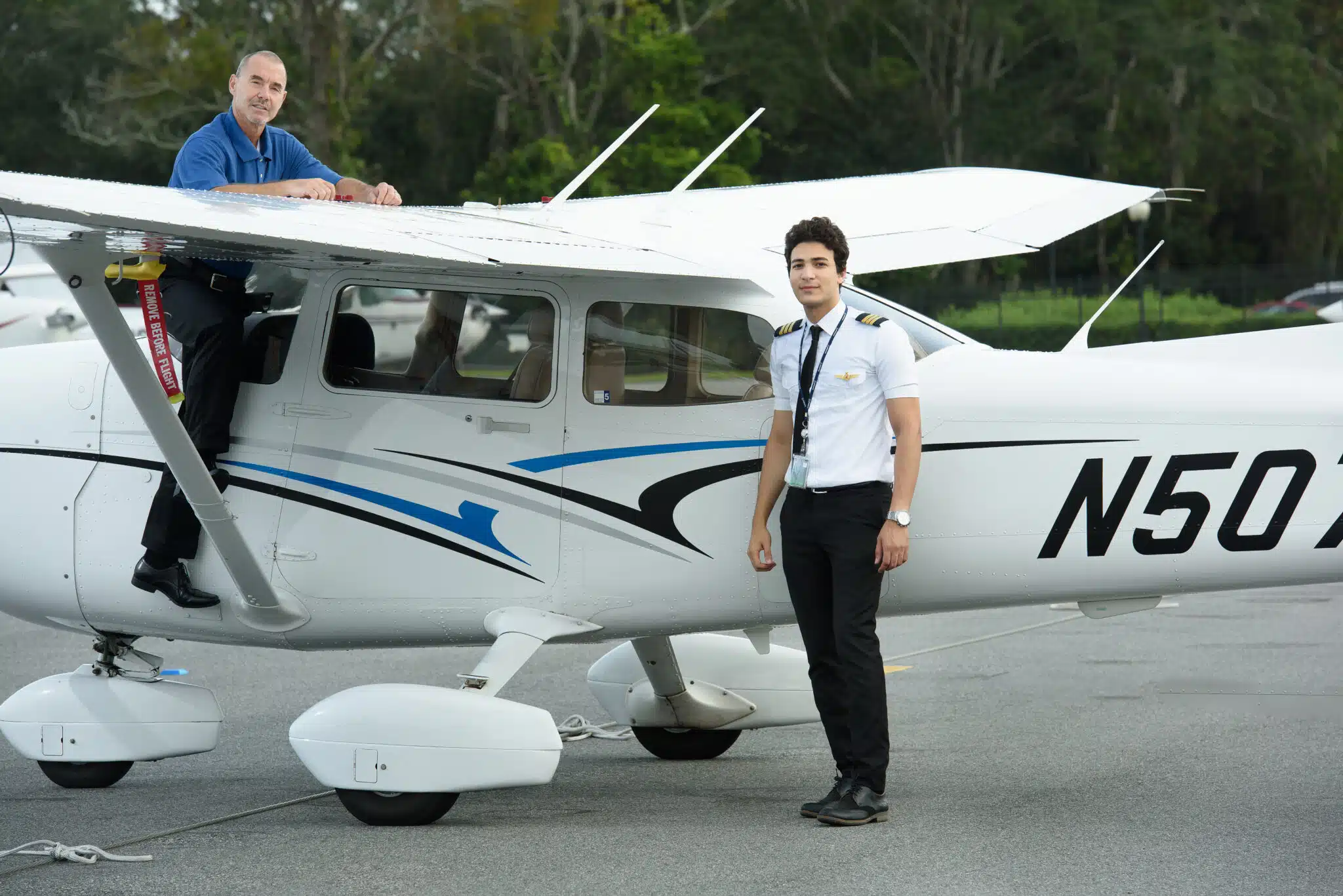

You walk into your first flight school tour, excited—but nervous. One question’s stuck in your mind: can you become a pilot if you wear glasses? You’ve heard rumors, seen strict medical requirements, and maybe even doubted if 20/20 vision is a dealbreaker.
Here’s the truth: wearing glasses doesn’t disqualify you. Not for a private license. Not for a commercial career. Thousands of working pilots—from airline captains to CFIIs—wear corrective lenses every day. The FAA doesn’t expect perfect eyes. They expect correctable vision—and smart habits in the cockpit.
This guide breaks down exactly what the FAA requires, how to pass your medical, and what kind of eyewear is approved. If your vision is the only thing holding you back, it won’t be after this.
Can You Become a Pilot If You Wear Glasses? FAA Says Yes
If you’re wondering can you become a pilot if you wear glasses, the FAA’s position is clear: absolutely, yes. As long as your vision can be corrected to meet specific standards, wearing glasses or contact lenses does not disqualify you from becoming a private pilot, commercial pilot, or even an airline captain.
In fact, a significant percentage of active pilots—both student and professional—rely on some form of vision correction. According to the FAA’s Aerospace Medical Certification Division, correctable vision is acceptable across all medical classes, provided you meet their distance and near vision thresholds with glasses or contacts.
There’s even a box on your FAA medical application that asks if you use corrective lenses. If you answer “yes,” and your vision meets the required standards with correction, the FAA will simply issue your medical with a note: “Must wear corrective lenses while exercising the privileges of this certificate.” No special restrictions. No extra hoops.
So, can you become a pilot if you wear glasses? Without hesitation—yes. It’s your corrected vision that matters, not whether or not you need help seeing clearly.
FAA Vision Standards for Pilots (2025 Update)
To qualify for any FAA pilot certificate, you must pass a medical exam conducted by an FAA-authorized Aviation Medical Examiner (AME). One of the first things they’ll check? Your eyesight.
Here’s how the 2025 FAA vision standards break down for the three main medical certificate classes:
| Medical Class | Distant Vision Requirement | Near Vision Requirement |
|---|---|---|
| Class 1 (Airline Transport Pilot) | 20/20 in each eye (corrected or uncorrected) | 20/40 (with or without correction) |
| Class 2 (Commercial Pilot) | 20/20 in each eye (with correction allowed) | 20/40 (corrected OK) |
| Class 3 (Private or Student Pilot) | 20/40 or better (with correction) | 20/40 (with or without correction) |
A few key notes:
- If you wear glasses or contacts, bring them to your FAA medical exam. You’ll be tested with them on.
- Your medical certificate will include a limitation note requiring you to wear those lenses during all flight operations.
- You don’t need to have 20/20 vision naturally. What matters is that your vision can be corrected to meet the standard.
If your prescription changes later, there’s no need to retake the medical unless your vision can no longer be corrected to FAA minimums. In that case, you may require a Special Issuance, but this is rare and handled on a case-by-case basis.
How the FAA Tests Your Vision for a Medical Certificate
During your FAA medical exam, your eyesight will be tested in three main categories: visual acuity, color vision, and peripheral field of vision. This screening ensures you meet the safety and situational awareness standards required for flight.
Visual acuity testing checks both distance vision (typically at 20 feet) and near vision (at 16 inches). If you wear corrective lenses, the Aviation Medical Examiner (AME) will test you while wearing them.
Color perception is tested using color plates (like the Ishihara test) to confirm you can distinguish between red, green, and white—critical for reading instruments and interpreting signals at controlled airports.
Field of vision testing ensures you have sufficient peripheral awareness—important for spotting traffic and maintaining visual separation in flight.
It’s worth noting that the FAA does not require perfect natural vision. They only require that your vision be correctable to their published standards (20/20 for Class 1/2, 20/40 for Class 3). So when asking can you become a pilot if you wear glasses, the FAA’s testing method shows that yes—you can, provided those lenses help you meet the visual benchmarks.
If you fail a vision test at your exam, you’re usually allowed to return with updated lenses for re-evaluation—no permanent disqualification involved, unless an uncorrectable condition is discovered.
Can You Become a Pilot If You Wear Glasses With a High Prescription?
Yes, you can still become a pilot—even if your glasses have a high prescription. The FAA doesn’t disqualify applicants based on how strong their corrective lenses are. The determining factor is whether your vision, with correction, can meet the required standards for your desired medical certificate.
If you’re wondering can you become a pilot if you wear glasses and your prescription is stronger than average—say, for severe myopia (nearsightedness) or hyperopia (farsightedness)—you’re not alone. Many active pilots fly with prescriptions of -6.00 diopters or greater, and some use specially designed high-index lenses or contacts to improve comfort and clarity in the cockpit.
However, if your prescription falls within the extreme range, or if you’ve had vision-related surgeries, your AME may request additional documentation—such as a report from your eye doctor, retinal scans, or stability assessments over time.
In rare cases, the FAA may issue a Special Issuance medical certificate, which still allows you to fly legally. These are reviewed case-by-case, especially if your vision issues are linked to other ocular conditions like keratoconus, retinal detachment history, or progressive disease.
The bottom line: high prescription doesn’t mean disqualification. It just means more thorough documentation may be needed—but thousands of professional pilots have flown with it successfully.
Can You Become a Pilot If You Wear Glasses for Astigmatism or Farsightedness?
Yes—you absolutely can. If you’re dealing with astigmatism, farsightedness (hyperopia), or a combination of both, the FAA allows you to fly as long as your vision can be corrected to meet the standard. These are common refractive errors, and glasses or contact lenses can correct them well enough for you to qualify for any class of medical certificate.
So, can you become a pilot if you wear glasses due to astigmatism or farsightedness? The FAA’s stance is clear: correction is what matters—not perfection.
If you’re currently training, bring an updated optometrist prescription to your Aviation Medical Examiner (AME), especially if you’ve had recent changes in visual acuity. Also, many examiners and instructors recommend that you bring a backup pair of glasses—not just to your checkride, but to every flight. This is particularly important for students, as losing or breaking your primary glasses mid-lesson can compromise safety and delay solo sign-offs.
Additionally, many pilots choose refractive surgery such as LASIK or PRK. These procedures are approved by the FAA, provided your vision stabilizes post-op and you pass the medical clearance requirements. There is no waiting period after surgery unless complications occur, but you’ll need your eye surgeon to confirm full recovery and visual stability.
Tips for Student Pilots Who Wear Glasses
If you’re a student pilot and you wear glasses, a few simple habits can make your training smoother, safer, and more comfortable. While vision correction won’t hold you back, poor planning around eyewear can.
Always carry a spare pair: The FAA requires it for some commercial pilots, and it’s a smart safety net for students, especially during solo flights or cross-country training. Keep it in your flight bag, not in the car or at home.
Invest in aviation-friendly eyewear: Choose frames that are lightweight, low-profile, and designed for comfort under a headset. Anti-reflective coatings help reduce glare from cockpit instruments and windows, particularly in bright conditions or during night flying.
Be proactive with instructors and medical examiners: Let your CFI know about your visual correction needs so they can monitor any visibility issues in-flight. During your FAA medical, disclose your prescription and bring your glasses to the exam—it streamlines the process and avoids delays.
Most importantly, don’t treat wearing glasses as a limitation. With the right approach, it’s just one more part of your preflight checklist—and one that thousands of successful pilots check off every day.
Can You Become a Pilot If You Wear Glasses Outside the USA?
Yes—and in most cases, the rules are very similar to the FAA’s. If you’re training or planning to fly outside the U.S., you might wonder: can you become a pilot if you wear glasses under foreign aviation authorities like EASA (Europe), DGCA (India), or CASA (Australia)? The answer is a confident yes—as long as your corrected vision meets their published standards.
EASA (European Union Aviation Safety Agency) allows pilots to wear corrective lenses as long as vision is correctable to 6/6 (equivalent to 20/20).
DGCA (India’s Directorate General of Civil Aviation) requires 6/6 vision with correction and does not disqualify candidates with glasses, including those with mild refractive errors or astigmatism.
CASA (Australia) also aligns closely with ICAO standards and permits pilots to fly with glasses or contact lenses if vision meets minimum thresholds after correction.
In fact, FAA medical standards are widely considered a global benchmark, and many other countries model their vision requirements after them. Some civil aviation authorities may request additional tests such as depth perception checks, color vision panels, or medical history verification—especially for airline or ATPL applicants.
If you’re unsure, always consult the aviation medical examiner (AME) licensed by your country’s aviation authority. But for most student pilots worldwide, wearing glasses is not a dealbreaker—just a detail in the paperwork.
Do Airline Pilots Wear Glasses? (Yes, Many Do)
If you’ve ever boarded a flight and noticed the captain wearing glasses, you’re seeing proof that vision correction is no barrier to a successful aviation career. In fact, many airline pilots wear glasses, including those at major carriers like Delta, Emirates, Lufthansa, and Air India.
The important requirement is corrected visual acuity—not natural perfection. Airlines worldwide follow their respective civil aviation medical standards, which universally allow pilots to wear glasses or contacts, as long as their corrected vision meets flight safety criteria.
Additionally, many airlines—particularly in Europe and Asia—require commercial pilots to carry a backup pair of glasses in their flight bag while on duty. This is a practical redundancy to ensure that vision correction is always available in-flight, even in the unlikely event of damage or lens loss.
So, can you become a pilot if you wear glasses and still fly for an airline? Absolutely. Whether you’re heading toward a regional FO role or aspiring to sit left seat on a widebody jet, your eyewear won’t hold you back—as long as you meet the corrected vision standards and stay medically current.
Vision Changes During Training or Career: What to Do
Your vision doesn’t have to remain perfect throughout your career—but how you manage changes does matter. One of the biggest misconceptions is that once you pass your FAA medical, your eyesight is no longer under scrutiny. In reality, pilots are expected to monitor their visual health throughout their flying life.
If you hold a First-Class Medical Certificate, you’ll need to retest your vision annually (or every 6 months if over 40). Second-Class Medicals are valid for 12 months, and Third-Class Medicals last 24–60 months depending on your age. During each renewal, your corrected vision must still meet FAA standards.
If your eyesight worsens or you undergo corrective eye surgery (e.g., LASIK or PRK), it’s your responsibility to report any changes or procedures to the FAA. Minor prescription updates usually don’t require action beyond informing your AME, but major surgeries or eye injuries may call for a temporary deferral and additional documentation from your ophthalmologist.
Bottom line: vision changes are expected, especially over a multi-decade flying career. As long as you’re proactive and keep your correction within acceptable FAA limits, you’ll stay certified and cockpit-ready.
Conclusion
So, can you become a pilot if you wear glasses? Without a doubt—yes. Corrective lenses are not a barrier to your flight career; they’re simply a tool. What the FAA (and every airline) cares about is your ability to fly safely, make sound decisions, and meet medical standards with or without glasses.
Thousands of professional pilots—regional captains, international first officers, corporate jet crews—take off every day with vision corrected by glasses or contacts. What sets them apart isn’t perfect eyesight—it’s preparation, documentation, and a mindset focused on capability, not limitations.
If your passion for flying is clear, your prescription doesn’t change that. Florida Flyers Flight Academy supports pilots at every stage—from first medical to final checkride. We help student pilots navigate vision-related questions, FAA Class 1–3 requirements, and prepare confidently for careers in commercial aviation.
FAQ: Can You Become a Pilot If You Wear Glasses?
Can you become a pilot if you wear glasses or contact lenses?
Yes. The FAA allows pilots to fly with glasses or contacts as long as their vision is correctable to 20/20 for Class 1 or 2, and 20/40 for Class 3. Wearing glasses does not disqualify you from becoming a pilot.
What’s the maximum prescription allowed for pilots?
There is no specific prescription limit. You can become a pilot if your glasses correct your vision to FAA standards. Even pilots with high prescriptions are eligible, though some cases may require additional documentation or follow-up exams.
Can you become an airline pilot if you’ve had LASIK?
Yes. LASIK and PRK are FAA-approved procedures. Once your vision stabilizes and there are no complications, you can hold any class of medical certificate. Your AME may require a post-op report from your surgeon.
Is it mandatory to carry spare glasses in the cockpit?
For airline pilots, yes. FAA regulations require commercial pilots who rely on corrective lenses to carry a spare pair while flying. Student and private pilots are not required to, but it’s strongly recommended.
Will failing the vision portion disqualify my medical?
Not necessarily. If you don’t meet vision standards during your medical exam, you may return with updated lenses or provide additional documentation. As long as your vision is correctable, you’re likely to be cleared.
Contact the Florida Flyers Flight Academy Team today at (904) 209-3510 to learn more about how to do the foreign pilot license conversion in 4 steps.