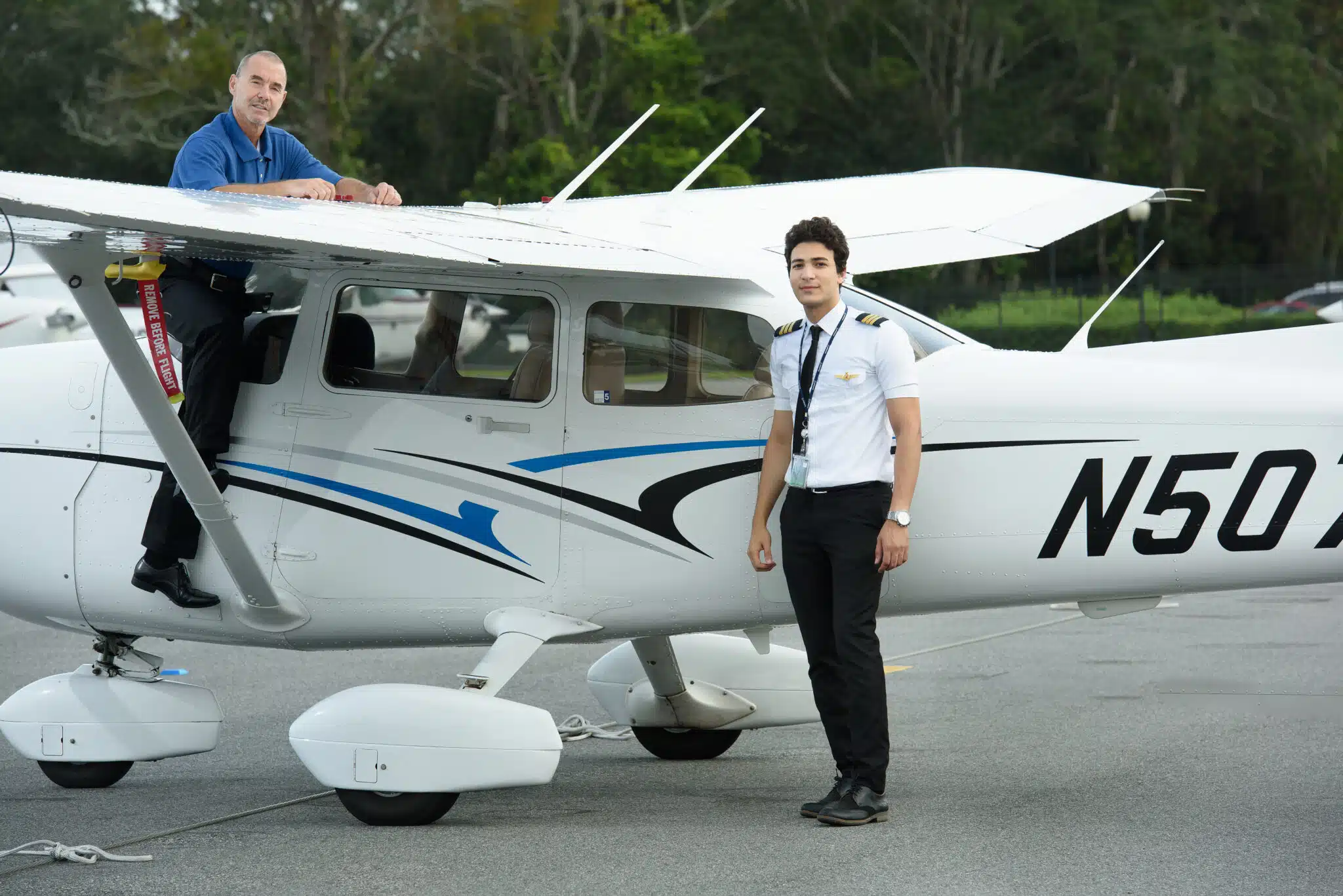
“When should I begin training to become a professional pilot?”
This is a question that frequently arises among those new to the aviation industry. The answer? “There’s no better time than now.”
If your dream is to become a professional pilot, it’s important to understand the journey ahead. The path from novice to certified aviator involves a significant time commitment, and the sooner you start, the closer you’ll be to achieving your goal.
The duration of your training will vary greatly depending on the level of effort you’re willing to invest. If you dedicate yourself to full-time flight training, you could earn the essential pilot certificates and ratings in less than a year.
On the other hand, if you opt for part-time training—squeezing in lessons after work or on weekends—it could take years to achieve the same milestones.
The choice of which ratings to pursue and in what order ultimately depends on your professional goals. However, most pilots who already hold a private pilot certificate typically advance by pursuing either an instrument rating or a commercial pilot certificate as their next step.
What It Means to Become a Professional Pilot
First, let’s clarify what it truly means to become a professional pilot. To many newcomers in aviation, the term “professional pilot” conjures images of airline captains in crisp uniforms. For others, it simply means being paid to fly.
However, being a professional pilot goes far beyond holding a handful of certificates or logging flight hours. True professionalism is a mindset—a reflection of one’s attitude, character, and dedication to the craft.
During flight training, students are repeatedly reminded of the standards they must meet to pass ground and flight tests for any certificate or rating. For instance, the FAA requires a minimum passing score of 70% on all knowledge tests. Similarly, FAA-designated pilot examiners evaluate applicants against established minimum performance standards during practical flight tests.
However, it’s crucial to understand that these standards are just that—minimums. They represent the baseline for certification, not the pinnacle of what it means to become a professional pilot. In the real world, nature and unforeseen circumstances can demand performance far beyond these minimums.
A true professional pilot strives to exceed regulatory standards. They don’t just memorize the types of clouds; they study how and why those clouds form and what weather phenomena might lurk within or nearby. This same depth of understanding applies to air traffic control procedures, aircraft systems, and emergency protocols.
When a pilot possesses more than a superficial understanding of their aircraft, its systems, and the environment in which they operate, it shows. This deep knowledge fosters a level of self-confidence that’s unmistakable—and it’s this combination of expertise and confidence, not just logged hours, that transforms someone into the kind of pilot everyone wants to hire.
Become a Professional Pilot: The Necessary Ratings
To become a professional pilot and fly for a fixed-wing regional or major airline in the U.S.—both of which operate under FAR Part 121—you must hold a valid Airline Transport Pilot (ATP) certificate. This requires at least 1,500 hours of flight time logged in your book.
However, the journey to become a professional pilot begins much earlier, starting with earning a commercial pilot certificate, an instrument rating, and, in most cases, a multi-engine rating.
For charter or business-aviation flight departments, the minimum certifications typically include a commercial pilot certificate, an instrument rating, and, depending on the operation, a multiengine rating.
While some Part 135 charter companies and Part 91 flight departments operating single-engine piston or turboprop aircraft may not require a multiengine rating immediately, anyone aiming to become a professional pilot will eventually need one. Therefore, the best long-term plan should focus on when to earn the rating, not if.
The Importance of Timely Training
You’ve likely heard this before, but the shorter the time spent earning the necessary ratings, the better—and not just for cost reasons. Compressing training time ensures that the new pilot retains more knowledge and is sharper for interviews compared to someone who took years to complete their training.
Think of it this way: Imagine someone who started driving lessons at 16 but only practiced once a month or every other month. Compare their performance to someone who completed their lessons and passed the licensing test all in the same week. The difference in skill and confidence would be stark. Learning to fly and earning the certifications needed to become a professional pilot is no different.
Choosing the Right Flight School
Aspiring pilots who want to become a professional pilot must decide whether to train at a local flight school (often operating under Part 61 regulations) or invest in a full-time program at a larger flight school (typically under Part 141 regulations).
While larger schools may require a significant financial commitment and possibly even relocating, they often provide a more structured and accelerated path to certification.
Another option is attending a degree-granting university with an aviation program. While this route opens the door to federal student loans and provides a four-year degree, it can take years to complete. Graduates may leave with several ratings but very little actual flight time. For resources on flight schools, check out Flying’s Learn To Fly Hub and the FAA website.
Accelerated Flight Schools
Some large commercial flight schools, such as Florida Flyers Flight Academy, are designed to help full-time students become a professional pilot in the shortest time possible. Many of these programs can take a student from zero flight time to earning a flight instructor certificate in less than a year of full-time study.
However, don’t mistake speed for ease. These programs are intense and demanding, requiring significant dedication and effort.
For those aiming to become a professional pilot in the airline industry, understanding seniority is crucial. A pilot’s seniority number determines nearly every aspect of their career, including the aircraft and routes they fly, their base location, vacation schedules, and when they can upgrade from first officer to captain (along with the accompanying pay raise).
Seniority numbers are typically assigned on the first day of airline training, with the oldest pilot in the class receiving the highest number. This means that delaying your flight training to save money could cost you in the long run. A pilot who trains and is hired sooner will secure a lower seniority number, which can significantly impact their career trajectory.
This overview assumes the pilot already holds a private pilot certificate. All the ratings mentioned—except for the multiengine rating—require the applicant to pass a knowledge test.
Become a Professional Pilot: Instrument Rating
Few experiences compare to the awe of a first flight—but a close second is piloting an airplane by reference to instruments as you climb through the clouds, breaking out into the bright sky above. Beyond the thrill, an instrument rating is a critical step for anyone aiming to become a professional pilot.
This rating teaches you how to safely fly an airplane in weather conditions below visual flight minimums—a significant challenge on its own. It also trains you to handle multiple tasks simultaneously, such as approaching a destination airport in poor weather.
During these scenarios, you’ll need to maintain control of the airplane (or monitor the autopilot closely), communicate with air traffic control (ATC), and prepare the aircraft’s navigation systems for a safe landing.
The Evolution of Instrument Flying
In the past, instrument flying might have involved little more than setting the correct ILS frequency on the radio. Today, however, technically advanced aircraft and GPS-guided approaches demand a deeper understanding. You’ll need to know how approach procedures are constructed and how to accurately load and activate them in the aircraft’s GPS navigator.
Earning an instrument rating also requires proficiency in reading and interpreting IFR enroute and approach charts. Additionally, it fosters a solid understanding and respect for the weather conditions in which you’ll be operating.
Eligibility and Training Requirements
To be eligible for an instrument rating, you must complete at least 40 hours of instrument training with a certified instructor. This training can be conducted in an airplane or a simulator and must include a 250-mile cross-country flight under instrument flight rules (IFR). You’ll also need to demonstrate proficiency in a variety of instrument approaches.
Many flight schools combine instrument rating training with the requirements for a commercial pilot certificate. This is because an instrument rating is essential for earning an unrestricted commercial pilot certificate. Without it, a commercial pilot certificate carries a significant restriction:
“The carriage of passengers for hire in airplanes on cross-country flights in excess of 50 nautical miles or at night is prohibited.”
For anyone looking to become a professional pilot, the instrument rating is more than just a regulatory requirement—it’s a cornerstone of advanced aviation skills. It equips you with the ability to operate safely in challenging conditions, making you a more competent and confident pilot.
Become a Professional Pilot: Commercial Pilot Certificate
Earning a private pilot certificate is often described as obtaining a “license to learn.” But when a pilot commits to training for a commercial pilot certificate, they take a significant step toward their goal to become a professional pilot.
This stage reveals a deeper curiosity about what makes an airplane fly—and what can get in the way. It’s also a humbling reminder that there’s always more to learn about aviation.
What the Training Entails
On the surface, the topics covered in the commercial pilot syllabus may seem similar to those in the private pilot curriculum. These include preflight preparation and procedures, airport and seaplane base operations, takeoffs, landings, and go-arounds, performance and ground reference maneuvers, navigation, slow flight and stalls, emergency and high-altitude operations, and post-flight procedures.
However, the commercial certificate demands a higher level of precision and skill. For example, accuracy landings require the pilot to land within 200 feet of a predetermined spot on the runway after pulling the throttle to idle. Similarly, steep turns demand maintaining a bank angle of up to 60 degrees while keeping airspeed within ±10 knots and rolling out within ±10 degrees of the required heading.
Flight Time Requirements
To be eligible for a commercial pilot certificate, you must meet specific flight-time requirements as outlined in FAR Part 61.129. For an airplane category and single-engine class rating, you’ll need a total of 250 hours of flight time.
This includes 100 hours in powered aircraft, with at least 50 hours in airplanes, and 100 hours as pilot-in-command, including 50 hours in airplanes. Additionally, you’ll need 50 hours of cross-country flight, with at least 10 hours in airplanes.
Instrument training is another critical component. You must complete 20 hours of instrument training, including 10 hours using a view-limiting device. This training covers attitude instrument flying, partial-panel skills, recovery from unusual flight attitudes, and intercepting and tracking navigational systems. Five of these hours must be completed in a single-engine airplane.
You’ll also need 10 hours of training in a complex or turbine-powered airplane, or a technically advanced airplane appropriate to the rating sought. This includes one daytime cross-country flight of over 100 nautical miles and one nighttime cross-country flight of the same distance, both in a single-engine airplane.
Additionally, you must complete three hours of flight training with an instructor in preparation for the practical test within two months of the exam.
Solo and Night Flight Requirements
The requirements don’t stop there. You’ll also need 10 hours of solo flight time in a single-engine airplane, or 10 hours performing pilot-in-command duties with an instructor on board. One of these flights must be a cross-country journey of at least 300 nautical miles, with landings at three points, one of which must be at least 250 nautical miles from the departure point.
Night flying is another essential component. You’ll need five hours of night VFR flight, including 10 takeoffs and 10 landings at an airport with an operating control tower.
Earning a commercial pilot certificate is often the most time-consuming step in the journey to become a professional pilot. It requires not only mastering advanced flying skills but also accumulating significant flight experience.
For the most up-to-date details, consult the FAA’s Commercial Pilot Airmen Certification Standards (ACS).
Multiengine Rating
For pilots aiming to become a professional pilot, earning a multi-engine rating is often a critical step. Unlike other certifications, there’s no specified minimum flight time required for this rating. Instead, the focus is on demonstrating proficiency and a thorough understanding of multiengine aircraft operations.
To earn the rating, you’ll need to meet the proficiency level required by your flight instructor, who will provide an endorsement for the practical test. This includes mastering the unique characteristics of multiengine aircraft, particularly maneuvers that highlight your ability to handle single-engine operations in a twin-engine airplane.
Become a Professional Pilot: What the Training Covers
The training for a multiengine rating covers many of the same topics as the commercial certificate, but with a focus on multiengine aircraft systems and performance. You’ll need to demonstrate a deep understanding of:
- Aircraft systems specific to multiengine planes.
- Performance calculations and limitations.
- Emergency procedures, including single-engine operations.
- Maneuvers such as engine-out scenarios, steep turns, and slow flight.
The goal is to ensure you can safely and confidently operate a multiengine aircraft, even in challenging situations.
Preparing for the Practical Test
The practical test for the multiengine rating will evaluate your ability to apply this knowledge in real-world scenarios. You’ll need to demonstrate proficiency in both normal and emergency operations, including:
- Engine failures during takeoff, climb, and cruise.
- Maintaining control and performance on a single engine.
- Navigating and landing safely under simulated emergency conditions.
By the end of your training, you’ll have a solid grasp of the unique challenges and advantages of flying multiengine aircraft, making you a more versatile and capable pilot.
For those looking to become a professional pilot, a multiengine rating is often a prerequisite for many high-paying and advanced flying jobs, including charter operations, corporate aviation, and airline careers. It not only expands your skill set but also opens doors to a wider range of opportunities in the aviation industry.
Certified Flight Instructor – Airplane
For pilots aiming to become a professional pilot, earning a Certified Flight Instructor (CFI) – Airplane rating is a valuable step. While the primary purpose of this rating is to teach others the skills and knowledge needed to progress from zero flight time to their checkride, it also offers a practical way for aspiring professional pilots to build flight hours.
These hours can be credited toward the 1,500-hour requirement for the Airline Transport Pilot (ATP) certificate, which is necessary for employment at a Part 121 air carrier.
The Learning Curve of Becoming a CFI
Training for a CFI certificate is often described as a humbling experience. It reveals how much there is to learn about flying, even for pilots who already hold advanced ratings. One of the first challenges is adapting to flying from the right seat of the training aircraft, which requires a mental shift in perspective and control inputs.
As a CFI applicant, you’ll also need to answer detailed questions from your instructor, who will act as a student. These questions go beyond how to perform a maneuver—they delve into why the airplane behaves the way it does. This process helps uncover whether you truly understand the principles of flight or are relying on rote memorization.
The CFI rating also requires you to demonstrate competence in teaching advanced maneuvers, including stall awareness, spin entry, spins, and spin recovery procedures. These skills are critical not only for passing the CFI practical test but also for ensuring you can effectively teach and mentor future pilots.
Through this training, you’ll develop the ability to break down complex concepts into understandable lessons, a skill that will serve you well both as an instructor and as a professional pilot.
For those looking to become a professional pilot, the CFI rating offers a dual benefit. First, it provides a pathway to build the flight hours needed for an ATP certificate. Second, it deepens your understanding of aviation, making you a more knowledgeable and confident pilot.
Whether you plan to teach long-term or use the CFI rating as a stepping stone, it’s an investment that pays off in both experience and career opportunities.
Conclusion
The journey to become a professional pilot is both challenging and rewarding, requiring dedication, skill, and a commitment to continuous learning. From earning your private pilot certificate to achieving advanced ratings like the instrument, commercial, multiengine, and CFI, each step brings you closer to your goal.
While the path may seem daunting, the key is to start now and stay focused. Whether you choose full-time training at an accelerated flight school or a part-time approach, every hour in the air and every lesson learned brings you closer to the cockpit of a professional aircraft.
Remember, professionalism in aviation isn’t just about certificates and flight hours—it’s about attitude, precision, and a deep understanding of the craft. By exceeding minimum standards and embracing the challenges of training, you’ll not only become a professional pilot but also the kind of aviator that airlines and flight departments are eager to hire.
So, take that first step today. The sky is waiting, and your future as a professional pilot is closer than you think.
Contact the Florida Flyers Flight Academy Team today at (904) 209-3510 to learn more about how to do the foreign pilot license conversion in 4 steps.