
10 best Renown Flight Schools in the USA
Major airlines plan to hire thousands of new pilots due to a severe pilot shortage. Leading flight schools in the United States provide complete training programs that launch successful aviation careers. These schools excel with their advanced training facilities, expert instructors and strong industry connections to develop capable pilots.
Students can pick from several specialized programs at these premier institutions to earn their private pilot license. Each school mentioned in this piece brings unique benefits to the table – from cutting-edge simulators to direct airline collaborations. Let’s get into ten outstanding aviation programs that consistently produce successful pilots and aviation professionals.
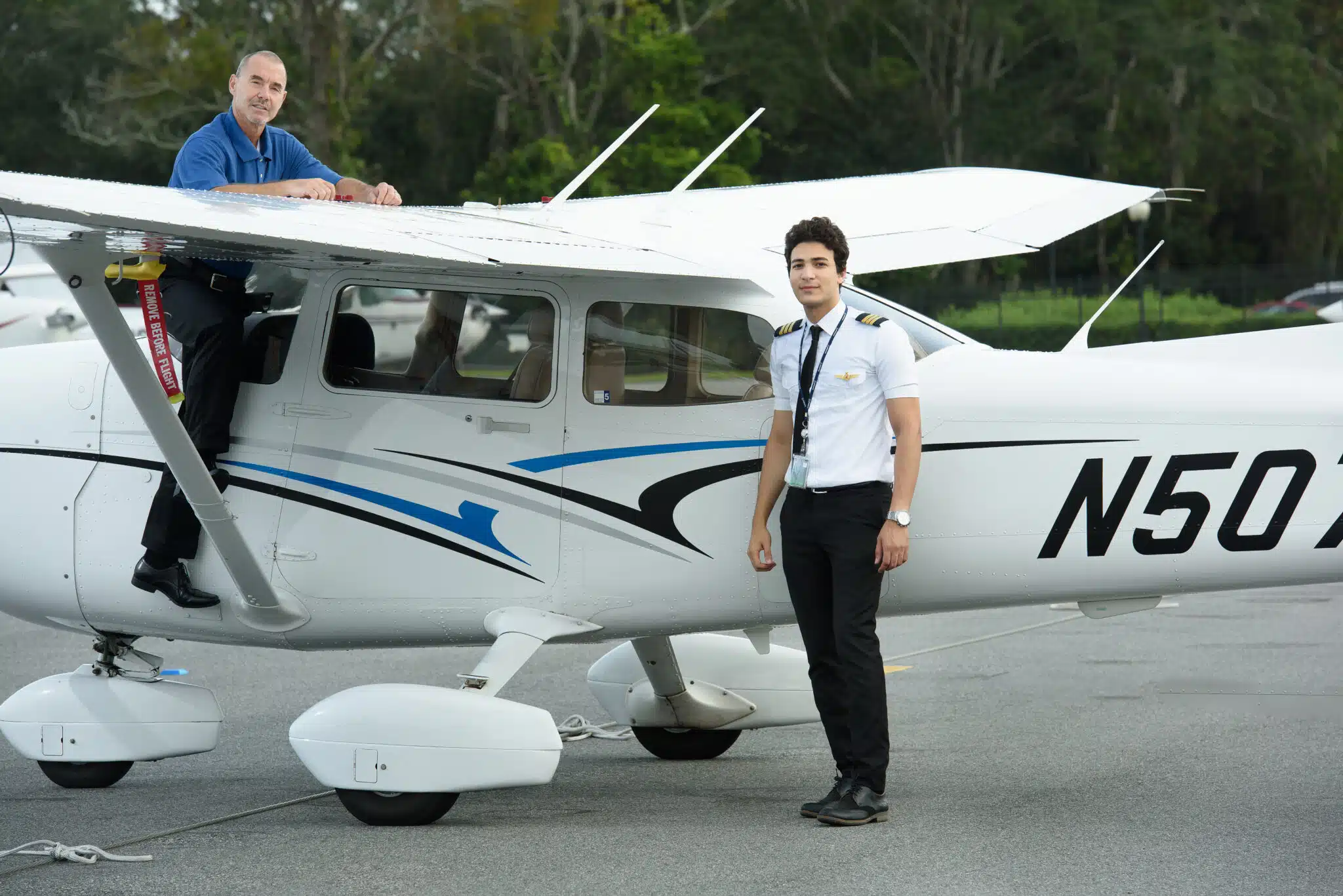
Florida Flyers Flight Academy Best of the Renown flight schools
Florida Flyers Flight Academy is one of the most detailed flight schools in the United States, situated in St. Augustine, Florida. The academy’s FAA Part 141 approved program operates in an ever-changing environment and has achieved a remarkable first-time pass rate exceeding 90% [1].
Florida Flyers Flight Academy Programs
Students can complete their training in just 111 flight hours through the academy’s signature Commercial Pilot Program [1]. The comprehensive curriculum covers all certifications from Private Pilot License (PPL) to Airline Transport Pilot (ATP). International students from Brazil, India, Egypt, and Saudi Arabia can benefit from specialized training programs designed specifically for their needs [2].
Florida Flyers Flight Academy Facilities
Florida Flyers Flight Academy offers a modern training environment that includes:
- A state-of-the-art fleet of Cessna and Piper training aircraft
- Advanced full-motion flight simulators that enable scenario-based training
- Small class sizes with one instructor for every 4-5 students to provide customized attention [2]
Florida Flyers Flight Academy Costs
Florida Flyers Academy provides competitive pricing for programs of all types:
| Program Type | Flight Hours | Ground Hours | Cost (USD) |
|---|---|---|---|
| U.S. Airline Career | 141 | 162 | 59,245 [2] |
| EASA ATPL Modular | 151.50 | 800 | 67,900 [2] |
| India Pilot Program | 200 | 125 | 48,200 [2] |
Students can choose from multiple payment options including wire transfers, credit cards, and digital payment methods. The academy accepts an original deposit with monthly installment payments [2]. Qualified candidates can access financial assistance and third-party lending options [3].
International students typically complete their training in 10-12 months, while domestic students who attend full-time can graduate in 4-6 months [2]. The academy’s M1 visa approval status makes pilot training available to international students pursuing their aviation dreams.
University of North Dakota
The University of North Dakota (UND) ranks among the world’s most complete aerospace institutions and has been a leader in aviation education since 1968. Students choose the John D. Odegard School of Aerospace Sciences because it blends liberal arts education with professional aviation training.
University of North Dakota Aviation Programs
UND delivers comprehensive aviation education through these programs:
- Bachelor of Business Administration in Aviation Management
- Bachelor of Science in Commercial Aviation
- Bachelor of Science in Air Traffic Management
- Bachelor of Science in Unmanned Aircraft Systems Operations [4]
The university’s 15 career pathway programs with major airlines help students launch their professional pilot careers [4]. UND’s steadfast dedication to excellence shows in their remarkable achievements with 110,000+ logged flight hours and 212,294 landings during the last academic year [4].
University of North Dakota Facilities
The University of North Dakota has the world’s largest collegiate training fleet that includes more than 110 aircraft and simulators [4]. The training facilities feature advanced simulation centers, physiological training equipment, and detailed research facilities. The university’s strategic location offers easy access to varied airspace for flight training and several regional airports that provide additional training options [5].
University of North Dakota Tuition
The University of North Dakota has set the following tuition and fees structure for the 2024-2025 academic year:
| Component | Per Credit | Academic Year |
|---|---|---|
| Tuition | $456.90 | $10,965.60 |
| Fees | $73.43 | $1,738.32 |
| Total | $530.33 | $12,703.92 [6] |
Students can expect different flight training costs based on their chosen program:
- Commercial Aviation (Airplane) with CFI/CFII certification: $93,849
- Air Traffic Management with Private Pilot Certificate: $30,028
- UAS Operations (Low-Altitude) with Private/Instrument ratings: $59,944 [7]
The university makes education accessible through strong financial support. 77% of undergraduate students receive financial aid that averages $13,500 each year [6]. Students who graduate from UND earn $11,000 more annually compared to graduates from other four-year institutions a decade after starting their college education [6].
Purdue University
Purdue University’s School of Aviation and Transportation Technology ranks #3 nationally in Aerospace Engineering [8]. The school’s complete approach combines technical excellence with practical flight training and prepares students for a variety of aviation careers.
Purdue University Aviation Curriculum
Purdue’s Professional Flight Technology program provides a unique bachelor’s degree that goes beyond standard flight training. Students have several educational paths available:
- Private and commercial pilot certificates with instrument rating
- Elite R-ATP qualification with only 1,000 flight hours requirement
- Combined bachelor’s and master’s degree option in five years [9]
The curriculum covers 50 specialized aviation courses that include aircraft systems, aviation meteorology, and crew resource management [10]. Students gain valuable experience through a program that combines theoretical knowledge with hands-on flight training.
Purdue University Flight Experience
Students benefit from Purdue’s cutting-edge training facilities that deliver practical, hands-on learning experiences. The training program includes:
| Training Component | Details |
|---|---|
| Aircraft Fleet | Modern training aircraft |
| Simulation Labs | Advanced flight simulators |
| Instruction Model | One-on-one mentoring |
| Certification Path | FAA-approved training [9] |
Students consistently demonstrate outstanding performance in this technically focused program. Their proficiency rates reach 80% or better across essential skills like leadership, decision-making, and technical mastery [9].
Purdue University Notable Alumni
Purdue’s aviation program alumni have achieved remarkable success in aviation sectors of all types. The program has built mutually beneficial alliances with industry leaders, including:
- United Airlines
- American Airlines
- Boeing
- FedEx [9]
Students benefit from direct pathways to professional opportunities through these connections. Many alumni now serve as airline captains, flight instructors, and executive pilots [11]. The program’s focus on industry needs has made it one of the nation’s most respected flight schools. Students pay tuition rates of $10,842 per year for in-state enrollment and $29,644 for out-of-state enrollment [12].
Western Michigan University
Western Michigan University’s College of Aviation stands out as a premier destination for aspiring pilots. Students receive hands-on training at one of the nation’s most sophisticated flight training facilities. The program has earned its place as the second-ranked aviation college in the country [13].
Western Michigan University Flight Training
Western Michigan University’s aviation flight science program operates from the Battle Creek Executive Airport. The airport has Michigan’s second-longest runway and stands as the third-busiest airport in the state [14]. Students learn in a complete training setup that has:
- Modern fleet of single and multi-engine aircraft
- Electronic Flight Instrumentation Systems (EFIS)
- Advanced Flight Management Systems (FMS)
- State-of-the-art training devices [15]
The curriculum focuses on technical proficiency and leadership development to prepare graduates for roles beyond simple pilot duties. Students become skilled at crew resource management, line-oriented flight training, and international flight operations [15].
Western Michigan University Program Duration
Students advance from zero flight experience to full certification and career readiness in this comprehensive program. The core team focuses on these essential components:
| Training Element | Focus Areas |
|---|---|
| Technical Skills | Aircraft systems, advanced aerodynamics |
| Management Skills | Airline operations, crew resource management |
| Professional Development | Global navigation, international flight |
| Research Opportunities | Faculty-led industry projects [15] |
Western Michigan University Campus Environment
Western Michigan University has built mutually beneficial alliances with aviation giants like Delta Air Lines, United Airlines, and FedEx [15]. These connections create valuable internship opportunities and clear career paths for students. The program’s graduates demonstrate remarkable success with a 96% employment rate among those who work or pursue further education [13].
The university offers a complete campus experience where students can join over 300 registered organizations and attend collegiate sporting events [14]. Students benefit from the airport’s strategic location that exposes them to various weather conditions and prepares them for ground flying scenarios. The facility operates alongside several prominent aviation organizations:
- Air National Guard base
- WACO Aircraft Corporation
- Duncan Aviation
- Corporate Flight Departments [14]
California Institute of Technology
Caltech stands out as a leader in aerospace research and engineering education. The school has an outstanding Ph.D. student-faculty ratio of 5.1:1 [16] that provides students with extensive mentorship and research opportunities in the aerospace field.
Caltech Aeronautical Engineering Ranking
The Division of Engineering and Applied Science, 105 years old, leads globally with 105 full-time faculty members [16]. Citation metrics demonstrate the program’s outstanding performance:
- Publications cited in top 5% of most cited journals: 34.1% [16]
- Publications cited in top 25% of most cited journals: 80.6% [16]
- Field weighted citation impact: 2.1 [16]
A rigorous selection process with a master’s acceptance rate of 9.1% [16] upholds the program’s academic excellence and research standards.
Caltech Aviation Curriculum
The aerospace program provides detailed graduate education in several specialized areas:
| Program Area | Degree Options |
|---|---|
| Aerospace/Aeronautical | Master’s, Doctoral |
| Engineering Science | Master’s, Doctoral |
| Environmental Engineering | Master’s, Doctoral [16] |
Students work closely with the Graduate Aerospace Laboratories (GALCIT) and gain access to exceptional facilities for research in fluids, solids, materials, biomechanics, propulsion, and combustion [17].
Caltech Research Opportunities
Caltech’s research environment thrives through its strong connections with NASA’s Jet Propulsion Laboratory (JPL). Students participate in state-of-the-art research through various programs:
- Summer Undergraduate Research Fellowships (SURF)
- SURF@JPL for U.S. citizens and permanent residents
- NASA Space Grant opportunities [18]
Research facilities support a variety of areas that include biological fluid dynamics, technical fluid mechanics, and autonomous systems technology [17]. The program’s strong connections extend throughout the Division, Institute, and JPL, which leads to collaborative efforts in mechanical engineering, applied physics, materials science, and planetary sciences [17].
Students can supplement their degrees with specialized knowledge through the aerospace minor program. This option proves particularly valuable for students who plan to pursue graduate programs in aerospace or aeronautical engineering [19]. Caltech’s all-encompassing approach to aerospace education has made it a leading institution for advanced research and professional development in the field.
United States Air Force Academy
The United States Air Force Academy (USAFA) stands as America’s premier military aviation institution that shapes the future of airpower through comprehensive flight training and leadership development. The academy turns cadets into skilled aviators and military leaders at the historic Davis Airfield, which holds its place among the world’s busiest airfields [20].
USAFA Aviation Education
The academy’s complete aviation program starts with the Aviation 100 course. This course delivers essential knowledge through a 10-lesson curriculum that focuses on powered flight fundamentals [21]. Students progress through several stages:
- Fourth-class cadets begin with Introduction to Soaring
- Students advance to Basic Soaring where they can experience solo flights
- The program continues with Aviation 300 and Airmanship 302
- Students receive specialized training in T-53 aircraft to achieve solo certification [21]
Students at the preparatory school can join the academy’s distinctive “Early Path to Wings” program. This program gives them simulator training, orientation flights, and opportunities to earn their private pilot certification [21].
USAFA Training Facilities
Davis Airfield stands as the central hub for the academy’s Airmanship Programs and provides advanced training resources for soaring, parachuting, and powered flight operations. The 98th Flying Training Squadron trains 700 cadets each year in parachuting [21]. The program teaches safety procedures and helps cadets perform effectively under stress.
Training capabilities include:
| Program Type | Features |
|---|---|
| Virtual Reality | Immersive simulators |
| Live Flight | T-53 aircraft training |
| Specialized Training | Formation flying, navigation |
| Glider Operations | Basic aerobatics, solo flights [21] |
USAFA Career Opportunities
USAFA graduates excel in a variety of career paths within the Air Force and Space Force. Their career distribution reflects diverse opportunities:
- Mission Support (Personnel, Police, Public Affairs): 10%
- Sortie Generation/Logistics: 6%
- Operations: 16%
- Scientific/Technical roles: 18% [22]
Career paths after graduation depend on each officer’s specialization. USAFA graduates serve in roles ranging from fighter pilots to space operations and cybersecurity specialists [22]. The academy equips officers with leadership skills needed for more than 35 different career fields, known as Air Force Specialty Codes (AFSCs) [22].
Arizona State University Polytechnic
Image Source: The Polytechnic School – Arizona State University
Arizona State University’s Polytechnic campus stands in the heart of Arizona’s aviation hub and has been 25 years old as the life-blood of professional flight education. The institution showed its excellence in aviation through detailed training programs and advanced facilities.
ASU Polytechnic Aviation Programs
Students pursuing a Bachelor of Science in Aeronautical Management Technology with Professional Flight concentration can build successful careers in commercial aviation. Regional airlines have pathway agreements with the program that guarantee students job interviews after graduation [23]. The program includes:
| Program Component | Details |
|---|---|
| Core Training | Private Pilot, Commercial Pilot certificates |
| Advanced Ratings | Instrument, Multi-Engine ratings |
| Required Hours | Minimum 1,000 flight hours |
| Certifications | FAA-approved instruction [23] |
The program’s structured coursework (AMT 150, 205, 210, 250, and 305) requires students to complete their instrument rating, commercial multi-engine, and single-engine ratings to maintain high standards [23].
ASU Polytechnic Location Advantages
Clear Arizona skies make this the best flying environment in the country [23]. Students benefit from:
- Training opportunities throughout the year
- Predictable weather that helps with flight planning
- Crystal-clear visibility
- Minimal training disruptions due to weather [24]
ASU Polytechnic Research Facilities
ASU’s campus offers advanced training equipment and research centers that deliver detailed aviation education. Students have access to these exceptional facilities:
- High-altitude simulation chamber capable of altitudes above 75,000 feet [25]
- Advanced flight simulators with various aircraft configurations
- Regional jet flight simulation training devices
- Modern wet-lab space with analytical instrumentation [25]
Research capabilities at ASU span across specialized centers like the Laboratory for Energy and Power Solutions (LEAPS) and the Swette Center for Environmental Biotechnology [26]. These facilities help drive advanced research in aviation technology and environmental sustainability.
ASU Polytechnic graduates enjoy strong career prospects. Airline pilots and flight engineers earn a median salary of $105,580 [23]. Commercial pilots can expect excellent opportunities with an industry growth rate of 18.54% [23]. Students benefit from hands-on experience at modern facilities in an ideal location. This makes ASU Polytechnic a top choice to learn detailed flight training.
Hallmark University
Hallmark University offers hands-on aviation training through its accelerated aircraft maintenance programs at a dedicated aviation campus in San Antonio, Texas. The 15-year old institution has become a leading technical flight school that prepares aspiring aviation professionals through practical experience and strategic collaborations with industry leaders.
Hallmark University Aviation Curriculum
Hallmark’s College of Aeronautics provides detailed FAA-approved programs that help students get certified quickly. Students can select from these specialized tracks:
| Program Type | Duration | Certification |
|---|---|---|
| Airframe & Powerplant Technology | 16 months | AAS Degree [27] |
| Airframe Technology | 10 months | AAS Degree [27] |
| Powerplant Technology | 10 months | AAS Degree [27] |
| Aviation Maintenance Management | 21 months | BS Degree [27] |
Students work directly with real aviation equipment and learn essential skills like safety wiring, soldering, inspection techniques, and engine operations. The hands-on training includes practical work with turbine engines, sheet metal, and riveting [27].
Hallmark University Program Duration
Students can complete their training and enter the workforce faster through the institution’s accelerated program structure. The program offers several beneficial features:
- Eight-week terms create manageable learning segments
- Small class sizes ensure individual attention
- Working professionals benefit from flexible scheduling options
- Students earn their degree and A&P certification in under two years [27]
Students gain valuable hands-on exposure to airport operations and maintenance procedures at the aviation campus, situated at San Antonio International Airport [28].
Hallmark University Career Prospects
San Antonio’s aerospace industry gets more and thus encourages more economic activity of $3.40 billion each year [28]. Local graduates have excellent job prospects. Aviation maintenance technicians in the region make $78,000 annually. This is a big deal as it means that their earnings surpass the U.S. median household income by $19,000 [28].
Strategic collaborations with top employers create clear paths to success:
- Flexjet values our graduates’ “fanatical attention to detail” [29]
- Bombardier places Hallmark students at the top of their recruitment list [29]
- PSA Airlines acknowledges the university’s commitment to student growth [29]
Aviation faces a critical technician shortage. Boeing projects they just need 754,000 newly trained aeronautics technicians worldwide through 2037. North America alone needs 189,000 positions [28]. Current workforce age plays a key role here. The median age of aviation mechanics is 51 years old – about nine years above the typical U.S. workforce age [28].
Embry-Riddle Aeronautical University
Embry-Riddle Aeronautical University, 97 years old, stands as the world’s largest and most detailed aviation-focused institution. The university leads strong research initiatives and plans to double within the next 5-10 years [30].
Embry-Riddle Aviation Programs
Embry-Riddle provides comprehensive aviation-focused degrees at several academic levels:
| Degree Level | Programs Available |
|---|---|
| Associate | Aeronautics, Aviation Maintenance |
| Bachelor’s | Aeronautical Science, Aviation Business |
| Master’s | Aeronautics, Aerospace Engineering |
| Doctoral | Aviation, Aerospace Engineering [31] |
Students learn through direct experience with modern aircraft that feature glass cockpits. The program logs an impressive 110,000+ flight hours each year [31]. The curriculum combines theoretical knowledge with practical skills and includes specialized courses in aircraft systems, aviation meteorology, and crew resource management.
Embry-Riddle Industry Connections
Students and research initiatives benefit greatly from the university’s mutually beneficial alliances:
- Joint research projects with major aerospace companies
- Professional education and workforce training programs
- Direct recruitment paths for internships and full-time positions
- Sponsored facilities, labs, and scholarships [30]
The Congressman John Mica Engineering and Aerospace Innovation Complex (MicaPlex), a 90-acre Aerospace Research and Technology Park in Daytona Beach, features an experimental aerodynamics laboratory and wind tunnel facility [30]. The Florida Test Bed facility advances technology that supports the nation’s growing air transportation requirements. The facility concentrates on:
- Lower fuel consumption and emissions
- Better pilot situational awareness
- Streamlined passenger service [30]
Embry-Riddle Campus Locations
Multiple campuses across different locations encourage engagement to maximize training opportunities.
The Daytona Beach campus stands as a powerhouse in higher-education research with:
- Advanced flight simulation centers
- State-of-the-art maintenance facilities
- Detailed avionics repair laboratories [32]
The College of Engineering connects with industry through its Office of Industry Relations and Outreach. This connection bridges academic and industry engineering, creating innovative programs like:
- Certificate of Study in Airworthiness Engineering (CSAE)
- Multidisciplinary Master of Science in Engineering (MMSE)
- Specialized corporate training programs [32]
Student success proves the university’s excellence. Graduates land positions at major airlines, aerospace manufacturers, and government agencies. The university’s focus on industry needs has made it a global leader in aviation education. It maintains mutually beneficial alliances with organizations like Northrop Grumman Corporation and Gulfstream Aerospace Corporation [32].
San Jose State University
Image Source: San Jose State University
San Jose State University’s Department of Aviation and Technology guides the West Coast aviation education from its prime location in Silicon Valley. The department’s strategic collaborations and ideal positioning create exceptional opportunities for future pilots and aviation specialists.
SJSU Aviation Program Overview
SJSU’s BS in Aviation program features four specialized tracks that align with different career aspirations:
| Specialization | Focus Area | Career Path |
|---|---|---|
| Aviation Management | Airport Operations | Public/Private Management |
| Flight Operations | Airline Operations | Commercial Airlines |
| Professional Flight | Pilot Training | Commercial/Transport Pilot |
| Maintenance Management | Aircraft Maintenance | Maintenance Operations [33] |
The Professional Flight track excels with its complete training structure. Students must earn three FAA pilot ratings through partner flight schools. The program delivers a well-laid-out approach with 141 flight hours and 162 ground hours of focused training [34].
Students working toward their private pilot license learn both theory and practical skills. The program combines science, mathematics, and management principles that help graduates tackle complex aviation challenges while upholding safety standards [33].
SJSU Flight Training Facilities
The department has modern training facilities at two locations:
Main Campus Industrial Studies Building
- Advanced simulation laboratories
- Latest avionics training equipment
- Modern classroom facilities [35]
Reid-Hillview Airport Facility
- Active flight training environment
- Direct access to training aircraft
- Ground operational exposure [35]
The program added a GT Glass Trainer AATD G1000 Training System that gives students state-of-the-art simulation technology for instrument training [36].
SJSU Industry Partnerships
Alaska Air Group and SJSU have created a groundbreaking Pilot Development Program that helps address the pilot shortage in aviation. This program brings several great advantages to students:
- Qualified sophomores receive conditional job offers
- Students get financial support for commercial pilot licensing
- Experienced airline pilots provide mentorship
- Students have direct access to positions at Horizon Air and Alaska Airlines [36]
Students can receive conditional job offers early in their studies and follow a clear career path until they retire at age 65 [36]. This program helps students who need support with flight training costs that can be more than $100,000 for ratings and certificates [36].
The aviation program has grown to become the fastest-growing program in SJSU’s engineering department [36]. Students learn practical skills through a focused curriculum that includes:
- Communication and critical thinking abilities
- Team development and management expertise
- Ethical decision-making processes
- Advanced aircraft design and performance analysis [33]
Students learn detailed knowledge about certification processes, meteorology, and aviation safety regulations. Silicon Valley’s location gives students unique exposure to state-of-the-art aviation technology and innovation [33].
The program maintains strong connections with industry leaders that create internships and job opportunities. Many graduates work at major airlines and aviation companies because of the program’s strong reputation. The Alaska Airlines partnership has raised SJSU’s status as a major professional pilot training center on the West Coast [36].
Conclusion
Top flight schools across the United States offer excellent aviation education options. Each school excels with its own unique programs, top-tier training facilities and expert instructors. Students can pick from various paths – from quick commercial pilot training to complete aerospace engineering degrees. These schools maintain modern aircraft fleets, innovative simulators and well-laid-out certification programs.
Mutually beneficial alliances between these schools and major airlines create clear career paths for graduates. Their prime locations, innovative facilities and industry-aligned courses help students launch successful careers and meet the growing need for qualified pilots. These programs’ graduates land jobs with leading airlines and aerospace companies, which shows how well their complete training approach works.
References
[1] – https://www.flightschoolusa.com/?srsltid=AfmBOorBFx7iNhILYJPIqGHAxUQ2Kq0xnc9RDu6gEWIao4Xb9M_JZmkT
[2] – https://www.wordpress-1216966-4324139.cloudwaysapps.com/flight-school-cost/?srsltid=AfmBOoodWUG37dBzlGmYG3mDbThvOQ7GpC4vXk8OsVYAPg3M1UsWnAye
[3] – https://www.wordpress-1216966-4324139.cloudwaysapps.com/florida-flight-school-cost/?srsltid=AfmBOoqTGGPHlncss4r6JEYijuhX4FVGJa1LRJ_6g0gxLeEBGpey4Lvj
[4] – https://aero.und.edu/aviation/index.html
[5] – https://aero.und.edu/phoenix/experience/facilities.html
[6] – https://und.edu/programs/commercial-aviation-bsaero/cost.html
[7] – https://aero.und.edu/aviation/student-info/program-costs.html
[8] – https://engineering.purdue.edu/Engr/AboutUs/FactsFigures/Rankings/undergraduate
[9] – https://polytechnic.purdue.edu/degrees/professional-flight
[10] – https://polytechnic.purdue.edu/degrees/professional-flight/courses
[11] – https://www.admissions.purdue.edu/majors/a-to-z/flight-professional-flight-technology.php
[12] – https://www.usnews.com/best-graduate-schools/top-engineering-schools/purdue-university-main-campus-02057
[13] – https://wmich.edu/aviation
[14] – https://wmich.edu/academics/undergraduate/aviation-flight
[15] – https://wmich.edu/aviation/academics/aviation-flight-science
[16] – https://www.usnews.com/best-graduate-schools/top-engineering-schools/california-institute-of-technology-02009
[17] – https://www.galcit.caltech.edu/research
[18] – https://sfp.caltech.edu/undergraduate-research/programs
[19] – https://www.admissions.caltech.edu/why-caltech/academics/majors-minors/aerospace
[20] – https://www.usafa.edu/facilities/davis-airfield/
[21] – https://www.usafa.edu/military/airmanship/
[22] – https://www.usafa.edu/military/careers/
[23] – https://poly.engineering.asu.edu/aviation/professional-flight-bs/
[24] – https://poly.engineering.asu.edu/aviation/
[25] – https://poly.engineering.asu.edu/labs-and-facilities/
[26] – https://engineering.asu.edu/research/centers/
[27] – https://hallmark.edu/aeronautics-school/
[28] – https://hallmark.edu/aviation-in-san-antonio/
[29] – https://hallmark.edu/aeronautics-employer-insights-for-success/
[30] – https://erau.edu/research/industry-collaboration
[31] – https://erau.edu/degrees/aviation
[32] – https://daytonabeach.erau.edu/college-engineering/industry-relations
[33] – https://www.sjsu.edu/avtech/programs/bs-aviation/index.php
[34] – https://www.sjsu.edu/avtech/programs/bs-aviation/bs-professional-flight.php
[35] – https://www.sjsu.edu/about/partnerships.php
[36] – https://blogs.sjsu.edu/newsroom/2024/flying-high-sjsu-aviation-partners-with-alaska-air-group-for-pilot-development-program/
Contact the Florida Flyers Flight Academy Team today at (904) 209-3510 to learn more about how to pay for flight school.