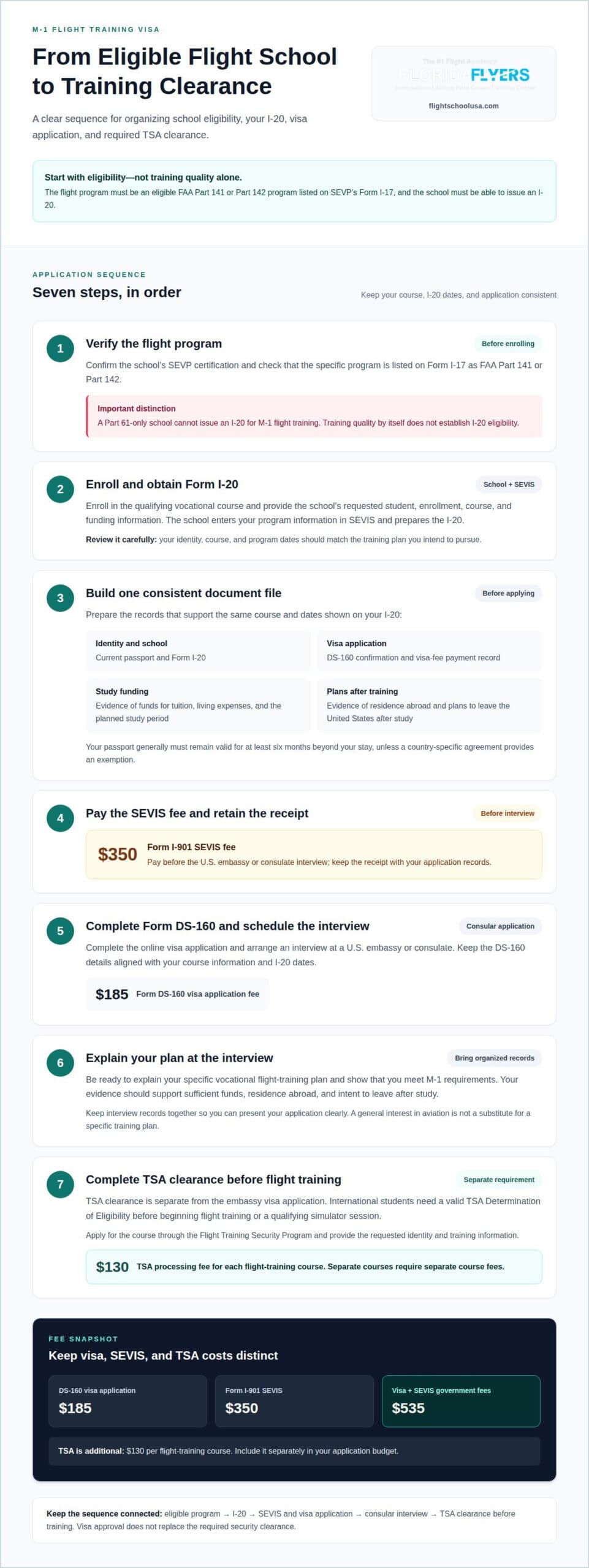
A flight school’s authority to issue your I-20 is a critical starting point for M-1 visa flight training. The program must be an eligible FAA Part 141 or Part 142 program listed on the Student and Exchange Visitor Program’s Form I-17; a school’s training quality alone doesn’t establish that eligibility.
Choosing a school is only the first step. You’ll also need to prepare the required documents, complete the student visa application, and plan around your program start date and consular interview. Missing a requirement or leaving too little time for processing can disrupt your training plans.
This guide explains how to assess a school’s M-1 eligibility, what to prepare for your I-20 and visa application, and how the interview and timing fit into the process. You’ll come away with a clear sequence for organizing your application and understanding the decisions that matter before you travel to the United States.
Das M-1-Verfahren verknüpft die Einschreibung in die Flugschule, das I-20-Formular, die Sicherheitsüberprüfung durch die TSA und den Visumantrag. Halten Sie diese Schritte unbedingt in der vorgegebenen Reihenfolge ein: Eine Visumgenehmigung allein ersetzt nicht die erforderliche Sicherheitsüberprüfung vor der Flugausbildung.
Beginnen Sie mit der Anmeldung zu einem geeigneten Berufsausbildungsprogramm für Piloten und der Beantragung des Formulars I-20. Zahlen Sie anschließend die SEVIS-Gebühr (Formular I-901), füllen Sie das Formular DS-160 aus und vereinbaren Sie einen Interviewtermin bei einer US-Botschaft oder einem US-Konsulat. Erläutern Sie im Interview Ihren Ausbildungsplan und weisen Sie nach, dass Sie die Voraussetzungen für das M-1-Visum erfüllen, einschließlich ausreichender finanzieller Mittel und der Absicht, nach Abschluss des Studiums auszureisen.
F-1 and M-1 applicants both follow a student-visa application process, but the appropriate classification depends on the program. An M-1 applicant should keep the course details, I-20 dates, and visa application consistent.
Prepare a current passport, Form I-20, DS-160 confirmation, and records showing payment of the visa and SEVIS fees. Bring evidence of sufficient funds for tuition, living expenses, and the planned period of study. These documents should support the same course and dates shown on your I-20.
Also organize evidence of your residence abroad and plans to leave the United States after training. Your passport generally must remain valid for at least six months beyond your stay, unless a country-specific agreement provides an exemption. Keep your interview records together so you can present your application materials clearly.
TSA clearance is separate from the embassy visa application. International students must receive a valid TSA Determination of Eligibility before beginning flight training or a qualifying simulator session. Apply for your course through the Flight Training Security Program and provide the requested identity and training information.
The TSA processing fee is $130 for each flight-training course. For example, a student applying for separate courses should account for each course’s processing fee, rather than treating TSA clearance as one general visa charge.
The Form DS-160 visa application fee is $185, and the Form I-901 SEVIS fee is $350. Together, the mandatory U.S. government fees for the visa application and SEVIS are $535. The TSA processing fee is separate, so include it independently in your application budget.
Pay the SEVIS fee before the embassy interview and retain the receipt with your DS-160 confirmation. At the interview, be ready to explain how your funds cover the program and how your residence abroad, study purpose, and post-training plans satisfy M-1 requirements. A complete, consistent file helps officers assess the application efficiently.
Für die M-1-Flugausbildung muss es sich um ein FAA-Teil-141- oder Teil-142-Programm handeln, das auf dem SEVP-Formular I-17 aufgeführt ist. Ihre Bewerbung sollte außerdem einen beruflichen Ausbildungszweck, ausreichende finanzielle Mittel, einen Wohnsitz im Ausland und die Absicht, das Land nach der Ausbildung zu verlassen, nachweisen.
Check the school’s SEVP certification and the program’s listing on Form I-17 before enrolling. Eligible flight training must fall under an FAA Part 141 or Part 142 program; a Part 61-only school cannot issue an I-20 for M-1 flight training. After enrollment, the school enters the student’s program information in SEVIS as part of preparing the I-20.
M-1 students may transfer schools only within the first 6 months after arrival, with USCIS approval. Transfers and extensions may require additional steps, and M-1 students have limited options for changing status while in the United States.
Das Formular I-20 wird Ihnen nach Ihrer Einschreibung in einen qualifizierenden Kurs von der jeweiligen Schule ausgestellt. Um es zu erhalten, reichen Sie bitte die Einschreibungsunterlagen der Schule sowie alle erforderlichen Informationen ein, die Ihre Identität, Ihre Kurswahl und Ihre finanzielle Leistungsfähigkeit belegen. Prüfen Sie das Formular I-20 sorgfältig: Programm und Zeitraum müssen mit dem von Ihnen angestrebten Flugkurs übereinstimmen.
Keep the I-20 with your visa application records. The document connects your school’s SEVIS record to your requested M-1 classification, so inconsistencies in your name, course, or study dates can complicate the application. A commercial pilot career goal should be supported by a specific vocational flight-training plan, not a general interest in aviation.
Welche Flugausbildungsprogramme qualifizieren sich für ein M-1-Studentenvisum? Flugausbildungsprogramme gemäß FAA Part 141 oder Part 142, die auf dem SEVP-Formular I-17 aufgeführt sind, können sich qualifizieren. Die Flugschule muss SEVP-zertifiziert sein und ein I-20-Formular für den gebuchten Kurs ausstellen können.
Wie erhält man ein I-20-Formular von einer FAA-zugelassenen Flugschule? Melden Sie sich für ein förderfähiges Programm an und übermitteln Sie der Schule die angeforderten Anmelde- und Studierendeninformationen. Die Schule nutzt diese Kursdetails, um das I-20-Formular über ihr SEVIS-Verfahren auszustellen.
Was sind häufige Gründe für die Ablehnung von Anträgen auf ein M-1-Flugtrainingsvisum? Anträge können geschwächt werden, wenn Studierende nicht ausreichende finanzielle Mittel, einen Wohnsitz im Ausland, den sie nicht aufgeben wollen, oder die Absicht, nach dem Studium auszureisen, nachweisen können. Widersprüchliche Kursangaben zwischen dem I-20-Formular und dem Visumantrag können die Beurteilung des Studienplans ebenfalls erschweren.
Can M-1 students change schools, extend their stay, or change visa status? A school transfer is limited to the first 6 months after arrival and requires USCIS approval through Form I-539. Extensions also require USCIS approval, and students cannot change from M-1 to F-1 status inside the United States.
Arbeiten jederzeit weiterbearbeiten können. Jede Präsentation und jeder KI-Avatar, den Sie von Grund auf neu erstellen oder hochladen, M-1 admission support um die Voraussetzungen für die Schulzulassung und den I-20-Prozess mit Ihrem Flugausbildungsplan in Einklang zu bringen.
Plan the embassy interview around your I-20 program dates, not just your intended travel date. Visa issuance and permission to enter the United States follow separate timing rules.
Complete Form DS-160, pay the required fees, then arrange an interview with a U.S. embassy or consulate. Appointment timing depends on the post handling your application, so build the interview into your preparation sequence instead of leaving it until travel is near. Bring paperwork that supports the same course, school, and dates shown on your I-20.
Applicants are instructed to pay the $350 Form I-901 fee before their U.S. embassy interview, according to U.S. Immigration and Customs Enforcement. Keep the payment record with your interview documents. A receipt helps connect the SEVIS payment to your student visa application and gives you a clear record to present if requested.
Nutzen Sie das Interview, um Ihren Studienplan zu erläutern und die Fragen im Einklang mit Ihren eingereichten Unterlagen zu beantworten. Ihr Studiengang, die Finanzierungsnachweise und Ihr geplanter Aufenthalt sollten in DS-160 und I-20 übereinstimmen. Falls ein Interviewtermin verschoben wird, passen Sie Ihre Reiseplanung an den neuen Termin an und gehen Sie nicht davon aus, dass der ursprüngliche Termin weiterhin für Ihren Antrag gilt.
Before attending, organize the passport, DS-160 confirmation, I-20, fee records, and supporting evidence in one folder. Review names and program dates across each document. A mismatch can create questions during the interview or delay the next step, so resolve clerical errors before presenting the paperwork.
New F-1 and M-1 student visas for U.S. flight training may be issued up to 365 days before the program start date. That issuance window lets students seek a visa well ahead of training, but it does not authorize early arrival for any date they choose. Keep the visa validity and I-20 start date distinct in your travel plan.
F-1 and M-1 students cannot enter the United States more than 30 days before the start date on Form I-20, according to U.S. Customs and Border Protection. For example, if your program begins on the date printed on your I-20, calculate your earliest permitted arrival from that date, not from the interview or visa issuance date.
Nachdem die Botschaft das Studentenvisum ausgestellt hat, vergleichen Sie dessen Gültigkeitsdauer mit den Daten auf Ihrem I-20-Formular, bevor Sie Ihre Reise buchen. Ein Visum berechtigt Sie zur Einreise in die USA; es ersetzt jedoch nicht die Programmdokumente und hebt die 30-tägige Aufenthaltsdauer nicht auf. Führen Sie Ihren Reisepass und Ihr I-20-Formular bei Reisen zur Kontrolle mit sich.
Keep flight reservations flexible until the visa is issued and the entry window fits your arrival plan. If the consular appointment moves, reassess the travel date against the I-20 start date and the 30-day rule. This separates the timing of the visa decision from the timing of lawful arrival for study.
Prepare a consistent file for your U.S. consulate interview, including your identity, course details, finances, and plans after study. The interview assesses whether your documents support the same vocational training purpose.
How much does flight training in the U.S. cost for international students? Die Kosten hängen vom Kurs, dem Trainingsplan, dem Flugzeugtyp und der erforderlichen Flugzeit ab und werden nach einer Angebotsanfrage mitgeteilt. Berücksichtigen Sie bei Ihrer Finanzplanung das gesamte Programm inklusive der damit verbundenen Lebenshaltungskosten, nicht nur die Studiengebühren.
Arrange these core records before your embassy appointment:
Keep the documents aligned. For example, the flight course described in your interview answers should match the program on Form I-20 and the study purpose in your DS-160. If a family member or other sponsor will fund your aviation training, organize records that show the source and availability of that support. Explain any differences between the sponsor’s documents and your own financial records clearly.
Ihre Finanzunterlagen sollten belegen, wie Sie die Kosten für das Programm während der gesamten Studiendauer decken können. Berücksichtigen Sie dabei Studiengebühren, Flugausbildungskosten und Lebenshaltungskosten. Ein Kontoauszug, der Gelder ohne Angabe ihrer Herkunft ausweist, kann Fragen aufwerfen. Fügen Sie daher, falls vorhanden, entsprechende Belege bei. Weisen Sie ausreichende finanzielle Mittel für den Kurs nach, ohne auf eine nicht genehmigte Beschäftigung in den USA zurückzugreifen.
At the consulate, answer directly and consistently. Be prepared to explain why you selected the course, how it supports your pilot career objective, and what you intend to do after completing the training. Your academic history can help explain a change in direction, while a clear account of the vocational course connects that history to your current plan. Keep your answers factual and consistent with your paperwork.
Before the interview, review names, dates, and school details across the passport, I-20, and DS-160. Place the originals and supporting copies in an orderly folder, then rehearse a concise explanation of your course and funding. This preparation helps you present a coherent application rather than searching through documents while answering the consular officer.
Ein M-1-Flugprogramm muss sowohl die Anforderungen der Einwanderungsschule als auch die der Flugausbildung erfüllen. Prüfen Sie die SEVP-Listung und den FAA-Status des Programms, bevor Sie die Einschreibung als Weg zu einem I-20-Visum betrachten.
For M-1 flight training, an eligible program must be FAA Part 141 or Part 142 and listed on the Student and Exchange Visitor Program’s Form I-17. A flight school with only FAA Part 61 status cannot issue an I-20 for an M-1 flight-training program under the SEVP guidance described here. FAA approval alone is not enough; the program must also meet the SEVP requirement.
Form I-20 connects your enrollment to the school’s SEVIS record. Confirm that the document identifies the vocational flight program you intend to take and that its program dates match your enrollment plans. Keep your passport information consistent with your school and immigration paperwork, including your legal name and identifying details.
Training authorization is a separate requirement. International flight students must receive TSA Flight Training Security Program approval before their first training flight or qualifying simulator session. TSA clearance is also required before training toward a type rating, instrument rating, or multi-engine rating. Do not treat an issued I-20 or student visa as a substitute for TSA approval.
TSA clearance applies to the training course, so keep the course information accurate throughout the application. If your planned course includes instrument training, for example, make sure your TSA application reflects the applicable training. A change to the planned course can affect the clearance process, so align the school’s course details with your TSA submission.
Der M-1-Status ist für berufliche Studiengänge vorgesehen, darunter auch förderfähige Flugausbildungsprogramme. Das M-1-Visum ist in der Regel für die Dauer des Ausbildungsprogramms gültig, maximal 12 Monate, und kann in bestimmten Fällen auf bis zu 3 Jahre verlängert werden. Studierende mit einem M-1-Visum, die eine Verlängerung der festen Aufenthaltsdauer beantragen, benötigen die Genehmigung der USCIS. Richten Sie Ihre Programmplanung nach den I-20-Terminen und den erforderlichen Schulungen aus und gehen Sie nicht davon aus, dass Ihnen automatisch zusätzliche Zeit gewährt wird.
Englischkenntnisse sind auch in der Pilotenausbildung wichtig. Ausländische Piloten, die eine FAA-Lizenz erwerben möchten, müssen den in den FAA-Richtlinien genannten ICAO-Standard für Englischkenntnisse der Stufe 4 erfüllen. Dies ist ein internationaler Betriebsstandard und unterscheidet sich von den Zulassungsvoraussetzungen für SEVP-Schulen und der TSA-Sicherheitsüberprüfung.
Before enrollment, compare the school’s official SEVP listing, FAA program status, I-20 course details, and TSA requirements. For help organizing the admission steps around an eligible flight program, use Unterstützung bei der Zulassung zur M-1-Flugausbildung.
Flight School USA offers M1 Visa Admission Services for international students planning U.S. flight training. Turn to this support when you’re matching a vocational program with the admissions and visa steps, including the school enrollment and I-20 process.
Für angehende Berufspiloten bietet Flight School USA verschiedene Programme an, darunter das Fixed-Price Career Program, das CFI Fast Track Program, das GI Bill Flight Training und das Airline Ready Program. Wählen Sie Ihren nächsten Schritt entsprechend Ihren Ausbildungszielen und -voraussetzungen und achten Sie darauf, dass Ihr Visumantrag mit dem gewünschten Programm übereinstimmt.
Contact Flight School USA or visit flightschoolusa.com to discuss your training and admission plans.
Your next move is to connect your aviation goal to a training pathway and an admissions plan. A disciplined M-1 visa flight training plan starts with a defined course objective, then keeps enrollment, documentation, and preparation aligned with that objective.
Flight School USA offers the Fixed-Price Career Program, CFI Fast Track Program, and GI Bill Flight Training for students pursuing different pilot pathways. Consider which direction fits your career aims, then address the M-1 admission process as part of your training preparation. A focused plan helps you approach each decision with purpose rather than treating paperwork as a last-minute task.
For guidance on the next step, Kontaktieren Sie die Flugschule USA to discuss your training and admission plans. Bring your intended course and goals into that conversation, and move forward with a clear direction for your aviation future.
Wählen Sie eine Flugschule mit einem anerkannten Flugprogramm und der Berechtigung zur Ausstellung des Formulars I-20. Für die Flugausbildung im Rahmen eines M-1-Visums muss das Programm den FAA-Vorschriften nach Teil 141 oder Teil 142 entsprechen und auf dem SEVP-Formular I-17 aufgeführt sein. Vergleichen Sie den Kursablauf des Programms mit Ihren Zielen als Pilot und vergewissern Sie sich, dass die Anmeldeunterlagen der Flugschule denselben Ausbildungsplan beschreiben, den Sie in Ihrem Visumantrag angeben möchten.
Die Antragsstellung sollte so erfolgen, dass die Einschreibung an der Schule und die Visumsunterlagen aufeinander abgestimmt sind. Melden Sie sich zunächst für ein anerkanntes Berufsausbildungsprogramm im Bereich Flugbetrieb an und beantragen Sie das Formular I-20. Zahlen Sie anschließend die SEVIS-Gebühr (Formular I-901), füllen Sie das Formular DS-160 aus und vereinbaren Sie einen Termin für ein Konsularinterview. Bereiten Sie Nachweise über ausreichende finanzielle Mittel, Ihren Wohnsitz im Ausland und Ihre Absicht, nach dem Studium auszureisen, vor. Absolvieren Sie separat das Sicherheitsverfahren des TSA Flight Training Security Program, bevor Sie mit dem förderfähigen Flug- oder Simulatortraining beginnen.
Private Reisen müssen mit dem Studienplan Ihrer Hochschule vereinbar sein und dürfen Ihren genehmigten M-1-Aufenthalt nicht verlängern. Planen Sie jede Auszeit in Absprache mit Ihrer Hochschule, damit Ihre Pflichtschulungen und Ihr SEVIS-Datensatz nicht beeinträchtigt werden. Sollten Ihre Pläne die Studientermine beeinflussen oder einen längeren Aufenthalt in den USA erfordern, ist für eine Verlängerung des festgelegten Aufenthaltszeitraums die Genehmigung der USCIS notwendig. Ein Urlaub an sich ändert weder Ihren Aufenthaltsstatus noch das Studienende.
Berechtigte Ehepartner und Angehörige können Studierende mit einem M-1-Visum in den USA mit einem M-2-Visum begleiten. Zu den berechtigten Angehörigen zählen Ehepartner und unverheiratete Kinder unter 21 Jahren. Planen Sie deren Anträge parallel zu Ihren Studienunterlagen und verwenden Sie dabei einheitliche Identitäts- und Verwandtschaftsnachweise. Die Anwesenheit Ihrer Angehörigen ändert nichts an den Studienanforderungen des M-1-Studierenden und verlängert dessen Studiendauer nicht. Stimmen Sie daher die Familienreisen mit dem I-20-Zeitplan ab.
Yes, eligible vocational flight training can support an M-1 student visa application in the United States. The training program must meet the applicable school and SEVP requirements, and the applicant must establish a genuine study purpose. For example, an enrolled student pursuing a defined pilot-training course should ensure the I-20, course details, and visa application describe a consistent plan.
You need enrollment in an eligible vocational program, an I-20 from the school, and a completed student visa application. Applicants must show a residence abroad they do not immediately intend to abandon, plans to leave the United States after study, and sufficient funds. Prepare to explain how the specific flight course supports your training objective, rather than relying only on a broad interest in aviation.
Prepare your passport, Form I-20, DS-160 confirmation, SEVIS payment record, and evidence supporting your funding and study plans. The Form DS-160 fee is $185, and the Form I-901 SEVIS fee is $350; U.S. Immigration and Customs Enforcement instructs applicants to pay the I-901 fee before the embassy interview. TSA processing is separate and costs $130 for each flight-training course.
The M-1 visa is typically valid for the vocational program’s duration, up to 12 months, and may be extended to a maximum of 3 years in some cases. The authorized stay follows the fixed admission period, so use the I-20 program dates to plan training and departure. An extension requires USCIS approval; do not assume unfinished training automatically extends your stay.


