
Informações sobre a carreira de piloto de linha aérea


What if the greatest risk to your aviation career isn’t a mechanical failure at altitude, but the predatory interest rates of a standard training loan? For many elite candidates, the prospect of six-figure debt is a barrier that feels insurmountable. You likely recognize that the traditional path of high-interest borrowing is a tactical error that compromises your long-term earnings. Understanding how to pay for flight school without loans is not merely a financial preference; it’s a professional necessity for those who demand a high return on their training investment.
Este guia de 2026 fornece as estruturas financeiras rigorosas necessárias para obter a certificação comercial sem dívidas. Você aprenderá a navegar pelas complexidades do GI Bill pós-11 de setembro, que oferece até US$ 17,661.89 para treinamento vocacional neste ano letivo, e como garantir uma parte do US$ 1 milhão em bolsas de estudo da Fundação AOPA. Apresentaremos uma sequência de etapas rápidas, desde a utilização do CFI Fast Track para horas autofinanciadas até o aproveitamento de programas de preço fixo que eliminam a volatilidade das taxas horárias. Ao final desta análise, você terá um caminho claro e livre de dívidas para conseguir um assento em uma grande companhia aérea.
O mercado da aviação em 2026 exige mais do que proficiência técnica; exige uma estratégia financeira superior. Aspirantes a pilotos comerciais muitas vezes encaram a dívida como um imposto inevitável sobre suas carreiras, mas essa perspectiva é um erro estratégico fundamental. Depender de capital privado com juros altos cria um déficit estrutural que pode atrasar a ascensão profissional por décadas. Para dominar a arte de pagar a escola de aviação sem empréstimos, você precisa adotar uma mentalidade de "Capital em Primeiro Lugar", tratando seu processo de certificação como um investimento de alto risco para o seu negócio, e não como uma compra de consumo. Essa abordagem prioriza a liquidez e o retorno financeiro rápido, garantindo que sua carreira permaneça um ativo, e não um passivo.
Choosing to finance training through private lenders often results in interest rates ranging from 10% to 15%. Over a ten-year repayment term, these rates can effectively double the total capital required to reach the flight deck. For a first officer entering the industry, a monthly debt obligation of $1,200 or more significantly reduces disposable income and limits the ability to relocate for premier career opportunities. Avoiding this burden provides an immediate competitive advantage. Debt-free pilots possess the liquidity to prioritize high-ROI training opportunities, such as the Airline Ready Program, without the friction of compounding interest or restrictive loan covenants.
Efficiency in training is the primary safeguard against the “hidden fee” spiral. Fragmented, pay-as-you-go models at local, uncertified schools frequently lead to inconsistent progress and redundant flight hours. This lack of structure is a financial liability. Historically, initiatives like the Programa de Treinamento de Pilotos Civis Demonstrou-se que estruturas rigorosas e padronizadas produzem os aviadores mais capacitados com o menor custo sistêmico. Os candidatos de elite modernos refletem essa eficiência ao selecionarem programas que oferecem transparência e recursos de nível profissional.
Utilizar os padrões da Parte 141 da FAA garante um caminho financeiro previsível. Esses programas seguem um currículo rigoroso e aprovado pelas normas regulamentares, que reduz a carga horária total exigida em comparação com o treinamento da Parte 61. Ao escolher um Programa de Carreira com Preço Fixo, você elimina a variação das taxas de combustível e da disponibilidade de instrutores. Essa abordagem estruturada é a ferramenta mais eficaz para evitar os estouros orçamentários que obrigam os alunos a contrair os empréstimos que pretendiam evitar. Dominar a logística de como pagar pela escola de aviação sem empréstimos garante que seu futuro salário na companhia aérea seja seu, e não de uma instituição financeira.
For veterans and high-performing candidates, identifying existing assets is the first operational step in mastering how to pay for flight school without loans. These resources are not merely subsidies; they are earned capital that, when deployed strategically, eliminate the need for high-interest borrowing. Success in this phase requires a technical understanding of federal reimbursement structures and a disciplined approach to competitive grant cycles. Transitioning from a consumer mindset to an asset-deployment strategy ensures that your training remains fully funded through completion.
Veterans must recognize that the Post-9/11 GI Bill is a precision tool for career advancement. For the 2026-2027 academic year, the Department of Veterans Affairs has set the vocational flight training cap at $17,661.89. To maximize this benefit, candidates should target FAA Part 141 schools, as these institutions meet the rigorous regulatory standards required for VA reimbursement. It’s a critical requirement that veterans obtain their private pilot certificate independently before activating the Post-9/11 GI Bill for flight training for advanced ratings such as Instrument, Commercial, and Multi-Engine.
Elite academies often participate in the Yellow Ribbon Program, which can bridge the gap between standard VA caps and the actual cost of a professional pilot track. This is particularly relevant for those pursuing GI Bill flight training in a full-time, immersive environment. By selecting an institution with a dedicated veteran support infrastructure, you ensure that certification logs and billing cycles remain compliant with federal audits, preventing any disruption in funding. If you are a veteran, your military service has already provided the primary engine for your debt-free education.
A obtenção de bolsas de estudo é uma tarefa profissional que exige um comprometimento de alto nível. Em 2026, somente a Fundação AOPA concederá mais de US$ 1 milhão em bolsas, com prêmios individuais chegando a US$ 14,000 para pilotos em busca de uma carreira promissora. Para garantir esses recursos, sua candidatura deve ir além de aspirações genéricas. Candidatos com alto retorno sobre o investimento (ROI) concentram-se em bolsas específicas de organizações como a EAA, a Women in Aviation International (WAI) e a OBAP. As inscrições para o ciclo de 2026 geralmente se encerram em 30 de dezembro, exigindo um cronograma estruturado para gerenciar vários prazos. Uma redação profissional deve demonstrar alinhamento institucional, aptidão técnica e um caminho claro para inserção em uma companhia aérea. Essa abordagem disciplinada transforma as bolsas de estudo, antes dependentes da sorte, em um pilar confiável de sua missão financeira.
The most significant threat to a debt-free training mission is financial variance. While many students believe that paying hourly is the most transparent method, this approach often masks the true cost of certification. Strategic candidates understand that how to pay for flight school without loans requires eliminating the risk of budget overruns. By shifting from a variable cost model to a structured financial agreement, you protect your capital from the volatility of the aviation industry. This transition is essential for maintaining professional-grade fiscal discipline and ensuring your mission reaches completion without the need for emergency borrowing.
National averages for 2026 indicate that most students require 60 to 80 flight hours to obtain a Private Pilot License, which is nearly double the FAA minimum of 40 hours. In an hourly “pay-as-you-go” model, every minute of extra instruction, every weather delay, and every maintenance cancellation directly increases your total expenditure. This variance is where most self-funded budgets collapse. A Fixed-Price Career Program provides a definitive solution by establishing a guaranteed “out-the-door” cost before the first takeoff. This contract transfers the financial risk of extra training hours from the student to the academy, ensuring that your funding remains intact regardless of fuel surcharges or inflation. Additionally, candidates can supplement these programs by pursuing Aviation Workforce Development Grants, further solidifying their debt-free status through federal support.
Speed is a financial asset. Fragmented training schedules lead to skill degradation, forcing students to spend expensive flight hours reviewing previous lessons. Elite academies mitigate this by offering full-time immersion tracks supported by integrated Student Housing. This model allows you to focus exclusively on professional development without the distractions of a standard commute or external logistical friction. High-frequency training improves skill retention and significantly reduces the total number of hours required for proficiency. By living on-site, you minimize cost-of-living expenses and accelerate your timeline to a paid cockpit seat. This level of immersion is a critical requirement for those who demand the highest ROI from their aviation education. Reducing the duration of your training is one of the most effective methods for managing how to pay for flight school without loans.
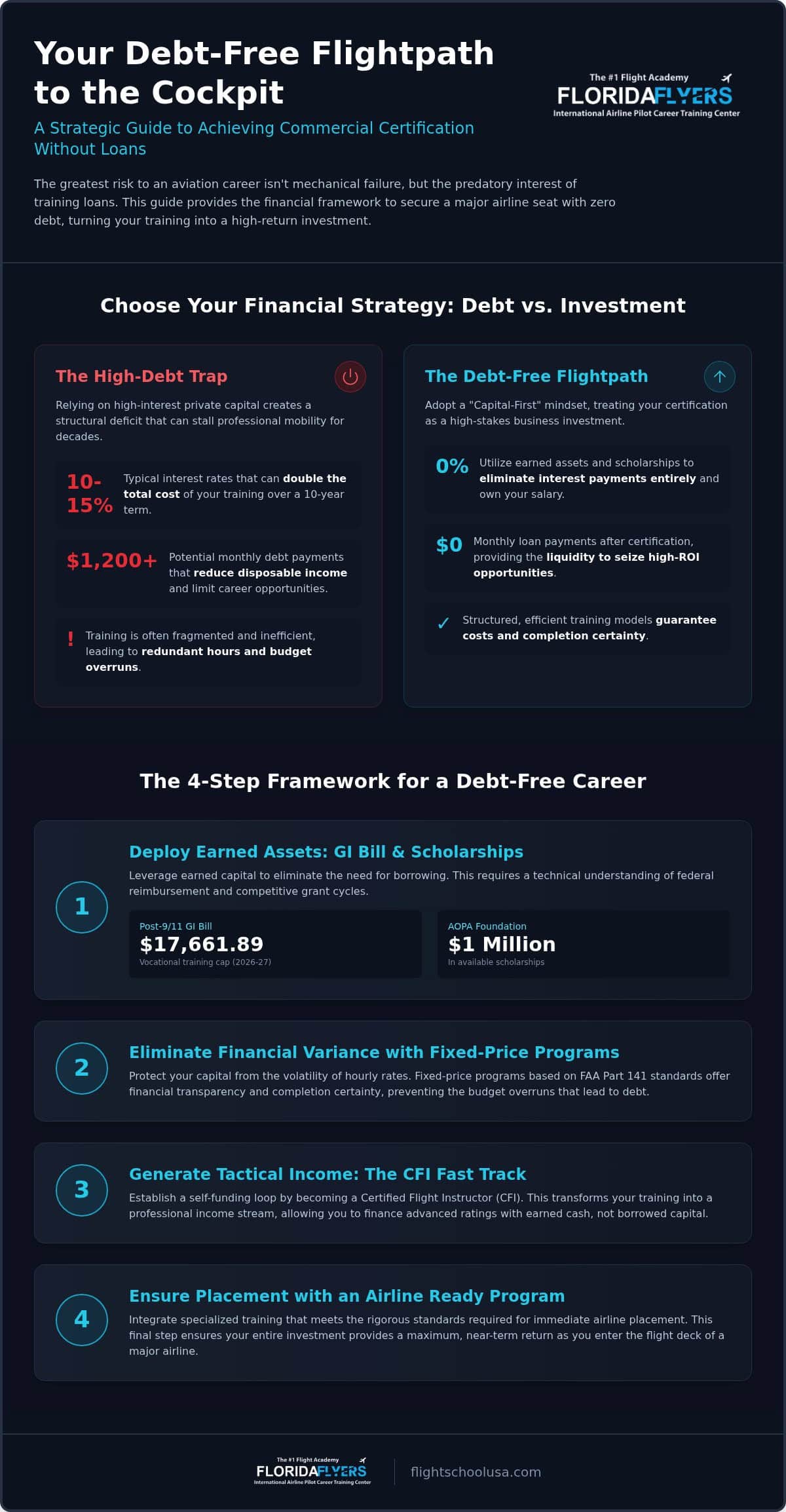
Achieving a debt-free cockpit seat requires a decisive pivot from capital expenditure to revenue generation. For the elite candidate, the middle stages of training are not a financial drain but an opportunity to establish a “Self-Funding Loop.” This strategy involves reaching a professional certification level as rapidly as possible to stop paying for flight hours and start receiving compensation for them. Mastering how to pay for flight school without loans necessitates this transition from student to professional, ensuring that advanced ratings are financed by industry earnings rather than high-interest debt.
O Programa CFI Fast Track serve como o principal motor dessa mudança financeira. Assim que você obtiver sua certificação de Instrutor de Voo (CFI), o perfil econômico da sua carreira muda fundamentalmente. Em vez de pagar a média nacional de 2026 de US$ 150 a US$ 250 por hora para aluguel de aeronave, mais taxas de instrutor, você será pago para voar. Esse ponto de transição é crucial para atingir o requisito de 1,500 horas para colocação em companhias aéreas sem investimento pessoal adicional. Além da renda imediata, atuar como instrutor desenvolve as habilidades de tomada de decisão em nível de comando que as principais companhias aéreas exigem. É uma função de alto risco que proporciona tanto o capital quanto as horas técnicas necessárias para o avanço profissional.
Strategic candidates also utilize non-flying roles to maintain liquidity during their initial training phases. Obtaining a Ground Instructor certification is a low-overhead method to generate revenue while still a student pilot. This allows you to teach theory and prepare others for FAA written exams, reinforcing your own knowledge while earning a professional wage. Other aviation-adjacent roles include:
The “Save and Strike” method is a proven tactical framework for those avoiding loans. This involves high-velocity work phases to accumulate capital, followed by full-time, immersive flight training to maximize skill retention. By treating your progression as a series of calculated business maneuvers, you ensure that every dollar earned is reinvested into your ultimate goal. If you are ready to stop paying for hours and start building your professional resume, you should apply for the CFI Fast Track Program today.
Elite candidates do not simply enroll in a training course; they execute a calculated professional mission. Mastering how to pay for flight school without loans requires more than just capital. It requires an institutional partner that mirrors your commitment to excellence and efficiency. Flight School USA functions as a rigorous gatekeeper of industry standards, providing the high-stakes environment necessary for those who demand a superior return on their training investment. By aligning with our structured tracks, you ensure that your financial strategy is supported by an academy that prioritizes time-to-market and professional-grade certification.
Your financial security depends on the regulatory integrity of your chosen school. Our FAA Part 141 certification is a critical requirement for veterans utilizing the GI Bill and for candidates seeking the most efficient path to commercial ratings. This status ensures that our curriculum meets the highest federal standards, reducing the total flight hours required for proficiency. In a volatile economic landscape, the value of our Fixed-Price Career Program cannot be overstated. It eliminates the risk of cost overruns and allows you to focus exclusively on your professional development. We also provide specialized expertise in veteran and international admissions, ensuring that your unique funding assets are deployed with maximum technical accuracy.
Integrating the Airline Ready Pilot Program into your debt-free plan is the final step in ensuring your training leads directly to a commercial cockpit. This program is designed to bridge the gap between basic commercial certification and the rigorous demands of airline operations. It transforms you from a student into a high-performance aviator capable of meeting the strict compliance standards of major carriers. When you train within our professional ecosystem, you aren’t just learning to fly; you’re adopting the lexicon of institutional credibility required for an elite career.
Securing your spot in our 2026 career programs requires immediate tactical preparation. You must begin by preparing a comprehensive financial dossier that outlines your available capital, scholarship applications, and veteran benefits. This level of discipline is the hallmark of a successful pilot candidate. Once your initial roadmap is established, the next step is to schedule a tactical consultation with our admissions team. We’ll assist you in finalizing your debt-free roadmap, ensuring that every rating from Private Pilot to the CFI Fast Track Program is accounted for within your budget. Command your future by choosing the academy that treats your career with the professional seriousness it deserves. The path to a debt-free airline seat is open to those with the discipline to take it.
Achieving a debt-free commercial certification is a matter of tactical execution rather than simple saving. By leveraging the 2026 GI Bill vocational caps and securing high-value scholarships, you protect your future earnings from interest-driven erosion. Utilizing a Fixed-Price Career Program eliminates the variance of hourly rates, while the CFI Fast Track converts your training into a professional income stream. Understanding Como pagar a escola de aviação sem empréstimos É a marca de um candidato de elite que encara sua carreira como um investimento de alto risco.
Como um Centro de Treinamento credenciado pela FAA Parte 141 e aprovado pelo GI Bill, a Flight School USA oferece a credibilidade institucional necessária para navegar por esses complexos sistemas financeiros. Nossa Garantia de Preço Fixo assegura que sua missão chegue à cabine de comando sem o peso de dívidas privadas. Você possui a disciplina necessária para esta carreira; agora você precisa desenvolver a estratégia financeira à altura.
Secure your debt-free future—Apply for our Fixed-Price Career Program today.
O caminho para um assento de elite em uma companhia aérea está aberto para aqueles que priorizam os padrões profissionais desde o primeiro dia. Aguardamos você na cabine de comando.
It is entirely possible to fund your training while maintaining full-time employment, provided you adhere to a rigorous scheduling discipline. Most candidates utilize a pay-as-you-go model to align training expenses with their monthly salary. However, this approach risks skill degradation if training frequency drops. To maintain professional standards, you must schedule at least two to three sessions per week. This ensures your capital is spent on progression rather than repetitive review sessions.
A home flight simulator is a tactical tool for reducing total flight hours, potentially saving thousands in aircraft rental and instructor fees. While the FAA limits how many simulated hours count toward certification, the real value lies in procedural mastery. Practicing checklists, radio communications, and instrument approaches at home allows you to perform with higher efficiency during actual flight hours. This reduces the total time required to reach proficiency, which is a key component of how to pay for flight school without loans.
Professional academies often provide structured payment milestones rather than high-interest traditional loans. For instance, a Fixed-Price Career Program allows you to pay in installments based on training phases. This model eliminates interest rates and provides total cost transparency from day one. By making block payments, you often secure a lower effective rate compared to individual hourly billing. These internal frameworks transfer financial risk away from the student, ensuring your capital is utilized for instruction rather than debt service.
You can utilize 529 plan distributions for flight training if the institution is recognized as an eligible educational provider by the IRS. Since Flight School USA focuses on professional vocational tracks rather than degree-granting programs, you should verify the specific tax status of your training facility. For many, 529 funds cover tuition, fees, and required equipment. Using these tax-advantaged assets is a superior strategy for those seeking a debt-free path to the flight deck.
The timeline to reach a commercial pilot salary without financing typically ranges from 24 to 48 months, depending on your income velocity. Self-funded candidates often work high-intensity phases to save capital before completing immersive training blocks. Utilizing the CFI Fast Track Program can accelerate this process significantly. By transitioning to a paid instructor role at 250 hours, you stop spending personal capital and begin earning a professional wage while building the required 1,500 hours for airline placement.
Em 2026, pilotos que financiam seus próprios estudos podem se qualificar para o Crédito de Aprendizagem ao Longo da Vida (Lifetime Learning Credit), que oferece um crédito tributário para mensalidades e despesas relacionadas qualificadas. Além disso, se você já trabalha no setor de aviação, habilitações avançadas podem ser dedutíveis como despesas de desenvolvimento profissional. Você deve garantir que todo o treinamento seja realizado em uma escola certificada pela FAA (Parte 141 ou Parte 61) para manter a elegibilidade. Consulte um profissional de impostos para maximizar essas deduções, pois elas representam uma recuperação crucial do seu investimento em treinamento.
Identifying non-publicized scholarships requires targeting niche aviation organizations and local airport associations. Beyond major entities like AOPA, look toward specific groups such as the Ninety-Nines, OBAP, or regional pilot unions. Many of these organizations offer grants that are not indexed by major search engines. Maintaining a command-level application schedule ensures you capture these overlooked assets. This disciplined search is an essential tactic for anyone researching how to pay for flight school without loans while maintaining high-performance standards.
The financial distinction lies in the regulatory structure and required flight hours. FAA Part 141 schools utilize a strictly audited syllabus that allows for lower hour minimums for certain ratings, which can reduce total costs. This structure is a requirement for GI Bill reimbursement, making it the superior choice for veterans. Part 61 offers more flexibility but often leads to higher variance in total training time. For self-funders, the predictability of a Part 141 Fixed-Price Career Program provides the highest security against budget overruns.


