
Pilot training trends 2025 are reshaping how new aviators prepare for the cockpit.
From adaptive flight simulators to updated FAA requirements, the way students learn to fly is shifting fast. These aren’t small changes—they’re industry-wide shifts that affect your progress, your costs, and your future job prospects. Schools are adopting smarter tools, offering more career pipelines, and prioritizing real-world readiness over outdated checklists.
If you’re planning to become a pilot, or you’re already in training, knowing the key pilot training trends 2025 will help you choose the right flight school, use the best tools, and stay ahead of the curve. This guide covers what’s new, what’s changing, and what it means for you as a future pilot.
One of the biggest pilot training trends 2025 is the integration of AI across both ground school and flight instruction. Students are no longer limited to static textbooks or one-size-fits-all lessons. AI-driven platforms now track individual progress, adapt lesson difficulty, and give personalized feedback—based on your exact strengths and weaknesses.
These smart tools aren’t just helping students pass written exams faster. They’re improving retention, speeding up readiness for checkrides, and identifying potential safety gaps early. Apps like FlightReady and BRIGHT can now simulate complex flight scenarios and adjust to how a student responds under pressure—all from a tablet or laptop.
For flight schools, these tools make instruction more efficient. For students, they create a clearer, faster learning path. As pilot training trends 2025 continue to evolve, AI is no longer a futuristic idea—it’s quickly becoming a standard part of every serious training program.
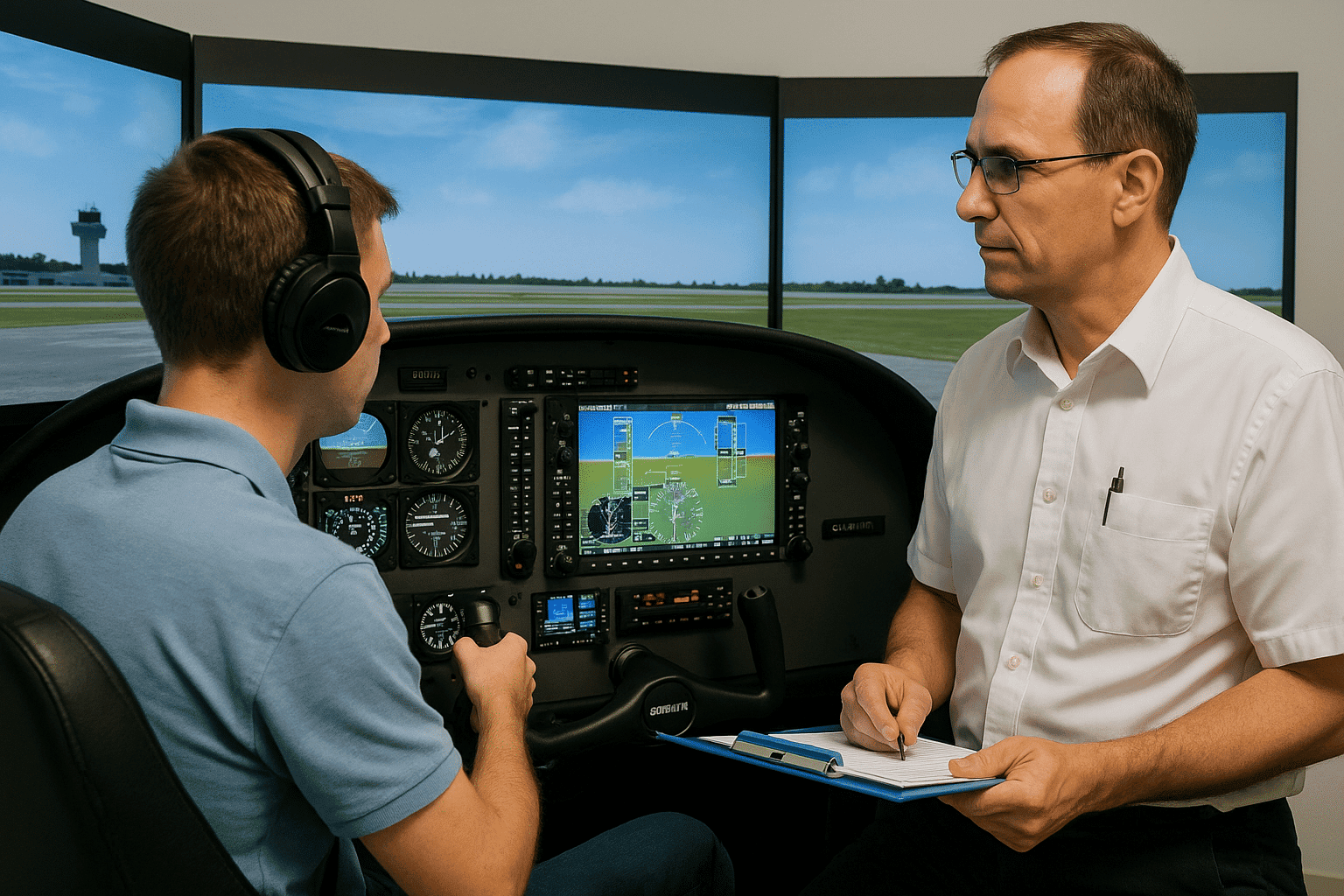
Another major shift in pilot training trends 2025 is the widespread use of high-fidelity simulators—both at flight schools and in students’ homes. What used to be reserved for airlines and ATP-level training is now showing up in early-stage private pilot programs.
Modern desktop simulators like X-Plane 12 and Microsoft Flight Simulator, when paired with VR headsets or yoke setups, now offer realistic visuals, motion, and even weather patterns. These tools allow student pilots to practice maneuvers, emergency procedures, and radio calls from home—without burning flight hours or fuel.
Flight schools like Florida Flyers Flight Academy are also investing in FAA-approved Advanced Aviation Training Devices (AATDs) to better prepare students before they step into real aircraft. The result? Faster checkride readiness, deeper muscle memory, and lower total training costs.
Pilot training trends 2025 are clearly favoring students who embrace simulation as part of their routine—not just as a backup, but as a core part of building flight skill.
Among the most impactful pilot training trends 2025 are the recent updates to FAA training standards. Instructors and students alike are adjusting to a curriculum that’s more focused on decision-making, risk management, and real-world scenarios—not just stick-and-rudder skills.
The Airman Certification Standards (ACS) have been revised to emphasize deeper understanding of system failures, aeronautical decision-making (ADM), and weather interpretation. Scenario-based training is now the FAA’s preferred approach, meaning students must demonstrate how they’d respond to in-flight challenges—not just memorize procedures.
Flight schools are already reshaping their syllabi to align with these changes. Programs have adapted to ensure students are both technically competent and judgment-ready by the time they reach checkride stage.
If you’re training in 2025, expect to be evaluated not only on what you do—but why you do it. Understanding these pilot training trends ensures you stay aligned with what examiners and airlines now expect from new pilots.
A rising trend that’s hard to ignore in pilot training trends 2025 is the influx of international students into U.S. flight schools. With global airlines expanding and pilot shortages continuing, more students from Asia, Africa, Europe, and South America are choosing the U.S.—especially Florida—as their training destination.
What’s driving this growth? FAA licenses are globally respected, training costs in the U.S. remain lower than in many other countries, and schools like Florida Flyers Flight Academy are approved for the M1 visa, making it easier for international students to enroll, relocate, and complete their training legally.
To meet this demand, schools are offering bilingual instruction, tailored onboarding, and housing support. Some even run custom programs aligned with foreign airline hiring standards, making U.S. training an efficient stepping stone to global careers.
As pilot training trends 2025 evolve, international accessibility isn’t a bonus—it’s becoming a core strength of forward-thinking flight academies.
Another clear shift in pilot training trends 2025 is the move toward tighter integration between ground school and flight training. Instead of treating theory and cockpit time as separate phases, many flight schools now blend them into a continuous, practical learning experience.
This means students cover critical topics—like weather systems, airspace, and emergency procedures—right before applying them in the air. Programs that used to rely on third-party ground schools are building in-house instruction to better align with each stage of flight training.
Flight academies are leading this model with structured programs that combine in-person ground classes, simulator prep, and instructor-guided flights. The result? Students absorb concepts faster, retain skills longer, and perform more confidently on checkrides.
As pilot training trends 2025 continue evolving, integrated training is becoming the gold standard—especially for students who want to move efficiently through the PPL, CPL, and CFI tracks without unnecessary repetition or gaps in understanding.
Among the most career-focused pilot training trends 2025 is the growing number of direct partnerships between flight schools and airlines. Today’s students don’t just train—they train with a clear job pathway in mind.
Regional airlines and charter operators are actively collaborating with top flight academies to offer fast-track programs. These pipelines often guarantee interviews—or even conditional job offers—upon successful completion of training. For students, this reduces uncertainty and accelerates career progression.
Florida Flyers Flight Academy, for example, has launched structured training-to-career paths that allow qualified students to transition into Certified Flight Instructor (CFI) roles and quickly build hours toward ATP minimums. Many of these programs align directly with airline hiring needs, from simulator types to multi-crew coordination.
If you’re planning to fly professionally, understanding pilot training trends 2025 means knowing which schools open real doors—not just hand out certificates.
One of the more personal yet growing pilot training trends 2025 is the focus on pilot wellness. Flight schools and examiners alike are placing increased emphasis on a student’s physical fitness, mental health, sleep habits, and stress management—because modern aviation demands more than just technical skill.
FAA medical examiners are paying closer attention to conditions like sleep apnea, fatigue, and hypertension. Meanwhile, schools are encouraging students to adopt fitness routines, healthy diets, and rest schedules that support long-term performance in the cockpit. This is especially relevant for students pursuing airline careers, where medical disqualifiers can delay or derail progress.
Forward-thinking academies now provide wellness education as part of their training environment. From guidance on hydration and nutrition to tips for managing stress before checkrides, these programs help students show up sharper, safer, and more prepared.
As pilot training trends 2025 continue to evolve, being fit to fly isn’t just about passing a physical—it’s about sustaining performance, reducing burnout, and staying sharp from day one.
Flight training is no longer stuck in the past. The pilot training trends 2025 prove that aviation education is getting faster, smarter, and more personalized—from AI-driven lessons to airline-ready pipelines.
Whether you’re just starting out or planning your next license, understanding these trends helps you avoid outdated programs and choose a school that’s aligned with the future of aviation. Your training environment should work for you—not against you.
Florida Flyers Flight Academy is ahead of every major trend shaping aviation training today. With modern simulators, integrated learning systems, and real airline partnerships, they help students train faster and smarter—without cutting corners.
| Question | Answer |
|---|---|
| What are the top pilot training trends 2025? | Key pilot training trends 2025 include AI-based learning platforms, affordable high-fidelity simulators, updated FAA standards, and direct airline career pipelines. |
| Is pilot training in 2025 more expensive or more affordable? | While aviation costs are rising, new tools like simulators and integrated programs help reduce total hours and delays—making training faster and more cost-effective. |
| How is AI being used in pilot training? | AI is being used for adaptive learning, progress tracking, personalized quizzes, and scenario simulations—helping students master skills faster and retain information longer. |
| Are FAA curriculum changes affecting students in 2025? | Yes. New FAA standards emphasize scenario-based learning, decision-making, and risk management—making flight training more practical and safety-focused. |
| Why are international students choosing U.S. flight schools in 2025? | The U.S. offers globally recognized FAA licenses, consistent weather, affordable training, and visa support. Schools like Florida Flyers welcome students from all over the world. |
Contact the Florida Flyers Flight Academy Team today at (904) 209-3510 to learn more about how to transfer flight schools.


