

Informazioni sulla carriera di pilota di linea
ⓘ TL;DR
Treating a flight simulator as a cheaper airplane wastes the money you were trying to save. The real flight simulator training benefits come from repetition, not logbook arithmetic.
A simulator is a different instrument. It lets you pause mid-maneuver, rewind a botched approach, and fail the same emergency until the response is automatic. The aircraft gives you one attempt and a bill.
This article explains what the device teaches, what simulator time can and cannot log, and how serious programs sequence it from private pilot through airline readiness. You’ll finish knowing how to judge whether a school uses simulation with intent or as filler. Simulator time also builds the instrument scan and radio calls that eat attention in the real cockpit.
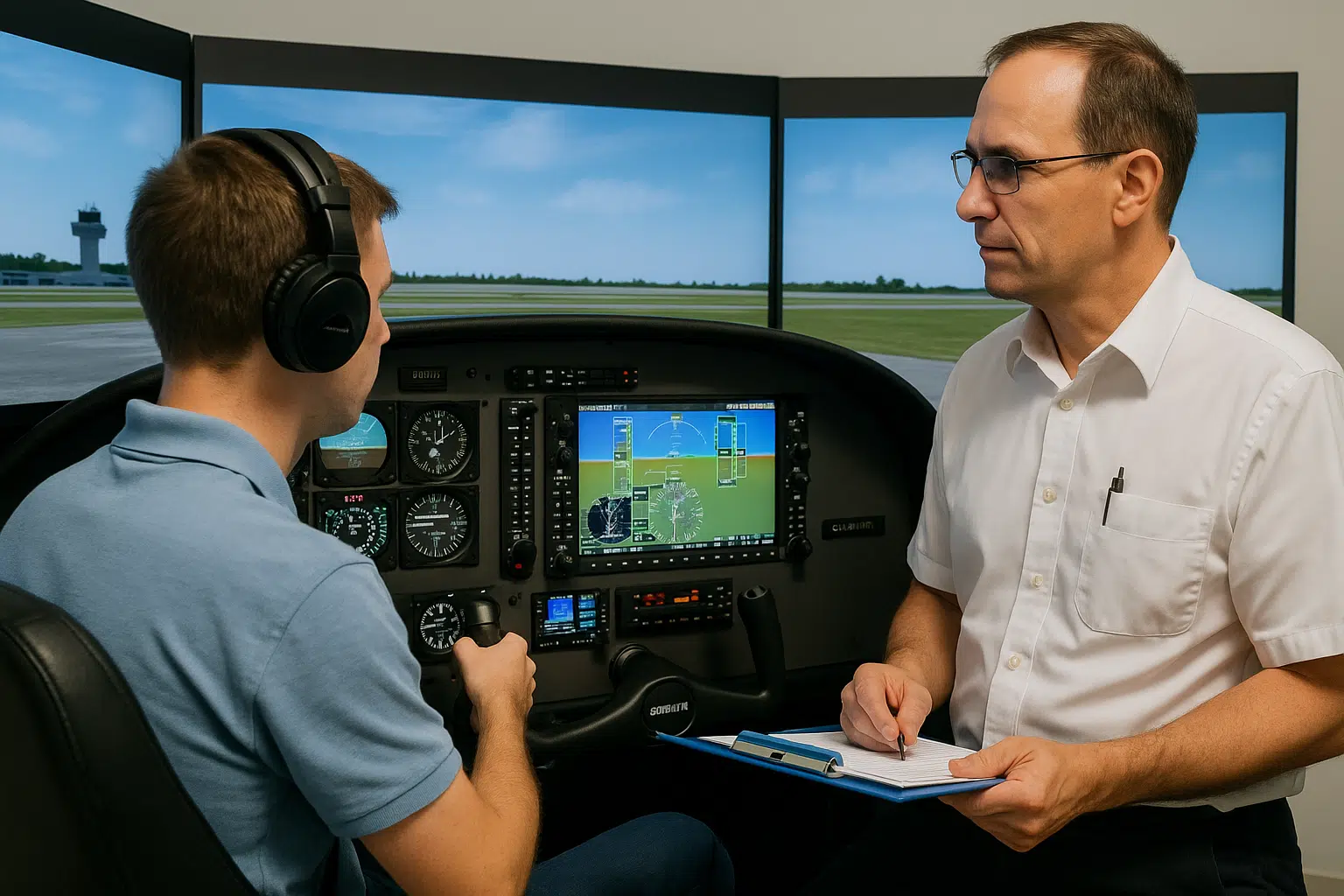
A flight simulation training device is a ground-based system that reproduces aircraft behavior and cockpit workload so pilots can rehearse procedures, scan patterns, and decision-making without leaving the ground. That definition matters because it describes a training instrument, not a budget substitute for flight hours. Understanding the real flight simulator training benefits starts with grasping how an airplane simulator works as a tool built for repetition, not logbook arithmetic.
Students routinely treat simulator sessions as a way to shave cost off their hourly totals. A maneuver attempted once in the air can be drilled a dozen times in an hour on the ground, which compresses the learning loop in ways no aircraft can match. The FAA’s National Simulator Program exists precisely because these devices serve a training function distinct from the airplane itself.
You wouldn’t want your first experience with an engine failure to happen in the sky. Flight simulation training is the safest way to fail and try again until you get it right, and that safety margin is the entire argument for the device.
The simulator lets pilots pause mid-maneuver, rewind a botched approach, and inject the same failure at altitude, on final, and in IMC within a single session. None of that is possible in the aircraft. A student who stalls a real airplane on a checkride prep flight gets one attempt and a long climb back to altitude. A student in a qualified device gets ten attempts before lunch.
This is why the device earns its place in a curriculum as a distinct tool rather than a cost-cutting substitute. Treating simulator time as a discount airplane hour wastes the one thing it does better than the aircraft: unlimited, consequence-free repetition. The schools that understand this produce pilots who arrive at the airplane already fluent in the mechanics, ready to spend real flight time on judgment instead of recall.
Flight simulator training benefits show up in four separate skill layers, not one blended mass of “practice.” Each layer builds a different automatic response, and skipping any of them leaves a gap the aircraft will expose.
Repeated control inputs in the simulator hardwire stick and rudder responses before a student ever fights real turbulence. Instrument cross-checks become reflexive the same way. A pilot who has flown two hundred simulated partial-panel scans doesn’t think about where to look next.
Flows, checklists, and callouts have to run without conscious effort so attention stays free for the airplane. The simulator lets a student run an engine-start flow fifteen times in an hour. That repetition is what turns a memorized checklist into an automatic one.
Talking to ATC in a low-pressure sim environment strips the intimidation that derails early cross-country flights. A student can fumble a clearance readback in the box, then get it right before the real frequency. Controllers on a live channel don’t offer second chances.
Holds, approaches, and course tracking can be flown repeatedly without burning fuel or repositioning the aircraft. A missed approach in the sim costs nothing but a reset. In the air, that same maneuver costs a full circuit and a chunk of the lesson budget.
With knowledge and first-hand experience in a low-stress environment, pilots in training gain confidence, skills, and proficiency in all necessary aspects of flying, as outlined in the airman testing standards that govern checkride evaluation.
These four layers stack into one outcome: automatic responses that free up mental bandwidth. That bandwidth is what a student spends on judgment instead of mechanics. preparing for flight eventualities means practicing the mechanics on the ground until they disappear from conscious thought.
The counter-argument is that sim time builds bad habits. That only happens when the sim is flown as a game, not as a training instrument.
Set the sim to real weather, real weights, and real failure modes, and the habits transfer cleanly. Students at Florida Flyers Flight Academy fly scenarios that mirror the exact conditions of their checkride. The box teaches the sequence; the airplane confirms it.
Flight simulator training benefits show up loudest in the scenario every pilot hopes to never face. An engine failure at 3,000 feet is a one-shot lesson in the aircraft. You get one attempt, one reaction, and whatever you learned lives only in memory.
In the simulator, that same failure gets injected at altitude, on final approach, in IMC, and at night. The pilot builds a decision sequence instead of a single memory. That repetition is the entire point.
Emergency response is not one skill. It is three, stacked in order. The first is the pause before action, the half-second where a pilot resists the urge to grab the yoke and instead confirms what actually failed. The second is checklist discipline under stress, running the flow while the adrenaline is still spiking. The third is the willingness to commit, to pick a field, declare an emergency, and stop second-guessing.
None of those three can be drilled safely in the air. You cannot practice an electrical fire in flight the way you practice a steep turn. The simulator lets an instructor freeze the scenario mid-emergency, rewind, and run it again with a different failure mode.
Qui è dove federally qualified simulation devices earn their certification. A device approved under Part 60 has been validated to reproduce the aircraft’s behavior closely enough that the training transfers.
Simulators provide a controlled environment where pilots can experience various emergency scenarios and train on how to get out of those scenarios without losing control. That controlled failure separates pilots who have practiced it from pilots who have only read about it.
Sotto full flight simulator conditions, an instructor can stack failures the aircraft never would. A failed alternator during an ILS approach in low visibility. A partial power loss on climb-out at night. Each rep costs nothing but time.
The pilot who has run that scenario a dozen times in the box reacts differently than the pilot who has only memorized the checklist. The hands know where to go before the brain finishes the sentence.
Two training paths compete for your money, and the gap between them decides how fast you reach proficiency. Flight simulator training benefits show up clearest when you compare a syllabus that flies everything in the aircraft against one that splits the work. The blended path wins, but not for the reason most students assume.
The traditional path treats the aircraft as the only real teacher. Every hold, every failed approach, every crosswind landing gets flown in the air at aircraft rates. That builds genuine sensation and real decision pressure, which no device reproduces. It also means a single botched ILS costs you a full lesson and a full invoice.
The blended path hands repetition to the simulator and reserves the aircraft for what only the aircraft can teach. Takeoffs, landings, flight control, and navigation get drilled on the ground first, which is one of the biggest flight simulator training benefits for students chasing real-world readiness. Weather becomes a setting you choose, not a forecast you gamble on. The trade-off is honest: a simulator cannot give you the seat-of-the-pants feel of a gust or the stakes of a real diversion.
Where the paths diverge hardest is spend and speed. The blended route is not cheaper because it skips flying. It is cheaper because it stops paying aircraft rates for repetition, which is the single largest line item in the vero costo dell'addestramento da pilota. Students typically reach checkride proficiency faster because weak areas get hammered in the box before the next flight, not during it.
Simulation standards for this kind of device work are governed by frameworks like the ICAO assembly simulation standards, which is why certification matters. Choose the blended path if your goal is airline readiness on a realistic budget. Choose the aircraft-only path only if you have unlimited hours and no timeline.
Flight simulator training benefits get oversold where they matter least, and the advice students follow most often misreads what the device is for. That misreading costs real money and confidence.
Read those four together and the pattern is hard to miss. Every one confuses the device with the method. The benefit comes from how the device is used, not from the device itself.
That distinction matters most when a student is weighing allenamento a ritmo controllato contro allenamento accelerato. A school that schedules sim sessions against a syllabus and debriefs them with recorded parameters turns the box into a genuine instrument. A school that parks students in front of it to log hours turns it into an expensive game.
Flight schools that treat the sim as a syllabus instrument, not a fill-in, produce students who arrive at the aircraft already knowing the flows. Florida Flyers Flight Academy runs simulator sessions against a defined debrief, so every minute in the box maps to a specific skill the airplane will test.
The counter-argument is fair: sim time costs money and delays the real thing. It does not hold up. A student who drills an approach in the box ten times before flying it once arrives sharper, not slower, and the aircraft hour is worth more because the procedure is already automatic.
Flight simulator training benefits compound when a program sequences them into a deliberate loop instead of treating the device as spare cockpit time. Skipping the first step is the error that costs the most, because a student who meets a maneuver for the first time in the air spends the lesson decoding geometry instead of flying it.
Passo 1: Introduce the maneuver in the simulator so the student sees the geometry and the sequence before the aircraft. A hold entry or a circling approach drawn on a screen becomes a picture the student carries into the cockpit. Meet it first at altitude and the lesson becomes a scramble to keep up.
Passo 2: Drill the procedure to fluency in the simulator until the flows are automatic. Repetition on the ground is where the checklist stops being a script and becomes a reflex. Without this, every aircraft hour gets taxed by recall.
Passo 3: Fly the maneuver in the aircraft, where attention shifts to feel and judgment instead of recall. The student now notices control pressure, sight picture, and timing. That shift is the entire point of the sequence.
Passo 4: Debrief against a standard, using recorded parameters rather than memory. A session reviewed from data catches the altitude bust a student swears never happened. Debriefing from recollection alone lets the same error survive into the next flight.
Passo 5: Repeat the weak areas in the simulator before the next flight, so no aircraft hour is spent relearning. This closes the loop and keeps the expensive hours pointed at new skill. The consolidated federal simulator rules exist precisely because qualified devices carry real training weight.
Run this loop and a student moves from private pilot through instrument, commercial, and multi-engine ratings without burning aircraft time on repetition. Florida Flyers Flight Academy builds its Self-Examining Authority, Fast Track Commercial Pilot Program, and Airline Career Program around this exact structure, which is why its graduates arrive at airline hiring already fluent in procedure. For anyone diventare uno studente di volo, the sequence matters more than the device.
A flight simulator training benefits package is only as strong as the school operating the device. Buyers rarely ask the right questions before enrolling. The five markers below separate programs that use simulation deliberately from programs that use it as marketing.
What the list reveals is a pattern most students miss. Schools that treat simulation as a distinct instrument structure every lesson around it. Schools that treat it as filler bolt it onto a syllabus that was never redesigned. The difference shows up in how quickly you progress, not in how many hours you log. Programs built around structured simulator integration report that certain training scenarios can be rehearsed on the ground, with reductions in aircraft time for repetitive maneuvers.
Florida Flyers Flight Academy runs its PPL through ATP pathway and programmi internazionali di addestramento per piloti on exactly this model, with simulator sessions scheduled by syllabus rather than by convenience. Before you enroll anywhere, ask which maneuvers are scheduled in the sim and how those sessions get debriefed. The answer tells you whether you are buying a training system or renting a chair.
Flight simulator training benefits compound only when every session has a syllabus behind it and a debrief after it. A pilot who drills holds with an instructor reviewing the recording walks away with corrected technique. A pilot who flies the same holds alone in a home cockpit walks away with the same error, now permanent.
The difference shows up on checkride day. A student who has rehearsed the maneuver with structured feedback recognizes the setup, the sequence, and the recovery before the examiner finishes the brief. A student who logged sim time without that structure arrives at the aircraft still guessing. Before your next flight lesson, ask your school two questions. The answer tells you whether you’re building skill or just burning time.
The Airline Career Program at Accademia di volo dei volantini della Florida sequences simulator training from private pilot through airline readiness so every repetition builds real skill. Visit their website to see how the program fits your path to the airlines.
Yes, and the flight simulator training benefits show up fastest in the skills that require repetition rather than nerve. A student can fly the same hold or engine-out procedure a dozen times in one ground session, which is impossible to match in the aircraft without burning fuel and instructor time on every attempt.
Professional pilots use desktop simulators for familiarity and chair-flying, but they treat that software as a supplement to certified devices, never a replacement. The gap is certification and debrief: a home setup can rehearse a flow, yet only a qualified device with an instructor reviewing recorded parameters builds the habits that transfer to a checkride.
The core benefits are safe failure, on-demand weather, and the freedom to pause a maneuver mid-sequence and restart it. A pilot who has already failed an approach in the box walks to the aircraft with a decision sequence instead of a blank stare, which is the difference between practiced and merely read.
Loggable simulator time depends on the rating, the device’s qualification level, and whether an authorized instructor signs off the session. A basic aviation training device earns limited credit toward an instrument rating, while a full flight simulator approved under the national program can substitute for a larger share of required hours.


Ti potrebbe piacere anche