Weather changes quickly, visibility drops, and pilots must be prepared to operate safely in clouds or low visibility. That’s where the instrument rating comes in, a certification that takes pilots beyond basic visual flying and into the world of instrument flight rules (IFR).
For any pilot aiming to advance their career, whether in airlines, corporate aviation, or charter services, the instrument rating is a must. It not only sharpens technical skills but also opens doors to professional opportunities worldwide. In the United States, the FAA sets specific requirements for earning this rating, including minimum flight hours, simulator training, and checkride standards.
In this guide, you’ll learn everything about the instrument rating in the USA, from eligibility requirements and training hours to costs, pass rates, and even how foreign students can qualify. By the end, you’ll know exactly what it takes to achieve this essential step in your pilot journey.
What Is the Instrument Rating in the US?
An instrument rating is an FAA certification that allows a pilot to legally fly under Instrument Flight Rules (IFR). This means you can operate an aircraft in conditions where visibility is limited, such as clouds, fog, rain, or poor weather, by relying solely on cockpit instruments for navigation and control.
For private pilots, this rating is often the first major step beyond the Private Pilot License (PPL). It transforms flying from being limited to fair-weather conditions into a skillset that makes you safer, more versatile, and ready for professional aviation careers.
The FAA issues an instrument rating under Part 61 or Part 141 training programs, each with slightly different structures. Regardless of which path you take, the rating requires dedicated study, simulator practice, and flight time with a certified instructor.
Simply put, the instrument rating is what separates recreational pilots from professional aviators. It builds precision, decision-making, and confidence to handle flights in nearly any condition, a critical milestone for anyone pursuing commercial or airline pilot opportunities.
How to Qualify for the IFR?
To fly under Instrument Flight Rules (IFR) in the United States, a pilot must earn an instrument rating. Qualifying for this rating means meeting specific FAA eligibility requirements and completing structured training.
Basic qualifications include:
- Hold a Private Pilot License (PPL): You must already be a licensed pilot before beginning instrument training.
- Medical certificate: At minimum, a valid third-class FAA medical certificate is required to exercise the privileges of the rating.
- English proficiency: Since all air traffic control and aviation communication is in English, you must be able to read, write, speak, and understand it clearly.
Training requirements include:
- Ground training: Covers navigation systems, instrument procedures, weather theory, and IFR regulations.
- Knowledge test: A 60-question FAA written exam must be passed before taking the checkride.
- Flight instruction: Includes both simulator training and actual instrument flying with a certified instructor.
Meeting these qualifications ensures that when you take your checkride, you’re fully prepared to operate under IFR, a major step toward becoming a safe and capable pilot in all weather conditions.
What Are the Instrument Rating Eligibility Requirements?
The FAA has specific eligibility requirements that every pilot must meet before applying for an instrument rating. These rules are outlined in 14 CFR § 61.65 and ensure that pilots are properly prepared for the challenges of flying under IFR.
Minimum eligibility requirements include:
- Age requirement: You must be at least 17 years old.
- Pilot certificate: You must already hold a valid Private Pilot License (PPL).
- English proficiency: All applicants must demonstrate the ability to read, write, speak, and understand English.
- Medical certificate: A valid FAA third-class medical certificate is required to exercise the privileges of an instrument rating.
To qualify for an instrument rating, pilots must log 50 hours of cross-country flight time as Pilot-in-Command (PIC). Out of these, at least 10 hours must be in airplanes, ensuring students gain real-world navigation experience across different routes.
In addition, the FAA requires 40 hours of actual or simulated instrument time. At least 15 of those hours must be with a certified instrument instructor, focusing on procedures, navigation, and handling the aircraft solely by reference to instruments.
Finally, every applicant must complete a long cross-country flight under IFR, covering at least 250 nautical miles. This flight must include instrument approaches at three different airports, using three different types of approaches such as ILS, VOR, or GPS. This ensures pilots can confidently handle diverse IFR scenarios.
These requirements ensure that every pilot who earns an instrument rating has the necessary foundation, training, and practical skills to fly safely in low-visibility and high-workload environments.

How Many Hours Does It Take to Get an Instrument Rating?
The FAA sets minimum training hours for an instrument rating, but most students require more to feel confident and prepared. Under Part 61 training, the minimum is 40 hours of instrument time, while Part 141 programs reduce the minimum to 35 hours due to their structured curriculum.
In reality, most pilots complete between 50–60 hours of instrument training before their checkride. This extra time allows for more practice with approaches, holding patterns, navigation, and decision-making under IFR. Many students also use simulators to log a portion of their training, which can reduce costs while building valuable skills.
The total time to earn an instrument rating varies by student, but consistent training — flying several times a week — helps keep skills sharp and often reduces the overall hours needed. Students who train irregularly typically require more time, which extends both the hours and the cost of earning the rating.
Can Flight Simulators Count Toward Instrument Rating Hours?
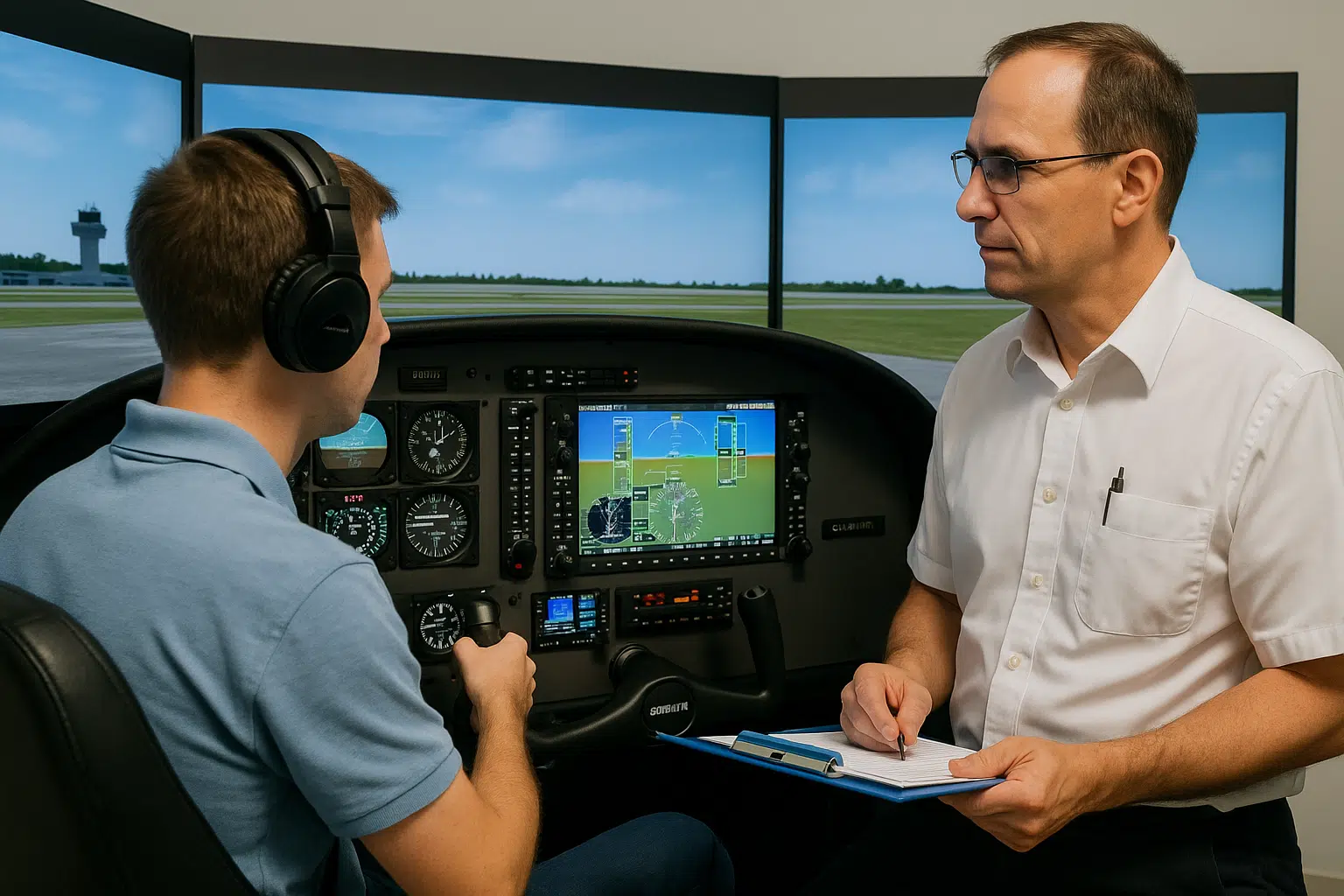
Yes, the FAA allows students to use flight simulators to log part of their required training for an instrument rating. This is an important option because simulators provide a safe, affordable way to practice procedures without the added cost of renting an aircraft.
Depending on the type of simulator, students can log between 10 and 20 hours toward the 40-hour requirement. Advanced Aviation Training Devices (AATDs) usually allow the maximum credit, while Basic Aviation Training Devices (BATDs) are more limited. The rest of the training must still be completed in an actual aircraft with a certified instrument instructor.
Simulators are especially valuable for practicing approaches, holding patterns, and emergency procedures. They let students repeat scenarios multiple times until proficiency is achieved, which helps reduce the overall cost and increases readiness for the FAA checkride.
How Much Does It Cost to Get Your Instrument Rating?
The cost of earning an instrument rating in the USA typically ranges from $8,000 to $12,000. The total amount depends on factors like the type of aircraft used, how many hours you take to reach proficiency, and how much of your training you complete in a simulator versus in an actual airplane.
Here’s a breakdown of the main expenses:
| Expense Category | Estimated Cost | Details |
|---|---|---|
| Aircraft Rental | $5,000 – $7,500 | Based on 40–50 hours at $120–$150 per hour |
| Instructor Fees | $2,000 – $3,000 | 15+ hours of dual instruction at $50–$70 per hour |
| Simulator Time | $500 – $1,000 | Reduces aircraft rental costs, approved by FAA |
| Ground School & Materials | $300 – $600 | Books, online training, and test prep software |
| FAA Knowledge Test | $175 – $200 | Written exam fee |
| Checkride & Examiner Fee | $600 – $1,000 | Includes practical test and aircraft rental for exam |
Average Total: $8,000 – $12,000
While the cost may seem high, the instrument rating is an essential investment for pilots pursuing professional careers. Financing options, scholarships, and the use of simulators can help lower the expense, making it more manageable for students who budget carefully.
What Is the Pass Rate for the FAA Instrument Rating?
The FAA publishes statistics on written exams and practical tests, giving students a clear idea of how challenging the instrument rating can be. On average, about 75–80% of applicants pass the FAA instrument written knowledge test on their first attempt. With proper preparation, most students find this exam manageable.
The practical test, or checkride, has a slightly higher pass rate, typically around 80–85% nationwide. Success depends on consistent training, strong ground knowledge, and comfort with IFR procedures such as approaches, holding patterns, and navigation. Students who train regularly and make use of simulators tend to perform better on their first attempt.
While retakes are allowed, each failure adds cost and delays progress. That’s why structured preparation — including mock exams, simulator sessions, and thorough review with instructors — is critical to passing both the knowledge test and the checkride for the instrument rating.
Can Foreigners Be a Pilot in the USA?
Yes, international students are welcome to train in the United States, and many choose Florida Flyers Flight Academy because of their high standards, modern fleets, and favorable flying weather. Foreign students can earn both a Private Pilot License (PPL) and an instrument rating in the USA, provided they meet a few additional requirements.
Visa & TSA Requirements:
- Most students need an M-1 Student Visa, issued after acceptance by an FAA-approved flight school.
- The TSA (Transportation Security Administration) also requires security clearance before beginning flight training.
While international students follow the same FAA curriculum as U.S. students, the process may take slightly longer due to visa paperwork, background checks, and English proficiency requirements. Once cleared, the training hours and requirements for an instrument rating remain the same.
For many, training in the U.S. is worth the effort. Lower overall costs compared to other countries, access to advanced simulators, and experienced instructors make America one of the best destinations for earning an instrument rating and progressing toward a commercial pilot career.
Conclusion: Why the Instrument Rating Matters in 2025
The instrument rating is more than just another certification — it’s the gateway to professional aviation. By training under IFR, you gain the skills to fly safely in challenging weather, navigate complex airspace, and operate confidently in nearly any condition. For aspiring airline and commercial pilots, it’s not optional — it’s essential.
From FAA eligibility requirements and training hours to costs, simulators, and pass rates, every part of the process is designed to prepare you for real-world flying. While the journey requires time and investment, the payoff is a stronger skillset, broader opportunities, and a direct path toward advanced pilot licenses and airline careers.
Ready to earn your instrument rating? Florida Flyers Flight Academy offers FAA-approved training programs, modern aircraft, and experienced instructors to help you succeed. Apply today and take the next step toward your future in aviation.
Contact the Florida Flyers Flight Academy Team today at (904) 209-3510 to learn more about how to transfer flight schools.