
Speed is an advantage only when your schedule and learning habits can sustain it. The pros and cons of accelerated flight training turn on the same tradeoff: intensive, frequent lessons can compress training into a shorter timeframe, but the pace demands a full-time commitment. In the United States, accelerated programs typically run for 1-4 weeks.
The appeal of accelerated flight training is clear: focused instruction can help you maintain momentum and work toward your aviation goals sooner. But long training days, frequent flights, and concentrated study leave little room for other commitments or recovery.
This guide helps you assess whether the pace fits your readiness, schedule, and learning style. It covers the benefits, pressure points, and program conditions to weigh when choosing between accelerated and traditional training.
Accelerated programs in the United States typically require full-time commitment over 1-4 weeks. The shorter calendar can suit pilots who can protect training time and maintain consistent study.
Accelerated training combines frequent flight lessons, study sessions, and instruction in a concentrated curriculum. Each lesson builds on recent practice, while missed sessions can interrupt momentum. Before committing, map the training schedule against work, family duties, and study responsibilities. A plan with protected training time is more realistic than one that depends on occasional openings.
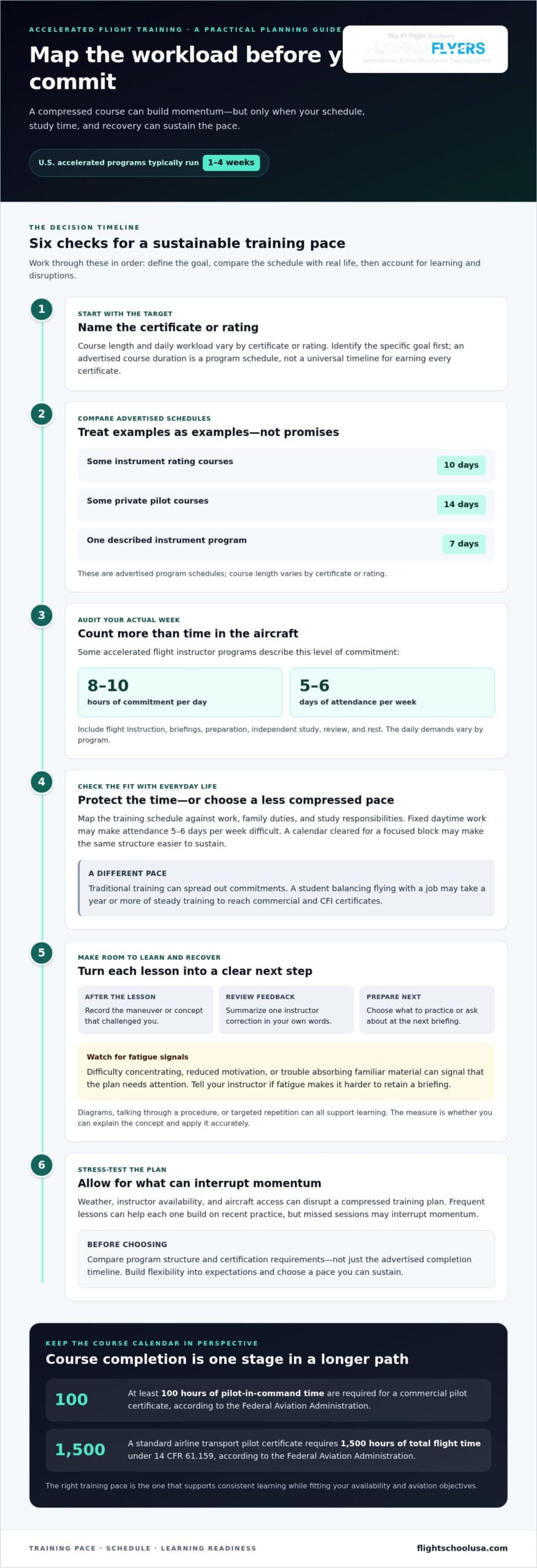
Time commitment means reserving enough hours each day for flight instruction, preparation, and review. Some accelerated flight instructor programs describe 8-10 hours of commitment per day and attendance 5-6 days per week. Those demands affect whether you can keep up without competing obligations. A typical accelerated program may span 1-4 weeks, but course length and daily workload vary by certificate or rating.
Advertised course durations illustrate the range: some accelerated instrument rating courses run 10 days, while some private pilot courses advertise 14 days. One instrument course is described as a 7-day program. These examples are program schedules, not a universal timeline for earning every certificate. Identify the specific certificate or rating first, then consider what the schedule requires.
Time availability is not simply the ability to attend lessons. You also need room for briefings, independent study, flight preparation, and rest between demanding sessions. For example, a student with fixed daytime work may struggle to attend training 5-6 days per week. A student able to clear their calendar for a focused block may find the same structure easier to sustain.
Traditional training offers a different pace for people who cannot train full-time or need to spread out their commitments. A student balancing flying with a job may take a year or more of steady training to reach commercial and CFI certificates. That longer path can preserve work and family routines, while accelerated training concentrates the workload into a shorter period.
Career goals also require perspective beyond the course calendar. The Federal Aviation Administration states that a commercial pilot certificate requires at least 100 hours of pilot-in-command time. The Federal Aviation Administration also states that a standard airline transport pilot certificate requires 1,500 hours of total flight time under 14 CFR 61.159. Course completion is one stage in a longer career progression.
Compare the advertised duration with your actual availability, not your ideal week. If a program spans 14 days, account for training, study, and recovery across that period. If you can’t reserve consistent time, a less compressed schedule may better support progress. The right choice is the pace you can sustain while building skills and meeting your aviation objectives.
Intensive learning can sharpen aviation understanding, but a packed schedule also raises fatigue. Accelerated flight instructor training may demand 8 or more hours daily, with attendance 5-6 days per week. That leaves less room for unplanned review or recovery. The key question is whether lessons remain useful when study, flying, and rest compete for the same hours.
Learning consolidates when you connect new instruction with what you already know and recall it during later practice. For example, after a lesson on turns, review your instructor’s feedback, choose one correction, then apply it on the next flight. This focused cycle turns a specific lesson into a usable skill, rather than a note you simply remember.
Intensive training can strengthen the connection between ground school and aircraft practice. If a ground lesson covers weather decisions, a flight briefing can apply those concepts to a planned route. Close timing can make the connection easier to recognize. But moving through material too quickly, without time to explain or apply it, can leave gaps that surface in later lessons.
Use a brief review routine after each lesson. Record the maneuver or concept that challenged you, summarize your instructor’s correction in your own words, then note what you will practice or ask about at the next briefing. A specific example, such as noting when a correction improved altitude control, gives your next lesson a clear learning target.
Burnout can show up as difficulty concentrating, reduced motivation, or repeated trouble absorbing familiar material. Treat these changes as signals to address, not proof that you lack ability. If fatigue makes it harder to retain a briefing, tell your instructor and revisit the plan. Rest and support matter because a tired student may struggle to learn from the next flight.
Learning preferences also affect which pace works for you. A student who understands concepts through diagrams may want to sketch a traffic pattern before discussing it. Another may learn best by talking through each step during a preflight review. Neither approach is inherently better. The measure that matters is whether you can explain the concept and apply it accurately in training.
Instructors can help set the pace by identifying what you have mastered and what needs another pass. Ask for specific feedback on one maneuver or ground topic, then use it to guide independent study. If radio procedures remain difficult, for example, rehearse a sample exchange before the next flight. Targeted repetition is more useful than reviewing every subject without a clear priority.
Choose an accelerated schedule only if its workload leaves space for focused learning, recovery, and feedback. Track how prepared you feel before each lesson, then adjust study habits when concentration slips. If an immersive program fits your goals, explore プロの飛行訓練 as part of your planning. Consistent progress toward aviation skills depends on learning quality, not calendar speed alone.
Accelerated training changes the pace, not the certificate or rating requirements. The medical qualification you need depends on the privileges you plan to pursue, so identify your aviation goal before comparing schedules.
Start by defining the credential you want and its flight-time requirements. According to the Federal Aviation Administration, under Part 61, the minimum total flight time for a commercial pilot certificate is 250 hours. For a private pilot certificate, the Federal Aviation Administration sets the Part 61 minimum at 40 hours and the Part 141 minimum at 35 hours. Under Part 61, the Federal Aviation Administration requires 40 hours of instrument time for an instrument rating. These are minimums, not a promise that every student will be ready at that point.
Part 61 and Part 141 differ in training structure. Part 61 lets training follow a pace shaped by the student’s schedule, with no fixed FAA-imposed timeline. Part 141 schools use an FAA-approved syllabus with defined lessons, stage checks, and milestones. Approved Part 141 courses can qualify students with fewer total hours than Part 61 requires. Compare the syllabus and evaluations against your learning style, not just the advertised duration.
Ask how the program manages progress, missed lessons, and practical-test preparation. A tightly sequenced course, for example, may require you to complete one stage before moving to the next. Find out how weather or scheduling interruptions affect that sequence. An advertised duration does not guarantee a passing checkride, so consider how the program tracks proficiency and responds when you need more practice.
Training costs depend on the program structure. Accelerated programs may require more spending upfront because instruction and aircraft use are concentrated, while finishing sooner may reduce living expenses. Compare what the quoted amount includes, how additional training is handled, and which costs can change with aircraft use or progress. Ask for a clear breakdown before setting your budget, and do not treat a low headline figure as the full cost.
Use these questions to compare flight schools and course conditions:
For example, a student pursuing an instrument rating should compare its training requirements, lesson sequence, and available review time. A commercial-track student should consider the Part 61 minimum alongside the program’s broader training plan. Choose a focused program whose structure, costs, and pace align with the credential you intend to earn.
Compare accelerated flight schools by reviewing safety procedures, instructor continuity, aircraft access, and how the schedule handles disruptions. Completion depends on your progress and practical-test readiness, so an advertised timeline alone does not establish program quality.
Weather can interrupt a tightly planned sequence, especially when conditions prevent a lesson from meeting its training objectives. A missed flight may affect later reservations, instructor time, and your preparation. Ask how the schedule accommodates weather delays and whether ground instruction or simulator sessions can support continued learning when flying pauses.
Instructor availability matters because consistent feedback helps you connect one flight to the next. A student practicing approach procedures, for example, benefits from knowing which corrections the previous instructor emphasized. A change of instructor can still work when lesson records clearly identify completed tasks and remaining objectives. Good instruction means more than a full calendar: it includes feedback that informs the next lesson.
Aircraft availability affects whether scheduled flights can go ahead. Maintenance issues or competing reservations can disrupt an intensive schedule, especially when aircraft access is limited. Compare the planned schedule with the school’s process for substitutions and rescheduling. A clear process helps you understand how a disruption affects flight lessons, ground instruction, and preparation.
Aircraft avionics also shape the training experience. If you plan to fly aircraft with a particular cockpit layout, consider whether the training equipment builds relevant familiarity. Instrument instruction in an aircraft with glass displays, for example, may differ from practice using traditional instruments. The key is alignment: training equipment should support the skills and aircraft environment relevant to your goals, including a future airline career.
Simulator access can provide useful practice when weather or aircraft scheduling limits flying. FAA regulations allow some simulator and training-device time to count toward certain ratings, subject to regulatory limits. That does not mean every simulator session replaces aircraft instruction. The training plan must meet the applicable rating requirements and use devices for tasks they can teach effectively.
Training in your own aircraft may build familiarity with its controls and avionics, but it also makes aircraft suitability and scheduling central concerns. Your aircraft, for example, may not have the equipment needed for a planned lesson or rating. Before relying on it for an intensive schedule, consider how it fits the curriculum, instructor availability, and safe completion of each training objective.
Compare practical details: safety and scheduling procedures, instructor continuity, aircraft access, avionics, and how simulators are used. Then consider a weather-delay scenario. If one missed flight shifts several later lessons, the program’s recovery plan matters. Simulator practice or ground instruction may help keep learning on track, but training needs differ from student to student.
Compare schools on safety procedures, the consistency and quality of instructor feedback, and how they provide aircraft or arrange substitutions and rescheduling when disruptions occur. Judge completion in light of student progress and practical-test readiness, not an advertised timeline.
Readiness takes more than enthusiasm for flying. You need to protect study time, respond to specific feedback, and stay attentive through an intensive schedule. Test your capacity before enrolling: set aside focused study time after a demanding workday, then review a technical topic. If other tasks repeatedly take over, the training pace may be difficult to sustain.
Discipline comes from repeatable actions, not a burst of motivation. Prepare questions before each lesson, review your instructor’s previous notes, and arrive ready to discuss one specific skill. This routine helps you connect instruction across consecutive flights. If you rely on last-minute preparation, frequent lessons may be harder to absorb, even if your interest in aviation is strong.
Consider how you respond when a maneuver needs repeated practice. One student may welcome immediate correction and apply it on the next approach; another may need quiet review before trying again. Neither response signals a lack of ability. The question is whether you can accept feedback, identify the correction, and return to the task without letting frustration disrupt the next lesson.
Your schedule capacity is another test. Map a realistic training week around work, family responsibilities, sleep, and study, including time to prepare before flying and review afterward. If the plan depends on canceling essential commitments or repeatedly sacrificing rest, revise it before training begins. A calendar that works only under perfect conditions is a poor measure of readiness.
Learning under pressure also requires honest self-assessment. After each flight, record one skill that felt secure and one that needs more practice. If fatigue makes it difficult to recall your instructor’s guidance, adjust your review routine or discuss the workload. This record helps you distinguish temporary discomfort from recurring difficulty concentrating.
Keep the checkride in perspective. An advertised course timeline describes a schedule, not your personal proficiency standard. The examiner conducting the checkride makes the final decision about whether you qualify for certification. Readiness means demonstrating the required knowledge and skills, not simply reaching the final scheduled lesson. If you need more practice, prioritize mastery over the calendar.
Motivation, discipline, a passion for aviation, full-time availability, comfort with pressure, and immersive learning habits can all support intensive training. They are useful indicators, not a checklist that predicts every outcome. Assess your habits honestly: can you stay focused through consecutive lessons, adapt when feedback changes your plan, and protect time for study? Weigh the accelerated flight training pros and cons against your actual commitments before deciding.
For students weighing the accelerated flight training pros and cons, the strongest choice matches the training pace to their real circumstances. If you’re ready to turn that self-assessment into a practical training plan, plan your next flight-training step.
Flight School USA offers a Fixed-Price Career Program for students planning structured, career-focused flight training. It may be a relevant next step if you’ve weighed the pace of accelerated training and are ready to consider a broader path toward aviation work. Students pursuing flight instructor training can also explore the CFI Fast Track Program. Veterans can consider GI Bill Flight Training, while international students can explore M1 Visa Admission Services for flight training in the United States. Match the program to your goals, training needs, and eligibility, rather than choosing based on speed alone. To discuss your flight training goals, contact Flight School USA.
Turn your interest in aviation into a decision you can act on. Set a clear goal for your next training stage, then decide what conditions would make the timing right. Your priorities may include career direction, schedule flexibility, or the pace at which you learn. Writing them down gives you a basis for evaluating your options, rather than letting the promise of speed decide for you.
Use your assessment of the pros and cons of accelerated flight training to identify the questions that still matter most to your plans. A focused conversation about those priorities can help you understand how a program fits your intended path. Flight School USA offers career-focused flight training options for aspiring pilots. Explore your flight training options and take the next step toward your aviation goals with confidence.
Traditional training may suit students who cannot commit full-time, need to maintain work or family responsibilities, or prefer a measured pace. It can also spread training expenses over time instead of concentrating instruction into a short period. Someone with a fixed work schedule, for example, might plan lessons around available days. The tradeoff is a longer path to certificates, ratings, and career goals.
Accelerated flight training concentrates instruction, flying, and study into a focused schedule. Students typically follow a structured sequence of lessons, applying concepts through ground study and flight practice. A lesson may introduce a maneuver, for example, followed by a flight where you practice it. The compressed format keeps training moving consistently, but you still need to meet proficiency standards before advancing.
Accelerated programs in the United States typically require full-time commitment over 1-4 weeks, while traditional training can extend much longer when students fly around work. A student following that part-time pattern may take a year or more of steady flying to reach commercial and CFI certificates. Compare the course scope, too: a short program may cover one rating, not an entire career-training sequence.
The total cost depends on the program, the concentration of instruction, aircraft use, and how much training you need to complete. Finishing sooner may reduce living expenses, while intensive instruction can increase upfront spending. Compare what the quoted amount includes, such as flight instruction and aircraft use, and how additional training affects your overall budget.
A concentrated schedule can help you maintain momentum, connect classroom concepts with flight practice, and move toward aviation goals sooner. Frequent lessons may make it easier to build on recent feedback instead of relearning material after long gaps. You can apply a correction from one flight during the next scheduled lesson, for example. That continuity can support focused skill development and an earlier start on career progression.
The demanding pace can leave less room for recovery, independent review, and other responsibilities. Fatigue may make instruction harder to absorb, while weather or scheduling interruptions can disrupt a compressed plan. Completing a course within its advertised timeframe does not establish checkride readiness. The examiner makes the final certification decision. Weigh the intensity against your ability to study, rest, and demonstrate proficiency.
Schedules depend on the program and certificate or rating. Accelerated flight instructor training may require attendance 5-6 days per week and 8-10 hours of commitment per day. That time can include flight instruction, briefings, ground study, and preparation. For instance, a flight cancellation may shift the day toward review or other planned instruction. Students should consider whether they can protect that time consistently.
Read the written terms to understand what the program includes, how progress is managed, and which circumstances affect scheduling or completion. Review the refund policy’s deadlines, deductions, and cancellation conditions before signing. Compare the advertised price with the stated inclusions, including instruction and aircraft use, and check how additional training is handled. Keep a copy of the agreement and any written schedule for reference.