
Informace o letecké škole


What if your flight training budget wasn’t a gamble against rising fuel costs and instructor turnover? For many, the central question of whether is a fixed price flight school worth it comes down to risk management in the high-stakes 2026 market. You’re likely concerned about the risk of running out of funds mid-program or discovering hidden fees that derail your airline timeline. It’s a valid anxiety. The professional aviation industry demands precision, yet many students enter training with a variable-cost model that leaves their career progression vulnerable to market volatility.
This analysis provides a rigorous ROI evaluation of fixed-price career programs. You’ll discover how to identify elite training structures that offer protection against inflation while maintaining the velocity required for major airline placement. We’ll break down the financial roadmap from zero experience to the flight deck, ensuring you understand how to leverage immersion-based student housing and structured curriculums to secure your professional future. This guide examines how a fixed-price model functions as a strategic hedge, transferring the burden of operational fluctuations from the student to the academy.
Choosing between training models is the first critical decision in a professional pilot’s career. The fundamental question of whether is a fixed price flight school worth it depends on how you value financial predictability versus operational flexibility. While casual flyers often prefer the pay-as-you-go approach, serious candidates for the airlines must view their training as a high-stakes investment where market volatility can decimate a budget. In the 2026 economic environment, an unhedged training plan is a liability that many students cannot afford.
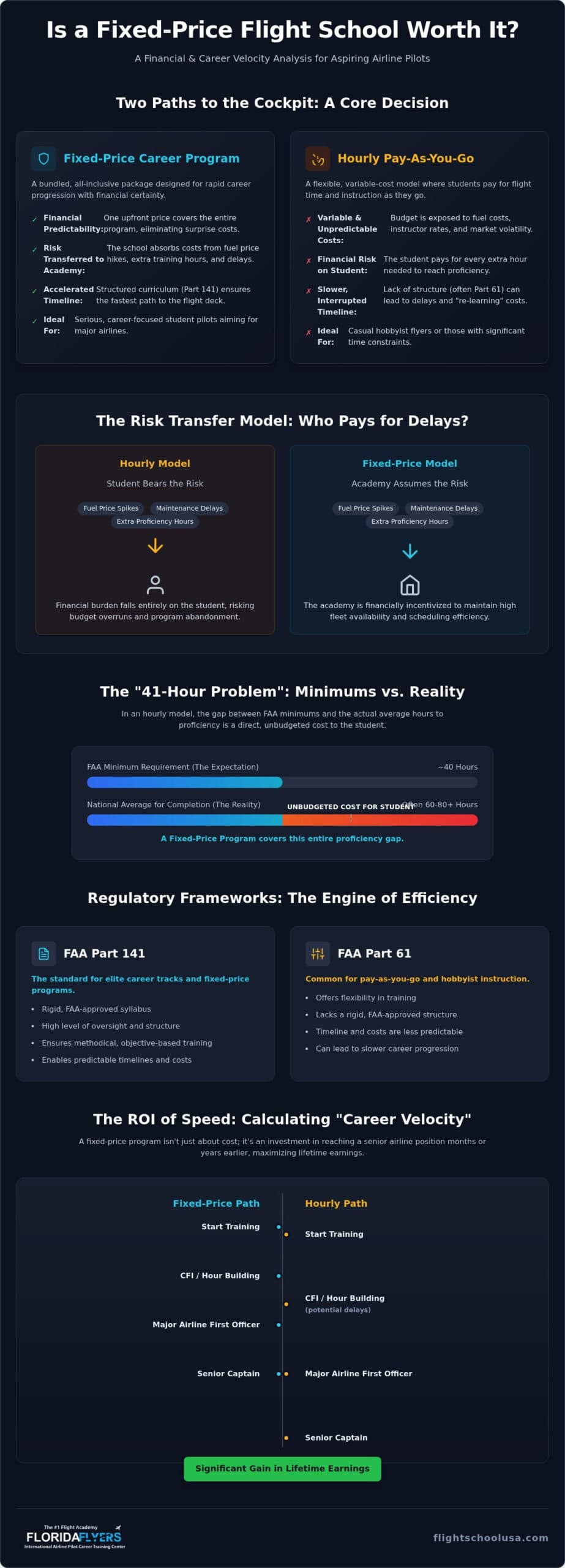
In an hourly training model, the student pays for aircraft rental and instructor time as they use it. This variable-cost structure appears low-risk initially, but it leaves the student entirely exposed to the “41-Hour Problem.” While FAA certification standards may list minimum hour requirements for a rating, the industry average for completion is significantly higher. In an hourly environment, every additional hour required to reach proficiency is an out-of-pocket expense that can lead to training abandonment when funds expire mid-program.
Conversely, a Fixed-Price Career Program functions as a bundled professional package. It hedges against the primary disruptors of the current market: sudden fuel price spikes and high instructor turnover. By locking in a rate, the student secures their pathway to the flight deck regardless of how the underlying operational costs fluctuate during their enrollment. This model demands a higher level of discipline but offers a level of security that the hourly model lacks.
The primary distinction between these models is the allocation of financial risk. In a traditional hourly school, the student bears the cost of every inefficiency; if an aircraft is grounded for maintenance or a flight is canceled due to weather, the student loses time and often faces “re-learning” costs in subsequent sessions. Fixed-price models invert this relationship entirely.
When an academy offers a flat rate, they assume the financial burden of additional proficiency hours and aircraft downtime. This creates a powerful incentive for the institution to maintain an elite fleet with high availability and reliable scheduling. Fixed-Price Training is a strategic contract where the academy assumes the financial burden of additional proficiency hours to ensure the student reaches the required standard without escalating costs.
The predictability of a fixed-price program is rooted in its regulatory framework. Most “pay-as-you-go” instruction occurs under Part 61, which offers flexibility but lacks the rigid, FAA-approved syllabus required for rapid career progression. Elite career tracks almost exclusively utilize Part 141 standards to maintain a strict timeline.
Part 141 schools operate with a level of oversight that ensures every hour in the cockpit contributes directly to a specific learning objective. This structure allows academies to offer guaranteed pricing because the training outcome is predictable and methodical. Understanding the Part 141 flight school advantage is essential for any student who demands a disciplined, professional environment over a casual hobbyist approach.
Určení, zda is a fixed price flight school worth it requires a shift from basic accounting to high-level financial strategy. You aren’t merely purchasing flight hours; you’re securing a time-to-market advantage. The “Career Velocity” metric evaluates the fiscal impact of entering a major carrier’s seniority list six months earlier than peers. According to the official pilot career outlook, which projects significant demand and elite salary trajectories, those six months represent a massive gain in lifetime earnings at the top of the seniority scale. A fixed-price model ensures your trajectory remains uninterrupted by the financial friction common in variable-cost programs.
To find the true ROI, you must calculate the Total Cost of Attendance. This includes often overlooked variables such as housing logistics, M1 visa processing for international candidates, and the cost of capital. A “dry” hourly rate might look attractive on a spreadsheet, but it lacks the structural support of an integrated academy. When you factor in the efficiency of on-site student housing and the elimination of “knowledge decay” through full-time immersion, the value of a bundled program becomes clear. If you’re ready to evaluate your specific transition, you can review our professional enrollment requirements to see how our structured tracks align with your goals.
Your first task is to research realistic completion timelines rather than regulatory minimums. While the FAA permits a Private Pilot Certificate at 40 hours, the national average in 2025 was closer to 24 weeks of consistent training. If you’re a part-time student, your timeline expands, and your costs in an hourly model will balloon due to the necessity of repeat lessons. Accelerated tracks demand the financial certainty of a fixed price because they operate on a high-intensity schedule where any budget shortfall could halt your progression and void your momentum. Assessing whether you have the “Fixed-Price Mindset” for full-time immersion is critical before committing to an elite academy.
In the 2026 aviation market, fuel surcharges and instructor rate increases are the primary drivers of budget overruns. Hourly students are tethered to these market fluctuations, often facing mid-program price hikes that they didn’t anticipate. Multi-engine training is particularly sensitive to these shifts, as the operational costs of complex aircraft are significantly higher. By utilizing a strategic guide to pilot costs, you can see how fixed-price programs act as a hedge against these 2026 economic pressures. This protection allows you to focus strictly on checkride proficiency rather than the fluctuating price of AvGas or the rising hourly rates of senior instructors.
To accurately assess if is a fixed price flight school worth it, one must dissect the specific components that constitute a professional career package. Many regional schools advertise a low entry price while burying essential costs in the fine print; however, an elite academy provides a transparent breakdown of every required resource. A comprehensive program should include all ground school instruction, simulator allocations, and pre- and post-flight briefings within the initial quote. This transparency is vital for maintaining a disciplined training schedule without the financial friction of incremental billing for every briefing session.
A critical ROI factor often overlooked is the status of FAA self-examining authority. Elite Part 141 institutions frequently hold this designation, allowing them to conduct checkrides in-house rather than waiting for the availability of a Designated Pilot Examiner (DPE). In the current market, DPE backlogs can delay a student’s progress by weeks or even months. When evaluating if is a fixed price flight school worth it, the ability to move through certification milestones without external scheduling delays represents a significant career advantage. Furthermore, the inclusion of M1 Visa admission services is a logistical prerequisite for international students, ensuring that regulatory compliance is handled with professional precision.
Modern glass-cockpit training is non-negotiable for anyone pursuing the airline pilot career path. Fixed-price academies often invest in newer fleets to reduce maintenance-related training pauses, ensuring that students remain on schedule. These programs typically provide Electronic Flight Bags (EFB) and premium software subscriptions, such as ForeFlight, as part of the bundled cost. By training on the same technology used in commercial flight decks, students develop the technical proficiency required for high-stakes airline transitions from day one.
The ROI of on-site student housing extends far beyond mere convenience. By living in a residential environment dedicated to aviation, students benefit from full-time immersion that significantly increases first-pass rates on FAA checkrides. Eliminating a daily commute allows for more intensive study sessions and peer-to-peer briefings, which are essential for mastering complex regulatory codes. These residential hubs also serve as professional networking centers, where future airline pilots build the industry connections that will support their careers for decades to come.
Success in a professional aviation career requires more than just financial capital; it demands a specific psychological profile. Before committing to an elite academy, you must determine if you possess the “Fixed-Price Mindset” necessary for high-velocity training. While casual flyers might find the flexibility of an hourly model appealing, those pursuing a Commercial Pilot License must decide if is a fixed price flight school worth it based on their ability to treat training as a full-time professional enlistment. A discovery flight at a prospective academy should serve as a strategic audit of their operational efficiency and aircraft maintenance standards rather than a simple introduction to flight. You are evaluating whether the school’s infrastructure can support the aggressive timeline promised in a flat-rate contract.
Securing the necessary liquidity is a non-negotiable prerequisite for enrollment in any premier career track. You should conduct a rigorous comparison between private personal loans and specialized flight school financing to identify the most sustainable path for your specific situation. For those with military service, the ability to deploy GI Bill flight training assets into a fixed-price program can significantly offset the initial investment and improve your overall ROI. Students who enter training with their funding fully secured often exhibit superior performance. The elimination of mid-training financial anxiety allows for total cognitive immersion in the complex regulatory and technical requirements of the FAA curriculum, leading to higher first-pass rates on critical checkrides.
Fixed-price programs are built on a strict 5-day-a-week cadence that mirrors the training environments of major airlines. This high-velocity schedule is designed to maximize knowledge retention and minimize the re-learning costs associated with the frequent training gaps found in hourly instruction. However, this structure carries an inherent risk; students must maintain specific progress milestones or risk falling out of the fixed-price agreement. You must realistically assess your ability to handle a full-time immersion schedule and the high-stakes pressure of a professional academy before signing a contract. If you are prepared to meet these elite standards and demand a clear financial roadmap to the airlines, you should submit your Fixed-Price Career Program application to begin the formal vetting process and secure your training slot.
The Fixed-Price Career Program at Flight School USA is not merely a training curriculum; it’s a professional launchpad designed for those who demand excellence. By consolidating the entire training pipeline into a single, predictable financial structure, we eliminate the administrative friction that often stalls progress at lesser institutions. For the serious candidate, the answer to whether is a fixed price flight school worth it is found in the seamless integration of logistics, from M1 Visa Admission Services to on-site Student Housing. We act as the rigorous gatekeeper of your professional standards, ensuring that every hour spent in our glass-cockpit fleet contributes to your status as an elite aviator.
A key component of this integration is the CFI Fast Track Program. This track is specifically engineered to bridge the critical gap between commercial certification and the 1,500-hour airline requirement. By transitioning immediately into an instructional role within our disciplined environment, you maintain your training momentum while building the multi-engine and instructional time required for major carrier placement. This high-velocity progression is only possible in an academy that manages the entire lifecycle of a pilot’s development. Ultimately, the fixed-price model is worth it for the professional whose time is more valuable than a variable hourly rate.
The Airline Ready Program functions as the final bridge to the flight deck, shifting the focus from basic proficiency to professional command. You’ll train in a high-stakes, regulatory-focused environment that mirrors the compliance standards of Part 121 carriers. This immersion ensures that you’re not just a pilot, but a professional ready to manage complex systems under pressure. When evaluating the total investment, the airline pilot salary serves as the ultimate ROI justification. Reaching that compensation bracket months earlier through an accelerated, fixed-price track provides a financial return that far outweighs any perceived savings from a slow, hourly model.
Securing your position in our 2026 cohort requires immediate action. The enrollment process begins with a comprehensive audit of your career goals and financial readiness. For international candidates, our M1 Visa Admission Services provide a structured pathway through the complex regulatory requirements of US-based training. You should request a personalized training and career plan to establish your specific timeline to the airlines. If you are prepared to meet our high-performance standards, you must finalize your application to ensure your training slot is secured. The elite career pilot track is reserved for those whose time is more valuable than an hourly rate; it’s for those ready to command.
Rozhodování zda is a fixed price flight school worth it depends on your commitment to a professional timeline. A flat-rate model isn’t just about financial predictability; it’s a strategic hedge against 2026 market volatility and fuel price surges. By locking in your costs, you transfer operational risk to the academy and focus entirely on achieving “Airline Ready” status. Elite training requires more than just hours in a logbook. It demands a high-stakes environment supported by FAA Part 141 Professional Standards and on-site student housing for total immersion.
Whether you’re utilizing GI Bill flight training or require comprehensive M1 Visa support, a structured career track ensures you reach the flight deck with maximum velocity. Your time is your most valuable asset. Don’t let variable hourly rates and scheduling delays stall your lifetime earnings potential. The flight deck is waiting for those who prioritize discipline and strategic investment.
Secure Your Future: Apply for the Fixed-Price Career Program
Take the first step toward your commercial command today. Your professional pilot aspirations deserve the security of a proven, high-performance roadmap.
A fixed-price model often results in lower total costs by protecting students from “The 41-Hour Problem” and 2026 market volatility. While hourly rates appear lower on a per-unit basis, they leave you exposed to fuel surcharges and instructor rate increases. When determining if is a fixed price flight school worth it, you must factor in the risk transfer where the academy assumes the cost of additional proficiency hours required for certification.
Fixed-price programs are structured as comprehensive career packages rather than a simple bank of hours. If you reach proficiency before the allocated time, the remaining value is typically absorbed into the academy’s risk-management pool, which covers students who require extra time. This model prioritizes reaching the professional standard rather than tracking individual minutes. It ensures that every student achieves the high-velocity career progression required for airline placement without incremental billing.
Elite fixed-price programs generally include ground school instruction and simulator sessions, but external administrative fees like FAA written exam costs and Designated Pilot Examiner (DPE) fees vary by contract. It’s critical to review the “Airline Ready” agreement to see if these third-party expenses are bundled. Schools with FAA self-examining authority often provide a more streamlined testing process, reducing the logistical delays associated with external examiners who operate on independent schedules.
Yes, veterans can deploy GI Bill Flight Training benefits within structured career tracks. Flight School USA integrates these assets to support transition into professional aviation roles. This funding can be applied to specific certifications within the Fixed-Price Career Program, provided the academy maintains the required VA approvals and Part 141 certifications. This allows veterans to secure a predictable financial roadmap while pursuing their commercial pilot aspirations through a disciplined, high-performance curriculum.
The primary requirement is strict adherence to a high-velocity training cadence. Students must maintain a full-time commitment, typically five days a week, to avoid knowledge decay and stay within the contract’s performance milestones. If a student fails to meet these progress standards due to a lack of preparation or attendance, they risk voiding the fixed-price guarantee. This rigorous structure ensures only the most disciplined candidates reach the airlines while maintaining the school’s operational efficiency.
The academy assumes the financial burden of operational delays in a fixed-price model. Unlike hourly schools where students pay for the re-learning time caused by maintenance pauses, fixed-price academies are incentivized to maintain high aircraft availability. This risk transfer is a major factor when evaluating if is a fixed price flight school worth it, as it protects your budget from the unpredictable nature of aviation logistics and ensures the school prioritizes fleet reliability.
Specialized flight training financing is available and often preferred for fixed-price programs. Lenders favor these tracks because the total cost of attendance is clearly defined, reducing the risk of mid-training fund exhaustion. Students can secure personal loans or academy-partnered financing to cover the entire career package. This up-front capital allows for total focus on training milestones without the distraction of incremental payment deadlines, leading to higher first-pass rates on critical FAA checkrides.
International candidates are eligible for these programs through M1 Visa Admission Services. These services facilitate the legal requirements for full-time flight training in the United States. Elite academies provide the necessary structural support, including on-site student housing, to ensure international students can maintain the immersion required for a fixed-price track. This comprehensive approach simplifies the transition for those seeking to enter the global aviation market and ensures compliance with all federal training regulations.


