

Commercial aviation glamour is not an entry-level entitlement; it is an operational privilege earned through unyielding discipline and years of seniority. If you’re torn between promotional flight school marketing promising effortless travel and bitter online forums warning of endless reserve purgatory, your skepticism is justified. The true pilot lifestyle reality sits squarely between those two extremes. It’s governed far more by 14 CFR Part 117 duty limits, early-morning circadian fatigue, and sudden reserve callouts than relaxing tropical layovers.
Succeeding in this profession requires stripping away illusions to assess how airline scheduling and career progression actually function. We will deconstruct the authentic operational demands of modern line flying, tracking the seniority-driven progression from regional first officer to senior airline captain. Ahead, you’ll gain an objective breakdown of duty periods, fatigue management, and the disciplined strategy required to conquer the demanding early stages of a professional flight career.
Social media frequently portrays commercial aviation as an endless sequence of panoramic horizon views and exotic layovers. That stylized depiction overlooks the rigorous execution required on every flight deck. Choosing a career as an airline pilot means adopting a high-stakes operational routine governed by strict regulations, relentless weather variables, and precise flight schedules. The actual pilot lifestyle reality replaces casual wanderlust with methodical, uncompromising discipline.
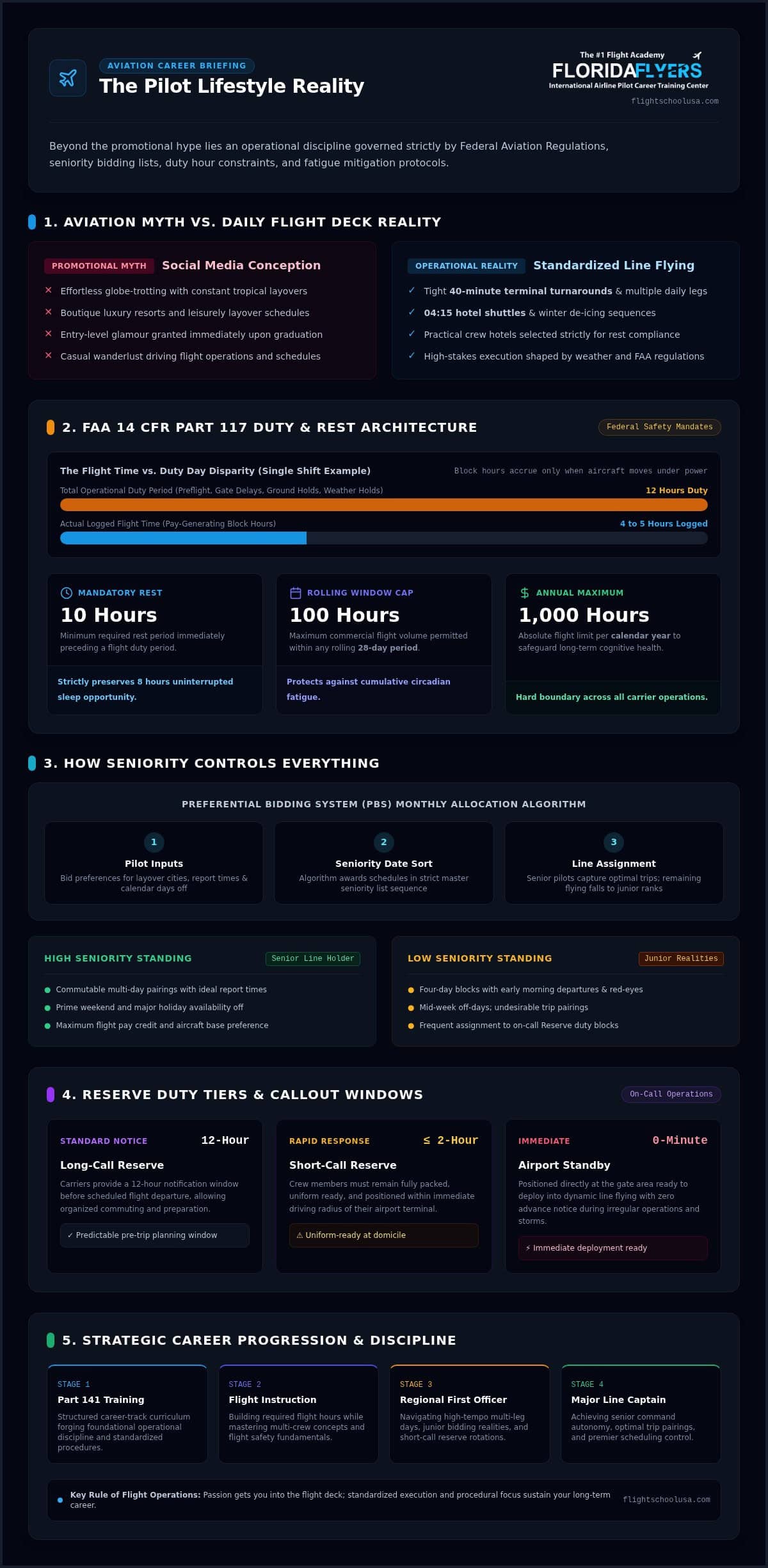
Promotional marketing rarely highlights 40-minute terminal turnarounds, winter de-icing sequences, or 04:15 shuttle departures from perimeter airport hotels. New airline first officers don’t spend their weeks at boutique luxury resorts; they execute multiple high-tempo flight legs each day, concluding rotations at practical crew properties selected strictly for rest compliance. Thriving in this environment demands a complete mental pivot. Passion gets you into the cockpit, but standardized execution and procedural focus sustain your long-term career.
The daily rhythm of an airline pilot is shaped by strict federal safety mandates. Under 14 CFR Part 117, the FAA establishes hard boundaries to balance operational demands against crew physiological limits:
Mastering these regulatory mechanics is essential. They govern your schedule, define your time away from home, and dictate the foundational pilot lifestyle reality you will encounter from your first day on the flight line.
In commercial aviation, performance reviews and personal charm don’t determine your schedule. Seniority does. Your relative position on the master seniority list dictates your aircraft type, base domicile, monthly days off, and holiday availability. Understanding how this system dictates the pilot lifestyle reality is critical before committing to the career.
Airlines use automated Preferential Bidding Systems (PBS) to build monthly lines. Every pilot inputs preferences for layover cities, report times, and specific calendar off-days. The algorithm then processes every request in exact order of company seniority date.
Junior pilots inevitably serve on reserve. On long-call reserve, carriers typically provide a 12-hour notification window before departure. Short-call reserve shrinks that response window to two hours or less, requiring crew members to remain fully packed, uniform ready, and positioned within driving radius of their airport terminal. During winter storms or widespread irregular operations, airport standby assignments can deploy you into dynamic line flying with zero advance notice.
Seniority is zero-sum, but it rewards career momentum. The U.S. Bureau of Labor Statistics projects sustained commercial cockpit demand in its long-term economic outlook, meaning accelerated retirements create swift vertical movement through the ranks. As thousands of senior captains reach the mandatory retirement age of 65, junior first officers advance rapidly into high-credit lines and faster captain upgrades.
Minimizing delays at the start of your training ensures you capture earlier seniority numbers, directly protecting your future quality of life. Candidates who commit to structured airline pilot career training build the standardized flight discipline required to complete airline training footprints without delay, establishing command authority much earlier in their careers.
Aviation subjects the human body to unique biological stresses. Cabin altitudes pressurized to 8,000 feet, relative humidity levels hovering below 15%, and irregular shift patterns create physical friction over a 30-year flying career. A fundamental pilot lifestyle reality is that operational longevity depends as much on personal physiological discipline as on stick-and-rudder competence.
Rapid transitions between early-morning report times and late-evening arrivals challenge your natural circadian rhythm. When sleep architecture degrades, micro-sleep risks rise and cognitive processing speeds drop, eroding essential safety buffers during complex instrument approaches. Line pilots counter this by actively engineering their rest environments:
Airport terminals and late-night hotel layovers rarely offer balanced nutrition. Relying on concourse fast food degrades cardiovascular health, directly threatening the strict blood pressure and metabolic standards required to maintain an FAA First-Class Medical certificate. Career pilots pack prepared, shelf-stable meals and maintain routine hydration schedules. Even on compressed layovers, disciplined crews prioritize consistent 20-minute bodyweight or resistance-band routines to counteract hours of sedentary flight deck operations.
Multi-day pairings naturally strain domestic routines. Birthdays, school functions, and unexpected household emergencies inevitably occur while you sit in a hotel thousands of miles away. Thriving under these conditions demands strong communication systems with family members and deliberate emotional compartmentalization. You must remain entirely focused during critical phases of flight, while actively prioritizing dedicated personal time during layovers to decompress and stay connected to home.
Professional flight training represents a capital-intensive commitment. Before taking on substantial debt or liquidating savings, aspiring aviators must examine the financial trajectory objectively. An honest appraisal of the pilot lifestyle reality requires contrasting early lean years against the compounding career equity achieved at major airlines. Prospective candidates should review current airline pilot salary benchmarks to build realistic expectations about early compensation against peak earnings.
The operational gap between earning a commercial certificate and reaching the 1,500-hour Airline Transport Pilot threshold is grueling. Most aviators bridge this gap through active flight instruction. Managing three to four student sorties daily means enduring turbulence, constant pattern work, and relentless instructional vigilance in non-air-conditioned training cockpits.
Speed during this stage matters immensely. Enrolling in an intensive CFI fast track program compresses your training footprint, positioning you to log billable instructional hours months sooner. Every month shaved off time-building translates directly into earlier airline seniority placement.
Once you secure seniority at a legacy carrier, the economic equation shifts decisively. Senior wide-body captains command compensation packages that rival executive C-suites, but their true wealth lies in unmatched calendar autonomy:
Accelerating your timeline through this economic curve is the single best operational decision you can make. Review your career trajectory and explore flight training pathways engineered to get you onto an airline seniority list without wasted time.
Commercial cockpit endurance isn’t an innate talent; it’s an operational discipline built during initial flight instruction. Casual flying clubs and unstructured training environments often cultivate casual habits, leaving candidates unprepared for airline ground schools and demanding simulator evaluations. Adapting successfully to the true pilot lifestyle reality requires institutional rigor from your very first preflight briefing.
Regional and major airlines rely strictly on standardized workflows. Candidates who spend their formative hours flying without rigorous callouts or formal checklist disciplines face severe friction during Part 121 qualification. Structured Part 141 flight training instills the operational reflexes required in transport-category cockpits:
Professional flight training must mirror the professional airline environment. Look for academies that operate structured dispatch facilities, enforce professional uniform codes, and mandate strict syllabus compliance. Unplanned delays and haphazard scheduling at local flying clubs stall career progress and extend time spent in low-time status.
Enrolling in a comprehensive fixed-price flight training program establishes clear operational milestones while keeping training timelines predictable. Elite carrier-oriented environments systematically condition you to handle unpredictable shifts, technical complexity, and high-tempo duty periods long before you sit in a commercial flight deck. Take command of your aviation trajectory by partnering with Isikolo seenqwelomoya eMelika today to build the professional foundation your airline career requires.
Thriving in commercial aviation requires respecting the system rather than wishing away its operational friction. The true pilot lifestyle reality is neither an ungrounded fantasy nor an endless trial. It’s a structured trade-off that rewards methodical preparation, diligent fatigue management, and unwavering procedural discipline. As you build seniority, unpredictable reserve rosters and tight multi-leg duty periods yield to exceptional calendar autonomy, schedule control, and major airline command.
Reaching that elite echelon demands a foundation built for airline standards. Flight School USA provides rigorous FAA Part 141 approved professional career flight training tracks alongside comprehensive Airline Ready programs designed for fast-track cockpit transitions. Through immersive training models that systematically build commercial flight discipline from day one, you develop the resilience required to navigate early career hurdles with confidence. Take command of your professional aviation career with Flight School USA and build the operational foundation your future flight deck demands.
Most commercial airline pilots work between 12 and 16 days per month. The remaining 14 to 18 days are completely free from duty. Junior pilots on reserve typically work closer to 16 duty days, whereas senior captains holding efficient lines often compress their monthly flight hours into 10 or 12 working days. Unlike corporate professions, days off are genuinely unencumbered by employer communications or work tasks.
Adapting to schedule volatility and irregular sleep routines represents the steepest challenge for first-year airline pilots. Transitioning from structured local flight training to multi-day line pairings tests physical stamina. The primary pilot lifestyle reality involves managing circadian disruptions across varying report times, navigating unpredictable reserve callouts, and maintaining physical recovery when sleeping in airport hotels away from home for several consecutive nights.
Reserve pilots serve as an on-call operational buffer to cover trip dropouts, sudden sickness, and weather cancellations. Carriers assign either short-call or long-call windows. Long-call reserve grants a 12-hour notification window before departure, while short-call requires reporting to the airport within two hours of dispatch notification. While on call, pilots must stay rested, uniform-ready, and legally compliant to deploy across the airline’s route network.
Yes, commercial pilots maintain thriving family lives by establishing intentional routines and clear communication channels. While multi-day pairings mean missing occasional weekend events, pilots benefit from large blocks of consecutive days off that standard corporate careers cannot match. When an airline pilot finishes a rotation and heads home, they have zero workplace obligations, allowing for concentrated, high-quality family focus without career distractions.
Failing or receiving a deferral on an FAA First-Class Medical exam temporarily grounds a pilot from Part 121 airline duties. Disqualifications rarely end a career permanently, however. The FAA provides a Special Issuance authorization process, permitting pilots with well-managed conditions to restore their medical privileges once compliance is proven. Professional aviators also maintain loss-of-license insurance to protect household finances during recovery and paperwork processing periods.
Seniority progression begins on your official date of hire and yields tangible schedule improvements within 12 to 24 months. Steady industry retirements accelerate movement up the master seniority list. As older captains retire, junior first officers gain bidding leverage to transition off reserve duty and secure preferred pairings. Understanding this timeline underscores the pilot lifestyle reality: early patience quickly converts into lasting schedule control.
No, airlines pay for all pilot lodging accommodations during scheduled layovers and company-directed training events. Collective bargaining agreements between pilot unions and carriers establish strict hotel safety, cleanliness, and soundproofing standards. Airlines contract pre-screened properties and provide direct shuttle transit to and from the airport terminal. Pilots also receive hourly per diem compensation to offset meal and incidental expenses while traveling on duty.


