

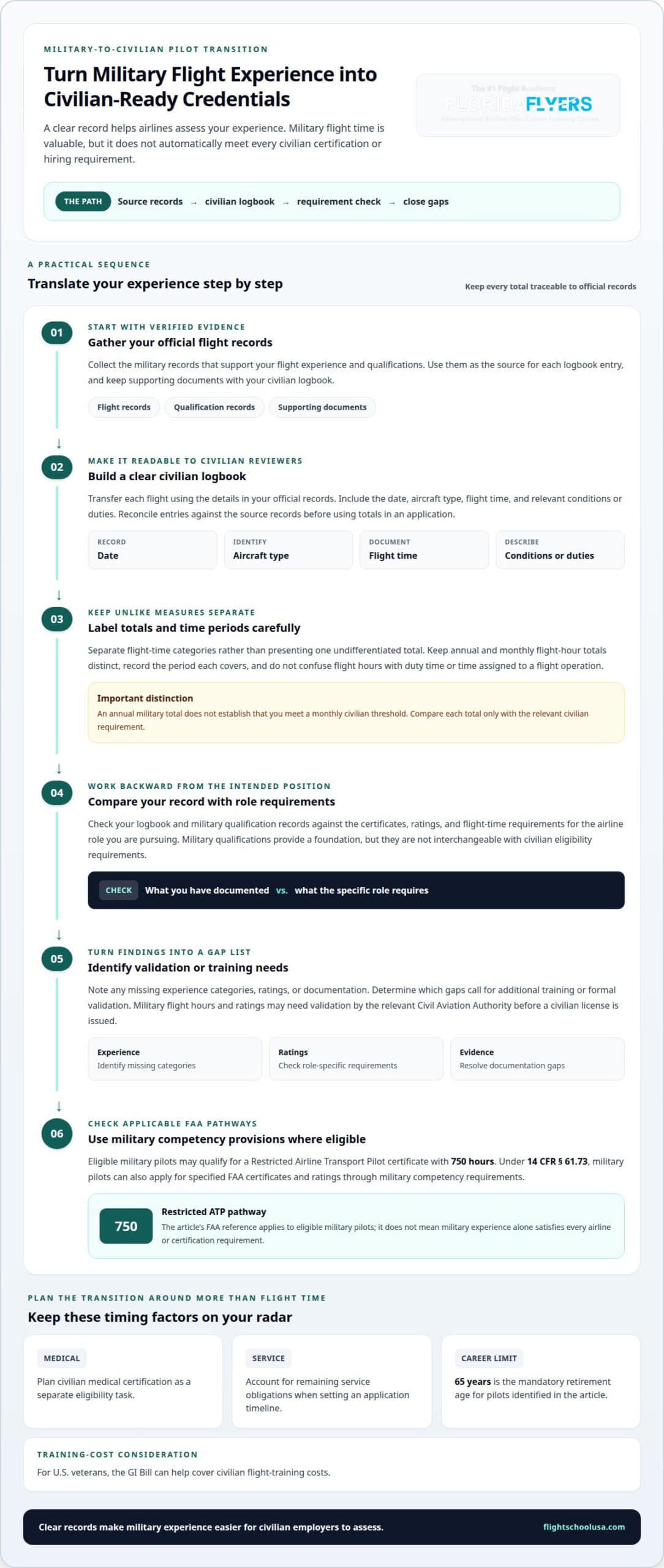
Military-to-civilian pilot transition challenges don’t automatically prevent an airline career, but military experience alone doesn’t mean you can move straight into an airline seat. According to the Federal Aviation Administration, eligible military pilots may qualify for a Restricted Airline Transport Pilot certificate with 750 hours; under 14 CFR § 61.73, military pilots can also apply for specified FAA certificates and ratings through military competency requirements.
The experience you bring is substantial, but civilian credentials, documented flight time, and airline application requirements still matter. Your hours and ratings need to be translated into the civilian framework, and you may need additional training to address gaps or meet the standards for a particular role. This guide explains how military flight experience counts, how to present it clearly on a résumé, and what to prepare before applying and interviewing. It also explores why pilots choose the transition, from pursuing a different aviation career path to planning for life after active duty.
Military flight hours can support an airline career, but they don’t automatically satisfy every civilian hiring or certification requirement. Civilian employers need a record they can evaluate, while FAA certificates and ratings depend on applicable civilian requirements. Military qualifications can provide a strong foundation; documented experience and any required additional training complete the picture.
Start by creating a civilian logbook that records your military flight experience in a clear, organized format. Transfer each flight using details from your official records, including the date, aircraft type, flight time, and relevant conditions or duties. Keep supporting military documents with the logbook, then reconcile the entries against those records before using the totals in an application. Separate the categories carefully instead of presenting one undifferentiated total. This helps reviewers understand the experience represented by each entry.
Military qualifications and airline hiring requirements overlap, but they are not interchangeable. Leadership, aircraft experience, and operational judgment can strengthen your candidacy, while civilian eligibility depends on the applicable certificates, ratings, and flight-time requirements. Military pilots need to translate their hours into civilian equivalents and document their ratings clearly. Hiring teams can then assess that experience against the requirements for a specific position.
Keep annual and monthly flight-hour totals distinct. They cover different periods and should not be confused with duty time or time assigned to a flight operation. Record the period covered by each total, then compare it only with the relevant civilian requirement. Military schedules and civilian operating frameworks may use different measures, so an annual military total does not establish that you meet a monthly civilian threshold.
To identify gaps, compare your logbook and military qualification records with the certificates and ratings required for your intended airline role. Note any missing experience categories, ratings, or documentation, then determine which require additional training or formal validation. Military flight hours and ratings may need validation by the relevant Civil Aviation Authority before a civilian license is issued. Clear records help make that review more efficient.
Medical certification, remaining service obligations, and age can affect transition timing. Plan for civilian medical certification as a separate eligibility task, and account for service commitments when setting an application timeline. The Electronic Code of Federal Regulations identifies 65 years as the mandatory retirement age for pilots, a relevant career-planning limit.
For U.S. veterans, the GI Bill can help cover civilian flight-training costs. Flight School USA offers GI Bill flight training, a pathway to consider as you plan the credentials and experience needed for civilian aviation.
An airline résumé must make military qualifications understandable to civilian hiring teams. Describe your aircraft experience, operational responsibilities, leadership, and relevant credentials in clear terms. Avoid unexplained military jargon and acronyms. A recruiter unfamiliar with a unit title or mission abbreviation may miss the experience behind it. Use plain aviation language, retaining official qualification names where they help verify your background.
Begin with the target position. Identify the experience and qualifications most relevant to that role, then place them where a reviewer can find them quickly. For example, describe the aircraft you operated, your responsibilities during flight operations, and the teams you led. Don’t rely on a military job title to communicate those details. Explain what you did and how it relates to civilian flying.
Audit your military experience before drafting. Compare your official records with each résumé entry, and make sure aircraft qualifications, ratings, flight experience, and accomplishments are described consistently. Distinguish verified qualifications from broader duties. If a role included both flying and leadership responsibilities, describe each separately rather than combining them in a claim that obscures your direct experience. This makes your profile easier to assess against an airline position.
Replace shorthand with accurate descriptions that civilian readers can understand. Expand an acronym at first use, or remove it when you can state the task clearly. For example, “led operational planning for flight missions” communicates more than an unexplained unit designation. Keep technical terms that identify meaningful aviation experience, but provide enough context for a hiring manager outside your military specialty.
Use a consistent structure for each experience entry: role, aircraft or operational context, responsibilities, and relevant results. Keep dates and qualifications aligned with your supporting records. Review every line for claims that need clarification, including abbreviations, military-specific titles, and broad descriptions such as “mission-ready.” Replace them with concrete duties or verified credentials. This final review protects accuracy while making your experience easier to understand.
Ask a civilian aviation mentor to review the resume for clarity. A fresh reader can flag language that makes sense within your service but not to an airline recruiter. Revise those lines, then check that the strongest qualifications appear prominently and the document supports the position you’re pursuing. For structured preparation around civilian aviation expectations, explore mafunzo ya ndege yanayolenga kazi as one possible next step.
Military pilots can pursue airline careers, but military experience alone does not complete the civilian certification process. In the United States, the route depends on your military qualifications and flight experience, the applicable FAA certificates, and any training needed to meet civilian standards. Airline eligibility and readiness to apply are related, but they are not the same.
According to the Federal Aviation Administration, military pilots may qualify for a Restricted Airline Transport Pilot (R-ATP) certificate with 750 hours, fewer than the hours required on civilian training tracks. That reduced threshold does not remove the need to establish eligibility, document military experience, and complete the applicable certification steps. It also does not mean every airline hiring requirement is automatically met.
According to the Federal Aviation Administration, a U.S. Restricted-Airline Pilot Certificate (R-ATP) allows military pilots with 200 hours of cross-country time to start the certification process. Treat that cross-country experience as one part of the record, not as a substitute for every other certificate or qualification. Organize supporting flight records and military qualifications before beginning the application process.
Under 14 CFR § 61.73, military pilots can apply for FAA commercial certificates, instrument ratings, or type ratings through specified military competency requirements. Start by identifying the civilian certificate or rating needed for your intended role. Then compare it with your military qualifications and prepare the supporting documentation. An FAA assessment or test may convert some military training into civilian credentials. One Air National Guard pilot said an FAA test converted military training into instrument, multi-engine, and aircraft ratings, according to the U.S. Government Publishing Office.
A Certificate of Eligibility relates to a separate military aviation pathway: FAA Airframe and Powerplant certification for maintenance technicians. For that process, the FAA assesses eligibility based on military occupational specialty, and technicians need a Certificate of Eligibility from their branch’s FAA-approved signature authority. It is not a pilot certificate. Military pilots should focus on the pilot certificates and ratings that match their flight experience.
Military pilots pursuing airline careers must obtain an FAA Airline Transport Pilot (ATP) certificate for commercial airline flying. The R-ATP pathway may apply, while the exact certificates, ratings, and additional training depend on your records and intended operation. Identify gaps early, including civilian certification requirements, relevant type ratings, or multiengine experience, then plan for the required tests or training.
There is no single transition timeline. The time required depends on how quickly you assemble your records, have your military qualifications evaluated, and complete any required FAA tests or additional training. Service obligations can also affect when you begin each step, so include them in your career plan.
A strong airline application connects your military experience to the specific civilian role. Start by reviewing the job posting and identifying its stated qualifications, responsibilities, and required documents. Then match each requirement with a clear example from your career. This gives your application a defined purpose and helps you prepare interview answers based on the same evidence.
Build a document set before submitting applications. Gather your current civilian certificates and ratings, flight records, and military qualification documents. Use consistent names and dates across all documents, and resolve discrepancies before they reach a hiring team. Keep a copy of every application you submit so you can prepare for questions about the experience and credentials you presented.
Prepare examples that demonstrate judgment, communication, leadership, and disciplined decision-making. Choose a specific situation, explain your responsibility, describe the action you took, and state the result. A military operational example can show how you handled changing conditions, coordinated a crew, or communicated a safety concern. Keep the explanation clear to an interviewer unfamiliar with your unit or mission.
A clear application profile can address military to civilian pilot transition challenges by showing how your experience fits civilian roles. Seek mentorship from experienced civilian aviators, too. Ask a mentor to conduct a practice interview for the airline role you’re pursuing. Have them flag service-specific terminology, unclear explanations, and answers that do not directly address the question.
Addressing military to civilian pilot transition challenges in an interview means explaining how you adapt to civilian operations. Describe your approach to procedures, teamwork, and communication in a civilian environment. For example, explain how you follow a standardized process while raising a concern through the appropriate channel. Ground your answer in your experience without suggesting military and airline operations are identical.
Before an interview, review the airline’s public description of its operation and the role’s stated duties. Prepare concise questions about the position, training expectations, and transition process. Avoid questions already answered in the job posting. A focused question shows that you have studied the opportunity and considered how your experience fits its responsibilities.
Finish your preparation with an accuracy review. Check that your application, interview examples, and supporting records describe the same qualifications. If a mentor identifies an unclear claim, revise it before submitting. This disciplined process turns a broad military career into a coherent airline profile, with every statement aligned with your documented experience.
Military pilots move into civil aviation for many reasons. Some want to continue flying after active duty, while others seek a different operating environment or career structure. The decision often combines professional goals with service commitments, family priorities, and long-term planning. Identify which factors matter most before choosing a transition timeline, since they shape the roles and qualifications to pursue.
Career timing is one practical consideration. Some pilots leave active duty around the 10-to-12-year mark to maximize their remaining working years before the mandatory retirement age of 65, as identified by the Electronic Code of Federal Regulations. That timing isn’t a universal rule. A pilot’s service obligation, personal plans, and civilian readiness all influence when to begin preparing.
Commercial aviation can provide a new professional setting in which to apply military flight experience. Discipline, leadership, and experience working as part of a crew can support civilian flying. But the shift also requires adapting to different regulatory frameworks, operational demands, and workplace cultures. Consider whether the airline environment fits your priorities rather than assuming familiar aircraft or procedures make the work identical.
For some aviators, the decision is also personal. A study of U.S. Army Special Operations Aviation transition experiences interviewed thirteen former aviators, crew chiefs, and flight medics who had left service within the past five years. It described transition as a personal and existential change, not just a set of logistical tasks. That finding underscores why career planning should include identity, family reintegration, and emotional well-being.
Financial planning matters, too. Civilian flight-training and certification costs depend on your existing credentials, required tests, additional flight training, and the qualifications needed for your intended role. Your costs depend on your individual circumstances. Veterans may also consider GI Bill support for eligible flight training as part of their planning.
Make the decision through a structured comparison. Write down your reasons for leaving, the civilian role you want, the credentials still required, and the service commitments that affect your timing. Then discuss the plan with a civilian aviation mentor and family members. This turns a broad goal into a practical transition strategy and helps clarify whether civilian flying fits your professional ambitions and personal priorities.
Flight School USA offers the Fixed-Price Career Program for aspiring pilots planning a professional aviation path. If your military experience leaves civilian training or career preparation steps to address, explore the Airline Ready Program and flight training options. Veterans can also consider GI Bill Flight Training as they plan their next credentials. International students can review M1 Visa Admission Services for flight training in the United States.
Use your documented experience and career goals to identify the training pathway that fits your next step. Contact Flight School USA to discuss your aviation training plans.
Military to civilian pilot transition challenges are easier to manage when your next move reflects your priorities, not just your past role. Decide what you want civilian flying to provide: a new operating environment, a long-term professional path, or a way to continue flying after active duty. That decision can guide which opportunities deserve your attention.
Turn your goal into a working plan. Set out the credentials you still need, the documents to prepare, and the personal commitments that shape your timing. Revisit the plan as you learn more about civilian roles. A deliberate process helps you make decisions with purpose instead of treating each application as a separate leap.
When you’re ready to discuss a career-focused training path, wasiliana na Shule ya Ndege Marekani. Bring your experience, goals, and questions to the conversation, then take the next step with confidence.
Yes, military pilots can pursue airline positions once they meet the applicable FAA certification and employer requirements. Military experience supports the application, but it does not replace civilian credentials. The Federal Aviation Administration’s Restricted Airline Transport Pilot pathway may apply to eligible military pilots. A practical first step is to identify the certificate required for your target position, then compare it with your current qualifications before applying.
You need an FAA Airline Transport Pilot certificate to fly in commercial airline operations, but preparing an application and meeting flight-duty qualifications are separate stages. Build your application profile while organizing the credentials required for the role. Military pilots may qualify for a restricted ATP pathway. Match your certificate status to the airline position’s stated requirements, and make your current qualifications clear in your application materials.
Yes, military flight hours can contribute to civilian pilot qualifications when properly documented and accepted for the relevant certification. Keep official records to support your flight experience, and organize the information so civilian reviewers can understand it. For example, separate aircraft experience and flight duties rather than presenting one unexplained total. This gives certification reviewers and airline hiring teams a clearer basis for evaluating your background.
Yes, the transition is achievable with disciplined preparation and a realistic plan. A successful shift involves more than transferring cockpit skills: it also requires learning civilian procedures, adapting to a different operating culture, and preparing for a new professional identity. Set a clear target role, identify its qualifications, and account for family reintegration and personal well-being alongside career tasks.
Choose a flight school based on the training gap you need to close and your intended aviation career. A veteran pursuing civilian certificates can consider GI Bill flight training, while someone preparing for airline employment can look at an Airline Ready Program. Compare the program’s stated training focus with your goals, records, and remaining qualifications. Flight School USA offers both pathways for pilots planning civilian aviation careers.
Start by defining the civilian role you want, then assemble your military qualification records and flight documentation. Write down the FAA certificates or ratings associated with that role and compare them with your current credentials. This creates a practical transition map: what you already hold, what needs evaluation, and what training or testing remains. A civilian aviation mentor can help refine the plan and prepare you for employer expectations.
Under 14 CFR § 61.73, military pilots can apply for FAA commercial certificates, instrument ratings, or type ratings through specified military competency requirements. The conversion process relies on matching military qualifications and supporting documentation to the civilian credential sought. An FAA test may also assess relevant knowledge. Keep official qualification records organized, and identify the specific certificate or rating needed for your intended civilian role.
The required testing and records depend on the certificate or rating you are pursuing. Prepare your military qualification documents and flight records, then identify the FAA testing steps for that credential. An Air National Guard pilot described an FAA test converting military training into instrument, multi-engine, and aircraft ratings, according to the U.S. Government Publishing Office. When possible, obtain relevant FAA certificates through an FAA-approved testing center before leaving military service.


