
Upplýsingar um starfsferil flugmanna


Could choosing 141 training change how you learn to fly without guaranteeing a faster license or an airline job? The key distinction is that FAA Part 141 governs an approved flight-training framework, not a pilot certificate. It sets expectations for a school’s approved courses and structured instruction, while you still have to meet the standards for the certificate or rating you’re pursuing.
If the numbers and terminology make Part 141 hard to compare with other training routes, you’re not alone. This guide explains the regulation in plain language, how an approved course is organized, and what lower minimum-hour requirements do and don’t mean for your training. You’ll also learn what to compare when evaluating a flight school, including its curriculum, progress checks, schedule, and student support.
We’ll clarify the difference between Part 141 and Part 61, explain what can shape your training experience, and show why a regulation alone can’t promise a particular result. As one practical example, Flight School USA holds FAA Part 141 approval and Self-Examining Authority. The latter is a separate credential, not an automatic feature of every Part 141 school.
Part 141 is an FAA framework for approved pilot-school training. It describes how a school is certified to provide specific pilot-training courses under the relevant federal rules. The approval applies to the school and its courses, not to the student as a personal qualification.
That distinction matters. “Part 141 student” is informal shorthand for someone training through an approved course; it isn’t a certificate the student will receive. The training goal might be a Private Pilot License (PPL) or Commercial Pilot License (CPL), but those are separate pilot credentials earned by meeting applicable requirements. Part 141 sets a training framework, not a promise of completion time, test results, or career outcomes.
14 CFR refers to Title 14 of the Code of Federal Regulations, which contains federal rules concerning aeronautics and space. Part 141, titled “Pilot Schools,” addresses pilot-school certification and the operation of schools conducting approved training courses. In practical terms, an FAA-approved school delivers training through courses accepted under this framework. Part 141 is not a student credential.
The distinction can help make sense of pilot flight training pathways, including the separate regulatory frameworks students may encounter. The Part 141 label identifies a school’s approved training context; it doesn’t describe every detail of a student’s day-to-day instruction or mean that every school’s course is identical.
Part 141 is neither a pilot license nor a flight rating. It refers to the regulations governing certificated pilot schools and their approved courses. A certificate or rating, by contrast, is a qualification a pilot may pursue and earn after satisfying the relevant training and testing requirements.
For example, a student could pursue a PPL or CPL through a course offered by an approved school. The school’s approval and the student’s eventual credential are different things: enrolling in a Part 141 course doesn’t itself grant a certificate or rating. The student must complete the applicable requirements and demonstrate the required knowledge and flying skills.
Keep this distinction in view when comparing training options. Identify the approved course, the certificate or rating it prepares you for, and how the school organizes instruction toward that goal. The regulatory label gives useful context, but the course itself connects training to the qualification you intend to pursue.
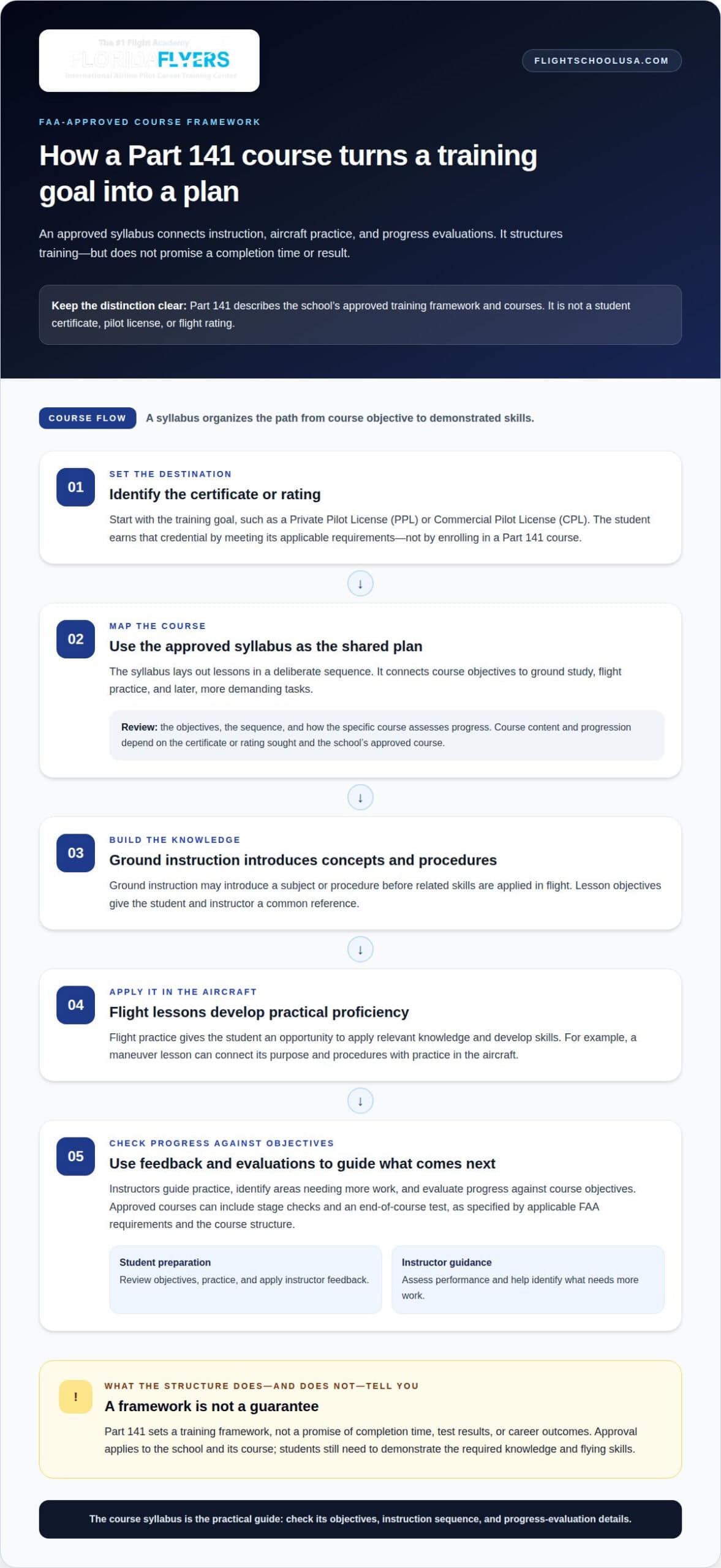
An approved course turns a broad training goal into a planned sequence of instruction and practice. Its syllabus connects ground study with the skills a student develops in the aircraft, giving the student and instructor a shared reference for course objectives. In short, an approved syllabus structures training by organizing lessons and practice around defined course objectives.
The FAA’s rules describe the framework for approved pilot-school courses, but a syllabus isn’t a universal script used identically at every school. Course content and progression depend on the certificate or rating sought and the school’s approved course. The Title 14 CFR Part 141 regulations provide the governing requirements; the course syllabus translates them into a training plan.
A syllabus lays out lessons in a deliberate sequence, so foundational knowledge and skills support later, more demanding tasks. Ground instruction may introduce a subject or procedure, while flight lessons give the student an opportunity to apply relevant knowledge and develop practical proficiency. For example, a lesson on a flight maneuver can connect its purpose and procedures to practice in the aircraft.
To make the syllabus useful, review the objective before each lesson, note what you need to practice, and use the instructor’s feedback to prepare for the next step. Approved courses can include stage checks and an end-of-course test, as specified by applicable FAA requirements and the course structure. These evaluations assess whether a student has met objectives for a phase or the course, rather than relying only on the number of lessons completed. The sequence and evaluation details can differ, so review the syllabus for the program you plan to take.
Instructors deliver training within the school’s applicable approved course, guide practice, and evaluate progress against its objectives. Their role isn’t simply to cover lesson topics. They help identify areas that need more work before a student advances. A defined curriculum provides structure, while instruction and evaluation address each student’s performance.
Approval applies to the school and its course, not to a student’s readiness. Students still need to prepare for lessons, apply feedback, and demonstrate the required knowledge and skills. Instructor guidance supports that work, but it doesn’t replace the student’s responsibility or guarantee a particular pace or result.
For prospective students, examine how the course links ground instruction, flight lessons, and progress evaluations. Look for clear course objectives and a process for communicating progress. Florida Flyers Flight Academy organizes structured flight training around defined training goals. Its flugmannaþjálfunaráætlunum offer a starting point for considering how that approach relates to your objectives.
Both frameworks govern routes to pilot certificates and ratings, but they organize training differently. Part 141 centers on FAA-approved pilot schools and their approved courses. Part 61 sets requirements for pilot certification and related qualifications, and training can take place outside a Part 141-approved course. The useful comparison isn’t “structured versus unregulated”; it’s how each route fits your learning preferences, schedule, and certificate goal.
Part 141 training takes place through a school’s approved course, with a syllabus that organizes instruction toward its objectives. Under Part 61, students and instructors follow the applicable certification requirements without relying on a Part 141-approved school course. The table summarizes the distinction without suggesting every school or student’s experience is identical.
| Íhugun | Hluti 141 | Hluti 61 |
|---|---|---|
| Reglugerðarumhverfi | Applies to certificated pilot schools and their FAA-approved courses. | Sets requirements for pilot certificates and ratings, among other aviation personnel qualifications. |
| Námskeiðsuppbygging | Training follows the school’s applicable approved course and syllabus. | Training follows applicable certification requirements; it isn’t dependent on a school’s Part 141-approved course. |
| Training arrangement | Delivered through an approved pilot school’s course. | Can be arranged with an authorized instructor outside a Part 141 course, subject to applicable rules. |
| Hvað á að bera saman | Course objectives, lesson progression, and how the school organizes instruction. | Instructor approach, training plan, and how instruction fits your needs. |
These are different regulatory frameworks, not a simple ranking. A Part 61 route can offer a different training arrangement, while an approved Part 141 course provides a defined school-based curriculum. In either case, the applicable certificate or rating requirements still matter. Don’t assume that a school’s approval tells you what every lesson includes or how your training will progress.
No. Part 141 approval doesn’t guarantee a shorter schedule, lower cost, stronger performance, or a particular result. Training pace depends on factors such as course design, student readiness, lesson scheduling, and the requirements for the goal. A structured curriculum may suit a student who values planned progression, but structure alone doesn’t determine the quality of instruction or the outcome.
Compare the training plan, not just the label. Review how the syllabus maps to your goal, how instructors assess progress, and what scheduling expectations shape your routine. Then weigh those details against your availability and learning preferences. Part 141 may suit someone seeking an organized school course; another route may suit a student who values a different training arrangement. Choose based on your goals and the applicable requirements, not on an assumption that one framework is automatically faster or superior.
Choose a course by examining what you’ll train for and how the school will support that objective. The Part 141 label tells you about the school’s regulatory framework; it doesn’t tell you whether a particular course, schedule, or learning environment is right for you. Use these four checks to assess the actual training path.
Read the course expectations carefully and identify the time and preparation required. Compare the planned progression with your availability for ground study and flight lessons, and consider whether you can sustain that commitment. If you’re an international student, include admission and study arrangements in your planning. A fixed-price flight training guide can help frame questions about how a defined training program is presented, while a Part 141 flight-school overview can clarify what school approval means. Use the actual course details to make your comparison.
Map course milestones to your intended progression. If your aim is commercial or airline flying, consider how the training sequence relates to certificates and ratings you may need over time. Career planning is broader than regulatory approval: approval describes a training framework, while a career plan should account for the qualifications and experience relevant to your objective. An airline pilot career training guide can provide context for that wider progression.
Keep the decision grounded in course content, instructor access, resources, and schedule expectations. Florida Flyers Flight Academy offers structured pilot training within an FAA-approved framework. Explore Florida Flyers flight training to consider how a structured course may align with your objectives.
Florida Flyers Flight Academy holds FAA Part 141 approval and applies the approved-school framework to its pilot training. Students train through structured courses toward specific aviation qualifications. The approval is a school credential, not an individual pilot certificate, and it doesn’t promise a particular timeline, check-ride result, or job outcome.
The academy offers Private Pilot License (PPL), Instrument Rating (IR), Commercial Pilot License (CPL), and Certified Flight Instructor (CFI) training. Each represents a distinct training objective. Start by identifying the qualification you want to pursue, then examine how the relevant course’s instruction and objectives align with that goal.
Structured training gives students a course framework, but individual progress still depends on meeting course requirements and demonstrating the required knowledge and flying skills. Program sequence and student experience vary by training objective. A PPL course and a CFI course, for example, prepare students for different qualifications and responsibilities, so they shouldn’t be assumed to have identical content or pacing.
Florida Flyers Flight Academy also holds Self-Examining Authority. This is separate from its Part 141 approval and permits the academy to conduct FAA check-rides in-house. It is a distinct academy credential, not an automatic feature of every Part 141 school. It doesn’t mean a student will pass; each applicant must demonstrate the required proficiency during the practical test.
When comparing programs, consider the training path as well as the starting course. Florida Flyers Flight Academy offers a Fixed-Price Career Program, CFI Fast Track Program, and Airline Ready Program. The academy also provides GI Bill flight training for veterans, M1 Visa admission services for international students, and student housing for full-time students. These options can help you evaluate how a program fits your career plans and student circumstances.
Before selecting a course, define your immediate target certificate or rating and your longer-term objective. Someone beginning flight training may first focus on private pilot qualifications, while a career-focused student may plan a progression that includes commercial and instructor training. Treat these as separate planning decisions: a course prepares you for its stated training objective, while a career plan considers how successive qualifications support your intended direction.
As you assess your next step, review the course structure and student expectations, then consider how the training fits your availability and preparation. Regulatory approval establishes a training framework; it doesn’t replace your responsibility to study, practice, and meet applicable standards. A school credential also doesn’t guarantee employment or a particular outcome. Make your decision with your goal, course requirements, and realistic training commitment in view.
Florida Flyers Flight Academy provides structured pilot training through FAA-approved courses and offers in-house check-rides under its separate Self-Examining Authority. Explore the academy’s programs and admission information to identify a course aligned with your aviation objective.
Your next step is to turn general knowledge into a plan that fits your ambitions. Consider where you’re starting, what kind of flying you’re working toward, and how training can fit into your life. Those priorities give you a stronger basis for choosing a course than the 141 label alone.
As you compare options, focus on the commitment you’re prepared to make and the support that will help you stay engaged. A professional flight-training path is built through steady preparation, sound instruction, and your own performance. Set a clear objective, then choose a next step that moves you toward it with confidence.
Florida Flyers Flight Academy offers training for students pursuing goals from foundational instruction to professional aviation pathways. Explore professional pilot training at Florida Flyers Flight Academy to take the next step toward defining your aviation future.
In flight school, “141” refers to the FAA rules in 14 CFR Part 141 that govern certificated pilot schools and their approved courses. It isn’t a pilot license or rating you earn. The number may also appear in unrelated search results, so use the surrounding context: references to the FAA, pilot schools, or flight instruction signal the aviation meaning. For a training decision, focus on the specific course involved.
Neither framework is automatically best for every student. One connects training to a school’s FAA-approved course; the other provides a separate regulatory framework for pilot training and certification. Compare the curriculum, flexibility, instructor access, and schedule with your goals. The applicable rules and course details matter more than a broad claim that one route is faster or produces better results. Let your preferred learning structure guide the decision.
Yes, commercial pilot training can be completed through an applicable Part 141 course, and Florida Flyers Flight Academy offers Commercial Pilot License training. Enrollment or school approval alone doesn’t award the certificate. Students must complete the relevant course, satisfy current FAA eligibility and experience requirements, and pass the required knowledge and practical tests. The course prepares you for that process, but it doesn’t guarantee a check-ride pass or a particular career outcome.
Part 141 concerns FAA approval of pilot schools and their courses, but approval applies to the particular school and course. The label doesn’t mean a student holds an FAA certificate, and it doesn’t identify every course a school may conduct. For a useful comparison, determine which approved course aligns with your goal, then distinguish the school credential from the pilot qualification you intend to pursue.
Not as a universal rule. Minimum aeronautical-experience requirements depend on the certificate or rating, the applicable regulation, and the specific approved course. A student may also need more training to develop the required proficiency. Don’t assume every student in this framework needs fewer hours or plan from a general comparison. Use current FAA requirements and the course details that apply to the qualification you’re pursuing.
There isn’t a universal completion timeline based only on school approval. Duration varies with the course, student readiness and progress, scheduling, weather, and access to training. A student able to maintain a steady lesson schedule may have a different timeline from someone with limited availability. Review the program’s expectations and plan around your circumstances rather than treating the regulatory framework as a promised finish date.
Only when the school holds specific authority to conduct them; approval as a pilot school alone doesn’t grant blanket permission for in-house practical tests. Florida Flyers Flight Academy holds Self-Examining Authority, which permits it to conduct FAA check-rides in-house. That authority concerns who may administer the exam, not the result. Each applicant must still prepare and demonstrate the required proficiency, and the credential doesn’t guarantee a passing check-ride.