
In 2026, the aviation industry is projected to hire approximately 8,000 pilots, marking the third-most aggressive recruitment year in U.S. history. This surge in demand highlights a critical crossroads for aspiring aviators who must weigh the pros and cons of being an airline pilot against the reality of a high-stakes professional environment. You likely understand that the path to the flight deck requires an elite level of discipline and a substantial investment in technical certification. It’s a career that demands excellence and offers unparalleled status, yet the risks of medical disqualification and training costs remain valid concerns for any serious candidate.
This evaluation analyzes whether the long-term career yield justifies the rigorous training investment required for commercial operations. We provide objective data on 2026 compensation structures, where senior captains at major carriers now earn $350,000 or more annually. You’ll gain a clear understanding of how the seniority system dictates your quality of life and receive a methodical roadmap for the most efficient training track. We’ve structured this guide to focus on the regulatory and financial metrics that define a successful aviation career.
A professional pilot’s career isn’t a casual pursuit; it’s a high-discipline mission executed within a strictly regulated framework. When you evaluate the pros and cons of being an airline pilot in 2026, you’re looking at a landscape defined by precision and procedural excellence. The days of the “hobbyist” pilot are over in the commercial sector. Today’s major carriers demand candidates who have been forged in high-performance environments that prioritize FAA Part 141 standards. This professional track ensures that every hour in the logbook translates to operational readiness, moving you beyond mere flight hours toward true mastery.
The current hiring market has shifted from the frantic post-pandemic surge into a calculated replacement cycle. Projections for 2026 indicate that approximately 8,000 pilots will be hired, making this the third-largest recruitment year in U.S. history. This demand is fueled by the 4,300 pilots reaching the mandatory retirement age of 65 annually. With over 16,000 retirements expected over the next five years, a unique strategic window has opened for entry-level pilots. Major airlines are aggressively recruiting from regional carriers to fill captain seats, which accelerates seniority growth for new first officers entering the system now.
Navigating the path to the cockpit requires a sophisticated understanding of FAA pilot sertifikasyon gereksinimleri and the mandatory 1500-hour rule. On February 13, 2026, the FAA issued OpSpec A134, a rule requiring all Part 121 carriers to ensure hiring is exclusively merit-based. This means your technical aptitude and training record are under more scrutiny than ever before. Elite academies don’t just teach you to fly; they prepare you for the high-stakes reality of FAA medical compliance and checkride standards from day one. By choosing airline pilot career training that mirrors these professional expectations, you position yourself as a premier candidate in a competitive market. Understanding the pros and cons of being an airline pilot requires recognizing that while the regulatory burden is high, it serves as the ultimate gatekeeper for an elite, high-yield profession.
The professional yield of a commercial aviation career remains one of the most compelling arguments for those evaluating the pros and cons of being an airline pilot. By 2026, the financial trajectory for pilots has reached unprecedented levels, rewarding those who navigate the training pipeline with precision. Beyond the technical satisfaction of flight, the role offers a level of societal prestige and institutional authority that few other modern professions can match. This isn’t merely a job; it’s a command position within a global infrastructure.
The current airline pilot salary structure reflects a market that values experience and safety records above all else. While the U.S. Bureau of Labor Statistics reported a median annual wage of $226,600 in 2024, senior captains at major carriers in 2026 frequently exceed $350,000 in total compensation. This figure is augmented by significant sign-on bonuses at regional levels, which currently range between $70,000 and $90,000 for first-year first officers.
According to the Occupational Outlook for Airline Pilots, the demand for qualified aviators continues to drive aggressive retirement funding and profit-sharing models. Total yield is further enhanced by:
Commanding a multi-million dollar aircraft provides more than just a paycheck; it offers a lifestyle defined by global mobility. The strategic advantage of non-revenue travel allows pilots and their families to access worldwide destinations at a fraction of the commercial cost. This perk is a cornerstone of the profession’s appeal, providing a level of personal freedom that is difficult to quantify for those outside the industry.
Once you establish seniority, the ability to commute from your preferred living location becomes a viable reality. This flexibility, combined with the “office with a view” at 35,000 feet, creates a work environment that is consistently ranked among the most desirable in the transportation sector. Balancing the pros and cons of being an airline pilot requires a realistic view of the progression from trainee to captain. Engaging in elite airline pilot career training ensures you meet the rigorous demands of 2026 carriers and secure these high-yield benefits early in your career.
While the financial rewards of the cockpit are elite, a thorough evaluation of the pros and cons of being an airline pilot must address the significant operational demands of the role. This is a high-consequence profession where personal freedom is often secondary to regulatory compliance and institutional hierarchy. Success in this field requires a specific temperament capable of managing extreme discipline under the “Law of the List.” You aren’t just flying an aircraft; you’re navigating a rigid corporate and federal structure that demands total commitment from day one.
Your hire date is the most critical metric in your professional life. This seniority number dictates your airframe, your geographic base, and your monthly schedule. New pilots start on “Reserve” status, essentially acting as on-call assets for the airline. This often results in working during holidays, weekends, and significant life events without much notice. The transition from Reserve to “Line Holder” status, where you possess the authority to bid for specific routes and days off, can take years depending on the carrier’s growth and retirement rates. The first five years of a commercial career demand the highest level of personal discipline as you navigate the bottom of the seniority list and prove your reliability to the organization.
The physical toll of commercial aviation is a primary operational concern that many newcomers underestimate. Long-haul missions and irregular duty cycles lead to circadian disruption and cumulative fatigue. While FAA Part 117 rest requirements provide a legal framework for safety, the actual burden of fatigue management falls on the individual pilot’s shoulders. According to the Bureau of Labor Statistics Pilot Career Outlook, pilots frequently encounter variable schedules that include overnight shifts and extended periods away from their home base. This irregular rhythm can strain social and family structures, requiring a robust support system and an adaptable lifestyle.
Maintaining your position in the flight deck is contingent upon a clean professional and medical record. You’ll face high-stakes FAA medical examinations annually, or semi-annually for captains over age 40. A single medical disqualification or a lapse in professional judgment can end a career instantly. This constant pressure ensures that only the most disciplined professionals remain in command. It’s not just about the technical ability to fly; it’s about the capacity to sustain elite standards and perfect health over a 30-year career. Any deviation from these standards carries the risk of immediate grounding, making the pros and cons of being an airline pilot a daily calculation for those in the cockpit.
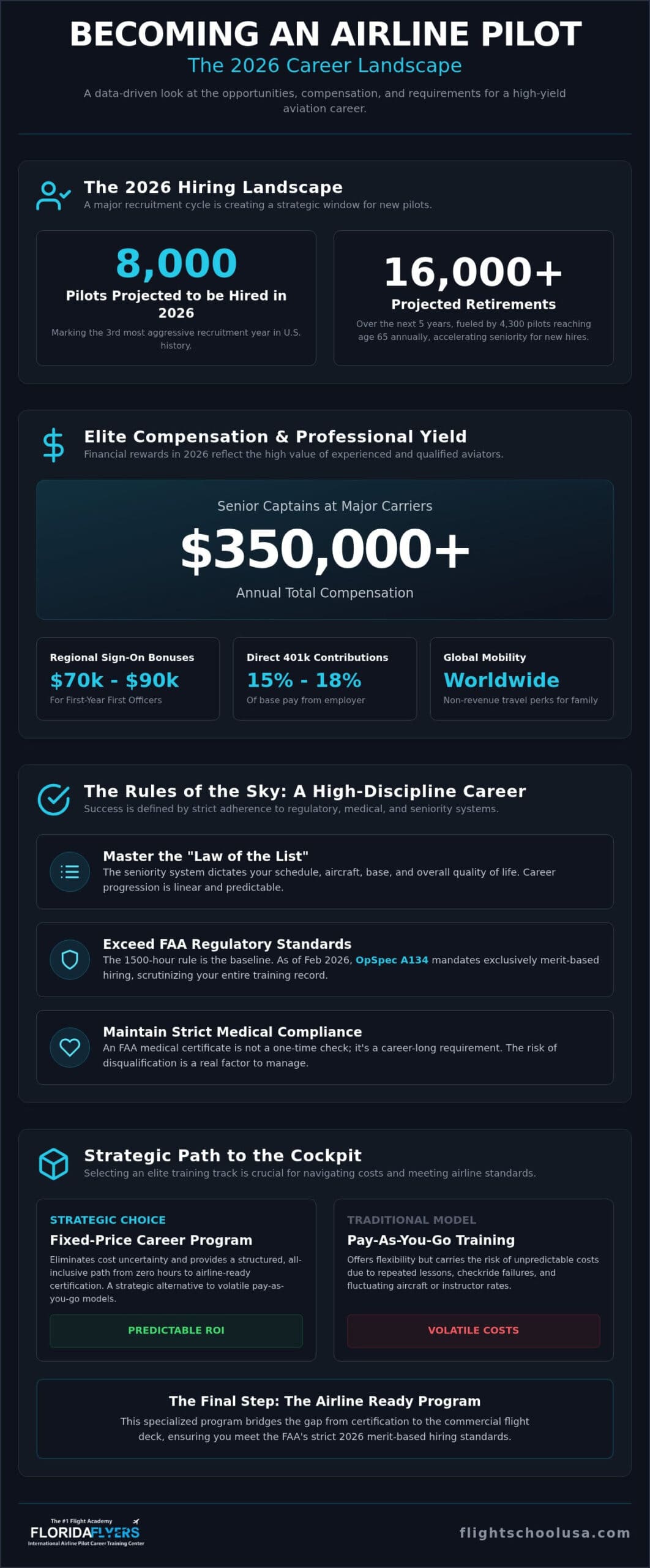
The financial commitment required to reach the flight deck of a major carrier is a significant component when analyzing the pros and cons of being an airline pilot. A full professional pilot program in 2026 typically requires an investment between $80,000 and $150,000 to navigate from zero experience to a commercial multi-engine rating. While these figures are substantial, you must view them as a tactical capital expenditure rather than a mere expense. The ROI is realized through accelerated seniority growth, where every month saved in training translates to thousands of dollars in career-end earnings. Analyzing the pros and cons of being an airline pilot includes a cold calculation of this debt-to-income ratio, ensuring the training investment aligns with 2026 salary scales.
Traditional flight schools often utilize a “pay-as-you-go” model that exposes students to significant financial volatility. Hidden fees, fuel surcharges, and maintenance delays can inflate the total cost far beyond the initial estimate. In contrast, fixed-price flight training programs offer mission certainty by capping the investment required for specific certification milestones. This model eliminates the risk of slow-paced training, which carries a high opportunity cost. A student who takes 24 months to reach 1500 hours versus one who completes an accelerated track in 12 months loses a full year of seniority, potentially costing over $100,000 in first-year regional salary and starting bonuses.
Maximizing available funding assets is critical for optimizing your professional ROI. Veterans can leverage the GI Bill for CFI training to eliminate or significantly reduce out-of-pocket costs, turning military service into a direct bridge to a commercial cockpit. For international candidates, utilizing M1 Visa Admission Services allows for immersion in the U.S. FAA training environment, which remains the global gold standard for technical prestige. Reducing the logistical burden through student housing further ensures that 100% of your focus remains on academic and practical mastery.
The 2026 pilot market rewards those who treat their education as a high-performance career track. By selecting a program that offers cost certainty and professional placement support, you mitigate the financial risks inherent in aviation. To secure your position in the next hiring wave, you should evaluate the Fixed-Price Career Program as your primary pathway to the flight deck.
The final phase of evaluating the pros and cons of being an airline pilot involves selecting the specific vehicle for your professional ascent. A premier academy is not merely a flight school; it’s a high-performance institution defined by its maintenance protocols, instructor technical proficiency, and a curriculum that exceeds basic regulatory requirements. You must follow a structured airline pilot career training roadmap to ensure your progression remains synchronized with the 2026 hiring cycle. Stalling in a disorganized training environment doesn’t just delay your career; it carries a massive opportunity cost in lost seniority.
Training within an FAA Part 141 environment is essential for those who demand institutional excellence. This structure mirrors the operational rigors of a Part 121 carrier, instilling a “standard operating procedure” (SOP) mindset from your first hour. You’ll develop critical Multi-Crew Cooperation (MCC) skills and master complex systems through advanced simulation technology. This preparation ensures that your transition to a regional or major airline flight deck is a seamless professional evolution rather than a jarring technical shift. By training to these elite standards, you mitigate the “cons” of the profession by arriving at your first airline job with the discipline required to handle high-stakes operations.
The transition from student to professional instructor is the most efficient bridge to the 1500-hour ATP requirement. Utilizing a CFI fast track program allows you to build flight time while refining your command authority and technical knowledge. This phase is where the mental shift from “learning to fly” to “professional aviator” occurs. You are no longer just a pilot; you’re a custodian of safety and institutional standards.
Is the cockpit your professional destination? If you possess the discipline to navigate the rigors of the seniority system and the technical aptitude to master complex aerospace systems, the yield is undeniable. The 2026 aviation landscape favors the prepared and the persistent. You’ve analyzed the pros and cons of being an airline pilot; now you must decide if you’re ready for the responsibility of command. To begin your ascent, you must Execute your career mission with Flight School USA and secure your place in the next generation of elite aviators.
The 2026 aviation landscape offers a unique strategic window for those prepared to meet the elite standards of the commercial flight deck. You’ve analyzed the pros and cons of being an airline pilot, recognizing that the potential for $350,000 senior captain salaries and global mobility is balanced by the rigors of the seniority system and strict medical compliance. Success in this high-stakes profession requires more than technical skill; it demands a calculated training investment that prioritizes cost certainty and operational readiness. By choosing a path that mirrors airline standards from day one, you ensure your progression remains synchronized with the industry’s massive retirement wave.
To capitalize on the 16,000 projected retirements over the next five years, you must execute your training mission with an institution that functions as a gatekeeper of industry excellence. Flight School USA is an FAA Part 141 Certified Academy providing a Fixed-Price Career Training Guarantee to eliminate financial volatility. Our programs are M1 Visa and GI Bill approved, ensuring that both domestic veterans and international candidates have a clear roadmap to command. Now is the time to transition from an aspirant to a professional aviator. Apply for the 2026 Fixed-Price Career Program and secure your future in the cockpit. Your career as an elite commander starts with a single, decisive action.
First-year regional first officers can expect starting compensation between $70,000 and $90,000 per year in 2026. This base pay is frequently supplemented by sign-on bonuses and per diem rates as carriers compete for qualified talent in a replacement-heavy market. While senior captains at major airlines earn significantly more, these entry-level figures represent a strong initial return on your training investment. Securing a position during this cycle allows you to begin building seniority and retirement assets immediately.
The pilot shortage has transitioned into a steady replacement cycle driven by approximately 4,300 mandatory retirements annually. While the frantic hiring pace of previous years has normalized, major airlines still require 8,000 new pilots in 2026 to maintain fleet operations and replace exiting captains. This environment creates a continuous vacuum that pulls pilots up from regional carriers; it ensures that the long-term career prospects remain robust for those meeting elite technical standards.
Transitioning from zero experience to a commercial flight deck typically requires 18 to 24 months of intensive, full-time training. This timeline accounts for obtaining private, instrument, and commercial ratings before accumulating the 1500 flight hours required for ATP certification. Utilizing an accelerated track allows candidates to reach the airlines faster, maximizing their lifetime earning potential. Efficiency is critical because every month spent in training is a month of lost seniority at the major airlines.
Navigating the seniority system and managing “Reserve” status are the most significant hurdles for new first officers. During the first few years, your schedule and geographic base are dictated by your hire date; this often results in irregular hours and limited control over days off. Additionally, new pilots must master fatigue management while operating under strict Part 117 regulations. Understanding these pros and cons of being an airline pilot is essential for maintaining the discipline required during the early career phase.
Veterans can utilize GI Bill benefits for advanced flight training, although specific coverage depends on the program’s Part 141 certification. Generally, the VA provides funding for instrument, commercial, and multi-engine ratings, as well as CFI programs, once a private pilot license is obtained. This financial asset is a tactical tool for reducing out-of-pocket costs. You should verify your specific eligibility and remaining entitlement to ensure your training path is fully optimized for maximum professional benefit.
FAA Part 141 schools operate under a strictly structured, syllabus-driven environment that requires FAA approval for every training module. This mirrors the operational standards of commercial airlines and often allows for reduced flight hour requirements for certain certifications. Part 61 training offers more flexibility but lacks the institutional oversight found in 141 academies. For those seeking a professional career, the 141 track is the preferred standard as it instills the procedural discipline required by major carriers.
The seniority system functions as the absolute “Law of the List,” determining every aspect of a pilot’s quality of life. High seniority allows you to bid for preferred routes, specific aircraft types, and consistent days off, while those at the bottom of the list must accept remaining assignments. This hierarchy creates a career trajectory where lifestyle benefits improve exponentially over time. Balancing the pros and cons of being an airline pilot requires recognizing that early-career sacrifices lead to significant long-term professional autonomy.
Maintaining an FAA First Class Medical certificate is a mandatory requirement for all airline pilots, and certain conditions can lead to immediate disqualification. These include severe cardiovascular issues, uncontrolled diabetes, certain neurological conditions, and specific mental health diagnoses. Substance dependence or a history of significant medical non-compliance also present critical risks to your certification. Regular examinations ensure you meet the high-stakes physical and mental standards necessary for the safe operation of commercial aircraft in a high-pressure environment.