
Информације о каријери пилота авио-компаније


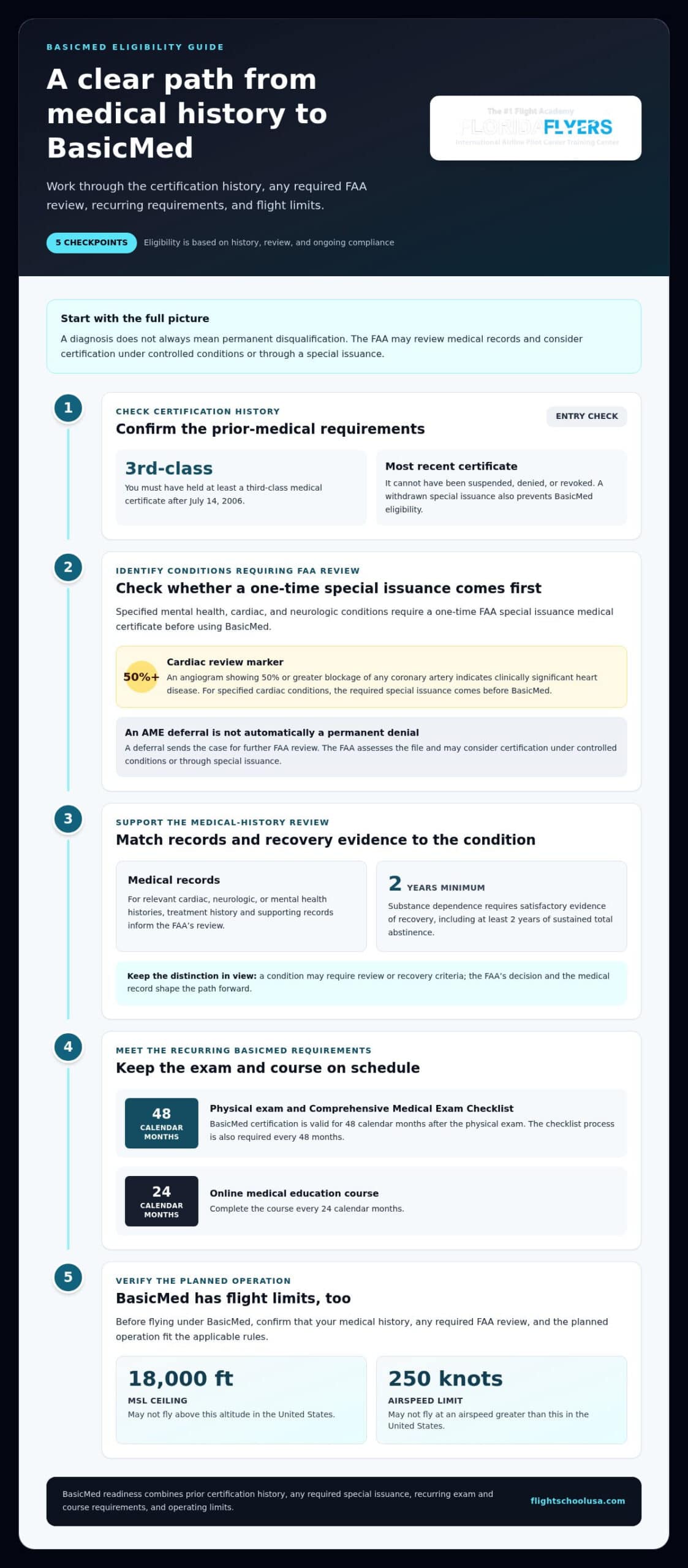
Some medical conditions prevent immediate BasicMed eligibility, but they don’t automatically end a pilot’s path to flying. The pilot medical certificate requirements include a prior medical certificate and, for specified mental health, cardiac, or neurologic conditions, a one-time FAA special issuance medical certificate before using BasicMed. An angiogram showing 50% or greater blockage of a coronary artery indicates clinically significant heart disease, while substance dependence requires evidence of recovery, including at least 2 years of sustained total abstinence.
It’s understandable to worry that a diagnosis means permanent disqualification. In many cases, the FAA can review medical records and consider a special issuance rather than treating a condition as an automatic, permanent bar. The key is to understand which rules apply to your history and what steps you must take before flying.
This guide explains BasicMed eligibility and conditions that can affect it, then covers vision, ECGs, hearing, medical examinations, certificate duration, and FAA MedXPress applications and renewals. You’ll learn what the examination involves and how to prepare for the next certification step.
Some medical histories affect BasicMed eligibility, but a diagnosis does not always mean permanent disqualification. BasicMed also has examination, course, and operating requirements that pilots must meet.
A disqualifying medical condition is a health issue that prevents medical certification unless the required review or recovery criteria are met. Certain mental health, cardiac, and neurologic conditions require a one-time FAA special issuance medical certificate before a pilot can use BasicMed.
Substance dependence is disqualifying for U.S. pilot medical certification unless the applicant provides satisfactory evidence of recovery, including at least 2 years of sustained total abstinence. A history of a condition therefore needs to be considered alongside its current status, treatment, and supporting medical records.
BasicMed eligibility also depends on prior certification history. The pilot must have held at least a third-class medical certificate after July 14, 2006, and the most recent FAA medical certificate cannot have been suspended, denied, or revoked. A withdrawn special issuance medical certificate also prevents eligibility.
Cardiovascular conditions are heart or blood-vessel disorders that may require additional FAA review before BasicMed use. An angiogram showing 50% or greater blockage of any coronary artery indicates clinically significant heart disease.
That finding affects the certification pathway, but does not by itself determine every later eligibility decision. For specified cardiac conditions, a pilot must first obtain a one-time FAA special issuance medical certificate before using BasicMed. The FAA reviews the applicant’s file to determine whether it can issue certification under controlled conditions.
An electrocardiogram, or ECG, records the heart’s electrical activity and may be part of a medical evaluation. Whether cardiac testing is needed depends on the condition and FAA review, not solely on BasicMed’s recurring physical-exam schedule.
An Aviation Medical Examiner (AME) denial or deferral occurs when the examiner cannot issue a medical certificate during the examination. Federal regulations require an AME to deny or defer certain medical conditions.
A deferral sends the case for further FAA review; it is not automatically a permanent denial. The FAA assesses the applicant’s file and may consider whether certification is possible under controlled conditions or through special issuance. This distinction matters when a condition requires more documentation or formal review beyond the examination.
For an applicant with a relevant cardiac, neurologic, or mental health history, the key step is to determine whether a prior special issuance is required before using BasicMed. The medical record and FAA decision shape the path forward.
Mental health conditions are diagnoses or histories that may affect medical certification and BasicMed eligibility. Pilots with specified mental health conditions must obtain a one-time FAA special issuance medical certificate before using BasicMed.
A diagnosis alone doesn’t describe the full certification picture. The FAA reviews the applicant’s file to determine whether certification can be issued under controlled conditions; treatment history and supporting records inform that review. Substance dependence has a separate recovery standard: satisfactory evidence must include at least 2 years of sustained total abstinence.
BasicMed certification is valid for 48 calendar months after the date of the physical exam, according to the Federal Aviation Administration. Pilots must also complete the online medical education course every 24 calendar months and the Comprehensive Medical Exam Checklist process every 48 months.
BasicMed has operating limits as well as medical criteria. In the United States, a pilot may not fly above 18,000 feet MSL or at an airspeed greater than 250 knots, according to the Federal Aviation Administration. Confirm that your medical history, required FAA review, and planned operation all fit the applicable rules before flying under BasicMed.
An FAA medical certificate’s duration depends on its class, the pilot’s age, and the privileges being exercised. How long is an FAA medical certificate valid by class and pilot age? First-class privileges last 12 months for pilots under age 40 and 6 months for pilots age 40 or older; second-class certificates last 12 months regardless of age. Third-class certificates last 60 months for pilots under age 40 and 24 months for pilots age 40 or older.
A medical certificate class sets the medical standard for particular pilot privileges; it is not a pilot certificate. Airline transport pilots need first-class privileges, while second-class privileges support commercial flying. Third-class certification serves other pilot operations. The appropriate class depends on the privileges you intend to exercise.
First-class vision standards measure whether an applicant can meet specified distance, near, and intermediate sight thresholds. Distant vision must be 20/20 or better in each eye separately, with or without correction. Near vision must be 20/40 at 16 inches. For pilots age 50 and over, intermediate vision must be 20/40 at 32 inches.
An electrocardiogram (ECG) records the heart’s electrical activity as part of the first-class medical examination. The first ECG is required at the first examination after age 35, then annually after age 40. Plan around those age-based milestones when scheduling the aviation medical examination, and bring relevant cardiac records if a known disorder affects the evaluation.
A second-class medical certificate is the medical certification associated with second-class privileges, including commercial pilot privileges. According to the Federal Aviation Administration, a second-class FAA medical certificate is valid for 12 months, regardless of the pilot’s age.
Certificate validity and the duration of first-class privileges are distinct: a certificate may remain valid even after higher-class privileges expire. Track the certificate class and the privileges you plan to exercise separately. This matters when a commercial pilot’s work requires second-class privileges, even if the certificate remains valid for a different class’s duration.
A third-class medical certificate is a medical certification used for pilot privileges that do not require a higher class. Third-class vision requires distance and near vision of 20/40 or better in each eye, with or without correction.
According to the Federal Aviation Administration, a third-class FAA medical certificate is valid for 60 months for pilots under age 40. For pilots age 40 or older, it is valid for 24 months. Compare your age on the examination date with the applicable duration, then schedule renewal before relying on an expired certificate for flight privileges.
These pilot medical certificate requirements connect medical planning with the privileges your career path demands. If commercial or airline transport flying is your goal, align medical-class planning with your flight training path and the privileges you intend to exercise.
A pilot medical examination assesses health against the privileges the applicant plans to exercise. The examiner and process differ for an FAA medical certificate and BasicMed.
An examination renewal interval is the period before a new medical evaluation is required for particular privileges. For a third-class FAA medical certificate, the Federal Aviation Administration sets validity at 24 months for pilots age 40 or older.
Certificate duration depends on class, age, and privileges, so track the applicable date rather than assuming every certificate follows the same schedule. A first-class certificate, for example, has a different duration from a third-class certificate. Under BasicMed, the physical exam follows its own schedule, separate from FAA medical certificate validity. Record the examination date and the next required renewal.
BasicMed examinations must be conducted by a state-licensed physician. A physician assistant or nurse practitioner cannot conduct and sign the examination instead of that physician. This distinction matters when arranging the physical: the clinician’s state license and role determine whether the completed examination meets the stated process. Use FAA Form 8700-2 for the Comprehensive Medical Exam Checklist, which the pilot and physician complete as part of BasicMed.
A medical examination is a structured review of health and function, with additional tests when an applicant’s circumstances call for them. A designated Aviation Medical Examiner (AME) conducts FAA medical certificate examinations, while BasicMed requires an examination by a state-licensed physician.
Expect the examiner to assess relevant medical history and conduct physical checks. Hearing is one concrete component: applicants must be able to hear a conversational voice at 6 feet with their backs turned to the examiner. The examination may also involve vision checks and evaluation of cardiovascular health, depending on the certificate class and medical history.
Bring relevant records, test results, and specialist evaluations so the examiner can accurately review your medical history. Pilots with a history of heart abnormalities may need repeat tests when previous results are more than six months old. An older result may no longer provide the evidence needed for the current assessment.
Examination fees vary by case, location, examination class, and required testing; the price is provided after a quote request. The fee is separate from certificate validity, which depends on class, age, and privileges, not the amount paid for the examination.
Before scheduling, identify whether you need an AME examination or a BasicMed physical, then gather records relevant to that route. Keep your certificate class and examination date together in your flight records. Planning renewal around the privileges you intend to use can help you avoid missing an interval before a certification or transport assignment.
A hearing standard is a measurable threshold used to assess an applicant’s hearing for aviation medical certification. U.S. pilot certification includes a conversational voice check, and audiometric tests use specified speech and tone levels.
A conversational voice check tests whether the applicant can hear ordinary speech under the examination conditions. The applicant must hear a conversational voice at 6 feet with their back turned to the examiner. This is a functional check, distinct from audiometric testing, which measures responses to speech or tones at controlled sound levels.
Prepare by following the examiner’s directions and responding clearly when speech is presented. If the examiner stands behind you at 6 feet, listen for the spoken words rather than turning toward the voice. This check addresses the practical ability to hear speech, an important part of communication in aviation.
An audiometric speech discrimination test measures how accurately an applicant recognizes spoken material at a set intensity. The required score is at least 70% reception in one ear at an intensity no greater than 65 dB.
A pure-tone audiometric test measures hearing sensitivity at specified frequencies, reported in hertz (Hz), and sound levels, reported in decibels (dB). For U.S. pilot certification, unaided thresholds must be no worse than these limits:
Read each value alongside its frequency and ear designation. For example, a result at 2,000 Hz is compared with the 30 dB better-ear limit or the 50 dB worse-ear limit, as applicable. The standards specify unaided thresholds, so a hearing-aid-assisted result should not be mistaken for an unaided measurement.
A hearing aid is an electronic device that amplifies sound for its wearer. The specified pure-tone thresholds are unaided, so bring any hearing aids you use and explain when you rely on them in daily activities. This gives the aviation medical examiner useful context without confusing aided hearing with the required unaided test.
Before an examination, organize prior audiograms and note whether each result was aided or unaided. Keep the test date, frequency, ear, and decibel result together; those details make comparison with the 500, 1,000, 2,000, and 3,000 Hz limits more precise. A private pilot and an airline-bound applicant both benefit from understanding the measured result and the privileges attached to the medical certificate. If a test identifies a concern, the examiner’s findings and the applicable certification process guide the next step.
To apply for an FAA medical certificate, complete an application in FAA MedXPress, then attend an examination with an Aviation Medical Examiner (AME). The AME reviews the application and medical information and determines the next certification step.
FAA MedXPress is the online system for completing an FAA medical certificate application. Access the system and follow its prompts to enter your identifying details, requested medical history, and the certificate class you are seeking.
Review every response before submitting. Corrections or omissions involving medication, a diagnosis, or a past medical event matter because the AME reviews the application. Keep your answers consistent with your medical records, and gather relevant specialist evaluations and test results before the appointment.
After completing the application, submit it through MedXPress and follow the system’s instructions for the examination. Bring the required application information and supporting records to the AME. The process connects your online disclosure to the in-person medical exam; completing only one part does not complete the application process.
An Aviation Medical Examiner is a physician designated to conduct FAA medical examinations and assess applications against applicable medical standards. At the appointment, the AME reviews your MedXPress information, conducts the examination, and determines whether to issue the certificate during the visit or send the case for further FAA review.
Give direct, complete answers about diagnoses, medications, and prior procedures. For example, an applicant with a cardiac history should bring relevant cardiac test results and specialist evaluations. An AME may defer a case when additional records or FAA review are needed; a deferral is not the same as immediate certificate issuance.
Before the appointment, organize records by condition and date, then compare them with the history reported in MedXPress. Include medication names and changes, as well as relevant test results and physician evaluations. This helps the AME compare your application with the supporting evidence and identify the next step.
A MedXPress renewal is an opportunity to report changes accurately, not simply repeat an earlier application. Review every medical history response, including changes since your last examination, and prepare records that explain treatment or recovery. If FAA medical standards require further review, the AME’s findings and your documentation will shape the next step.
For training and career planning, keep medical certification tasks aligned with your intended flight privileges. Plan your aviation training with certification milestones in view.
After reviewing medical certification and renewal requirements, aspiring pilots can consider Flight School USA’s Fixed-Price Career Program as a structured training pathway. If you’re pursuing a professional aviation career, align your medical certificate class and renewal planning with the privileges required for your training and career goals.
Other options include the CFI Fast Track Program, GI Bill Flight Training, M1 Visa Admission Services, and the Airline Ready Program. Each serves a different training or student pathway, so the right next step depends on your goals and circumstances. Medical certification remains a separate FAA process; use the standards and renewal steps discussed above to plan responsibly alongside flight training.
To explore training options, contact Flight School USA or visit flightschoolusa.com.
Treat pilot medical certificate requirements as one part of a broader career-planning decision. Align your training goals, intended privileges, and certification responsibilities before committing to a pathway. A deliberate plan keeps administrative requirements connected to the professional direction you want to pursue.
Flight School USA offers the Fixed-Price Career Program, CFI Fast Track Program, and GI Bill Flight Training. Consider which pathway fits your circumstances and the role you’re working toward. Choose training that supports your next stage, and keep medical certification on your planning checklist.
For guidance on training options and your aviation goals, contact Flight School USA. Take the next step with a clear plan and continue building toward your future in aviation.
BasicMed lets eligible pilots fly without a current FAA medical certificate, provided they meet its medical, course, and operating conditions. A pilot completes the Comprehensive Medical Exam Checklist with a state-licensed physician and takes the online medical education course. The pilot also needs a valid driver’s license and qualifying prior medical certification. For example, a planned flight above BasicMed’s altitude or speed limits requires another applicable certification path.
An FAA medical certificate is an authorization showing that a pilot meets medical standards for specified flying privileges. It is separate from a pilot certificate: one addresses medical qualification, while the other records pilot certification and ratings. The medical standards are organized under 14 CFR Part 67, according to the Електронски кодекс савезних прописа. The certificate class determines which medical standard applies to the privileges being exercised.
Report your medications and relevant medical history accurately in the FAA MedXPress application, and bring records that clarify your treatment. The FAA considers the underlying condition and its treatment when assessing medical eligibility. Don’t stop, change, or conceal a prescribed medication to affect an application; discuss treatment decisions with the prescribing clinician. Medication entries should match the medical history and supporting records you provide during certification.
Don’t fly while your physician believes a medical issue makes flying unsafe. Ask the physician to explain the specific concern, such as a symptom, medication effect, or condition that could affect safe operation. Under BasicMed, a state-licensed physician must conduct and sign the examination checklist, and that process does not override the physician’s assessment. Address the health concern and its effect on your ability to fly before resuming operations.
BasicMed applies to eligible U.S. pilots flying within its medical and operating conditions, not to every pilot or operation. Eligibility includes having held at least a third-class medical certificate after July 14, 2006, a valid driver’s license, and no disqualifying recent certificate action. Commercial pilots and airline transport pilots carrying passengers or cargo for hire must use an FAA medical certificate instead. BasicMed also restricts aircraft and flight operations.
Medical classes correspond to different levels of flying privileges. A first-class medical certificate is required for airline transport pilots, while second-class medical privileges support commercial pilot operations. Third-class certification applies to other pilot operations requiring a medical certificate. These classes do not grant pilot ratings or authorize operations beyond the pilot’s certificate and ratings; they establish the medical qualification associated with the privileges exercised.
Applicants must meet the applicable medical standards for the class sought and complete an examination with an Aviation Medical Examiner. First- and second-class applicants need distance vision of 20/20 in each eye, while third-class distance and near vision standards are 20/40 in each eye. First-class applicants also face age-based ECG requirements. The examiner reviews the applicant’s medical history and examination results against the requested class.
Some conditions require an Aviation Medical Examiner to deny or defer issuance, but that does not always mean permanent disqualification. Specified mental health, cardiac, and neurologic conditions may require FAA special issuance review. Substance dependence requires satisfactory evidence of recovery, including sustained total abstinence. The FAA reviews the applicant’s records to determine whether certification can be issued under controlled conditions. The condition’s history, treatment, and supporting medical evidence all matter.


