

A pilot career is easier to discuss with a plan than a promise. Convincing parents about a pilot career starts with a clear training route, a realistic approach to managing costs as training progresses, and a way to evaluate career prospects and safety at each stage.
Your parents may be weighing the financial commitment, uncertainty about long-term employment, and the responsibility involved in flying. Those concerns deserve direct answers, not pressure to agree. A structured plan lets you explain what training involves, how you’ll make decisions along the way, and what you’ll do if your goals or circumstances change.
Prepare for the conversation by laying out the training route and costs, addressing career prospects without making promises, and explaining how safety is built into training. A step-by-step plan for pursuing an airline career can help your family consider the decision on its merits.
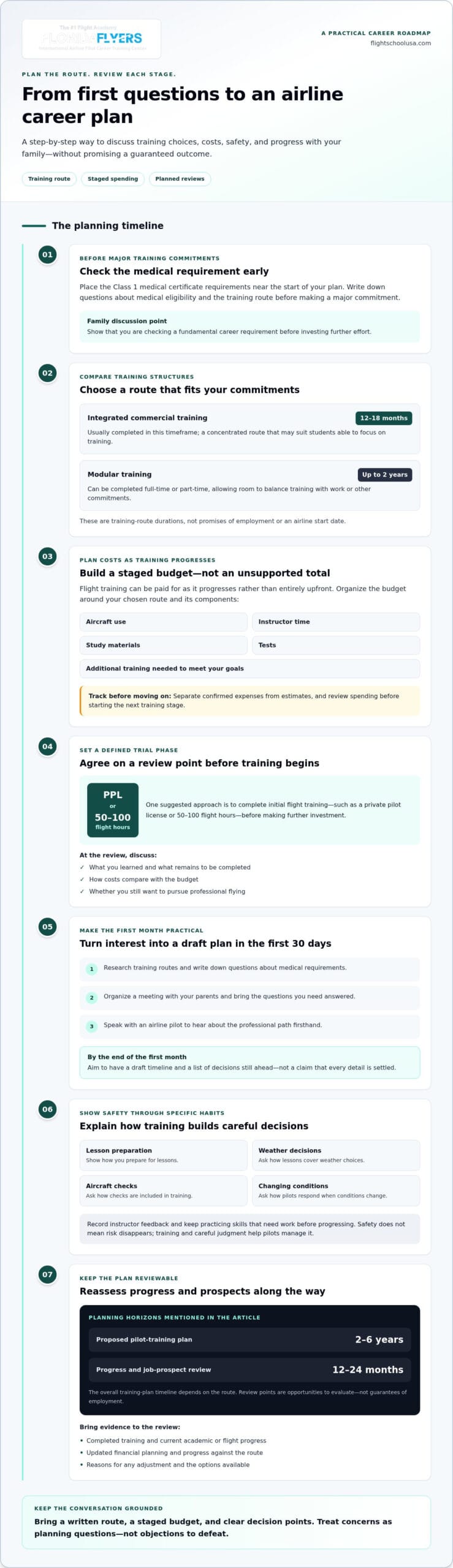
Treat your parents’ concerns as planning questions, not objections to defeat. Convincing parents about a pilot career is more credible when you bring a written route, a staged budget, and clear decision points. Show how training could progress from introductory instruction toward professional qualifications, then explain what information you’ll use to decide whether to continue. A documented plan gives your family something specific to evaluate.
Training costs call for a process, not an unsupported total. Flight training can be paid for as it progresses rather than entirely upfront, allowing families to consider spending in stages. Build a budget around your training route and its components, such as aircraft use, instructor time, study materials, tests, and any additional training needed to meet your goals. Separate confirmed expenses from estimates, and explain how you’ll track spending before moving to the next stage.
Use a trial phase to make the decision more manageable. One suggested approach is to complete initial flight training, such as a private pilot license or 50-100 flight hours, before making further investment. Set a review point with your parents before training begins. At that meeting, discuss what you learned, what remains to be completed, how costs compare with your plan, and whether you still want to pursue professional flying. A trial phase creates a defined opportunity to assess your commitment.
Career stability deserves a realistic discussion rather than a promise of an airline job. Explain that an airline career involves a sequence of training and employment steps, and that progress depends on completing each stage and pursuing suitable opportunities. A proposed pilot-training plan may take 2-6 years, depending on the route. Use that timeline to discuss how you’ll manage study, work, savings, and changing circumstances. Your family should see both the intended destination and the decisions along the way.
For a useful career conversation, prepare a simple progress review. Reassessing progress and job prospects after 12-24 months gives you and your parents a planned point to revisit the path. Bring evidence of your completed training, current academic or flight progress, and updated financial planning. If the plan needs adjustment, discuss the reason and the options instead of treating the original route as fixed. This makes career stability a subject for ongoing evaluation, not a claim made before training starts.
Address safety with specific questions and observable habits. Ask an instructor how lessons cover preparation, weather decisions, aircraft checks, and responses to changing conditions. Show your parents how you prepare for lessons, record feedback, and work on a skill that needs more practice before progressing. These examples demonstrate that safe flying depends on disciplined decisions, not confidence alone. Don’t promise that risk disappears. Explain how training and careful judgment help pilots manage it.
Before the discussion, write down your answers to three questions: what route are you proposing, how will you monitor expenses, and when will you review your progress? Bring a sample training schedule and a staged budget, then invite your parents to identify what information they need. If cost is their main concern, for example, agree on a spending review before the next training phase. If safety worries them most, include an instructor-led explanation in your plan. Clear answers make the conversation more productive.
Present a career map, not just a destination. A useful plan connects training choices with airline preparation, key decisions, and ways to track progress. Divide the route into stages and identify what you need to complete before moving forward. Explain which training path you’re considering, how it fits your schedule, and what will show you’re ready for the next stage.
Begin with the medical requirement. Aspiring airline pilots should check Class 1 medical certificate requirements early, before making major training commitments. Put this near the start of your plan, then list the other questions you need answered about training eligibility and the route ahead. Early medical planning helps your family see that you’re considering a fundamental career requirement before investing further effort.
Compare training routes by duration and structure. Integrated commercial pilot training programs usually take 12 to 18 months to complete. That concentrated route may suit students who can focus on training, while the timeline gives parents a concrete basis for discussing study and work commitments. Present the duration as a planning estimate, not a promise about employment or a guaranteed start date at an airline.
Modular training offers a different structure. It can be extended to 2 years and completed full-time or part-time, allowing students to balance training with work or other commitments. Give your parents an example schedule: identify when you could train, when you would work or study, and how you would review your workload. The key comparison is not simply speed. It’s which structure supports steady progress alongside your responsibilities.
Use the first 30 days to turn interest into practical steps. Set a calendar date to research training routes, write down questions about medical requirements, and organize a meeting with your parents. You can also speak with an airline pilot to understand the professional path firsthand. By the end of that first month, aim to have a draft timeline and a list of decisions still ahead, rather than a claim that every detail is settled.
Age can shape which opportunities deserve attention, but it should not end the discussion. Many scholarship and cadet programs accept candidates through their 30s, while some have stricter age cutoffs. Add eligibility research to your career plan, then record the application window and requirements for programs you’re considering. This step helps you and your family distinguish between a broad career goal and a specific opportunity with its own criteria.
Give each milestone a practical measure. Track completion of a training phase, progress toward the next qualification, and readiness to pursue relevant opportunities. Pair each milestone with a family review so you can explain what has changed and what comes next. Don’t present a single airline job as the only measure of success. Show the steps you control and the decisions that depend on your progress.
Make the plan easy to discuss. Use a one-page timeline with training stages, the Class 1 medical check, study or work commitments, and scheduled reviews. Ask your parents to identify their main question, then add a concrete action beside it. If they’re concerned about preparation for airline work, compare your goals with a structured Flugfélagstilbúið forrit as part of your route research.
Compare career paths using the same categories, not prestige alone. Put pilot training beside a route such as nursing, software development, or electrical work. For each, record the preparation required, when expenses arise, when paid work may begin, and what daily work involves. This avoids treating aviation’s early training commitment as directly comparable with another career’s later costs. Your parents can evaluate the full path rather than one striking expense or an imagined salary.
For costs, map when spending occurs and what it supports. A pilot-training budget can include instruction, aircraft use, study materials, and required assessments. Compare those categories with the education, equipment, or supervised practice involved in nursing or electrical work. The useful question isn’t simply which path costs more. Ask when expenses arise, whether training can progress in stages, and how each stage affects your ability to work or save.
Pay needs a timeline too. Compare a pilot’s earnings at different career stages with a nurse’s or software developer’s progression, using reliable figures for the same country and comparable experience. Don’t compare an airline captain’s compensation with a new graduate’s salary. Instead, note when each path leads to paid work, how advancement happens, and what qualifications support progression. That gives your family a fairer view than a single headline salary.
Separate potential earnings from guaranteed income. An airline career requires training and qualification milestones before airline employment becomes relevant. A software developer may follow a different route into paid work. Compare the steps each profession requires, then identify which outcomes depend on experience, performance, or available positions. This helps you discuss pay responsibly without presenting an eventual role as an immediate result of starting training.
Lifestyle matters just as much. Compare the demands of airline flying with a local nursing role, an office-based software position, or electrical work at different job sites. Write down what matters to you: schedule predictability, travel, location, teamwork, and time away from home. Then consider how each career’s working pattern fits those priorities. Your family may value stability, while you may value travel or operational responsibility. Naming those priorities makes the trade-offs concrete.
Use a side-by-side comparison sheet with four headings: preparation, expense timing, career progression, and lifestyle. Under “preparation,” list pilot-training milestones and the credentials required for your chosen alternative. Under “expense timing,” mark when costs occur without treating different pathways as identical. Under “progression,” show how responsibilities change. Under “lifestyle,” give a realistic example, such as airline travel compared with a locally based profession.
Finish by identifying your strongest alternative, not a weak one. If you’re comparing aviation with nursing, research both pathways with equal care. Ask an airline pilot and a nurse about the demands they face, then compare their answers with your written criteria. This shows your parents you’ve considered more than income or status. It also gives you a disciplined basis for choosing a career whose training demands, working conditions, and direction fit your goals.
For a fuller comparison, research DGCA training requirements, costs and timelines, academy options, exams, and your long-term airline goals before discussing the decision with your parents. In India, the stated route to becoming a pilot includes 10+2 education with Physics and Mathematics.
Add these details to your comparison sheet alongside when paid work may begin and the lifestyle you hope to have. Identify which costs apply to your chosen route, what each stage prepares you for, and what questions remain. This gives your family a practical basis for weighing aviation against other careers without assuming every training route or future airline outcome is the same.
An aviation career includes more than an airline cockpit. Your goal might be airline flying, while flight instruction or charter flying could be other professional roles. Explain which role interests you and why. If you want to fly for an airline, for example, describe the work itself: operating aircraft, following procedures, communicating with crew, and making disciplined decisions. Specific responsibilities give your parents a clearer picture than “I want to fly.”
Show that professional flying involves formal assessment. To qualify as a pilot, a person must pass a written test, an oral test, and a flight test. Explain in general terms what each evaluates: knowledge, understanding, and practical flying ability. That sequence frames training as a process based on demonstrated competencies, not simply enthusiasm or time spent near aircraft.
One reported career story began with a first flight at age 12. Early exposure, practical experience, and sustained training can help someone explore a possible aviation career. Present this as one individual’s experience, not a standard timeline or an expected result. Its practical lesson is that early exposure and steady effort can help someone understand aviation before making larger career decisions.
A different reported example shows that aviation paths can begin later. One person said they began flying at about age 50 and were hired as a new first officer at age 58. This account does not predict what another student’s career will look like. It can help answer a family’s concern that there is only one acceptable age or route into professional aviation. Your own plan should focus on the requirements and opportunities relevant to you.
Give your parents a way to learn about the work directly. Connect them with an airline pilot and prepare questions together. Ask what daily responsibilities demand the most discipline, how pilots prepare for a flight, and what they wish they had understood before training. A conversation with a working pilot can make terms such as “crew coordination” and “flight preparation” more concrete for everyone.
Practical exposure can also help clarify whether aviation suits you. A job at an airport, such as washing or fueling airplanes, offers a way to observe airport operations and speak with people who work around aircraft. Treat it as exploration, not proof that a cockpit career is guaranteed. Keep notes on what you learn, which responsibilities appeal to you, and what questions remain.
When discussing a pilot career with your family, distinguish a certificate from a job outcome. A pilot’s license never expires, but holding one doesn’t automatically lead to an airline position. Explain the difference plainly, then describe the effort required to develop professional competence and pursue aviation work. This shows respect for the distinction between qualification and employment.
Close the discussion with a useful next step: choose one aviation professional to speak with, write down three questions, and summarize the answers for your parents. Then skoðaðu faglega flugþjálfun as you consider how formal instruction could support your aviation goals.
One forum participant recommended finding a job at an airport, such as washing or fueling airplanes, as a way to start pursuing flying. This can provide practical contact with aviation while you consider the training involved. Another participant said connecting parents with airline pilots helped gain their support, reinforcing the value of a direct conversation.
Personal accounts can offer examples, but they are not promises about timing or outcomes. One forum participant said he took his first introductory flight at age 15. One forum participant said he soloed on his 16th birthday and earned his private pilot certificate by paying for it himself. Competition for trainee pilot positions in local air forces is extremely high, with estimated odds of 1 in 500. Treat that figure as a reason to research the route you are considering, its requirements, and other aviation options, not as a measure of your ability or a guarantee about what lies ahead.
Florida Flyers Flight Academy’s Fixed-Price Career Program is a next step when you’re ready to turn a career plan into focused flight training. Bring your family’s questions about training structure, career goals, and how you’ll assess progress. A clear discussion can help you identify what you need from a career-focused program and how it fits your proposed route.
Students pursuing airline preparation can also explore the Airline Ready Program, while aspiring instructors may consider the CFI Fast Track Program. Veterans can review GI Bill Flight Training, and international students can explore M1 Visa Admission Services. Choose the pathway that matches your circumstances and professional objective. Contact Flight School USA to discuss your flight-training plans.
Convincing your parents about a pilot career isn’t a single conversation. It’s a chance to demonstrate how you make decisions. Keep listening after you’ve presented your plan. Their questions may reveal what needs more thought, whether it’s your personal priorities, the training route, or how you’ll measure progress. Treat the discussion as an ongoing exchange, and return with considered answers rather than expecting immediate agreement.
Your next move can be to turn your career goals into a focused training discussion. Identify what you want to learn, what questions remain, and which path best fits your objectives. Then bring your family into that next step, so they can understand the decisions you’re making and why. Hafðu samband við Flugskóla Bandaríkjanna to discuss your flight-training plans. A thoughtful plan and steady follow-through can help you move forward with confidence.
A pilot career requires sustained training, flexibility, and readiness for changing work demands. Airline schedules can include early starts, overnight trips, weekends, and time away from home, affecting family routines and social commitments. Job stability also depends on completing qualifications and finding suitable employment; training alone doesn’t guarantee a position. Discuss these realities with a working pilot and ask how they manage schedule changes, career transitions, and ongoing professional expectations.