

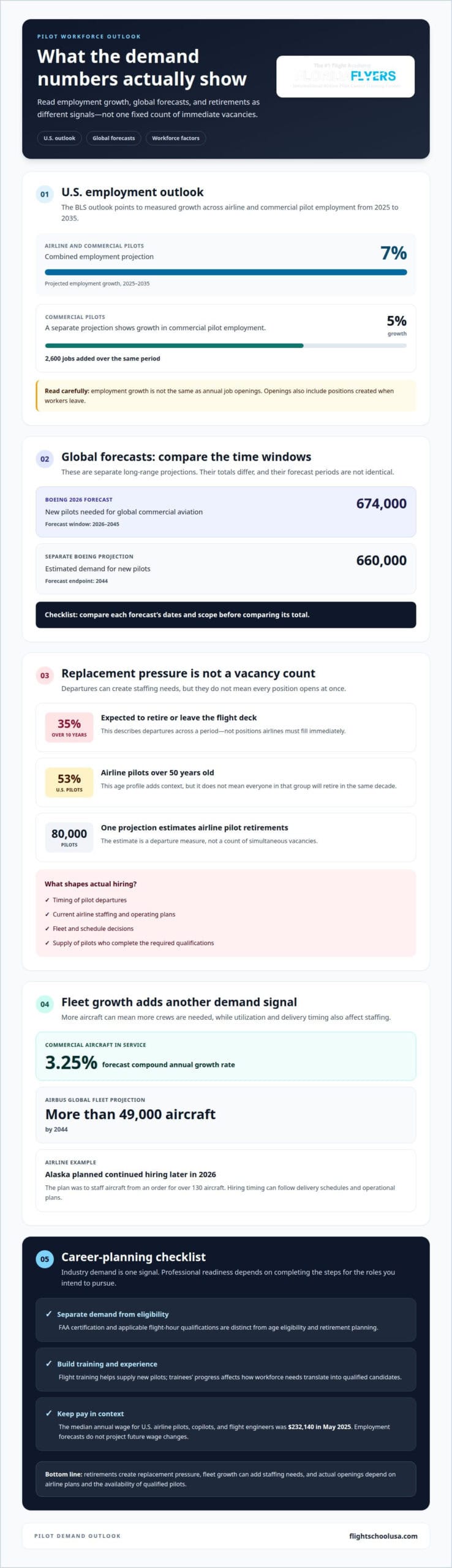
The strongest answer isn’t a single shortage figure: the future demand for airline pilots remains substantial, but projections vary with the forecast period and the jobs counted. In the United States, the U.S. Bureau of Labor Statistics projects airline and commercial pilot employment to grow 7 percent from 2025 to 2035. Boeing’s 2026 forecast projects global commercial aviation will need 674,000 new pilots from 2026 to 2045.
A separate Boeing projection estimated demand at 660,000 new pilots by 2044. The figures use different forecast windows, so the dates matter when comparing one outlook with another. Retirements are another part of the picture: 35 percent of pilots are expected to retire or leave the flight deck over the next 10 years.
This article compares current forecasts with earlier outlooks, explains what U.S. employment trends and hiring plans suggest, and shows how flight training can lead to professional flying. The key is to treat demand projections as an industry-wide outlook, then understand the training and career steps that can prepare you for opportunities ahead.
Yes. Retirements and other flight-deck departures create replacement pressure, although they don’t translate into one fixed number of immediate vacancies. Retirement eligibility can be one factor in airline pilot workforce planning. FAA certification and flight-hour qualifications are separate from age eligibility. Assessing future demand for airline pilots means considering both the number of pilots leaving and the staffing airlines need to maintain or expand operations.
One projection estimates that 80,000 airline pilots are retiring. Separately, 35% of pilots are expected to retire or leave the flight deck over the next 10 years. These figures describe departures across a period, not positions that airlines must fill at once. Replacement hiring depends on the timing of exits, current staffing, and operational plans. A departure creates potential workforce pressure; an airline’s hiring decisions determine whether and when it becomes an opening.
The U.S. age profile provides further context: 53% of airline pilots are over 50 years old. That figure identifies a substantial group approaching retirement age, but it doesn’t mean every pilot over 50 will leave during the same decade. Individual retirement timing varies. Airlines must plan for expected departures while retaining enough qualified pilots to operate scheduled flights.
American Airlines expected additional pilot retirements in 2027, contributing to continued hiring needs. This example shows how anticipated exits can affect an airline’s staffing plans. Retirement is only one influence: fleet and schedule decisions also shape hiring. A departure forecast measures possible workforce pressure, not a guaranteed vacancy or hiring date for a particular applicant.
What drives future demand for airline pilots? Retirements and other departures from the flight deck create replacement needs, while airline growth can add staffing requirements beyond those vacancies. Flight training helps supply new pilots, but enrollment alone does not show how quickly trainees will qualify for professional roles. Airline operating plans and trainees’ progress through training both affect how workforce needs translate into hiring.
For an aspiring pilot, separate industry demand from personal readiness. First, recognize that the 65-year retirement age contributes to replacement pressure. Next, treat FAA certification and applicable flight-hour qualifications as distinct steps toward professional eligibility. Then build training and experience toward the roles you intend to pursue. The future demand for airline pilots signals workforce needs across a decade, while actual openings depend on departures, airline plans, and qualified pilot supply.
U.S. employment projections point to measured growth, not a uniform hiring surge across every flying job. The U.S. Bureau of Labor Statistics projects employment of airline and commercial pilots to grow 7 percent from 2025 to 2035. That combined rate covers two occupational groups, so the separate projections help clarify where expected growth is concentrated. Employment growth also differs from annual openings, which include positions created when workers leave.
Employment in airline pilot roles is projected to grow, though the outlook may vary across aviation jobs. Commercial pilot employment is projected to grow 5 percent, adding 2,600 jobs over the same period. These figures distinguish scheduled airline operations from other commercial flying. For readers weighing career paths, the distinction matters: a broad pilot outlook can conceal different hiring patterns across aviation roles.
Aircraft fleet growth is one force behind demand. Commercial aircraft in service were forecast to grow at a 3.25% compound annual growth rate. Airbus projects the global fleet will exceed 49,000 aircraft by 2044. A larger fleet can require more pilots to operate flights, while replacement needs add another source of hiring. Actual staffing pressure also depends on how frequently aircraft fly and how airlines organize operations.
Alaska planned to continue hiring later in 2026 to staff aircraft from an order for over 130 aircraft. That example connects fleet plans with anticipated staffing: adding aircraft can require crews to operate them. The timing matters, since an order does not mean every aircraft enters service at once. Hiring can therefore follow delivery schedules and operational plans rather than the announcement date alone.
Air travel demand and aircraft use affect the staffing needed to operate a growing fleet. When aircraft fly more often, airlines need crews to cover the added activity. Changes in utilization can also shift workforce needs, even when fleet size stays similar. Fleet growth and pilot departures have different effects: expansion adds operating requirements, while departures create vacancies airlines may need to fill.
The median annual wage for U.S. airline pilots, copilots, and flight engineers was $232,140 in May 2025. Employment forecasts measure job growth, not future wage changes; pay can vary with employer, role, and career progression. Boeing’s forecast does not assume single-pilot commercial airplane operations, so its staffing outlook does not build in that change as a way to reduce pilot demand.
For career planning, use employment growth as one signal, then consider the type of flying and the qualifications needed for it. Fleet orders, aircraft utilization, and airline hiring plans each shape the path from training to a professional role. Pilots preparing for that transition can explore the Programa para sa Paghahanda sa Eroplano as a career-focused next step.
Global estimates indicate sustained demand for newly qualified commercial pilots, but their totals depend on the forecast window. One projection calls for 267,000 new pilots over the next 10 years. Boeing projects 674,000 new pilots from 2026 to 2045, while Airbus forecasts 633,000 by 2044. These totals aren’t directly interchangeable: their periods and forecasting approaches differ.
CAE forecasts that 300,000 new pilots will be needed globally over the next decade. A separate estimate projected a shortage of nearly 80,000 airline pilots by 2032. These figures describe different things: projected hiring need includes pilots required to support operations, while a shortage estimate compares demand with available supply. Neither guarantees that every region will experience the same gap.
Forecast scope matters, too. Boeing’s 20-year Pilot and Technician Outlook considers commercial aircraft fleets with more than 30 seats. It excludes business aviation and civil helicopter demand. Business aviation has a separate outlook: the sector will need 33,000 new pilots over the next 10 years, primarily to replace retiring pilots and support growth. Comparing forecasts requires checking which aircraft categories they include.
Regional projections also differ. Europe was projected to face a shortage of 19,000 airline pilots by 2032, and the Middle East, 18,000. Asia was expected to begin experiencing a shortage toward the end of the decade. Latin America wasn’t expected to see demand outpace supply over the decade, while Africa’s small shortage was expected to shrink as pilot availability increased. Global totals can obscure these distinct regional conditions.
Airline type and aircraft category shape demand. Commercial airline forecasts focus on passenger and cargo operations using larger aircraft, while business aviation has separate replacement and growth needs. Boeing’s forecast excludes business aviation and civil helicopters, so it does not cover staffing demand across every type of flight operation.
Flight-school enrollment affects pilot supply only when students complete training and qualify for professional roles. Training capacity depends on resources such as instructors and aircraft, as well as students’ progress through each stage. Higher enrollment can expand the future pipeline, but it does not equal newly qualified pilots ready for airline operations. When planning a career, distinguish interest in training from completed qualifications and experience.
Economic downturns can change forecasts by slowing air travel growth or leading airlines to defer fleet expansion and hiring. Airline growth and aircraft additions can increase crew requirements. These shifting conditions explain why long-range estimates are projections, not fixed hiring schedules. To interpret an estimate, check its forecast period, region, airline segment, and included aircraft categories.
The U.S. outlook gives a practical near-term measure of airline and commercial pilot openings. According to the U.S. Bureau of Labor Statistics, the United States is projected to have about 16,400 openings for airline and commercial pilots per year, on average, from 2025 to 2035. This answers the hiring question for the coming decade, but it isn’t a single estimate covering the full 20-year period. Longer-range forecasts differ in scope and horizon.
For the U.S. workforce, aircraft pilots and flight engineers are projected to reach 166,300 jobs in 2035, an increase of 11,300 jobs from 2025. That total describes projected employment at a point in time. It differs from annual openings, which include positions created when pilots leave existing roles and employers seek replacements. Read the two measures together: one indicates workforce size, while the other signals recurring hiring needs.
The 16,400 annual openings figure combines airline and commercial pilots. It should not be read as a count of airline-only vacancies or as a promise of hiring by a particular carrier. Commercial pilots work across aviation roles, and the split between those roles can change with employer needs. For a career decision, identify the type of flying you’re pursuing, then interpret the broad openings estimate as context rather than a personal hiring forecast.
Staffing needs also extend beyond pilots. Boeing’s forecast projects that commercial aviation will need 728,000 new maintenance technicians and 1,023,000 new cabin crew members over the 20 years from 2026 to 2045. Its forecast calls for more than 2.4 million new aviation personnel globally over that same horizon. Those figures cover different occupations, but show why a commercial aviation outlook must account for coordinated staffing across flight operations and support functions.
For pilot supply, the path from training to employment matters as much as enrollment. Trainees must progress through instruction, build the experience required for professional roles, and meet employer criteria. Each step affects how quickly training capacity becomes a supply of available pilots. Employers, training organizations, and aspiring pilots therefore work on different timelines, even when long-range projections point to continued workforce needs.
Use a three-part reading of any forecast: check its geography, its time horizon, and whether it counts jobs, openings, or newly needed personnel. For example, the U.S. Bureau of Labor Statistics’ annual openings estimate covers 2025 to 2035, while Boeing’s broader staffing figures span 2026 to 2045. Neither figure alone describes every airline’s hiring plan. Together, they provide a structured view of workforce demand and the distinctions that matter for career planning.
A hiring forecast describes industry demand; it does not guarantee a direct route from enrollment to an airline cockpit. A career pathway links the stages: structured flight training, required certifications, experience building, and applications for professional roles. Training develops knowledge and practical skills, while later experience and employer requirements determine which opportunities fit a pilot’s record.
Begin by matching your training plan to your intended flying career. Airline, regional, and other commercial roles have different operating environments and hiring criteria. Clarifying your goal before training helps you plan the right progression. For example, someone targeting airline operations should work toward the qualifications and experience those roles require, rather than treating initial flight instruction as the final career milestone.
A practical progression includes several linked stages:
For pilots interested in instructing, the CFI route can connect training with continued flying. Instructors explain procedures, assess student performance, and maintain consistent standards, developing communication and judgment alongside flight experience. It is one possible route, not the only one. The right next step depends on your career goals and qualifications.
Regional airline positions can be part of an airline career path, but they are not a universal prerequisite for every professional pilot. Employers assess candidates against requirements shaped by the aircraft, operation, and role. Align your training and experience with the positions you are pursuing, then apply when your qualifications meet the employer’s stated criteria.
Forecasts support long-term planning, but an individual career depends on completing each stage. Treat training, certification, experience, and applications as separate milestones. A practical plan identifies the next qualification, the experience needed afterward, and the types of flying that build toward your target role. This keeps career decisions grounded in readiness for the work, not headlines about pilot demand alone.
For aspiring professional pilots ready to turn a career objective into a structured training plan, galugarin ang pagsasanay sa paglipad na nakatuon sa karera. A defined pathway can connect initial instruction with the qualifications and experience required for professional flying.
Flight School USA’s Airline Ready Program supports aspiring pilots preparing for commercial aviation. It can be a next step when you are ready to connect flight training with a professional career objective. The best route depends on your experience and goals: the Fixed-Price Career Program supports career-focused training, while the CFI Fast Track Program is designed for those pursuing flight instruction. Eligible veterans can also use GI Bill Flight Training as part of their training plan.
Forecasts describe industry demand, but career preparation takes deliberate progress through training and experience. Let your target role guide your next decision, whether you are starting flight training or advancing toward airline readiness. Contact Flight School USA to discuss your pilot training goals.
The future demand for airline pilots can help inform your direction, but your next move should reflect your experience, goals, and readiness for professional training. Set a target role, identify the qualifications and experience it requires, then choose a training pathway that supports those steps. This turns a broad industry outlook into a practical career plan.
Flight School USA offers the Fixed-Price Career Program, CFI Fast Track Program, and GI Bill Flight Training. These programs support different goals and circumstances, from career-focused preparation to flight-instructor training and training for eligible veterans.
Discuss your career objective and the training path that fits it. Kontakin ang Flight School USA to take the next step toward professional flying.
Boeing’s 2026 forecast projects demand for 674,000 new pilots from 2026 to 2045. An earlier Boeing outlook projected 660,000 by 2044, but the forecast windows differ, so the figures aren’t a direct year-over-year comparison. Also distinguish workforce demand from shortage estimates: a prior projection described a nearly 80,000-pilot global shortage by 2032, which measures a supply gap rather than total hiring need.
Boeing’s forecast projects demand for more than 2.4 million new aviation personnel globally over the next 20 years. This total covers more than pilots: the forecast includes 674,000 pilots, 728,000 maintenance technicians, and 1,023,000 cabin crew members from 2026 to 2045. These occupation-specific estimates help explain why aviation workforce planning involves flight crews and the teams that maintain aircraft and support passenger operations.
Long-range projections point to hundreds of thousands of pilots needed globally, but the cited estimates use endpoints beyond 2040. Boeing projects 674,000 new pilots from 2026 to 2045, while Airbus forecasts 633,000 by 2044. Neither endpoint should be presented as a total specifically through 2040. For career planning, compare the forecast period and scope, and treat these figures as industry demand estimates, not guaranteed vacancies.
The available retirement projection is cumulative, not an annual U.S. count: 80,000 airline pilots are retiring, and 35% of pilots are expected to retire or leave the flight deck over the next 10 years. Those figures don’t establish how many U.S. airline pilots will retire in any single year. Annual departures vary with individual retirement timing, while airlines’ replacement hiring also reflects staffing and operating plans.
Hiring plans show continued demand, alongside differences between airlines and years. United Airlines planned to hire 1,800 pilots by the end of 2026 and planned to hire more pilots in 2027 than its 2026 total. Southwest announced plans to hire approximately 872 pilots in 2026, while FedEx planned to hire approximately 800. These announcements are employer-specific plans, not a guarantee that openings will remain uniform across U.S. airlines.


