
Airline Gubernator Tutela Information

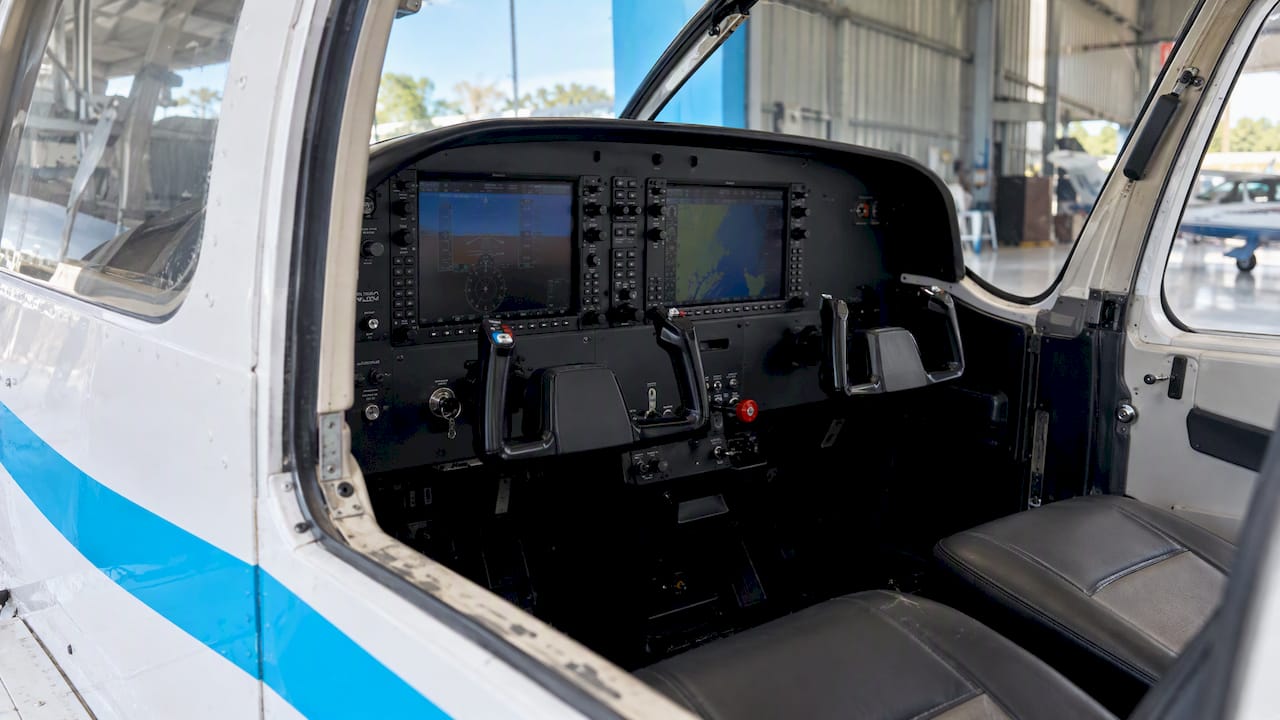
Glass cockpit training gives student pilots a consolidated, easier-to-read picture of the airplane: attitude, airspeed, altitude, engine data and a moving map on two screens instead of a scatter of round dials. The documented benefits are stronger position awareness, more accurate GPS navigation and, in at least one recent simulator study, lower workload for novices. The documented costs are more head-down time, a real learning curve on the avionics themselves, and the risk of leaning on automation. Below, we separate what the evidence supports from what the marketing implies, so you can decide how glass fits into your own path to the airlines.
In training, a glass cockpit is an electronic display system that consolidates traditional flight instruments and other aircraft data. AOPA describes the usual arrangement: a primary flight display (PFD) that commonly shows attitude, airspeed, altitude and vertical speed, and a multifunction display (MFD) that commonly carries engine, navigation and moving-map information.
The difference from a round-dial, or “steam-gauge,” panel lies mainly in how information is arranged and displayed. The physical flying does not change. AOPA’s guidance on technically advanced airplanes says the stick-and-rudder skills are the same as in dial-equipped airplanes, while the information is presented differently and a large moving map can add weather, terrain and nearby-aircraft information.
That distinction frames everything that follows. Glass changes what you look at and how quickly you can find it. It does not change what the airplane needs from you.
quod NTSB’s safety study on glass cockpits in light aircraft notes that integrated displays can present more information in the same panel space as conventional instruments. For a student, that means the core of the instrument scan sits on one screen, and a moving map answers the question “where am I?” without a chart on your knee.
An FAA study of advanced general aviation displays found that pilots rated position awareness highly. It also found that GPS/MFD guidance reduced cross-track error on inbound and final-approach segments compared with a VOR. Flying the centerline more precisely is exactly what instrument training asks of you.
The same study carries a trade-off worth knowing: pilots were less accurate at holding altitude during the longest segment. Better lateral tracking did not automatically mean better vertical discipline.
A 2024 peer-reviewed simulator study of novice pilots reported significantly better flight performance, lower measured mental workload and improved situational awareness with a G1000 glass panel than with a steam-gauge panel. That is encouraging for beginners.
Read it as evidence about a specific G1000-versus-steam-gauge interface in a simulator, not as a universal guarantee. The FAA study cited above found no overall workload difference by display type, so the honest summary is that workload benefits depend on the pilot, the display and the task.
A peer-reviewed simulator study of 30 pre-private-pilot students found faster early learning and better performance within the FAA ATP standard for precision approaches when students used an advanced synthetic-vision display rather than a conventional one. For instrument-rating candidates, whose checkride centers on precise approach flying, that finding is relevant. It is a single simulator study, and it concerns synthetic vision specifically, so treat it as supportive rather than conclusive.
Modern training and airline-track aircraft are built around electronic displays, and the FAA recognizes this. AOPA reports that in 2018 the FAA added technically advanced airplanes as an alternative for commercial-pilot training, with the TAA definition including a glass panel with a PFD, a GPS moving map and an autopilot. Glass experience is therefore not a luxury for a career pilot; it is part of the regulatory landscape.
A fair assessment of glass cockpit training benefits has to include the costs. The research is consistent on four of them.
The FAA study also found that visual-only alerts can fail to attract attention. In practice, that means a student should rehearse what a failed or degraded display looks like before it happens in the air.
The benefits are not evenly distributed across the certificates.
Primary (private pilot) training. The case for glass is weaker here than many assume. In primary training, the emphasis belongs on positive aircraft control using outside visual references, and anything that pulls your eyes into the cockpit works against that. A glass panel is usable for private training, but your instructor should deliberately hold your attention outside. Our guide to visual fuga praecepta covers why seeing and avoiding is the core habit to build first.
Instrument training. This is where the research is most favorable. Cross-track accuracy on approaches improved with GPS/MFD guidance, and the synthetic-vision study showed gains on precision approaches. A moving map, integrated autopilot and clear navigation data reduce the mechanical burden of procedures so you can concentrate on decision-making.
Commercial training. AOPA recommends combining technically advanced airplane experience with some analog or complex-airplane experience, so that pilots develop both modern-avionics familiarity and an understanding of traditional aircraft systems.
| Training | Where glass helps most | What to guard against |
|---|---|---|
| Privatus gubernator | Situational awareness, moving map for orientation | Eyes inside the cockpit instead of on the horizon |
| Instrumentum rating | Approach tracking, workload during procedures | Fixation on small deviations, weak altitude discipline |
| Commercial and beyond | Familiarity with TAA-style equipment and automation | Gaps in conventional-instrument and systems knowledge |
This is the question that should keep you from choosing glass for the wrong reason. A MMXV pari studio recensuit compared pilots trained on steam gauges with pilots trained on glass cockpits. Pilots trained on steam gauges performed better when moving to glass than glass-trained pilots did when moving to steam gauges.
The implication is not that glass is bad. It is that the transition runs more smoothly in one direction, and that a pilot who has only ever seen a PFD may be underprepared for a round-dial airplane. That is the strongest argument for the complementary approach described below.
Use these criteria rather than a blanket rule.
Learn the avionics on the ground first. Desktop and training-device sessions let you practice menus, flight plan entry and approach loading without a Hobbs meter running. We cover one structured way to do this in our 8-week glass cockpit training program, and for pilots already certificated, our glass cockpit transition guide explains what changes and what does not.
Rehearse failures in a simulator. Because light aircraft cannot safely reproduce many glass failures, a simulator is the right place to see them. Our overview of Commoda exercitationis simulatoris volatus explains how to use that time and how it differs from time in the airplane.
Use a deliberate scan. AOPA’s position is that glass changes the location and depiction of information but should not change the fundamental instrument-scan concept. Scan the PFD, cross-check, look outside, repeat.
Do not chase small numbers. If you catch yourself correcting a few feet while heading and airspeed drift, you are in the trap AOPA describes. Fly the airplane, then refine.
Keep your conventional skills alive. Regular practice on basic references, including partial-panel work, protects you if the screens ever degrade.

We train commercial pilots on an accelerated, Part 141 path, and our advice on glass is consistent: treat the displays as a force multiplier for a pilot who already scans, plans and looks outside, not as a substitute for any of those habits.
Our students are working toward airline certification on a fixed timeline, so every hour has to teach something. That is why we favor learning avionics on the ground before the airplane, rehearsing failures in a simulator, and holding the outside-reference discipline from the first lesson. The research above supports that sequencing: the benefits show up when pilots are properly trained on the specific equipment, and the risks show up when they are not.
We would also caution against choosing a program by panel type alone. Ask what the training does with the panel, who teaches it and how it handles the day a display behaves unexpectedly. Those answers predict your proficiency far better than whether the airplane has glass.
— Rainer
If your goal is an airline seat, the question is how glass training slots into a complete, cost-controlled path. Our Certa-Price Airlines fuga School Program is published at $85,900 as a one-off price, designed so you are not watching an open-ended meter tick. If you are comparing structures first, our US Airlines nauclerus Tutela Program is listed at $49,950 as a one-off price, and our pagina cursuum institutionis gubernatorum covers the individual certificates and ratings, from private through instrument, multi-engine and CFI.
Because we conduct FAA checkrides in-house under Self Examining Authority, you avoid the long waits for practical exams that stall many students, and that matters when your avionics skills are fresh. If you want to see how the pieces fit, talk to us about your training path.
It refers to an electronic flight display system that replaces or consolidates traditional round-dial instruments. It commonly includes a PFD for attitude, airspeed, altitude and vertical speed, and an MFD for engine, navigation and map information, according to AOPA.
Not necessarily. One 2024 simulator study found better performance and lower workload for novices on a G1000 panel, but an FAA study found no overall workload difference and showed that two to three hours was not enough to master the displays. Glass can be easier to read yet still demands dedicated avionics training.
It helps with specific tasks, particularly practicing avionics and failures that light aircraft cannot safely recreate. The NTSB recommends simulators or procedural trainers for exactly that purpose. It complements, rather than replaces, time in the airplane; see our guide to logging pilot hours in a simulator for how that time can count.
Both is the best-supported answer. AOPA recommends combining technically advanced airplane experience with analog or complex-airplane experience during commercial training, and a 2013 study found steam-gauge-trained pilots transitioned to glass better than the reverse.


