
Agahiyên Kariyera Pîlotê Airline


By the time most professionals reach age 40, they mistakenly believe the window for an elite aviation career has closed, yet the reality in 2026 is that you still have a full quarter-century of commercial flight eligibility ahead of you. Entering the cockpit at this stage isn’t a hobbyist’s pursuit; it’s a high-velocity tactical mission that requires precision and a strict adherence to professional standards. You’re likely facing legitimate concerns regarding the volatility of training expenses and the rigorous requirements of FAA medical certification for older aviators. We understand that at this point in your career, there’s no room for inefficiency or financial ambiguity.
This article serves as your authoritative roadmap for becoming a pilot at 40, offering a clear path to launch a 25-year career before the mandatory retirement age of 65. You’ll master the professional requirements for an accelerated pivot, learn how to utilize a fixed-price financial plan to eliminate cost variability, and understand the specific medical criteria necessary for long-term success. We’ll outline the exact timeline from your first flight hour to your commercial transition, ensuring your mid-career shift is executed with the discipline and excellence that the industry demands.
Starting a career in aviation at 40 is a calculated, high-stakes professional maneuver. In 2026, the demand for seasoned decision-makers in the cockpit has reached a critical peak. When you’re becoming a pilot at 40, you aren’t just catching up; you’re bringing two decades of professional maturity to a field that prioritizes discipline and risk management. Airlines recognize that candidates entering the industry mid-career often possess the emotional intelligence and stability required for complex operations. This maturity is a tangible asset during the high-stress environments of initial transition training and line operations.
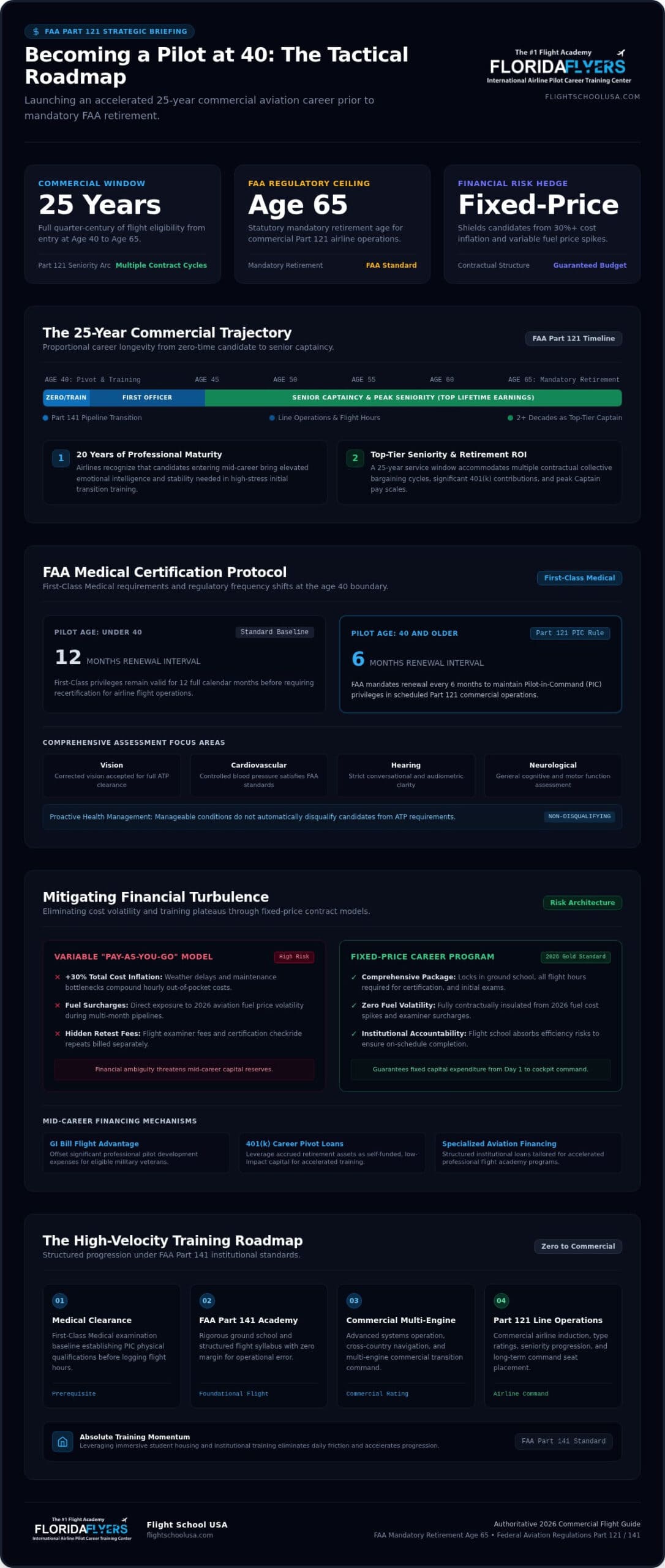
The FAA mandates that commercial pilots serving in Part 121 airline operations must retire by age 65, directly establishing a 25-year window for those entering the field at 40. This duration is more than sufficient to reach the top of the seniority list and maximize lifetime earnings as a Captain. A 25-year career allows for multiple contract cycles and significant retirement contributions, making the pivot financially sound. You aren’t merely looking for a job; you’re securing a two-decade legacy in a high-prestige profession.
Securing a First-Class Medical certificate is the first non-negotiable step in your mission. For pilots under 40, this certificate is valid for 12 months for first-class privileges. However, once you cross the age 40 threshold, the FAA requires renewal every six months to maintain PIC privileges in airline operations. The exam evaluates vision, hearing, cardiovascular health, and general neurological function with precision. Don’t let common health misconceptions deter you. Most manageable conditions, like corrected vision or controlled blood pressure, do not automatically disqualify a candidate from meeting the Airline Transport Pilot certification requirements. Proactive health management ensures you remain compliant throughout your 25-year career.
Executing this pivot successfully requires an immediate shift in perspective. You’re no longer a student exploring a hobby. You are a professional pilot candidate executing a tactical training plan with zero margin for error. This mindset demands an immersive approach where every flight hour is a deliberate step toward commercial command. By treating your training as a high-performance academy experience, you align yourself with the rigorous standards of the world’s leading airlines. Becoming a pilot at 40 is about efficiency, precision, and the relentless pursuit of professional excellence.
Financial volatility is the primary threat to a successful mid-career transition. Most flight schools rely on a variable hourly model, which exposes you to the “pay-as-you-go” trap. This model is inherently risky because weather delays, maintenance issues, and individual learning plateaus can inflate your total investment by 30% or more. For someone becoming a pilot at 40, this level of financial ambiguity is unacceptable. You need a training structure that treats your career pivot as a high-stakes business investment rather than a hobbyist’s expense.
The Fixed-Price Career Program is the gold standard for 2026 because it locks in your total cost from day one. This contractual structure typically includes ground school, all necessary flight hours to meet Pêdiviyên Sertîfîkaya Pîlotê FAA, and initial certification attempts. Most importantly, it shields you from the 2026 volatility in aviation fuel prices and eliminates hidden surcharges, insurance fees, or examiner costs. By choosing a fixed rate, you’re buying certainty and professional accountability from your institution. This model places the burden of training efficiency on the school, ensuring they’re incentivized to get you to the cockpit on schedule.
Financing a career change at this stage requires a sophisticated approach to capital. Veterans should capitalize on the GI Bill flight training advantage to offset significant portions of their professional development. For those without military benefits, utilizing 401(k) loans or specialized aviation financing are common tactical moves. It’s critical to evaluate the tax implications of professional education expenses, as many career changers can leverage these costs to mitigate their tax liability during the transition year. Becoming a pilot at 40 requires a financial plan as disciplined as your flight training, ensuring you have the liquid capital to reach the 1,500-hour mark without interruption.
Securing your budget allows you to focus entirely on the flight deck without the distraction of fluctuating invoices. The ROI of certainty cannot be overstated; it provides the psychological security needed to master complex maneuvers and regulatory knowledge. If you’re ready to stabilize your investment and eliminate hidden fees, reviewing the Fixed-Price Career Program is your next logical step in this mission.
Executing a mid-career pivot requires a training structure that favors speed without compromising regulatory rigor. While part-time training often leads to stagnation, a full-time, immersive environment is the only way to maintain the momentum necessary for becoming a pilot at 40. You’ll begin with Phase 1, achieving your Private Pilot License (PPL) and Instrument Rating (IR) under a structured FAA Part 141 curriculum. This phase is critical; it builds the foundational discipline required for all subsequent ratings. Phase 2 transitions you into high-performance operations, focusing on the Commercial Pilot License (CPL) and Multi-Engine Rating (MER), where you’ll master the technical precision demanded by commercial carriers.
A 12-to-18 month timeline is achievable for candidates who commit to total immersion. Utilizing student housing is a strategic necessity rather than a convenience; it places you in a 24/7 professional environment that mirrors the intensity of airline initial training. This focus eliminates the distractions of a standard civilian lifestyle and ensures you remain “checkride ready” at every stage. To reach the 1,500-hour Airline Transport Pilot (ATP) minimums, you must follow a precise sequence of certifications:
The most efficient path to the cockpit involves transitioning from student to instructor. The CFI Fast Track Program allows you to log the remaining 1,200+ hours required for airline eligibility while receiving compensation. Teaching others isn’t just a requirement; it’s a leadership crucible that prepares you for the Captain’s seat by forcing you to master every regulation and maneuver from the right seat. Older candidates often excel here, as their previous professional experience translates into superior instructional capability.
The U.S. Bureau of Labor Statistics highlights a robust airline pilot salary and career outlook, providing the data needed to justify the intensity of this high-velocity roadmap. Once you’ve neared your hour requirements, the Airline Ready Program serves as the final gateway, refining your skills to meet specific carrier standards. Becoming a pilot at 40 demands this level of sequential precision to ensure you enter the workforce with maximum seniority potential.
A mid-career pivot into aviation is a strategic financial decision that requires a clear understanding of lifetime earnings. When becoming a pilot at 40, you’re entering a seniority-based system where your entry date determines your career trajectory. Despite the later start, a 25-year window allows you to progress through the ranks of major carriers, where compensation packages in 2026 reflect the intense demand for qualified flight deck leadership. Beyond the base airline pilot salary, pilots benefit from substantial 401(k) direct contributions and comprehensive benefits that secure their post-65 financial standing. This isn’t a gamble; it’s a calculated move into a high-prestige sector.
Experienced professionals often possess a “Second Act” advantage. Your prior corporate or technical background makes you an ideal candidate for corporate aviation roles or flight department management. These positions often value the maturity and administrative acumen that younger pilots haven’t yet developed. You bring a level of professional discipline that airlines are willing to pay a premium for in today’s market.
In the 2026 market, first-year First Officer pay has reached unprecedented levels due to aggressive signing bonuses and retention initiatives. While regional airlines provide the initial entry point, the transition to a major carrier typically occurs within three to five years for dedicated pilots. A five-year Captain at a major airline can command a salary that rivals executive-level compensation in other industries. The pilot shortage continues to drive up hourly rates and per diem allowances, ensuring that your 25-year career remains highly lucrative until the day of mandatory retirement. The seniority system rewards those who enter the pipeline with focus and intent.
Calculating the return on investment requires looking at the total time-to-income. The Airline Ready Program is designed to accelerate this transition by refining your skills to meet specific carrier standards immediately. By reducing the time spent in lower-paying entry roles, you reach the high-earning Captain seats faster. Most pilots find their break-even point occurs within the first four years of commercial operation, leaving over two decades of peak earning potential. This timeline is non-negotiable for anyone looking to maximize their financial legacy.
Becoming a pilot at 40 isn’t just about the cockpit; it’s about securing a premier professional status that few other fields can offer at this stage of life. If you’re ready to execute this financial transition and secure your place in the flight deck, begin your journey with Flight School USA today.
Executing a successful transition requires more than just intent; it demands an institutional partner that mirrors the high-stakes environment of a commercial airline. At Flight School USA, we provide a structured, high-performance academy specifically tailored for professionals becoming a pilot at 40. Our methodology prioritizes regulatory compliance and operational excellence, ensuring that every candidate meets the industry’s most rigorous standards. By integrating elite training with immersive logistics, we eliminate the friction typically associated with mid-career shifts. You aren’t just enrolling in a school; you’re entering a professional pipeline designed for results.
For a professional pivot, FAA Part 141 certification isn’t optional; it’s a non-negotiable requirement for quality assurance. Unlike the variable nature of Part 61 training, a Part 141 curriculum follows a strictly structured syllabus approved by the FAA. This rigor ensures a higher level of proficiency and often allows for reduced hour requirements for specific certifications, accelerating your timeline to the cockpit. Elite academies using these standards signal to airline recruiters that you’ve been vetted through a disciplined, regulatory-focused system. This institutional pedigree is vital when you’re competing for seniority in a high-velocity market where precision is the primary currency.
Our admissions process is a tactical operation designed for professionals who demand efficiency and transparency. We offer specialized M1 Visa Admission Services for international professionals seeking to train under the premier standards of the United States. To maintain absolute focus, we provide student housing that fosters an environment of total immersion, allowing you to live and breathe aviation alongside fellow career-track candidates. This immersive approach is critical for maintaining the training momentum necessary to complete your transition within the 12-to-18 month target. It removes the logistical burdens of civilian life, allowing you to focus entirely on the flight deck.
The cornerstone of our partnership is the Fixed-Price Career Program. This isn’t merely a training package; it’s a contract for financial security and professional success. It protects your capital from the volatility discussed in previous sections and ensures that your path to becoming a pilot at 40 remains focused on the flight deck rather than administrative hurdles. Your tactical plan for a full-time training commitment starts with a professional assessment of your career goals. Secure your position in our Fixed-Price Career Program today.
Transitioning into the flight deck at age 40 is a strategic maneuver that demands absolute precision and elite institutional support. You’ve learned that a 25-year commercial career remains entirely viable before the FAA mandatory retirement age of 65. By utilizing a structured FAA Part 141 curriculum and leveraging immersive student housing, you can maintain the high-velocity momentum required to reach the 1,500-hour mark efficiently. Becoming a pilot at 40 is not a secondary pursuit; it’s a high-stakes professional pivot that yields substantial ROI through senior airline compensation and elite retirement benefits.
Don’t leave your mid-career transition to chance or variable hourly rates that threaten your capital. Our academy provides the Fixed-Price Cost Guarantee and the professional rigor needed to satisfy airline recruiters. The window for your second act is open, and the demand for disciplined, mature aviators has never been higher. Take the final step in securing your professional legacy and command your trajectory in the skies.
Apply for the Fixed-Price Career Program and Launch Your Aviation Pivot
Forty is not too old to launch a commercial aviation career; it’s a strategic entry point for those seeking a high-velocity professional pivot. In 2026, the industry continues to prioritize qualified candidates who demonstrate the discipline and maturity required for the flight deck. Starting now provides a 25-year window for career progression before the mandatory retirement age. Your previous professional experience often translates into superior decision-making skills that airlines highly value during the recruitment process.
Completing the core certifications for becoming a pilot at 40 typically takes 12 to 18 months under a full-time FAA Part 141 curriculum. This timeline includes achieving your Private Pilot License, Instrument Rating, and Commercial Pilot License. After these initial stages, you’ll need to build the 1,500 flight hours required for airline eligibility. Most candidates utilize a CFI Fast Track Program to reach this milestone within two to three years of total training time.
Pilots over age 40 must meet the rigorous standards of an FAA First-Class Medical certificate to exercise Captain privileges in airline operations. The primary difference for older aviators is the renewal frequency; the FAA requires a new examination every six months rather than annually. The exam evaluates cardiovascular health, vision, hearing, and general physical fitness. Maintaining high health standards is a critical component of your professional compliance and ensures your longevity in the cockpit.
Veterans can absolutely utilize GI Bill Flight Training to fund their mid-career transition at our academy. This benefit is a powerful tool for mitigating the financial requirements of advanced ratings and certifications. We provide the necessary administrative support to ensure you remain compliant with Department of Veterans Affairs regulations while maximizing your benefits. It’s a strategic way to leverage your military service into a high-prestige second career in professional aviation.
The FAA mandatory retirement age for pilots in Part 121 commercial airline operations remains 65 in 2026. This regulation creates a clear terminal date for your career, allowing for precise financial and professional planning. For those becoming a pilot at 40, this provides a quarter-century of eligibility to reach the top of the seniority list. Understanding this limit is essential for calculating your lifetime earnings potential and maximizing your contributions to retirement accounts.
A fixed-price flight training program is the superior choice for career changers because it eliminates the risk of budget overruns. Traditional hourly rates expose you to financial volatility caused by weather delays or fuel price spikes. Our Fixed-Price Career Program provides a contractual guarantee, allowing you to plan your career gap with absolute financial certainty. It places the responsibility for training efficiency on the institution, ensuring you receive the highest level of instructional accountability.
Initial earnings for a First Officer at a regional airline are competitive, often supplemented by signing bonuses and retention pay in the current market. As you progress to a Captain’s seat at a major carrier, your salary will reach the upper tiers of professional compensation. Total lifetime earnings for a 25-year career can be substantial, especially when considering airline 401(k) contributions. Your maturity and prior professional background can also lead to lucrative roles in corporate aviation.
Airlines actively hire pilots who began their training in their 40s, provided they meet all FAA certification and hour requirements. Recruiters focus on your technical proficiency, safety record, and leadership potential rather than the year you earned your first rating. In fact, many major carriers appreciate the stability and professional experience that mid-career pilots bring to the flight deck. Successfully completing a rigorous training program at 40 demonstrates the high-level discipline airlines demand.


